Saturday's economy & business stories



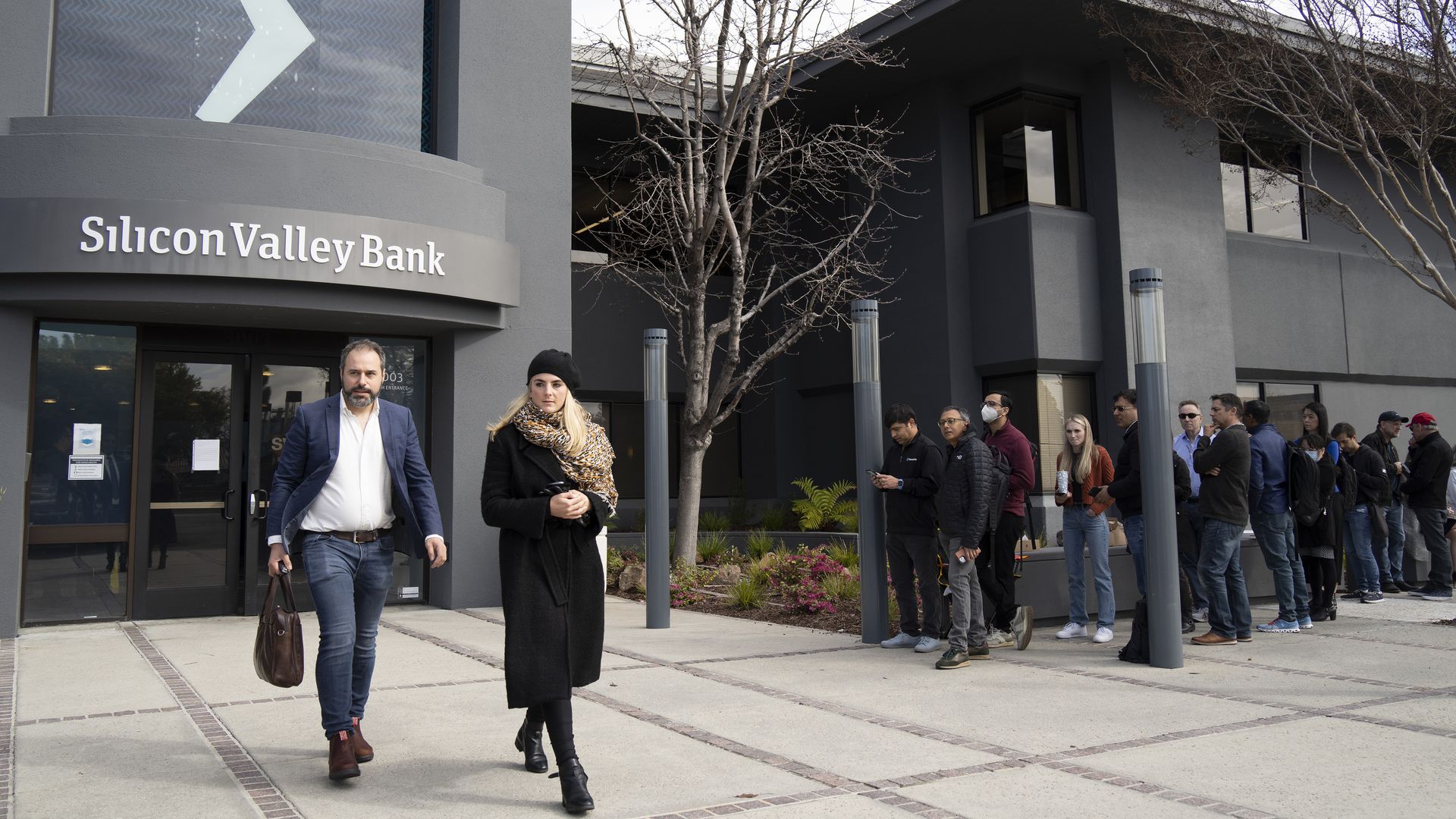
Mapping out Silicon Valley Bank's businesses


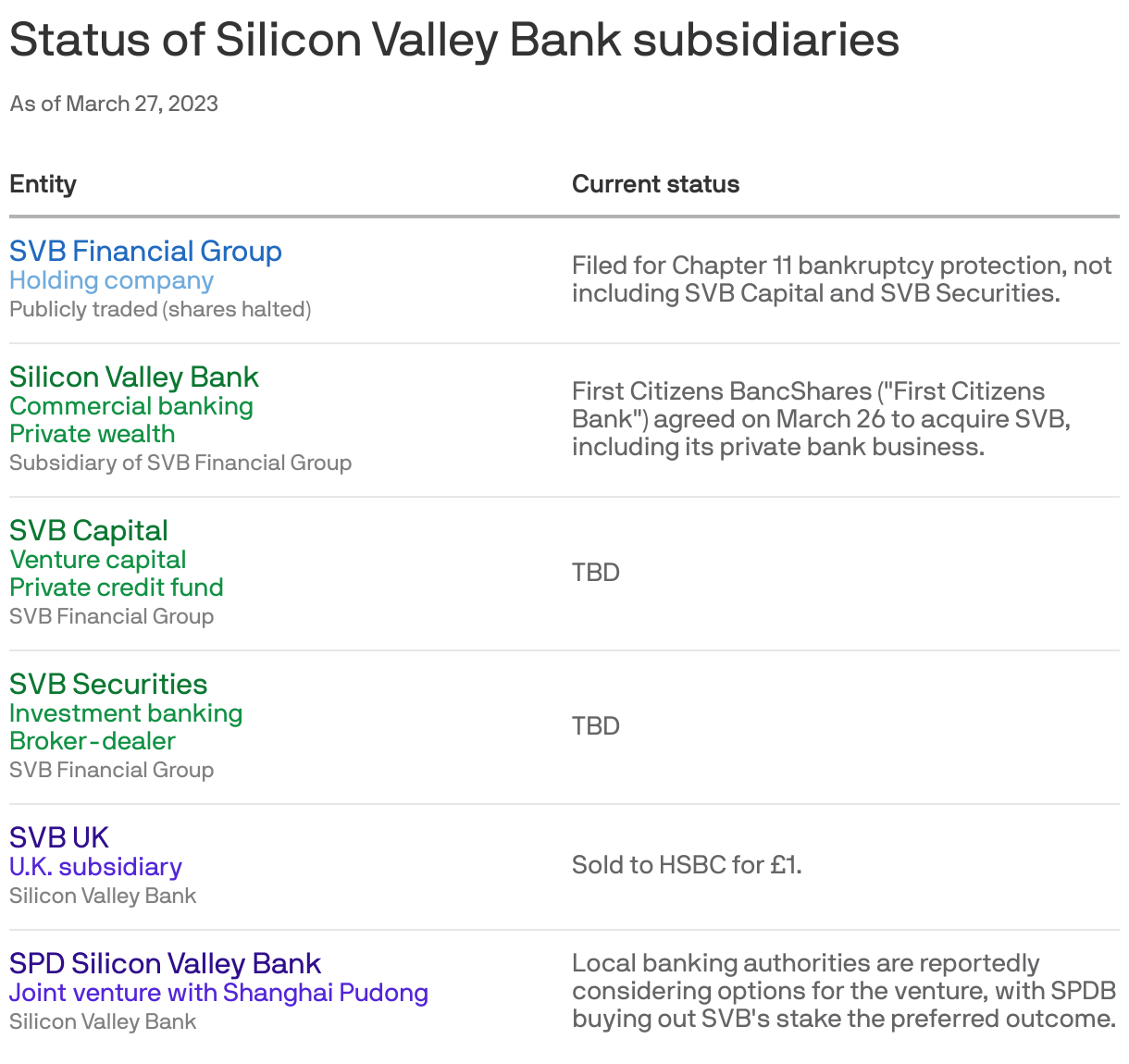
As Silicon Valley Bank's saga continues, we've mapped out its various corporate entities and how they're connected.
What to watch: We'll be updating the table above as things develop.
Go deeper:

Timeline: Silicon Valley Bank's saga
The past 10 days have felt like an eternity, so here's a handy timeline of what's happened:
March 8: SVB announced it has raised $500 million from General Atlantic and plans for a $1.25 billion common stock sale, plus another $500 million of depository shares.
- Earlier in the day, Silvergate, a bank popular with the crypto industry, announced it's shutting down operations, a harbinger to what's to come.
March 9: When markets opened, SVB's stock fell 30% (and eventually 60% that day and a growing number of VCs and startups started to pull their money out of the bank.
- SVB CEO Greg Becker attempted to appease VCs and startups in a conference video call, asking them to "stay calm." The bank also updated Goldman Sachs on deposit outflows, effectively killing the share offering.
- By the end of the day, customers had initiated $42 billion in withdrawals, making it the largest bank run in history.
March 10: U.S. regulators took control of the bank Friday morning, shutting it down.
- In the evening, the FDIC informed an unknown number of SVB employees that they’d keep their jobs as part of the newly formed bridge bank for the next 45 days.
March 12: Bids to acquire SVB were due on Sunday, but there was no sale (the FDIC reportedly declined the lone bid by an unnamed company).
- March 12: The U.S. government announced it would backstop all SVB deposits.
- Regulators shut down Signature Bank in New York, citing systemic risk.
March 13: SVB’s U.K. arm is sold to HSBC for £1.
- First Republic Bank’s stock plunges 60% as the market got jittery about a broader banking crisis. Other regional banks also saw stock drops.
- SVB reopens for business as the newly set up Silicon Valley Bridge Bank.
- The Fed announces a review of SVB’s failure.
March 15: Credit Suisse, who’s had its own woes for quite some time, announced it will borrow up to 50 billion Swiss francs ($53.68 billion) from the Swiss National Bank to strengthen its liquidity.
March 16: Treasury Secretary Janet Yellen reassured Congress that the U.S. banking system is “sound.”
- 11 banks inject $30 billion of deposits into First Republic Bank as a show of confidence as it’s spent the week trying to avoid SVB’s fate.
March 17: SVB Financial Group files for Ch. 11 bankruptcy protection in the Southern District of New York.
- Bids in a second attempt to sell SVB are reportedly due.

Navigating SVB's new era
Startups breathed a sigh of relief Sunday night when the Federal Reserve announced it would backstop Silicon Valley Bank deposits. Yet amid anxiety about the banking sector and the future of venture capital funding, this past week has been surprisingly busy.
The big picture: Among startup-land denizens and venture capitalists who were SVB clients, there hasn't been a uniform approach about what to do since the government takeover.
Why it matters: SVB’s temporary successor, Silicon Valley Bridge Bank — helmed by CEO Tim Mayopoulos — has been on the charm offensive this week, sending emails to customers and holding video calls to answer questions.
- "[P]lease keep a portion of your deposits and operating business at SVB as part of your diversification strategy. Bringing any portion of your deposits back to Silicon Valley Bridge Bank is a vote for us to succeed," the bank said in an email to customers seen by Axios.
State of play: Startups and VCs have opted for a couple of approaches:
- Move away from SVB: Others have fully pulled out their funds from SVB and moved to a bigger bank — “the scar tissue is very very deep,” says Logikcull CEO Andy Wilson.
- A mix of banks: A growing group of companies are doing it all, keeping some funds in SVB (typically $250,000 or less) and putting the rest in one or more other banks.
- Some are surely opting to stick with SVB, though it's unclear how popular this this approach is.
Between the lines: While not a universal sentiment, a non-trivial portion of the startup world says SVB should survive and remain a sustainable business. This would be a good outcome for the U.S. banking system, and because SVB itself is a unique startup friendly institution.
- A group of VCs put out a support statement, advising startups to keep at least 50% of their cash at the embattled bank (as of late Friday, it still hasn't found a buyer).
The intrigue: “I miss SVB” has become a growing refrain from folks who’ve opened new accounts at other banks and noticed the differences in the customer experience.
- Also, the minimum balances at other banks are posing a challenge for smaller companies looking for SVB alternatives.
Meanwhile: A slew of fintech companies providing various services, to startups and other businesses, have stepped in to offer alternatives to SVB, and banks in general. For example:
- Brex, best known for its corporate credit cards for startups, announced over the weekend emergency credit lines for companies. It also offers various other cash management options like the ability to split funds across several banks, in FDIC-insured $250,000 chunks.
- Arc, which also offers a similar slew of services and rolled out same-day payroll financing and venture debt this week, said on Wednesday that since the prior Thursday, it’s seen “15x growth in deposit volumes and 500+ applications for hundreds of millions in both short-and-long-term financing.”
- Ramp, yet another fintech startup focused on business cash management, set up a referral program to direct customers to alternative banks, facilitating over $1 billion in deposits within the first 48 hours after SVB shut down.
Yes, but: These fintech companies have some limitations — namely, that they aren’t banks.
- “[Banks are] always better at doing loans because they have the lowest cost of capital,” Brex CEO Henrique Dubugras tells Axios, adding that his company returned its SVB funds to the bank and even added a little more.
The bottom line: The past week has been an education in cash management for Silicon Valley.

What banks are good at
Good bankers know the industry they serve. They know its idiosyncrasies, its cast of characters, its business cycles. They help their clients through good years and bad — and are rewarded with deep loyalty and fat deposit accounts.
Why it matters: The industry that bankers know differs from bank to bank — but it's never banking. A wine-industry relationship banker at Silicon Valley Bank has to know much more about malolactic fermentation than about Tier 1 capital adequacy ratios.

A theory on T-bills and the debt ceiling
The spike in the number of individuals directly holding Treasury bills makes it more likely that the government will find its way to raising the debt ceiling.
Why it matters: The biggest reason the debt ceiling is such a big political problem is that most Americans don't care about it, and most of those who do think that its existence is a good thing and that it shouldn't be raised.

Why First Republic shares went on a rollercoaster ride


Here's a riddle for you. Shares in First Republic Bank closed at $31.21 on Monday, and opened at $49.69 on Tuesday — an overnight spike of 59%. There was no news about the bank over the course of the intervening hours. So why did the stock move so much?
The answer: The stock moved so much because there was no news about the bank over the course of the intervening hours. But also, once banks start to get into trouble, the share price naturally becomes incredibly volatile, just because their balance sheet leverage is so enormous at that point.

Americans are piling into T-bills


With T-bills yielding 5%, it's hardly any wonder there's been a huge surge of enthusiasm for them, even when the main website for purchasing them feels like it's stuck in 1998.
State of play: The above chart shows the number of people buying T-bills on TreasuryDirect through February, before the banking crisis.

The decline of the trades
America needs technical workers — and supply isn't measuring up to demand.
The big picture: Older workers in the skilled trades are retiring and not enough young people are training up to take their jobs as construction workers, plumbers, electricians and beyond.

WeightWatchers embracing weight-loss drugs and closing more locations
After decades of emphasizing personal responsibility and behavior change, WeightWatchers is embracing clinical weight loss treatments and is cutting back on the in-person meetings that once defined the company.
Why it matters: WW, as it's been known since 2018, is trying to find its financial footing, having lost more than a quarter of a billion dollars in 2022 after a pivot to “wellness” faltered and the pandemic cratered in-person attendance.

How COVID permanently changed shopping and restaurants
Three years after the start of the coronavirus pandemic, how, where and when American consumers shop and eat has transformed.
The big picture: People have come to love some changes, like curbside pickup and more takeout options, and have mixed feelings on others, like shorter store hours and QR codes replacing real menus in restaurants.

How the Fed is forced to "walk and chew gum" at the same time
The Fed has three overarching goals: stable prices, maximum employment and financial stability. Right now, it is failing at No. 1 and risks falling short on No. 3.
- However, the great dilemma it faces is that its anti-inflation tools work at cross purposes with the ones it uses to prevent a financial crisis. The central bank faces a set of hard choices as it tries to solve both problems at once.
Why it matters: Pushing forward with further interest rate hikes and balance sheet shrinkage might be the right thing for inflation reduction, but it may destabilize the financial system further.
- Conversely, more aggressive action to support banks may prove counterproductive in the campaign to bring down inflation.
- Fed officials tend to emphasize the use of different tools for different purposes, but in practice, their effects are harder to disentangle. And that creates a communications muddle.
Driving the news: The usually boring weekly release of the Fed's balance sheet was rather different Thursday, as it showed a whopping $153 billion extended to banks through the discount window, a mainstay tool for ensuring banks have access to cash in an emergency.
- That's a record, topping the disbursements made during the 2008 financial crisis (peak: $111 billion) or the March 2020 onset of the pandemic ($51 billion).
- As of Wednesday, the Fed also had extended $143 billion to support the deposit guarantees at SVB and Signature Bank, plus $12 billion extended in a new bank lending facility announced on Sunday.
Between the lines: After nearly a year of steadily shrinking a balance sheet swollen by the quantitative easing program, the emergency lending caused the Fed balance sheet to expand by nearly $300 billion in a single week.
- Fed asset holdings for QE — a form of monetary stimulus — are conceptually different from those held as a result of emergency bank lending, which tends to fall as soon as crisis conditions abate.
- At the same time, it's flooding the economy with cash, putting the Fed in a weird position: It is simultaneously withdrawing liquidity from the financial system with one hand while adding it with the other.
What they're saying: "There is some overlap in terms of the economics [of] these two types of tools, just as there is also rarely a perfect separation between financial stability and monetary policy goals," said Krishna Guha and Peter Williams of Evercore ISI in a research note.
- "Messy real world policymaking needs to embrace this," they wrote, saying that central bankers are trying to walk and chew gum at the same time with financial stability and monetary policy.


There is nothing new about the tension stated above, which has existed for as long as central banks have been responsible for stabilizing economic conditions and their financial systems.
- Past examples show the pitfalls — including one from just last year.
Flashback: In the first eight months of 2008, cracks were rapidly spreading among banks that would eventually turn into the global financial crisis. But inflation was also quite high, in large part due to surging energy prices.
- The European Central Bank raised interest rates to tame inflation, which turned out to be the wrong move. It put additional strain on European banks that would unravel that fall.
Last year, the Bank of England intervened in the market for U.K. government bonds to prevent the collapse of some pension funds — while at the same time pledging aggressive tightening to tamp down prices.
- That episode has gone better, as the bank has been able to continue monetary tightening with the crisis moment past.
The takeaway: It is more workable to have policies cut in different directions if the financial stability problem really is limited and isolated — not the start of an open-ended crisis.
The bottom line: As they set policy next week, Fed officials have to decide what kind of crisis they think this is — a problem limited to a handful of mid-sized banks that have now been safely contained, or the beginning of something bigger.

Biden to Congress: Ban execs of failed banks from the industry
President Biden wants Congress to enact tougher penalties for executives who oversee failed banks.
Why it matters: Silicon Valley Bank and Signature Bank were both taken over by the FDIC in the last week — events that threatened to grow into a larger-scale banking crisis.

Theaters offer luxury, unique experiences to draw back moviegoers
The box office is showing signs of life again after a stagnant few years due to the pandemic and patrons are returning to a revamped movie theater experience.
The big picture: Hundreds of theaters have shuttered since the onset of the pandemic, but those that remain are betting that making movie-going a more luxurious or unique experience will bring back audiences.

Private equity firm buys Pornhub owner Mindgeek
Ethical Capital Partners, a newly formed Canadian private equity firm, has acquired MindGeek, owner of Pornhub and other adult content sites.
Why it matters: MindGeek has an egregious history, having been accused of hosting revenge porn and underage sexual content, to the point that Mastercard and Visa shut off some payment services to the company's subscription and advertising systems.


Silicon Valley Bank's former parent files for Chapter 11
Silicon Valley Bank's former parent company filed for Chapter 11 bankruptcy protection on Friday, a week after the U.S. government took over its commercial bank that collapsed from a run on deposits.
Why it matters: The filing is an effort to preserve value for the remaining businesses within the former parent company, SVB Financial Group.

SVB employees blame remote work for bank failure
In a story in the Financial Times out Thursday, current and former Silicon Valley Bank employees cited the bank's commitment to remote work as one reason for its failure.
Why it matters: In the aftermath of the collapse of the 16th biggest bank in the country everyone is trying to understand what happened.

The FDIC's long game
As anyone who’s ever dealt with an insurance company knows: They like to minimize the amount they have to pay out in claims. The FDIC is no normal insurance company — but its actions last weekend are entirely consistent with a desire to save as much money as possible.
Why it matters: The FDIC on Sunday decided to bail out a set of Silicon Valley millionaires and billionaires who had substantial uninsured deposits at Silicon Valley Bank. That's great for the plutocrats in question — but it also turns out to be great for everyday Americans who pay through various bank fees for the FDIC insurance fund.

Humanoid robots are coming
Human-shaped robots with dexterous hands will be staffing warehouses and retail stores, tending to the elderly and performing household chores within a decade or so, according to a Silicon Valley startup working toward that vision.
Why it matters: Demographic trends — such as a persistent labor shortage and the growing elder care crisis — make fully-functioning, AI-driven humanoid robots look tantalizingly appealing.

Autonomous cars could help millions of disabled Americans find jobs, study finds
Widespread availability of autonomous vehicles (AVs) could boost the U.S. economy by hundreds of billions of dollars by bringing more people with disabilities into the workforce, according to a new study, Joann Muller reports.
Why it matters: Transportation is a huge barrier for people with physical and developmental disabilities.

TikTok CEO: App sale won't address U.S. concerns
TikTok CEO Shou Zi Chew insisted Thursday that forcing the app's Chinese parent company, Bytedance, to sell it would not address the the national security concerns of the U.S. and other governments.
The big picture: Chew's comments to the Wall Street Journal coincided with the U.K. and New Zealand becoming the latest to announce new TikTok restrictions on government devices due to security concerns.

Finish Line: Gratitude attitude
Political reporter Jonathan Swan, in his farewell Q & A with our Axios staff, said the best piece of advice he'd ever received was that you get back everything — and more — if you give it away.
- Swan, a rare media star whose generosity grew in proportion to his stardom, was talking about sharing sources, bylines and reporting advice.
Why it matters: The older I get, the more certain I am this applies to every aspect of life — particularly work. The more you give and serve others, the more you benefit and get ahead.
This cuts against the popular narratives of the "great man" — the daring but often uncaring entrepreneur or billionaire glass-breaker.
- There's often an assumption you need a cutthroat edge or I-don't-give-a-rip abandon to do big things fast.
Reality check: I'm not suggesting great success flows from being soft or merely generous. But everyone should aspire to be both great and generous — the twin wins.
When I think of our most talented yet generous colleagues — editor-in-chief Sara Kehaulani Goo, or media trends expert Sara Fischer, or Mia Vallo, our head of marketing and growth — they tend to be exceptionally ambitious, workaholics and hyper-competitive.
- But they give to others what was given to them. And they don't assume they are spectacularly special just because they are spectacularly talented.
Some ways to put this into practice:
- Pay it forward. Look for daily opportunities to share your wisdom, secrets and life hacks. It's ludicrous to assume this disadvantages you. It makes people cheer for you.
- Get over yourself. There's a 99.9% chance you aren't Thomas Edison or Mother Teresa. Stop thinking you're better than other people because your specific skill brought you success. Flip the script: Be grateful for your breaks. Enjoy success — and share it with others with reckless abandon.
- Small things matter. Few people inspire others with heroic words or deeds. But small things to you ... are big things to others. A coffee with a new colleague. A note of encouragement. In-the-moment advice. A gentle correction or instruction. A simple thank you.
- Be intentional. Thank, respect and serve people in your organization who are newer than you. We naturally suck up. But today’s intern could be tomorrow's boss.
- Pass it on. Talk to others about how gratitude helps them get ahead. If you see an opportunity to gently rein in an ego gone wild, take it.


/2023/03/17/1679039555008.gif?w=3840)
/2023/03/18/1679104583109.gif?w=3840)