Best known for his relentlesspublic criticism of Google as a monopoly, longtime Yelp public policy chief Luther Lowe has a new gig: heading up policy efforts for Y Combinator.
Why it matters: Startup-land has historically shied away from politics, but the famed Silicon Valley accelerator is now embracing it head on.
Data: United Nations; Chart: Tory Lysik/Axios Visuals
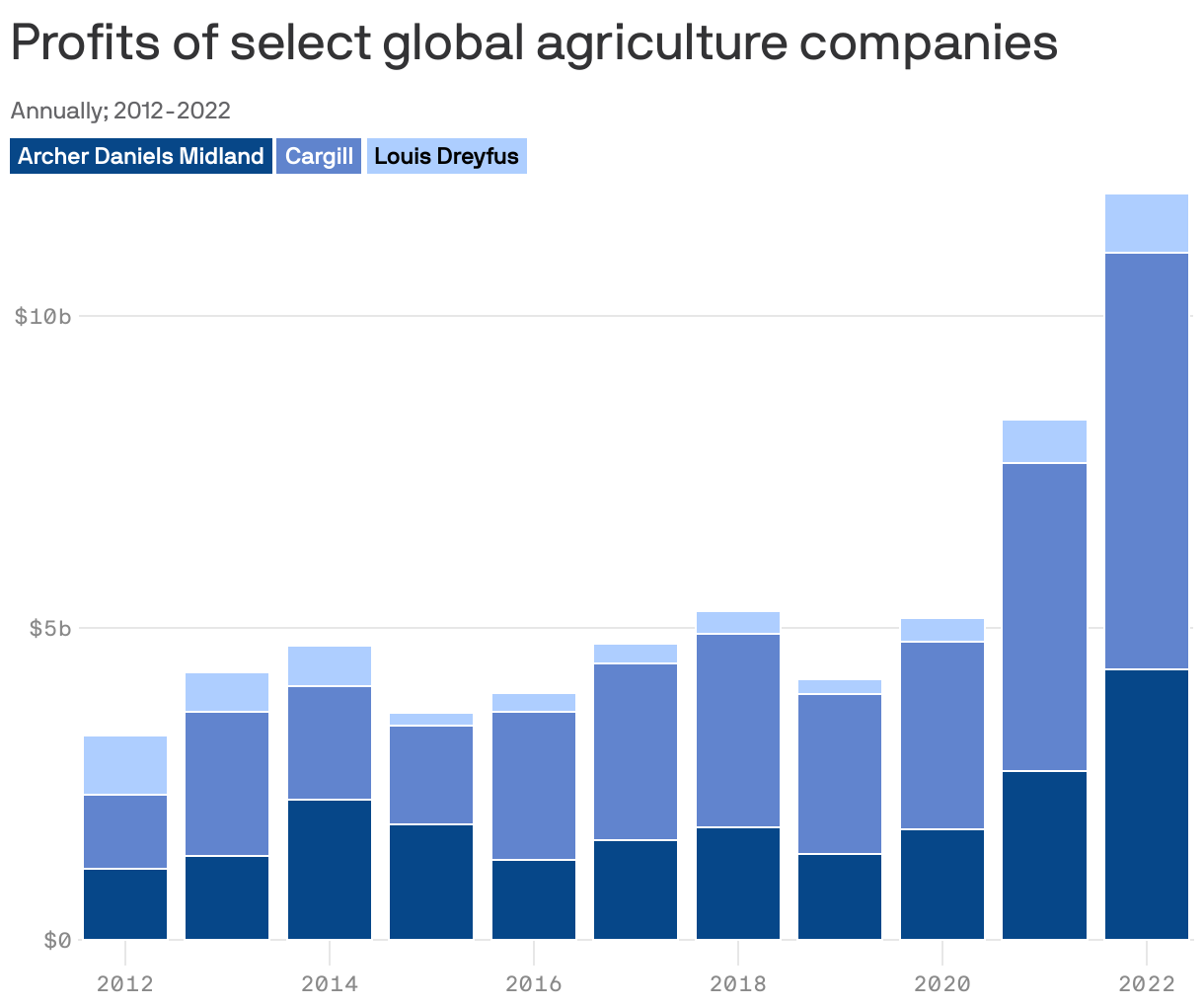
We're in a major hunger crisis — and private corporations are reaping the benefit.
Why it matters: The largest food-trading companies have the status of oligopolies and have become "unregulated financial institutions," according to a blistering 29-page chapter of the 2023 UNCTAD trade and development report, entitled "Food Commodities, Corporate Profiteering and Crises."
The main reason mortgage rates are so high — closing in on 8% — is just that long-term interest rates are high. But the main reason mortgage rates are so much higher than other long-term rates is that U.S. mortgages can be prepaid without penalty.
Why it matters: Prepayability is broadly great for homeowners, since it gives them the ability to refinance whenever rates come down. By the same token, however, it's bad for lenders, who are now charging a lot of money to cover their prepayment risk.
The interest rate on a 30-year fixed-rate mortgage is the second most salient price in the American economy, after only the price of gas. And it looks like it's going to hit 8% sooner rather than later.
Why it matters: A world of 8% mortgages is one Americans haven't seen in over 23 years. The last time mortgage rates were that high, Bill Clinton was president, Brad Pitt married Jennifer Aniston, and Apple Computer was worth $15 billion — a mere 0.5% of its current value.
Everything you thought you knew about moral hazard in the banking system is probably wrong. That's the provocative yet compelling message from a new paper by two economic sociologists, Kim Pernell and Jiwook Jung.
Why it matters: Policymakers worry greatly about deposit insurance and the way in which it allows or even encourages excessively risky behavior on the part of banks. That moral-hazard argument is often given as the prime reason why deposit insurance shouldn't be increased to, say, $25 million.
Amazon's ambitions for a satellite-internet business reached a major milestone today with the launch of its first two prototype satellites.
Why it matters: Dubbed Project Kuiper, Amazon's satellite plans could drive its next phase of growth and will face off against Starlink, the satellite-internet business from Elon Musk's SpaceX, which already boasts more than 2 million active customers.
Data: Lean In, McKinsey & Company; Note: Respondent company industries weighted by the composition of the Fortune 500 in 2022; Chart: Simran Parwani/Axios
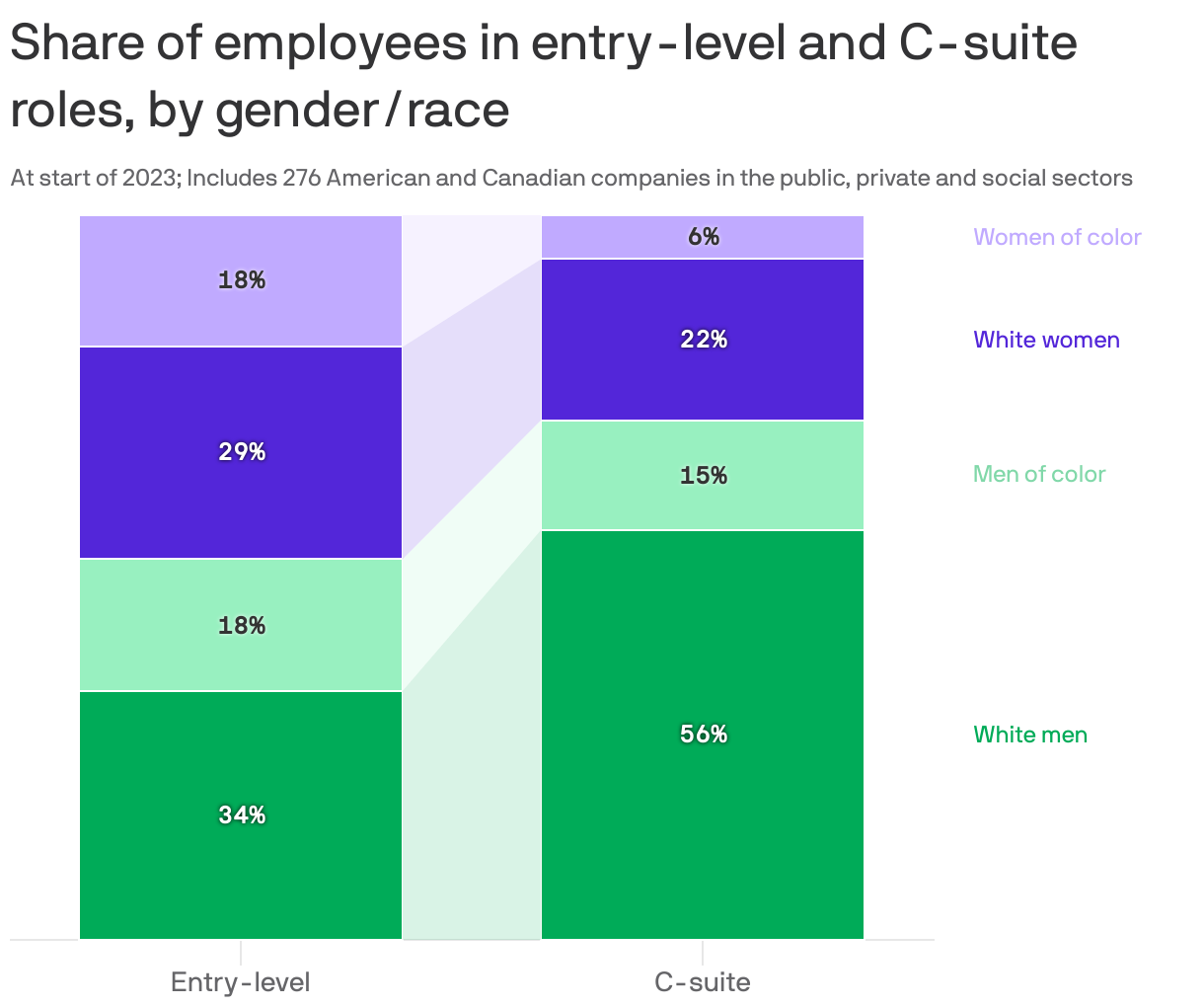
Here's a clear picture showing just how warped the path to the C-suite can be for women of color.
Why it matters: A vast majority of HR leaders say diversity, equity and inclusion is critical to their company's future success, according to this year's LeanIn.org and McKinsey's Women in the Workplace study.
Employers pulling back from remote work are making their own workplace goals harder to achieve.
Why it matters: Nearly 3 out of 4 HR leaders say diversity, equity and inclusion policies are critical to their company's future success — and worker flexibility is one tool that would help them achieve that, a closely watched study published yesterday suggests.
The price of postage stamps could increase again in January 2024 — the fourth rate hike in less than two years — under a new United States Postal Service proposal revealed Friday.
Why it matters: If approved, the approximately 2% increase would be the 18th stamp rate change since 2000.
A work stoppage that's been deemed the largest health care strike in U.S. history could could see a part two with implications for employees, patients and the field at large.
The United Auto Workers president on Friday reported "significant progress" in contract talks with the Detroit Three automakers and said the union would hold off on expanding its strike for now.
Why it matters: The decision signals that the union and the automakers are moving closer to deals that would put an end to a historic, weeks-long strike that currently involves about 25,000 workers at General Motors, Ford and Stellantis.
The big headline out of the employment report is that job growth is much stronger than was thought. That was enough to send the bond market reeling on fears of higher rates ahead.
But the data is probably less worrying on the inflation and interest rates fronts than it looks at first glance.
Let the mourning commence: The short-lived Raspberry Rally Girl Scout cookies won't be for sale this season.
The big picture: The widely sought-after cookie flavor, unveiled last year, sold out quickly after its release and led to a hugely marked-up resale market.
Hyundai, Kia and Genesis are the latest automakers to adopt Tesla's charging interface, marking the latest dominoes to fall in the widespread acceptance of the tech for North American electric vehicles.
Driving the news: The Korean automakers join others including Ford and General Motors in adopting the North American Charging Standard. Newly built vehicles starting in late 2024 will have that port, while the companies also plan to make adapters available for existing cars.
Crocs is taking a step beyond clogs and going western with cowboy boots.
The big picture: The unofficial shoe brand of the pandemic said the boots will be released later this month and come with a "spin-able spur charm on the backstrap."
The U.S. economy added a staggering 336,000 jobs in September, defying expectations of a slowdown, with the unemployment rate holding steady at 3.8%, according to new data the Labor Department released Friday.
Why it matters: The new data reverses what had been signs of a definitive cooling in the labor market. A less-frothy job market is a key objective of the Federal Reserve's campaign to tamp down inflation.
Data: FactSet, U.S. Bureau of Economic Analysis; Chart: Tory Lysik/Axios Visuals
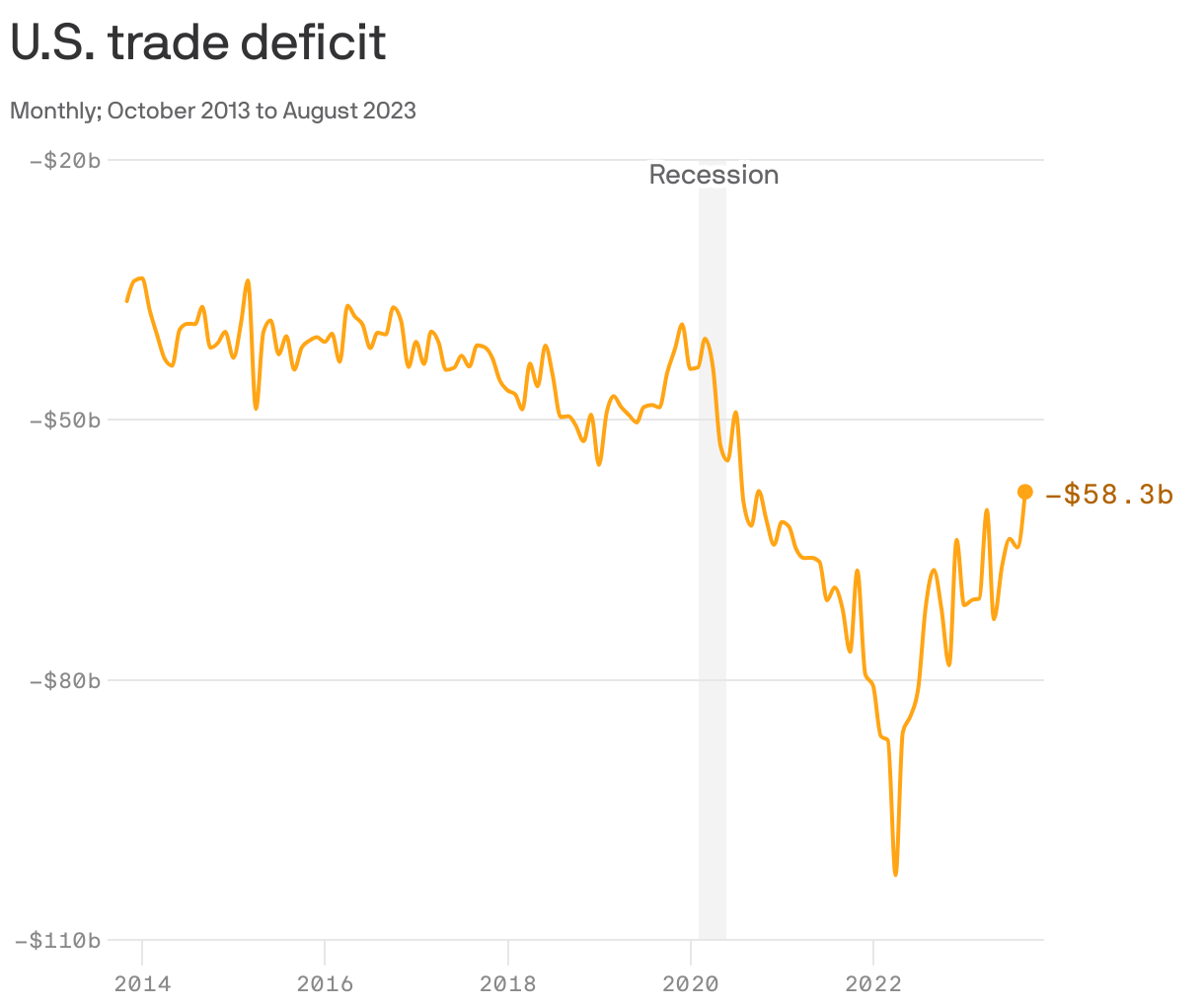
The U.S. trade deficit narrowed in August to the smallest in three years.
Why it matters: The deficit is going down because of a sharp downturn in imports of consumer and investment goods, which could be a sign of weakening demand in the U.S.
Few glitches in our species are more annoying — and baffling — than our inability to just listen.
I'm talking about sitting quietly, with an open mind — unburdened by selfish or defensive mind spams, and soaking up what the other person is actually saying.
Why it matters: This isn't a rant about crack-like phone addiction or gnat-sized attention spans. It's an attempt to help us — me very much included — to hear not what we want to hear, but what others are saying.