More than 31 million people watched midterm elections coverage in primetime across 13 live television news networks Tuesday, surpassing 2022 viewership by an impressive 23% but still down 14% from 2018, according to Nielsen data.
Why it matters: A historic night for Democrats drew a slightly younger audience. Around 9% of viewers were between ages 18-34, up from 7% in 2022.
Tuesday's Democratic election sweep could tap the brakes on the autonomous vehicle industry's ambitious growth plans.
Why it matters: Just as robotaxis are hitting the streets in larger numbers, the technology has become more politically charged in Washington and statehouses across the country.
Democratic socialist Nithya Raman toppled embattled Los Angeles Mayor Karen Bass in a stunning upset, putting South Asian immigrants on course to lead America's two largest cities.
Why it matters: With New York's Zohran Mamdani already in office, Raman's win puts democratic socialists on track to run two of America's most powerful city halls — testing whether their promises on affordable housing and better government can survive the pressures of governing.
Congress returns next week facing a renewed push for transparency over the Jeffrey Epstein files, as a top House Democrat promises new investigations following the party's midterm victories.
Why it matters: The Epstein files controversy has been a recurring political issue throughout President Trump's second term and featured prominently in the midterm campaigns. Democrats' incoming House majority could bring fresh scrutiny of his administration's handling of the files.
California Gov. Gavin Newsom announced Thursday he plans to commute all 548 of the state's death sentences to life without parole, a sweeping decision that could empty the nation's largest death row.
Why it matters: If Newsom follows through, it will be the largest mass commutation of death sentences in U.S. history, reducing the national death-row population by more than a quarter.
The move comes during Newsom's final months as governor and ahead of a potential 2028 bid for president.
One of the biggest nail-biters of the 2026 election isn't playing out in a purple state, but crimson Mississippi, where Democrat Scott Colom is trying to pull off a Magnolia State upset.
The big picture: It's one of the most remarkable currents of Tuesday's blue wave. The race pitted Colom, a Democratic district attorney powered by grassroots clout, against incumbent Republican Cindy Hyde-Smith in a state Trump won by some 23 points in 2024.
WASHINGTON — Senate Leadership Fund executive director Alex Latcham said Republicans faced voter-enthusiasm and affordability headwinds as polls began closing Tuesday, hours before a Democratic wave cost the GOP control of Congress.
Why it matters: SLF and affiliated groups spent $810 million to preserve GOP Senate control, money that ultimately could not counteract voter backlash to President Trump's handling of the economy and the Iran war.
Axios' Stef Kight and Hans Nichols spoke with Aspen Institute Congressional Program executive director and vice president and former U.S. Rep. Charlie Dent (R-Pa.), Latcham and Center Aisle Coalition president and former U.S. Rep. Stephanie Murphy (D-Fla.). The Nov. 3 event was sponsored by Kalshi.
What they're saying: "Republicans … face some headwinds in motivation and enthusiasm to get our base out to vote," Latcham said. "We also face headwinds in how voters perceive our handling on the economy, on inflation, affordability."
Yes, but: Murphy warned that Democrats could mistake a victory for a sweeping mandate and lose sight of voters' economic concerns.
"We should govern and address … the issues that the American people are challenged with today, which is around affordability," she said.
What's next: As Trump's unpopularity grows, Dent said the 2028 Republican presidential nominee would likely need to be someone with distance from the president.
"Everybody seems to think the conventional wisdom is [Vice President] JD Vance is the guy. Well, I got news for you: If the president's approval rating is in the 30s, and JD Vance is so tied to the president as he is … how do you separate yourself?" Dent said.
Content from the sponsor's segment:

Kalshi's Tarek Mansour (left) with Axios' Nicholas Johnston on stage at a Nov. 3 Axios Live event. Photo: Denny Henry for Axios
In a View From the Top conversation, Kalshi co-founder and CEO Tarek Mansour argued that prediction markets are able to provide up-to-date election insights.
"I think that in '28, I certainly feel that, like, anyone who's not using prediction markets to get informed is going to be left behind," Mansour said.
The chairman of House Republicans' campaign arm, Rep. Richard Hudson (R-N.C.), joined the lengthy list of Republicans who've lost their reelection bids, AP projects.
Why it matters: The man tasked with preserving House Republicans' majority couldn't save his own seat, in a stunning indictment of the GOP's campaign operation.
Scott Colom, a Democratic prosecutor from Mississippi, has a narrow lead in what could be one of the biggest upsets of the 2026 midterms.
Why it matters: If he wins, Colom would be Mississippi's first Black U.S. senator since the Reconstruction era and the first Democrat elected to the state's Senate delegation since 1982.
President Trump won historic levels of support from Black men in 2024. Two years later, those gains appeared to evaporate as Republicans suffered their worst midterm defeat in 50 years.
Why it matters: Democrats feared the Supreme Court's decision weakening the Voting Rights Act would threaten their political future in the South. Instead, Black voters helped deliver historic Democratic victories in Texas and Georgia, with a potential upset brewing in Mississippi.
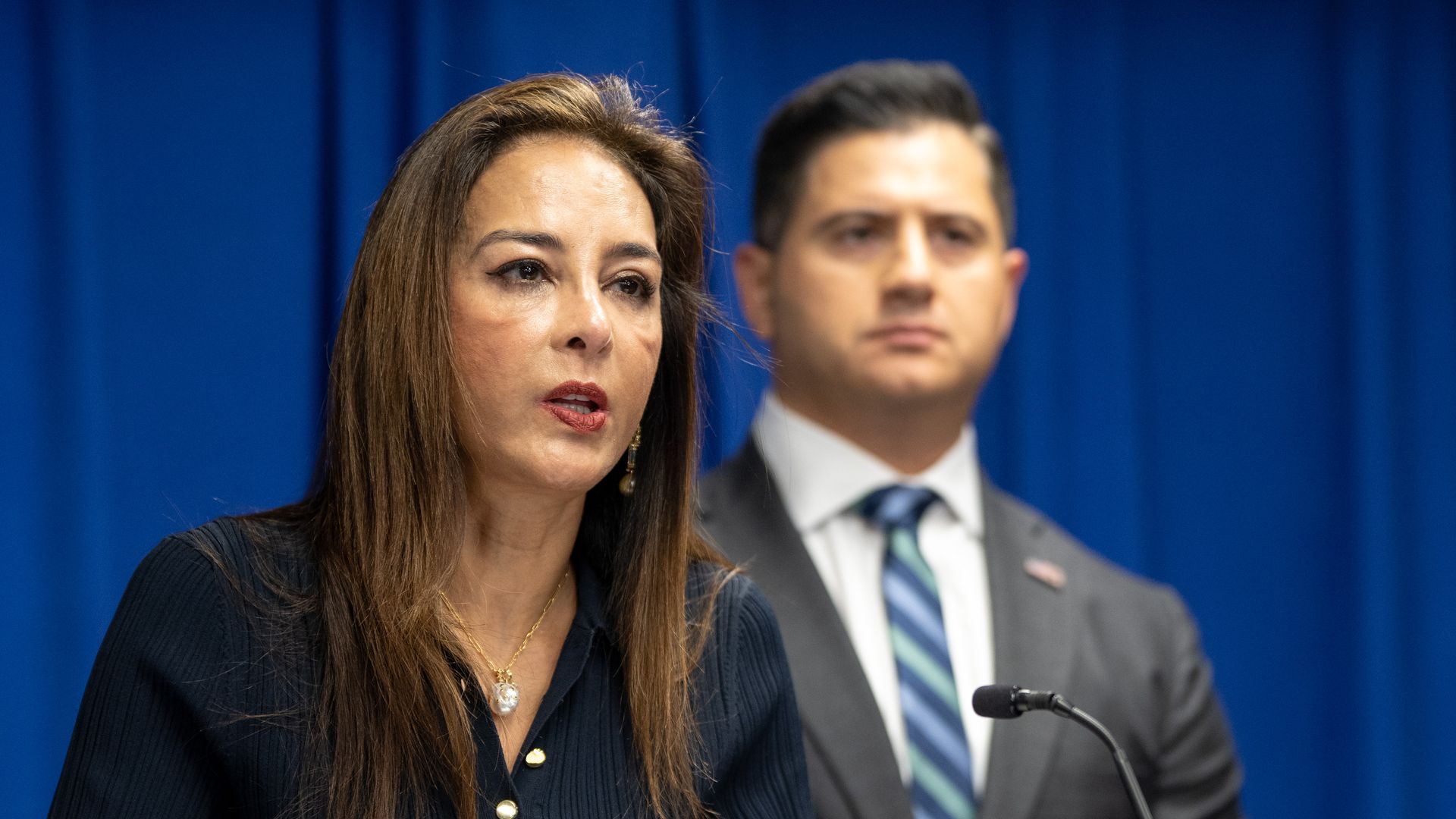
Harmeet Dhillon, assistant attorney general for civil rights at the Justice Department, has resigned from her role, Attorney General Todd Blanche said Thursday.
Why it matters: Dhillon, who spent her tenure replacing attorneys with others more closely aligned with the Trump administration's ideology, is the first senior-levelJustice Department official to step down following Democrats' blue sweep in the midterm election.
Young voters swung so hard toward Democrats in Tuesday's midterms that it raises new doubts about whether Republicans can build a lasting coalition among Americans under 30.
Why it matters: Trump's success with Gen Z voters, especially young men, fueled talk of a generational shift toward Republicans. Tuesday's results tell a different story.
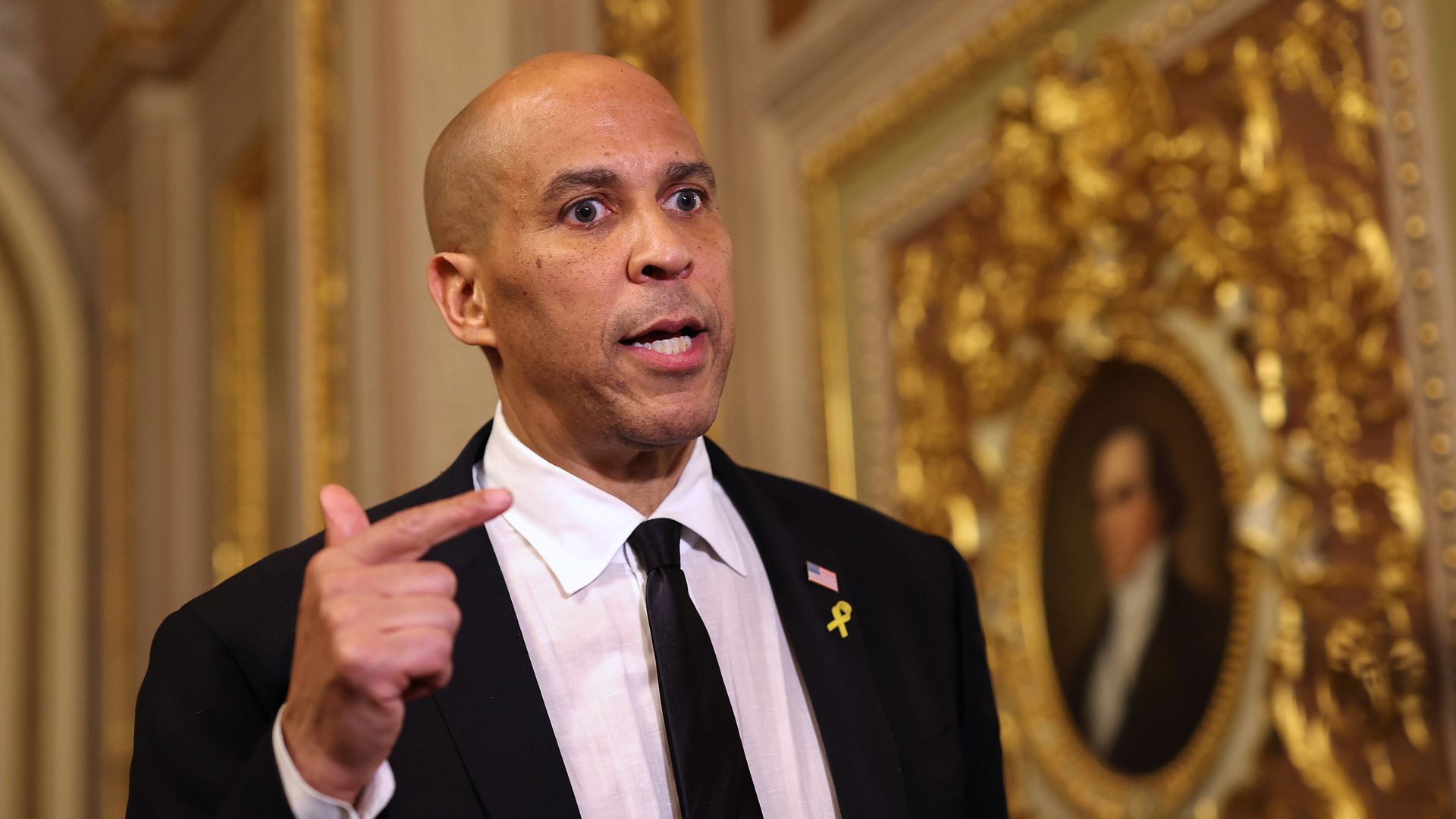
Sen. Cory Booker (D-N.J.) is heading back to South Carolina this weekend to speak to Black voters, celebrate Democrats' success in a deep-red state and lay out his vision for the party's future.
Why it matters: For Senate Democrats, the 2028 presidential primary is getting underway before they formally vote on their next Senate leader.
Corporate America can't ignore the message voters are sending with the scale of Democrats' midterm victories. This wasn't an election defined by any single issue. It was everything, all at once.
Why it matters: For communicators, the challenge now is separating political noise from the concerns that directly affect their businesses and shaping decisions that tackle those issues.
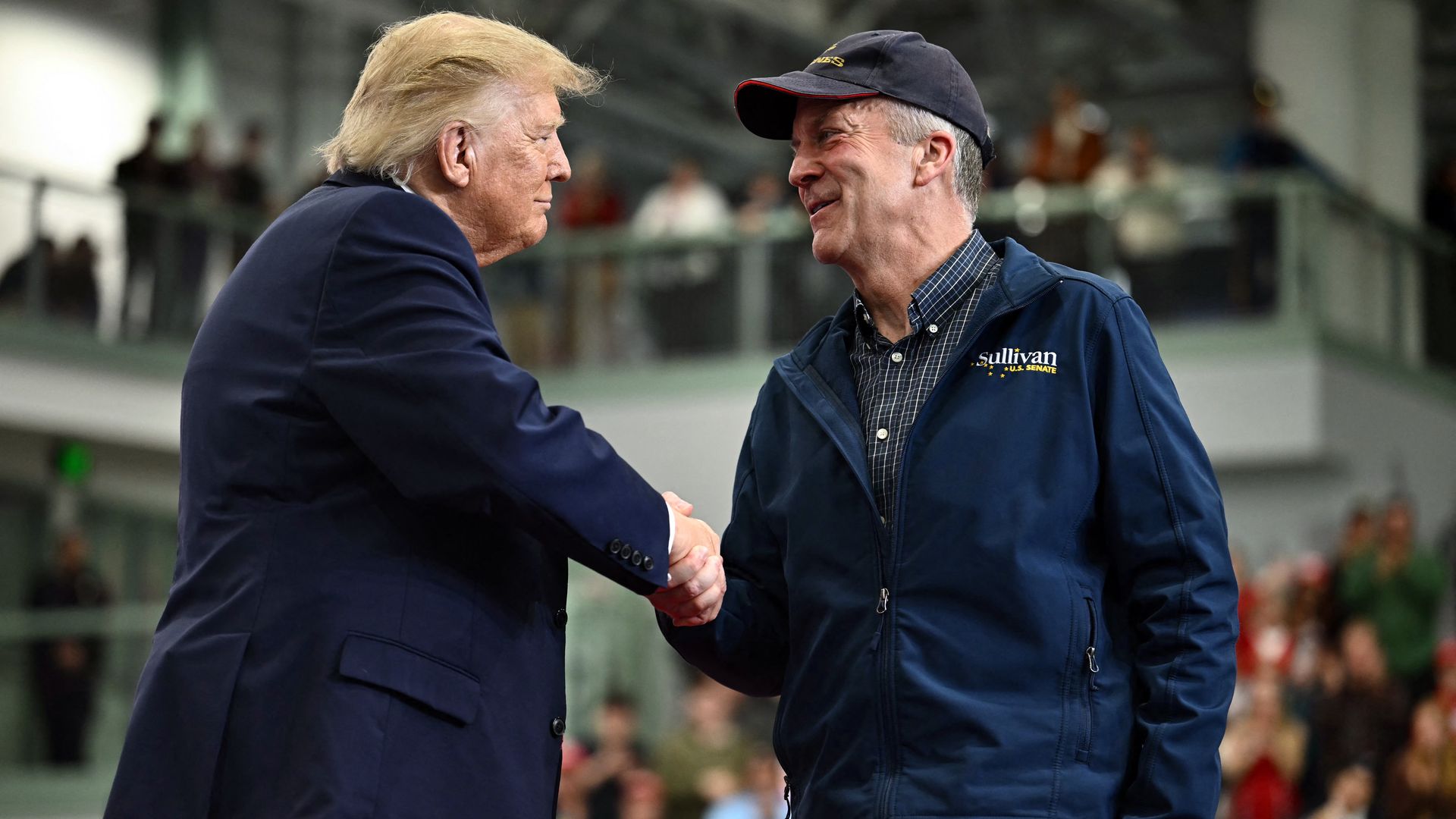
President Trump wrote Thursday that incumbent Alaska Sen. Dan Sullivan (R) should receive the vote totals for Dan J. Sullivan, a Senate candidate in Alaska's tumultuous race who has the same name as the incumbent lawmaker.
The big picture: Trump's DOJ has sought to intervene in the race, citing voter confusion, and recently escalated its probes by sending target letters to Democratic operatives.
Vice President Vance stepped out of President Trump's shadow Wednesday, seizing on the GOP's midterm catastrophe to begin the explosive task of claiming MAGA as his own.
"The reason we lost is the war," Vance wrote in an extraordinary 600-word postmortem on X, blaming Trump's Iran campaign for Republicans' historic collapse.
Why it matters: Vance's presidential ambitions are entangled in the wreckage of a war he privately opposed but publicly defended. His path to 2028 demands a delicate political calculation.
Americans made it very clear on Tuesday that health care is too expensive. The challenge for Democrats is to agree on the quickest way to deliver some relief.
Why it matters: Voters can't wait until 2029 for life to get cheaper — but any short-term action to meaningfully lower health costs will require Democrats to make deals with President Trump.
The AI industry is scrambling to repackage a $10 trillion infrastructure buildout to appease a hostile electorate that overwhelmingly voted to restrict data center construction in ballot measures across the country.
It's not just changing the name of data centers to "compute campuses," but offering communities real money, including dividends and benefits for schools or cities, plus environmental concessions and labor protections.
Why it matters: Tuesday's election proved voters won't tolerate unchecked growth, although the market and many analysts see the blue wave slowing — but not stopping — data center construction around the U.S. To prevent an existential threat, the world's biggest companies are working on a rebrand.
How well they execute on their promises will determine the pace of the global AI race.
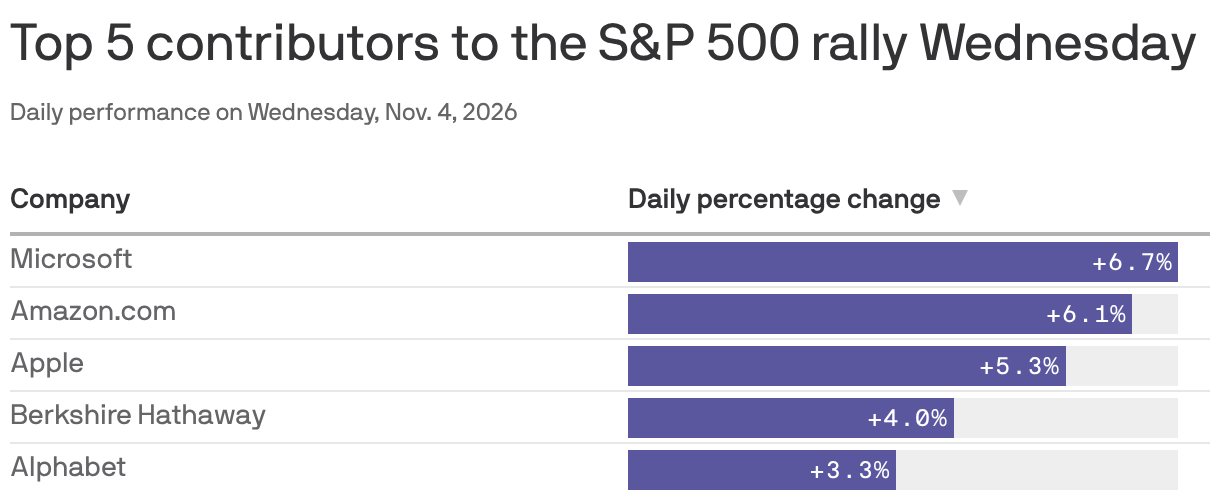
Voters clearly put the brakes on the AI buildout this week, but the biggest tech companies kept on rolling.
Why it matters: The rally in the shares of the likes of Microsoft and Amazon reflects a growing realization on Wall Street that a slowdown in the AI race may not be such a bad thing.
If companies can put off enormous spending commitments, they get to show healthier cash flows, avoid financing costs and possibly sidestep risky investments.
It's a de facto motto in the Trump White House: "Somebody's gotta take the fall." Lately, that person looks like Secretary of Defense Pete Hegseth.
Why it matters: From the unpopular war in Iran to his bad bipartisan relations with members of Congress, Hegseth's record has made him the most vulnerable member of Trump's Cabinet after Tuesday night's midterm shellacking.
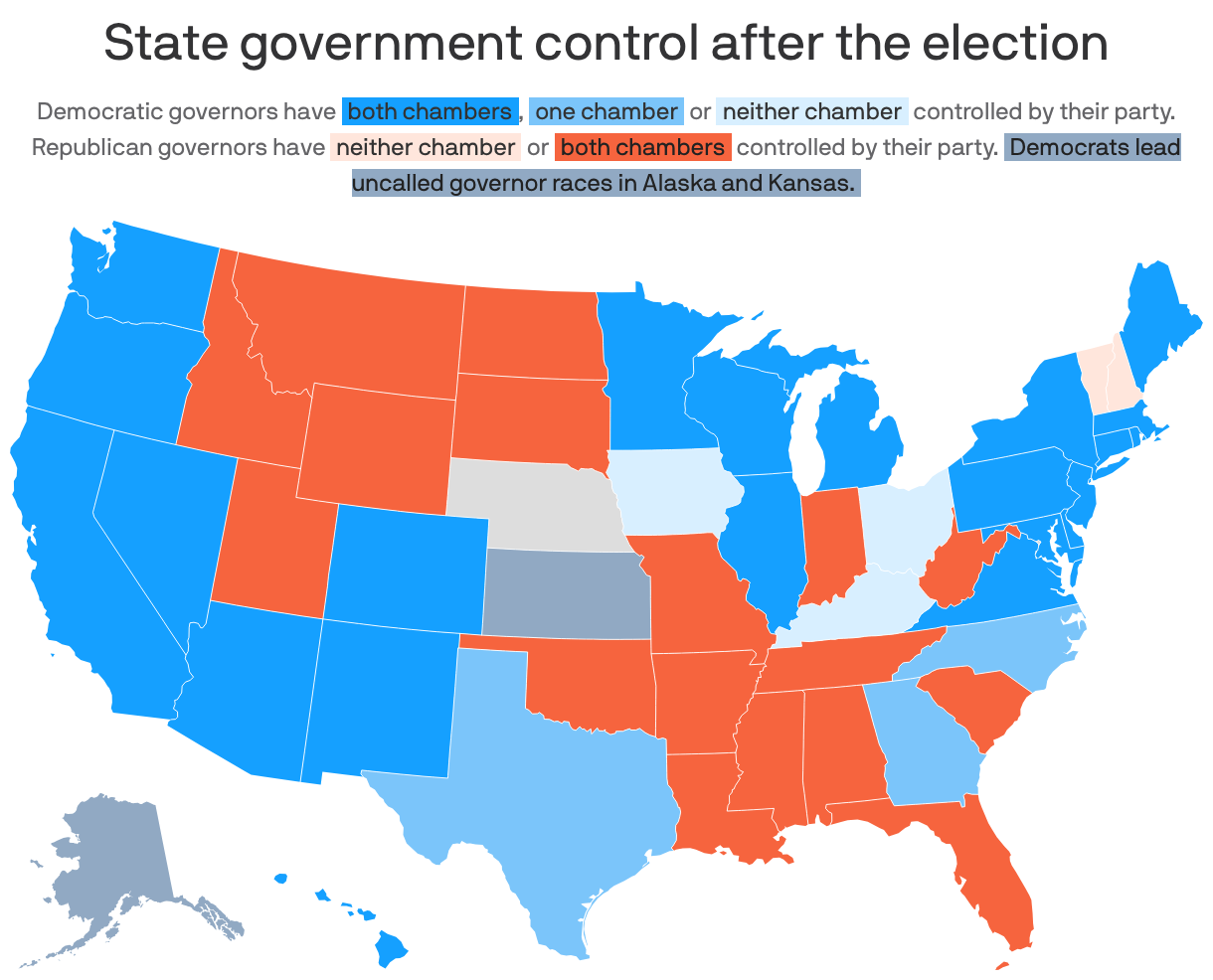
Democrats are on track to take control of a majority of legislative chambers, ending 16 years of Republican dominance over America's statehouses.
If current leads hold, 75% of Americans will live in a state with a Democratic governor, and 53% will live in Democratic trifectas.
Why it matters: Statehouses are the front line of American federalism, and Tuesday's gains dramatically expand Democrats' power to increase minimum wages, protect abortion access, and set voting rules ahead of 2028 for most Americans.
Democrats of all political stripes won so big on Tuesday that the party didn't settle its long-running civil war between moderates and progressives.
Instead, the party's historic victories gave each faction some reasons to claim that its brand of Democrats can defeat the GOP in 2028.
Driving the news: Democratic operatives are sure of one thing, though: Tuesday's blowout wins mean that more party leaders will be willing to run for the White House than if the midterms hadn't gone so well.
President Trump has conceded that the Iran war cost Republicans dearly in the midterms. Now he must decide whether to cut his losses and reach a deal — or double down and go back to bombing.
Why it matters: All of Trump's options are problematic:
The first is to strike. But going back to war would be highly unpopular — keeping gas prices high and probably not yielding a better military result.
Another is to negotiate. But if Iranian officals refuse to make concessions — or, sensing weakness after the president's political loss, up their demands — Trump will have a hard time reaching a deal.
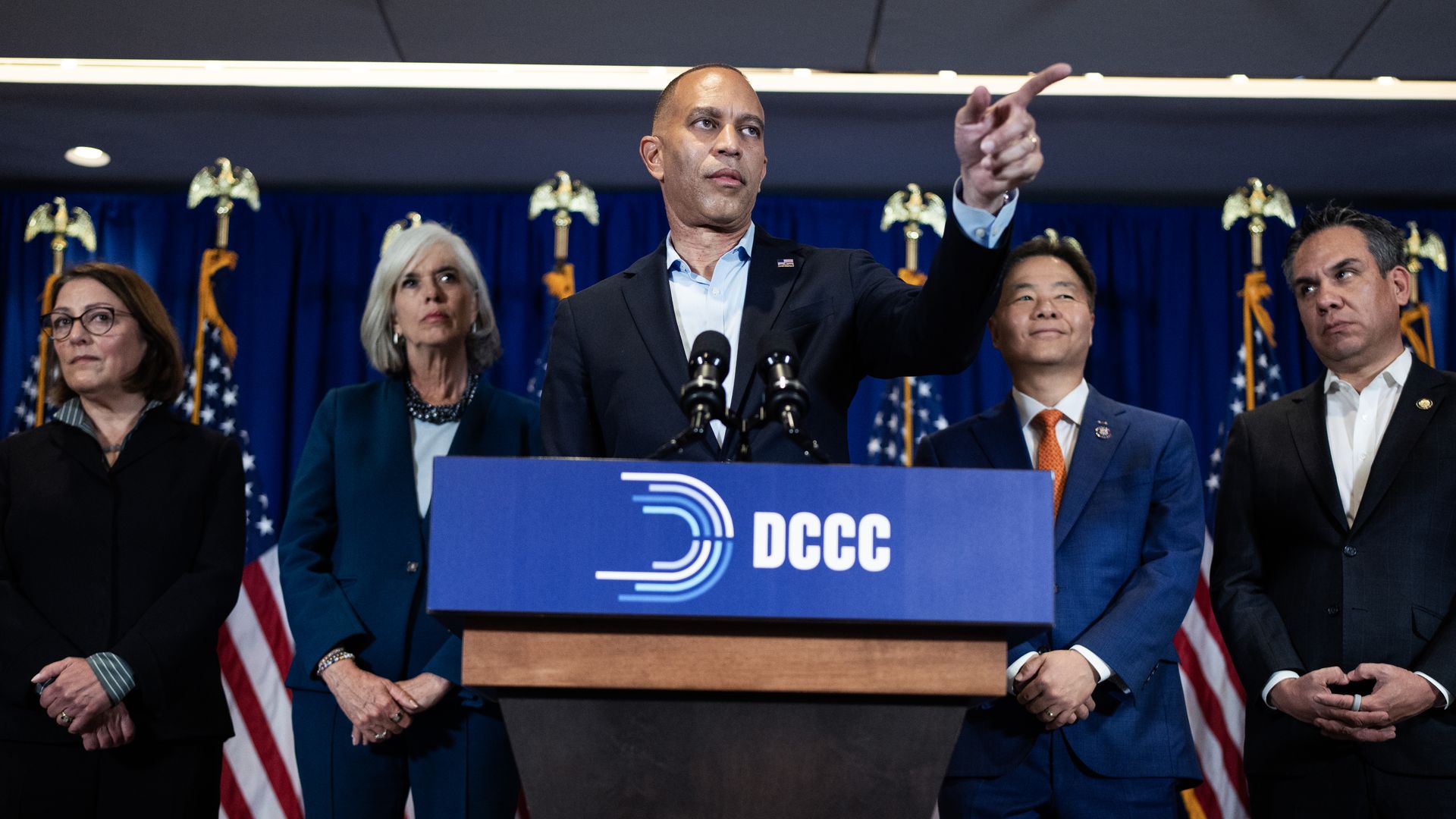
House Democrats channeled anti-Trump fury into a landslide victory over Republicans. Now comes the hard part: Figuring out what to do with their huge majority.
Why it matters: That question is already igniting a power struggle between Democrats' ideological factions as they lay out contradictory visions for what the next two years of governing looks like.