Why this could be the AI pause that refreshes


Add Axios as your preferred source to
see more of our stories on Google.
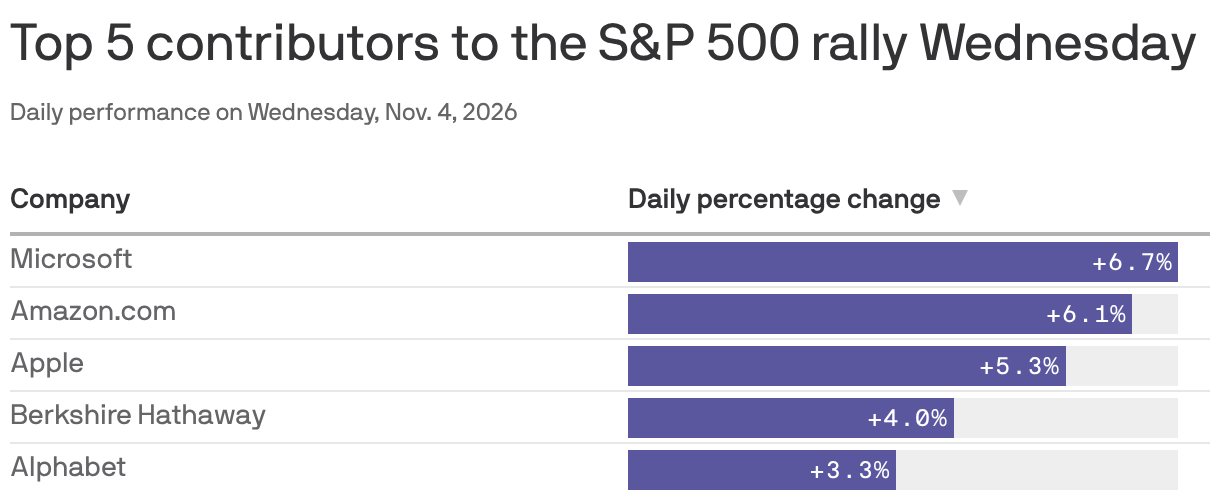
Voters clearly put the brakes on the AI buildout this week, but the biggest tech companies kept on rolling.
Why it matters: The rally in the shares of the likes of Microsoft and Amazon reflects a growing realization on Wall Street that a slowdown in the AI race may not be such a bad thing.
- If companies can put off enormous spending commitments, they get to show healthier cash flows, avoid financing costs and possibly sidestep risky investments.
State of play: The Big Tech hyperscalers were among the biggest winners in Wednesday's post-election relief rally: Microsoft was up 6.7%, Amazon, 6.1%, and Alphabet, 3.3%.
- These are companies with businesses that generate a lot of cash doing things like selling advertising or cloud computing or software and don't absolutely need to rapidly become AI companies.
- "Delays may frustrate, but they also make it less likely that trillions of dollars are invested in equipment at risk of becoming obsolete or depreciating faster than its financiers expected," the Financial Times Lex column noted.
Yes, but: Not all hyperscalers. Oracle closed down nearly 2% on Wednesday. And, over the long term, the challenges facing smaller AI firms could blow back on the big ones.
- Those challenges might entail a slowdown in profits for companies that have had soaring sales from supplying the "picks and shovels" of the AI trade — things like fiber-optic connectors, servers and memory storage devices.
- The market seemed to be pricing that outlook in on Wednesday.
- Engineering and construction companies closely associated with the AI buildout, like Quanta Services, Emcor, Vertiv and HVAC contractor Comfort Systems were hammered especially hard.
- As was GE Vernova, a maker of turbines for power plants needed for AI computing.
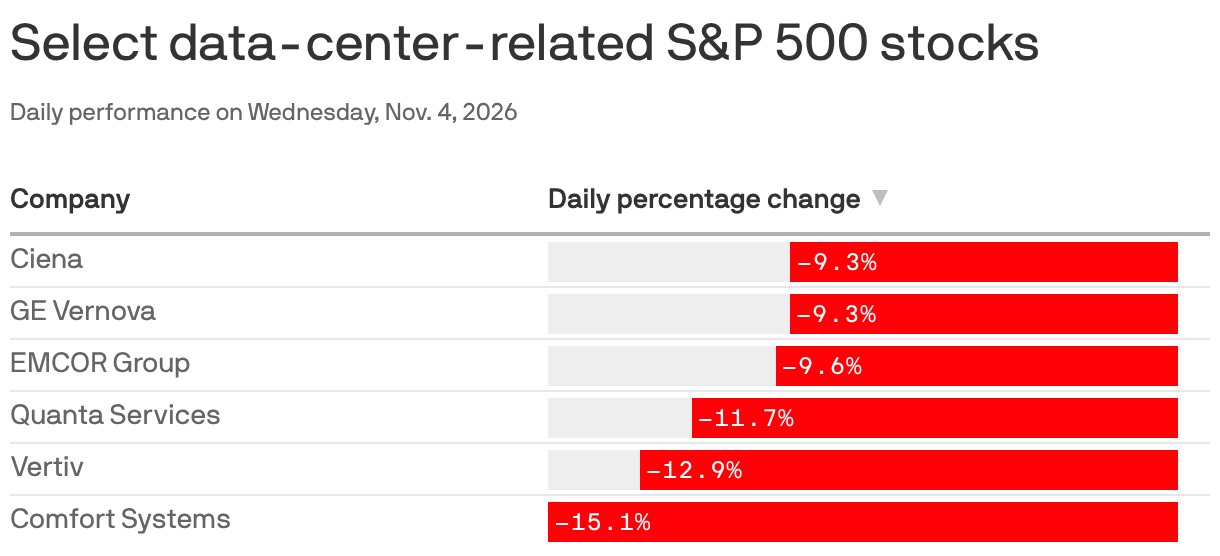
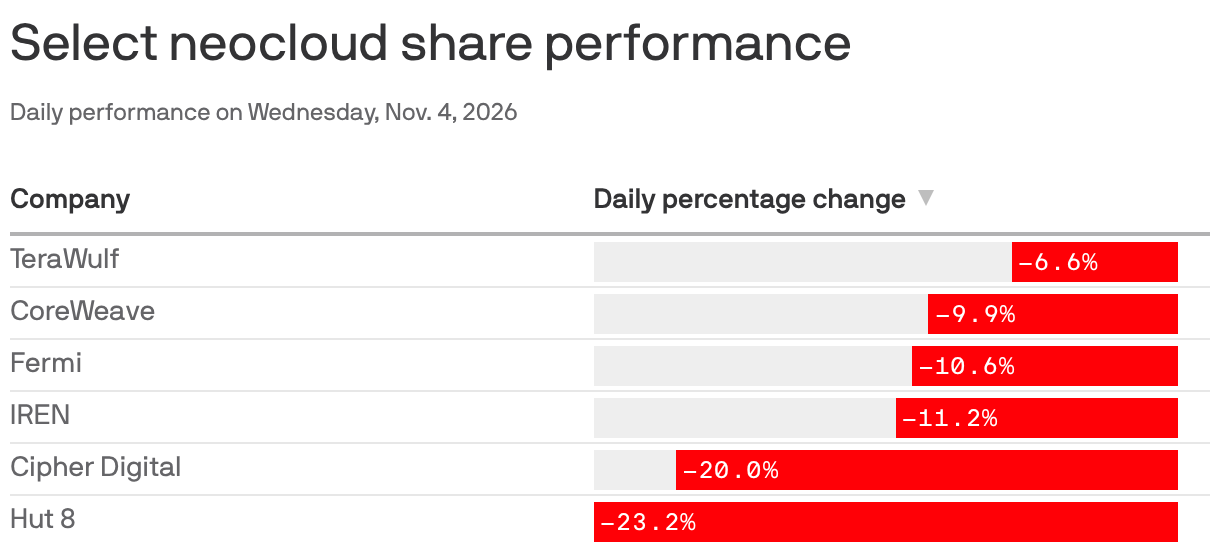
The neoclouds — smaller data center operators — also stumbled on Wednesday.
- These companies have borrowed a lot of money to build data centers and buy semiconductors. Slowdowns in construction mean delays in earning revenue while they're paying interest on that debt.
Where it stands: Democratic victories at the state level, plus dozens of voter referendums, appear set to slow the data center buildout.
- While most 2027 construction isn't likely to be affected, 37.5 gigawatts of planned 2028 capacity could face pauses and another 15 gigawatts could face "conditions," JPMorgan's Michael Cembalest noted Wednesday.
- "While pauses are the more impactful outcome," he wrote, "conditions can be onerous: requiring data centers to pay grid costs to protect ratepayers, ending tax incentives, imposing water limits, setting requirements for onsite backup power, mandating labor requirements and banning non-disclosure agreements during permitting."
The big picture: At the macro level, slowing down the AI capex mania could be overall positive for the economy, a range of economists and investors have argued.
- It could ease "overheating risk in the next year or two and plausibly extend the AI investment cycle," Evercore's Krishna Guha wrote. "This will help keep the whole economy demand and supply in balance without many more rate hikes."
- The slowdown could take some of the air out of what had been looking awfully bubbly. "Anti-AI politics is bad for AI stocks in the short run but very good for preventing a bubble in the medium to long run," Substack writer Derek Thompson posted.
Zoom in: It could also be a relief for the bond market, because it would mean less new debt competing for investors' money — potentially easing upward pressure on borrowing costs, Andrew Szczurowski, strategic income portfolio manager at Morgan Stanley Investment Management, told Axios before the election.
- He also said that at some point soon investors may stop rewarding tech companies for spending heavily on AI:
- "You get to a point where investors on the equity and bond side are no longer... giving you applause for how much you're spending."
The bottom line: While there will be some negative impacts, in the long run — to borrow a line from an old Coca-Cola ad — this could be the AI pause that refreshes.
