What to know about the double-Dan Sullivan controversy in Alaska

Add Axios as your preferred source to
see more of our stories on Google.
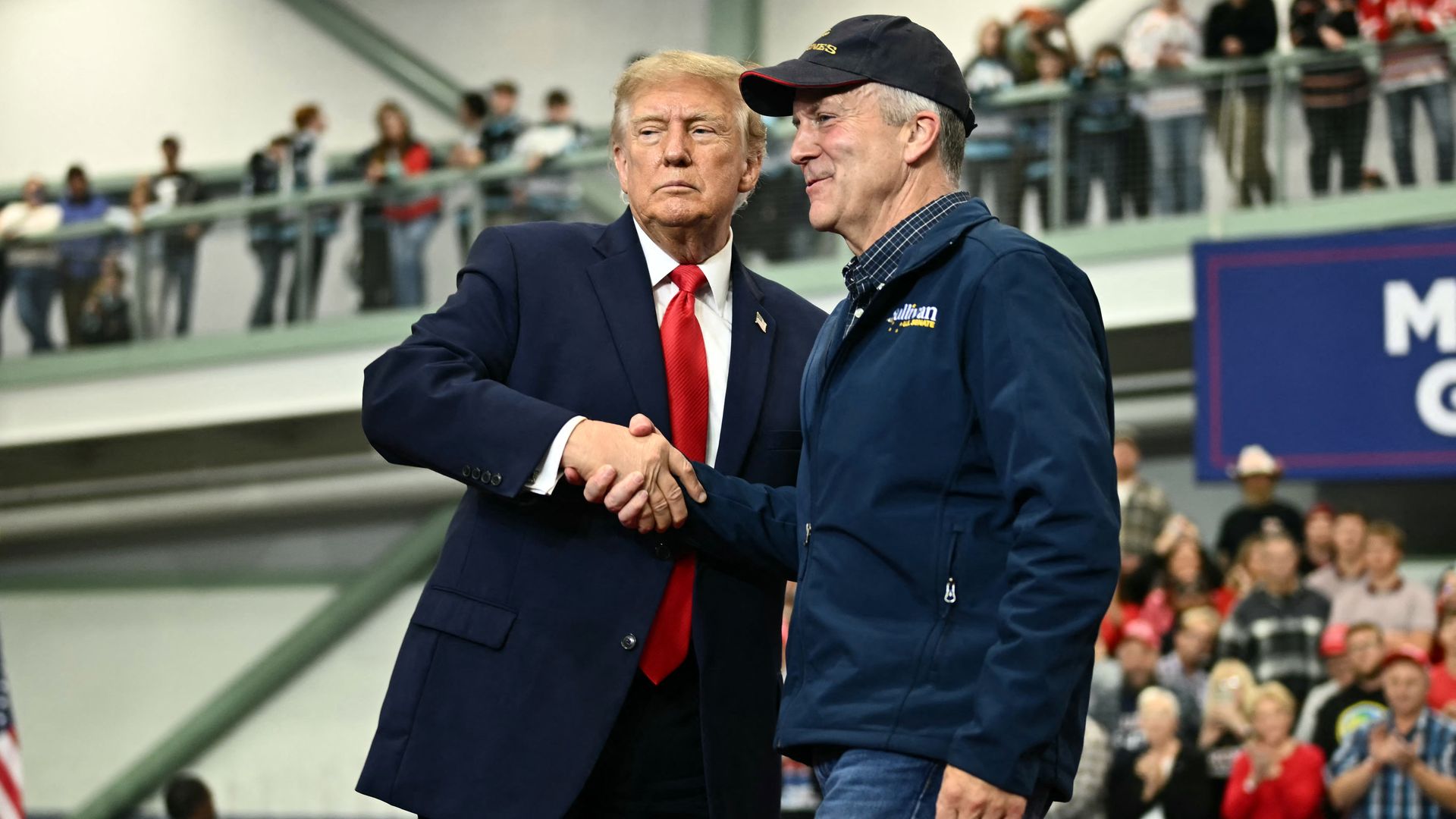
President Trump greets Sen. Dan Sullivan at a campaign rally supporting Sullivan's reelection bid in Wasilla, Alaska, on Oct. 13. Photo: Kent Nishimura/AFP via Getty Images
Alaska's tight Senate race is facing a new controversy over two candidates named Dan Sullivan appearing on the ballot — a twist that's drawn attention from President Trump.
The big picture: The controversy is adding uncertainty to one of the nation's most competitive Senate contests, with control of Congress on the line in next week's midterm elections.
Catch up quick: The New York Times reported this week that Democratic operatives with ties to Mary Peltola's Senate campaign helped recruit a candidate named Dan J. Sullivan to challenge Republican incumbent Dan S. Sullivan.
- Trump accused Peltola and Democrats of election fraud and called for criminal prosecution, though the Times did not establish that any laws were broken.
- Alaska Gov. Mike Dunleavy ordered an investigation into Peltola's campaign over the NYT report. House Republicans are also launching an Alaska Senate race probe.
Though the presence of two Sullivans in the Senate race has been known for months, the Times' report adds a new wrinkle to a dispute that's already reached the courts.
Here's what to know about the controversy.
The same-name Senate race controversy
The controversy centers on two candidates with nearly identical names appearing on Alaska's Senate ballot: Republican incumbent Dan S. Sullivan and unaffiliated challenger Daniel J. Sullivan Jr.
- The ballot will show registered Republican "Sullivan, Dan S." and unaffiliated candidate "Sullivan, Daniel J. Jr." Peltola and Republican Gerald Heikes will also be on the ballot.
- The challenger initially filed as a Republican but later changed his registration to undeclared. He will appear on the ballot without a party label.
Flashback: Concerns about the duplicate names have existed for months.
- In June, a top Alaskan election official ruled that candidate Daniel J. Sullivan was ineligible to run on the state's primary ballot.
- The official said she found the candidacy was "filed with a purpose to confuse or mislead and to thereby compromise the ballot's fairness or neutrality," per the Associated Press.
The Alaska Supreme Court later ruled that state election officials lacked the authority to disqualify Sullivan based on their concerns about his motives, allowing him to appear on the ballot.
- The court did not determine whether his candidacy was intended to mislead voters.
Trump reacts to Alaska controversy
Flashback: Last week, the Justice Department sued Alaska, seeking to block certification of the Senate election if the incumbent loses by a margin potentially attributable to voters confusing the two Sullivans.
- Both Peltola's campaign and the Democratic Senatorial Campaign Committee have asked a federal judge to dismiss the case.
- Alaska officials are seeking dismissal of the lawsuit, arguing that it has no legal basis and that the federal government lacks authority to intervene in a matter governed by state election law.
Zoom in: The new NYT report, published this week, cited texts, interviews and documents showing that Peltola's aides worked with Democratic operatives to recruit candidates who could siphon votes from the Republican senator.
- Per the report, a staffer was told to review every "Dan Sullivan" in the state, leading the team to Dan J. Sullivan, the retired schoolteacher who was registered as a Republican.
- Peltola's campaign and the DSCC denied recruiting Sullivan, per NYT.
The latest: The NYT report sparked a reaction from Trump this week, who wrote on Truth Social that the recruitment by Peltola's campaign was done "in order to defraud, confuse, and obfuscate the Election," in his call for Peltola and the other Sullivan to be prosecuted.
- Gov. Dunleavy ordered a state investigation on Oct. 28 into the allegations, and House Oversight Chair James Comer launched a congressional probe on Oct. 29.
What they're saying: "Mary got in this race because Alaskans deserve a champion who is fighting to lower their costs and put Alaska first, and no tweet or threat from any DC politician will keep her away from that fight," a spokesman for the Peltola campaign tells Axios. "The Alaskans for Mary campaign has no involvement with either Sullivan campaign."
The other side: In a statement to Axios, Nate Adams, a spokesman for Dan S. Sullivan, accused Peltola, her advisers and Democratic operatives of coordinating with the DSCC to recruit candidates to deliberately confuse voters.
- "We always knew this was a coordinated effort to mislead Alaskans, and Mary Peltola was counting on it staying buried until after the election. Now that she's been caught red-handed, she still won't come clean," Adams said. "Instead, she's doubling down on the lie and is now attacking the same media outlets she's been misleading for months."
How Sullivan confusion could affect the Alaska race
Why it matters: Alaska's ranked-choice voting system could limit the impact of voter confusion for the two Sullivans.
How it works: Ranked-choice voting allows voters to rank multiple candidates in order of preference. If no candidate wins a majority of first-place votes, the lower-performing candidates are eliminated and their supporters' votes go to the next-ranked choice.
- If Dan J. Sullivan is eliminated, ballots listing the incumbent as the next remaining choice would transfer to him.
- But voters who mistakenly select Dan J. Sullivan without ranking the incumbent could still cost the Republican votes in a close race.
By the numbers: Dan J. Sullivan received 2.5% of the vote in Alaska's August primary, compared with 41.4% for the incumbent and 49.5% for Peltola.
