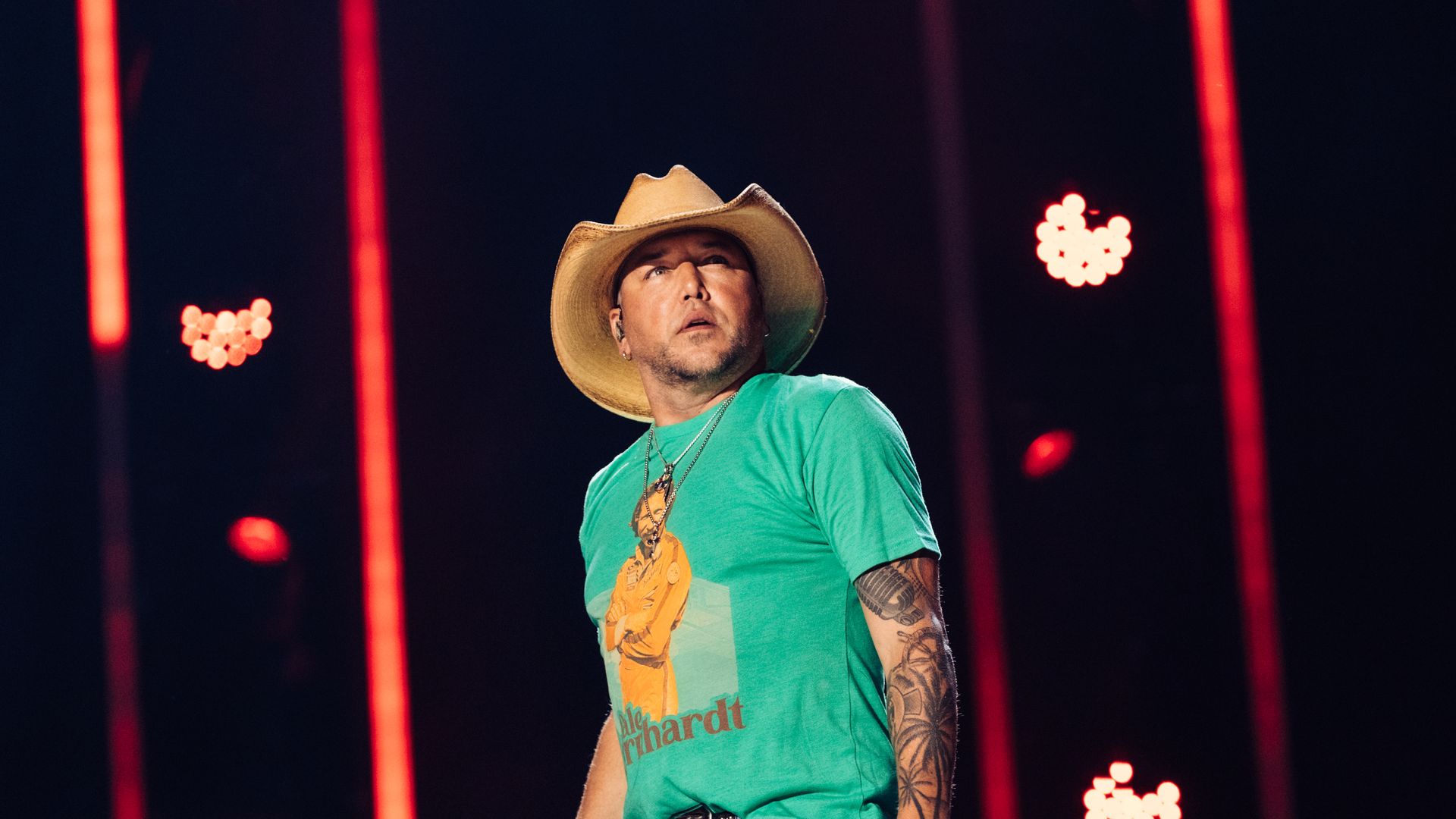
CMT stopped airing Jason Aldean's controversial music video for "Try That in a Small Town," a spokesperson told Axios.
Driving the news: Critics say the song strikes a threatening tone while criticizing gun control and protests against police. The video, which was released Friday, splices videos of fires, crimes and burning flags with protest images.
Corporate America is slimming down to keep profits flowing.
The big picture: U.S. companies with investment-grade credit ratings reduced operating expenses by 5.3% in the first quarter to $2.86 trillion, according to an S&P Global Market Intelligence report released Tuesday.
Why it matters: S&P's findings indicate that many companies are cutting costs around the edges on things like hiring and business travel, rather than executing wholesale layoffs or deep operational cuts.
It also comes at a sensitive time, with the jury still out on whether the Federal Reserve's aggressive tightening campaign will lead the economy into recession, or a soft landing.
The intrigue: Businesses with weaker balance sheets didn't cut as much, possibly because they don't have as much fat to trim.
Companies with noninvestment-grade credit ratings shed only 3.8% of their operating expenses.
Yes but: The energy and consumer discretionary sectors were especially aggressive in slashing costs, having reduced expenses by 13% and 10%, respectively, S&P reported.
Companies ranging from Disney to FedEx and Dell have initiated cost cuts in recent months by some combination of shedding employees. They've also ended certain operations and reduced spending broadly.
In some cases, expense reductions reflect passive changes, such as a decline in energy expenses.
But, but, but: Operating expenses still grew as a percentage of revenue for investment-grade companies, rising 0.8 percentage points to 91.4%, S&P found.
That means that companies didn't entirely counterbalance a slide in business with more reductions.
💭 Our thought bubble: Continued strength in the job market — despite the slowing pace of job growth — suggests that companies are still hesitant to cut too much.
Driving the news: Saudi Aramco CEO Amin Nasser is replacing Bader Alsaad, chair of the Arab Fund for Economic & Social Development, who will depart when his term expires in 2024.
Why it matters: With more than $9 trillion in assets under its management, BlackRock has emphasized its commitment to responsible environment, social and governance (ESG)-based investing.
But CEO Larry Fink has recently tried to distance the company from the hot-button term as political backlash builds.
Saudi Arabia is also under scrutiny for its human rights record.
Details: Nasser led Saudi Aramco's record-large IPO, and he's directed the company's push for net zero emissions by 2050.
But he's also argued that "alternatives are not ready to shoulder a heavy load of the growing energy demand and therefore we need to work in parallel until alternatives are ready," Reuters reported.
Driving the news: Taco John’s confirmed to Axios Tuesday that it will abandon its longtime trademark registration with the U.S. Patent and Trademark Office, after Taco Bell fought to "liberate" it.
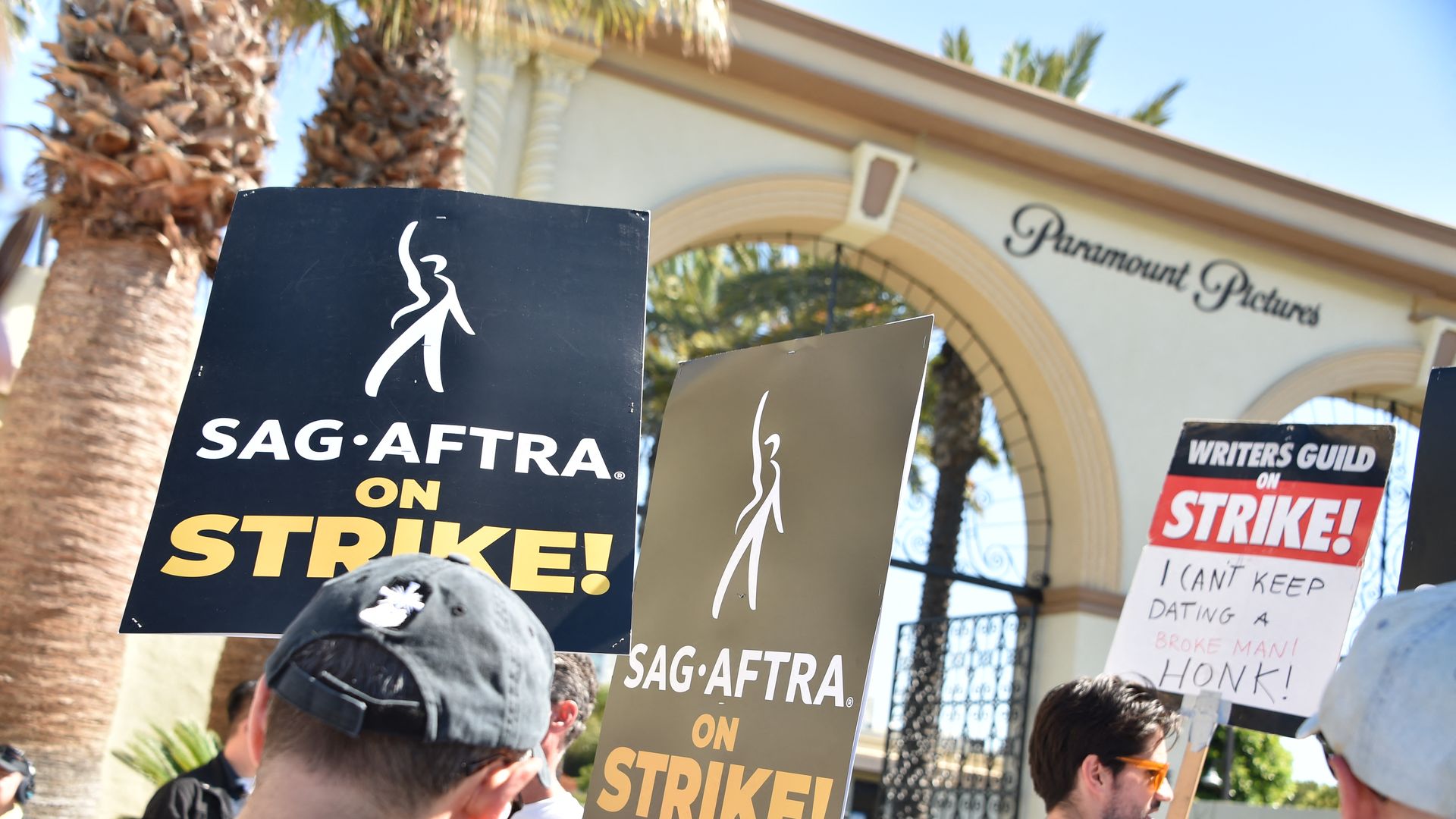
The Hollywood strike that has brought the industry to a halt is about a greater battle for workers' rights amid the rise of generative AI, several actors tell Axios.
What's happening: Actors joined writers on the picket lines last week when negotiations for a new contract between the SAG-AFTRA union that represents 160,000 people and the Alliance of Motion Pictures and Television Producers (AMPTP), which represents the studios, broke down.
The G20 has some notes for member states as they craft rules for the crypto business and, especially, so-called stablecoins.
Driving the news: Final recommendations have come out from the Financial Stability Board (FSB) on crypto, with the aim of harmonizing regulations across the world's largest economies.
Vox Media, the parent company to websites such as New York Magazine, Eater and SB Nation, will no longer use Chorus — its proprietary content management system — to power its own websites, sources told Axios.
Why it matters: CMS licensing was once seen as a lucrative opportunity for publishers looking to grow revenue beyond ad dollars. But WordPress' continued dominance in the space has made it harder to compete.
Retail sales rose 0.2% last month as shoppers upped spending on e-commerce platforms and at home furniture stores and electronics shops, the federal government said Tuesday.
Why it matters: Consumer spending — the bedrock of the U.S. economy — is still solid. Americans continue to open their wallets, though at a more measured pace, as inflation pressures continue.
Hundreds of local broadcast stations have come together to create a new advocacy coalition that will urge the Federal Communications Commission to take action on a regulatory loophole that they say imperils their ability to get distributed on streaming services.
Why it matters: As more Americans ditch their traditional cable and satellite packages for digital alternatives, local broadcasters worry their newscasts will be left out.
OpenAI, the parent company to ChatGPT, on Tuesday said it reached a two-year deal with the American Journalism Project (AJP) to help fund efforts by local outlets to experiment with artificial intelligence technology.
Why it matters: It's part of a larger effort by OpenAI to work with journalism companies on news and tech-sharing agreements.
Movie theater operators are the businesses most at risk from a protracted writers' and actors' strike, Moody's Investors Service concludes in a note out Monday.
Why it matters: Theaters rely on new releases, more so than TV networks or streamers do. If the strikes go on much longer, the pipeline of fresh content may run dry.
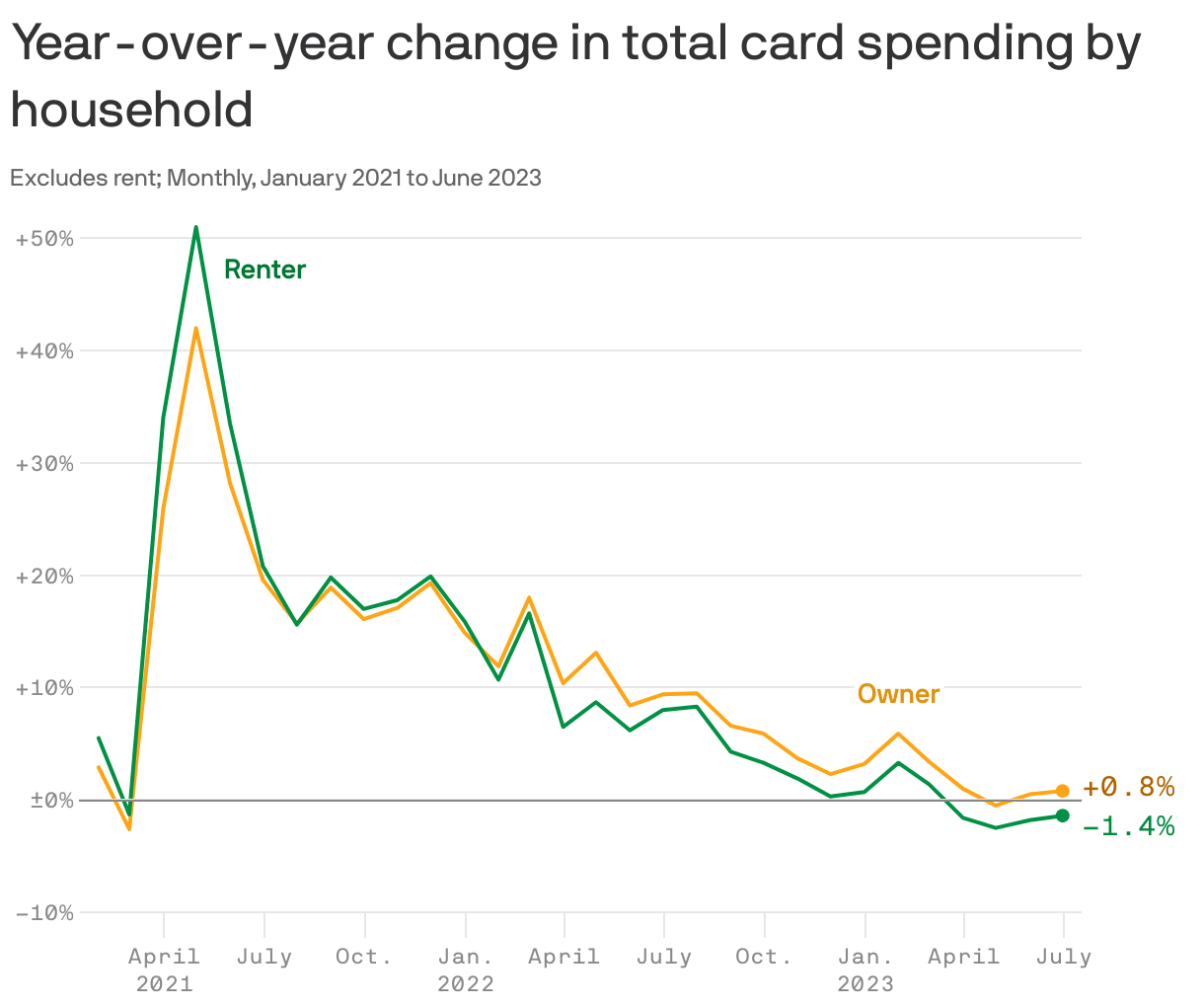
Reproduced from Bank of America Institute; Chart: Axios Visuals
Years of staggering rent inflation are taking a toll: Renters are pulling back their spending on non-rent stuff.
What's happening: Spending growth among renters and homeowners used to largely move together. But starting in early 2022, a gap emerged — renters' spending growth started lagging that of owners, per Bank of America's internal card spending data.
Following a brutal sell-off in the first half of 2022, Netflix has managed to claw its way back into investors' hearts, but its streaming peers face major challenges during Q2 earnings season, which kicks off this week.
Why it matters: Disney, Warner Bros. Discovery, Paramount and Comcast promised investors that their budding streaming services would be profitable beginning in 2024. Now that the clock is ticking, reality is starting to set in.















/2023/07/17/1689627555716.gif?w=3840)