Tuesday's politics & policy stories

Trump sets sights on Mars
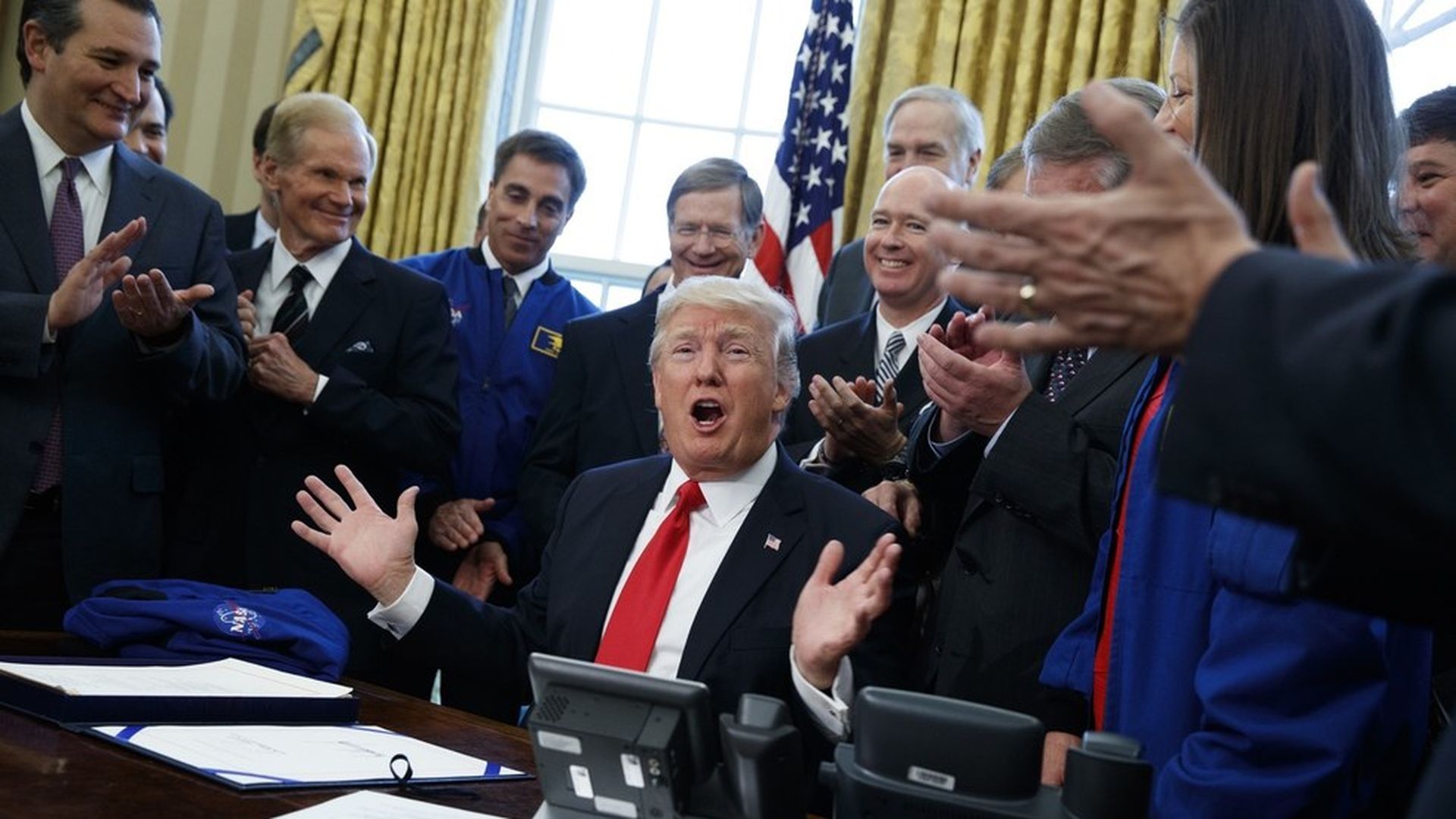
In the Oval Office today, President Trump signed a bill authorizing nearly $20 billion in funding for NASA, and making a a manned mission to Mars an official NASA objective. That mission is scheduled for 2033.
"Good. I love that," Trump said in response to Florida Sen. Bill Nelson's pronouncement that "we're going to Mars."
And Texas Rep. John Culberson took one giant leap for Trump: "With your bill signing today and your vision and leadership, future generations will remember that President Donald Trump was the father of the interplanetary highway system."

The takeaways from Spicer's Tuesday briefing
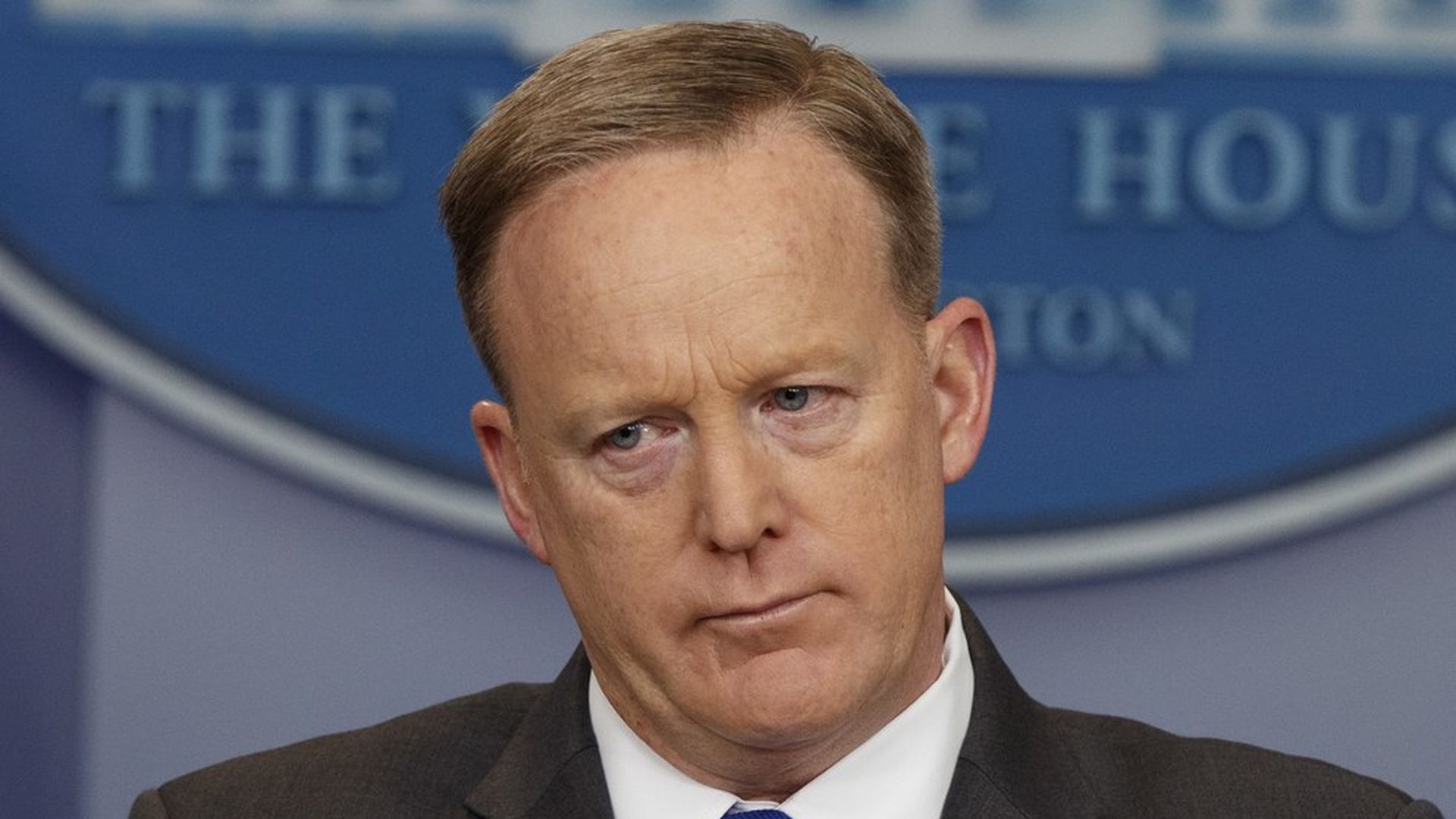
Spicer kicked off today's briefing with a strong defense of the GOP's new healthcare bill, noting that he hopes Thursday's vote will help make this "the last anniversary" of the Obamacare law. Spicer also stated that Trump walked away from his meeting on Capitol Hill this morning feeling "optimistic" about the vote. Other takeaways:
- Republican vote on new healthcare bill: "We're going to make sure we remember those that stood by us," said Spicer. As for those that vote against it? "I think they'll pay a price at home."
- Ban on large electronics on some foreign airlines: The move was in response to "elevated intelligence" that indicates a continued threat from terrorists.
- Will Trump address his wiretap claims, as he said he would? "Let's see how the week goes."
UK follows US, bans electronics on some foreign flights
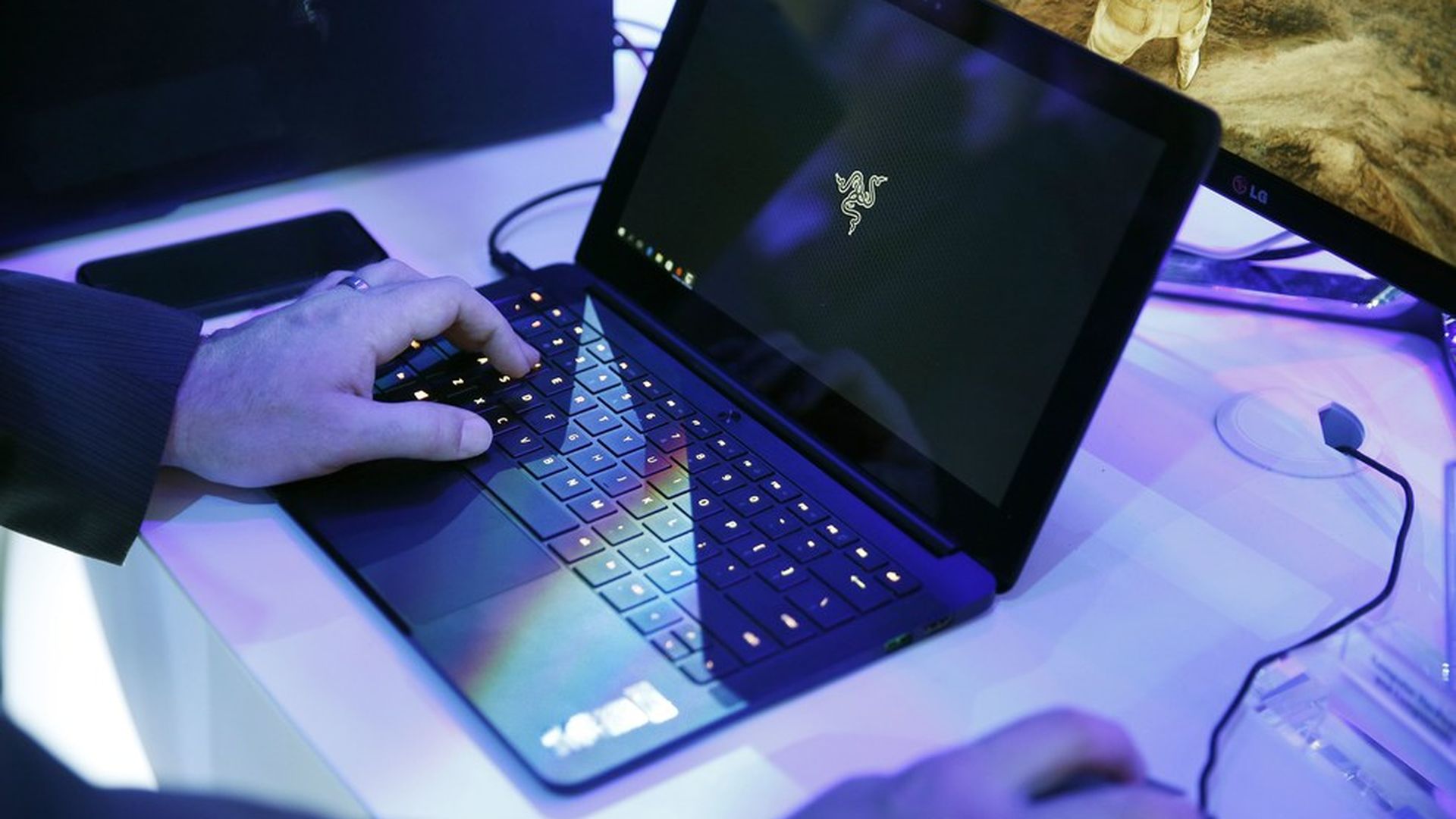
The U.K. has followed the U.S. and is barring passengers traveling on flights from some Middle Eastern countries from bringing large electronics — such as laptops, tablets and other portable devices — onto the plane, reports Sky News. Security sources told Sky that the move is not a reaction to a specific intelligence attack, but rather a response to the ongoing general threat to aviation.
The U.S. issued a similar ban this morning, which imposes these restrictions on flights from 10 airports in 8 majority-Muslim countries. The exact details of the U.K. ban have yet to been made public, so they may not exactly mirror the U.S. restrictions.


Trump singled out House Republican on Obamacare replacement
President Trump singled out House Freedom Caucus Chair Mark Meadows (R-NC) by name in a Capitol Hill meeting with House Republicans today, according to a source in the room.
Trump asked Meadows to stand and then talked about how Meadows supported his campaign early, adding he expects Meadows to support the Republican Obamacare replacement bill in the end. Trump said, according to our source:
"Mark, I'm gonna come after you." — Trump to Meadows, while smiling and winking
In a press gaggle after the meeting, Rep. Bill Flores (R-TX) said Trump was "half joking" in his comments. When Meadows emerged from the meeting, he said he was still a "no" on the bill, adding that he didn't anticipate any Freedom Caucus members would change their vote.
This post has been updated to clarify an editing error saying the meeting was at the White House. It was on Capitol Hill.
Large electronic devices banned from some flights to U.S.
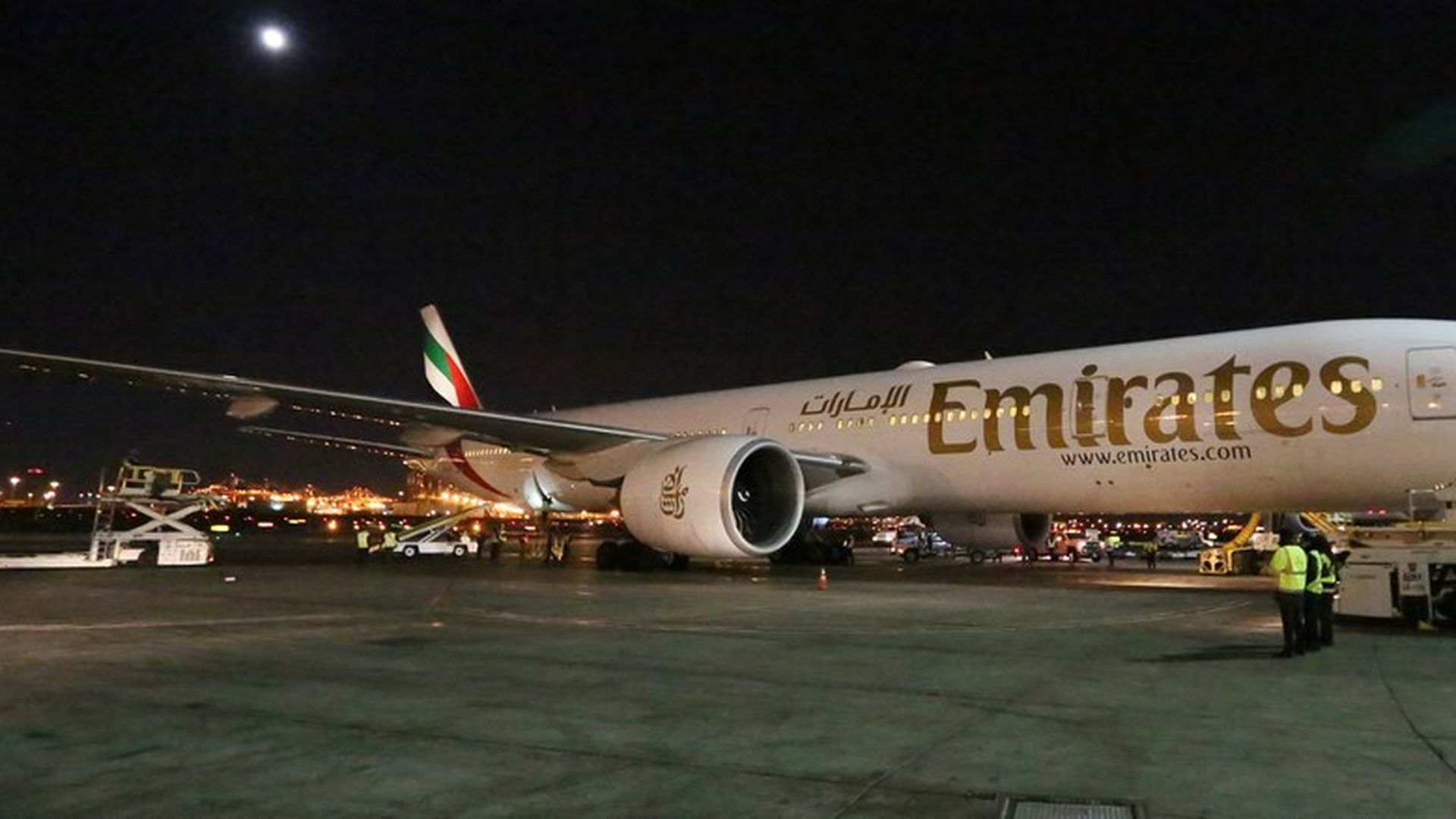
Passengers on foreign airlines headed to the U.S. from 10 airports in eight majority-Muslim countries will have to check electronic devices larger than a cell phone — including laptops, tablets, cameras, travel printers — under new Homeland Security flight restrictions that took effect this morning, per the N.Y. Times.
An unnamed U.S. official told CNN the ban was related to al Qaeda in the Arabian Peninsula and that some information came from the recent U.S. special forces raid in Yemen.
The list of airports affected: Amman, Jordan; Cairo; Istanbul; Jeddah and Riyadh in Saudi Arabia; Kuwait City; Casablanca, Morocco; Doha, Qatar; and Dubai and Abu Dhabi in the United Arab Emirates.

Trump insiders fear long, lawyerly fight under the "big gray cloud"
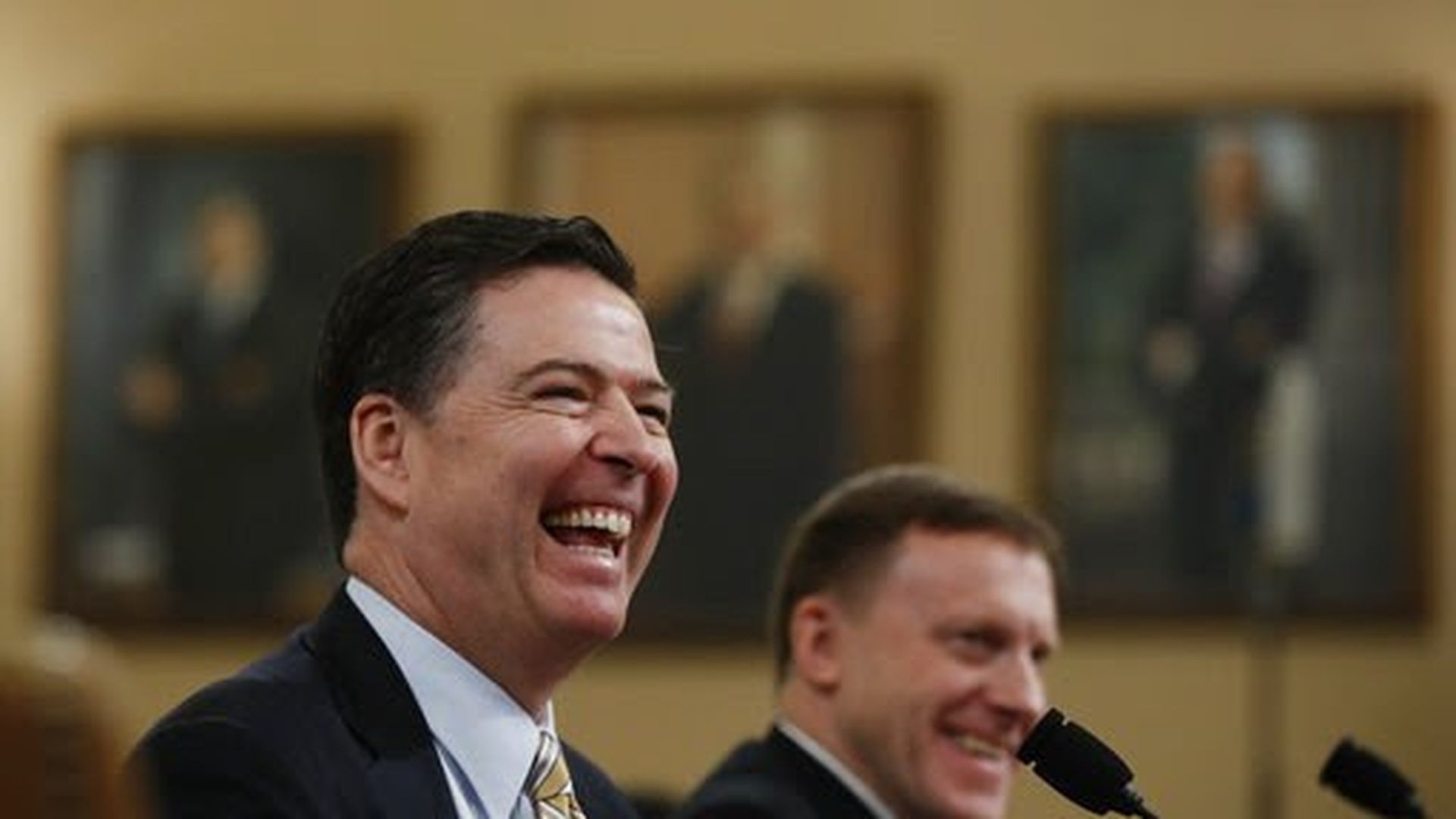
Republicans already thought the day couldn't have gone worse. As David Leonhardt begins his column in today's paper, "All the President's Lies": "The ninth week of Donald Trump's presidency began with the F.B.I. director calling him a liar."
And then a final exchange, ending FBI Director Jim Comey's astonishing five hours of testimony, was considered by insiders to be the most devastating of all, making Trump advisers fear West Wingers will have to lawyer up — and face distractions, legal bills and paranoia.

Kellyanne Conway wrote about "America First" in 2014
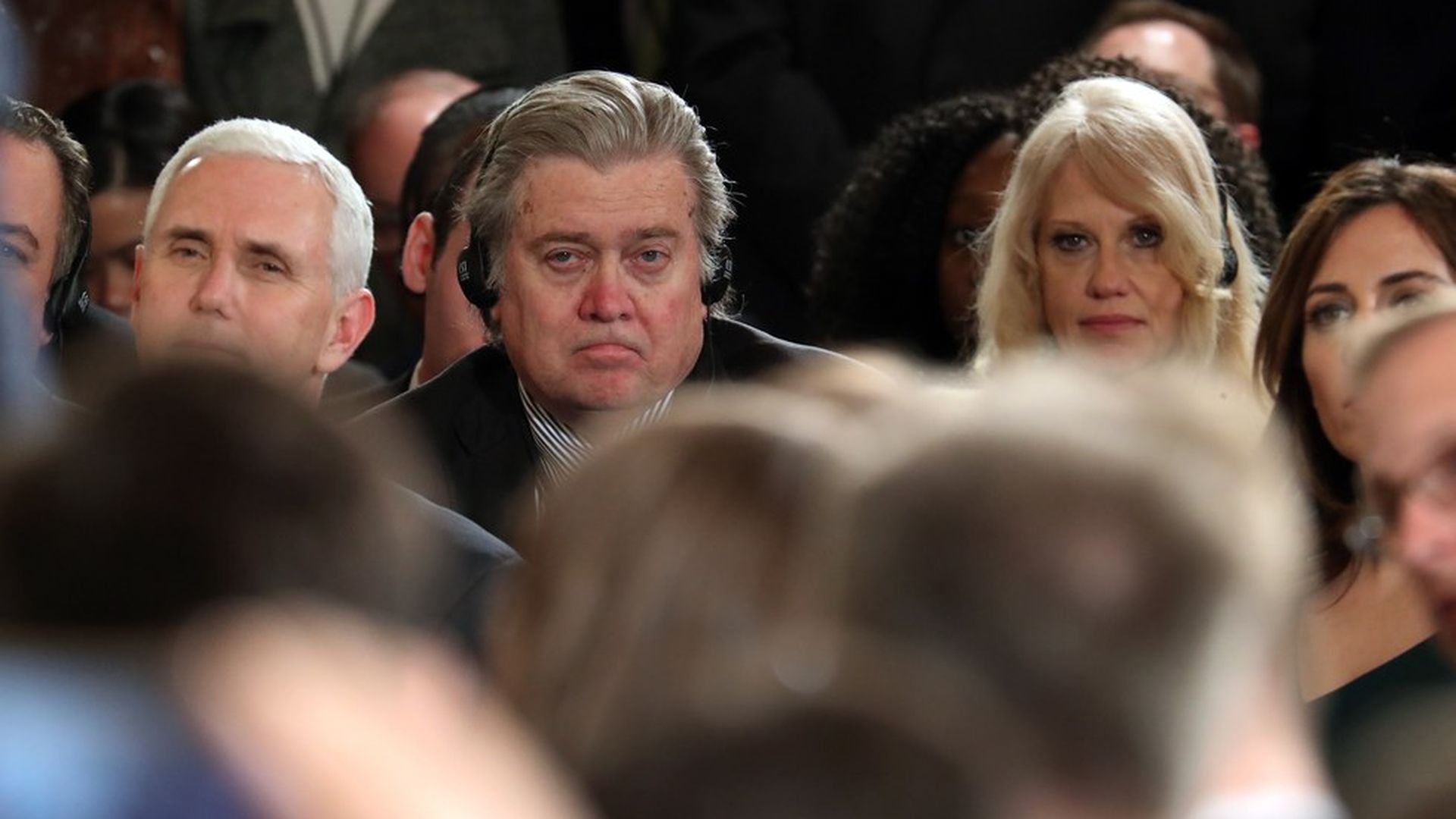
Kellyanne Conway wrote in 2014 that immigration should be about "America First," and about "fairness … to blue-collar workers," according to The Atlantic's piece on her role in Trump's election victory. Sound familiar?
The path to Trump:
- The poll wasn't widely circulated and only appeared on Breitbart — Steve Bannon, who was the Breitbart's CEO at the time, took notice. Bannon had been considering how to bring the "missing white voters" into elections.
- In August 2015 Trump issued a policy paper that had an apparent Conway and Bannon influence:
The conversation before was, 'What is fair to the illegal immigrant?' Are you ripping families apart? Should the DACA kids stay? Should they have driver's licenses? … Now, the conversation is also, 'What's fair to the American worker?' What's fair to the local economy? What's fair to law enforcement? What is fair all the way around?
Ivanka Trump moving to the West Wing
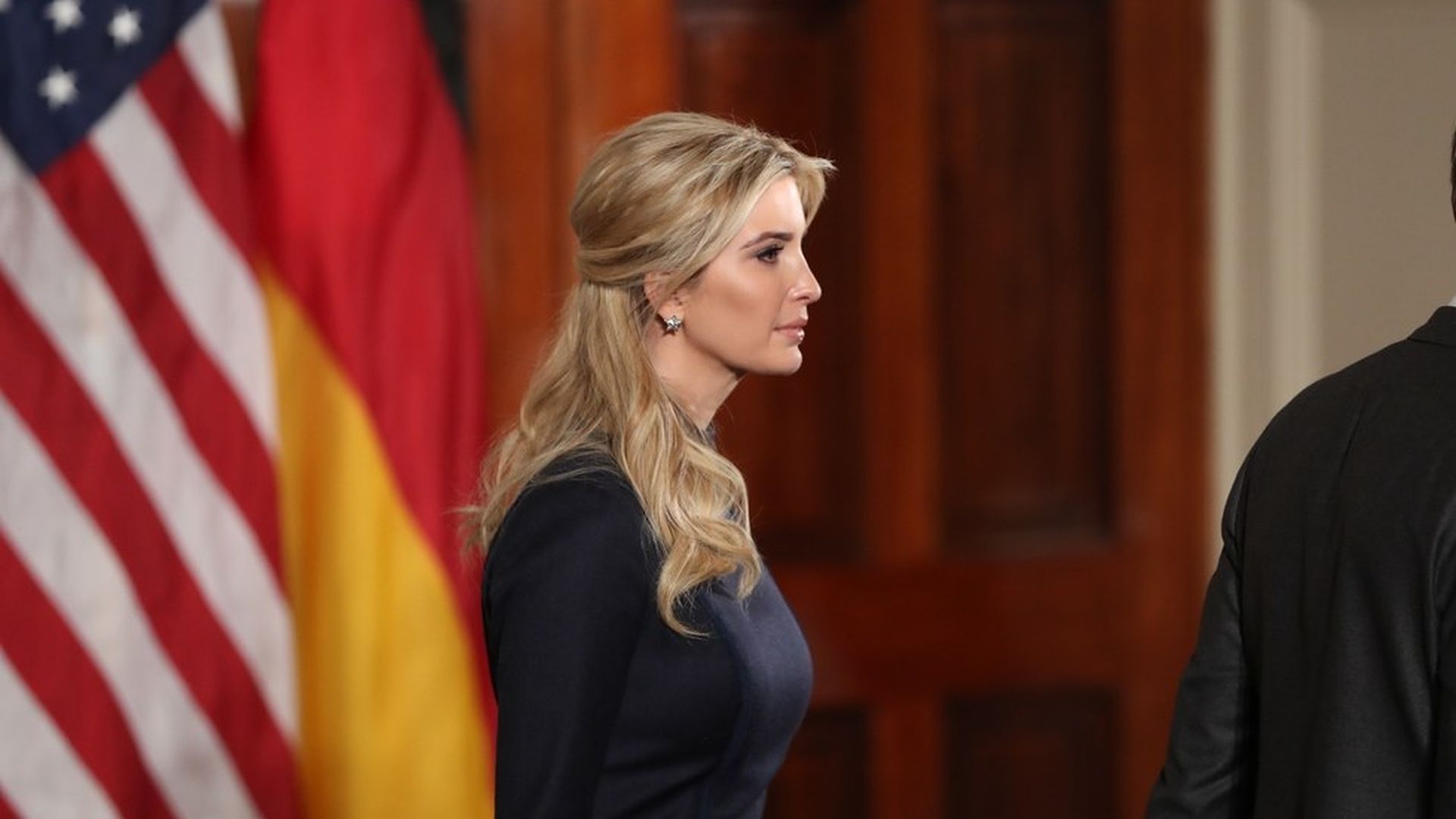
Ivanka Trump is moving into an office on the second floor of the West Wing this week in a move that she admits has "no modern precedent," per Politico. According to her attorney, she'll be serving as her father's "eyes and ears" for a broad range of issues.
What she won't have: An official job title — though she reportedly plans to adhere to the same ethics rules as other West Wing employees.
What she will have: A security clearance, a government-issued phone, and swirling questions about potential conflicts of interest, though she has divested her Ivanka Trump brand into a trust.
The real Gorsuch fireworks are coming tomorrow
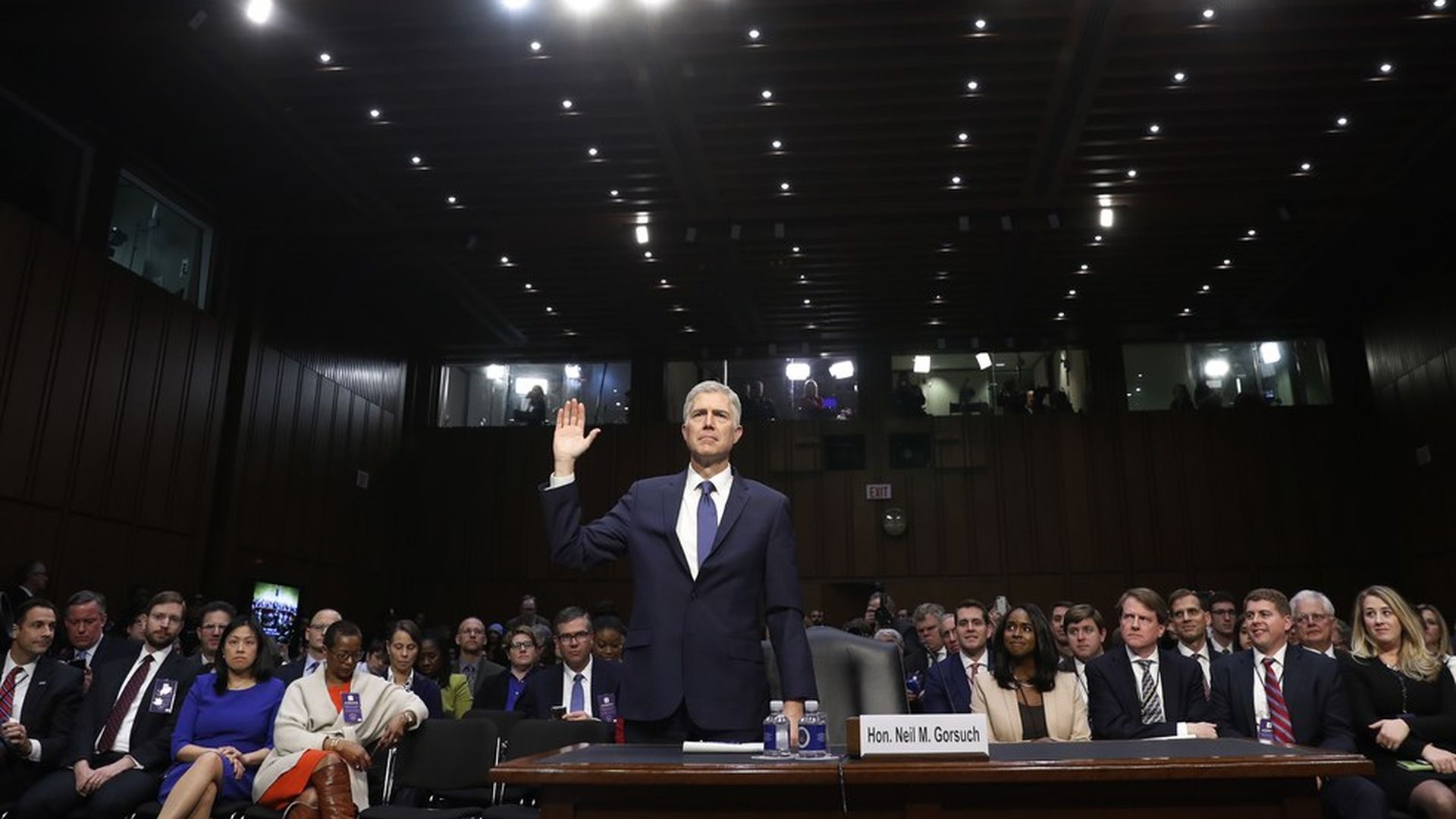
Judge Neil Gorsuch appeared before the Senate Judiciary Committee today to kickoff his hearing as Trump' Supreme Court nominee to fill the vacant seat of the late Justice Antonin Scalia.
Senators and Gorsuch gave opening statements today. Tomorrow's question and answer session will begin at 9:30AM, with half an hour allotted for each senator to ask questions.

The ongoing love/hate relationship between Trump and Comey
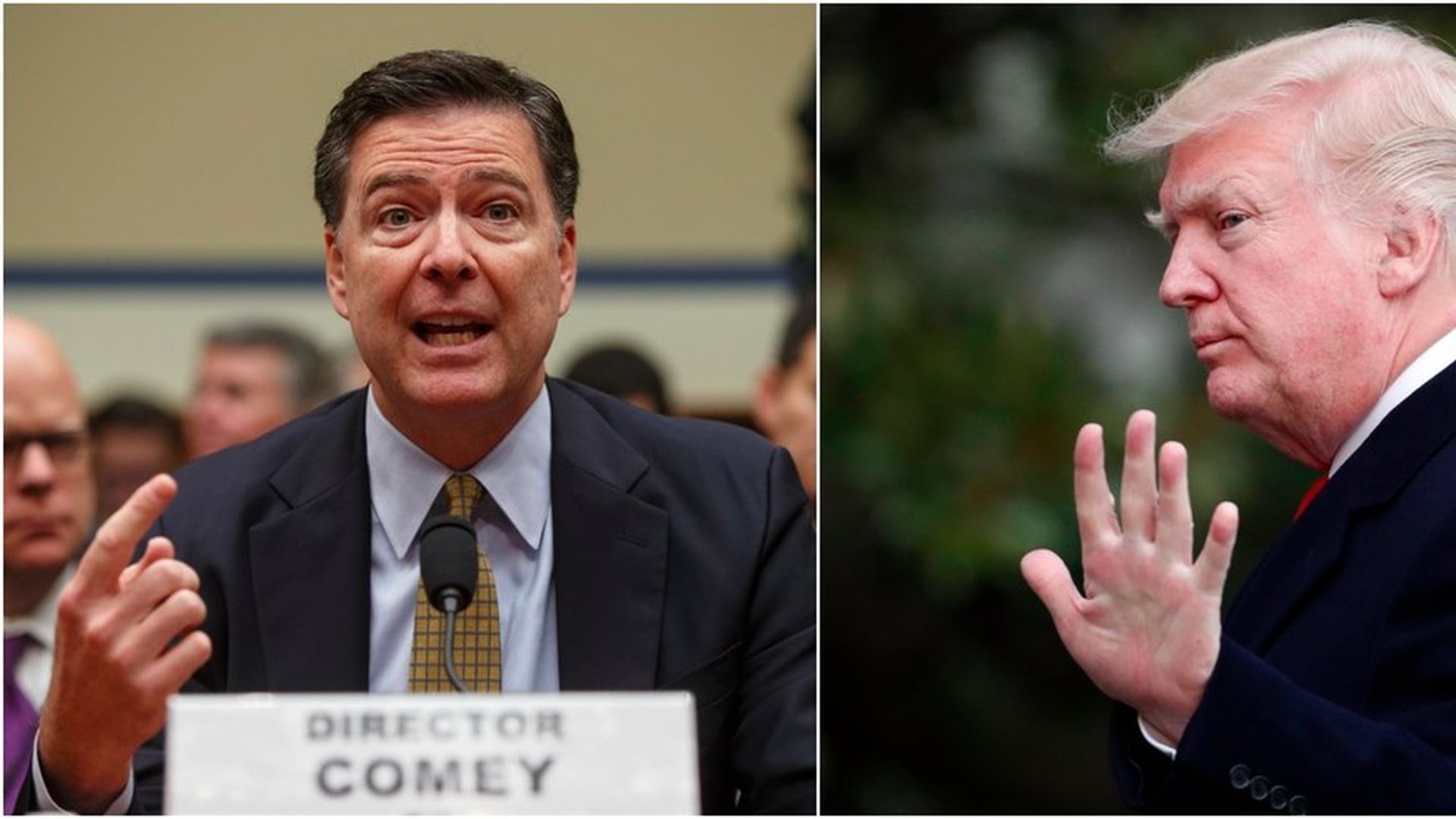
First he was accused of causing Hillary's loss in November, and now FBI Director James Comey has the power to do serious damage to Trump's presidency with an investigation into Trump-Russia contacts. As Comey went back and forth on Hillary's email scandal, Trump went back and forth on his feelings for Comey. Below is a timeline of their relationship, from early July until today:
Roger Stone says alleged Russia links 'manufactured by US intelligence'
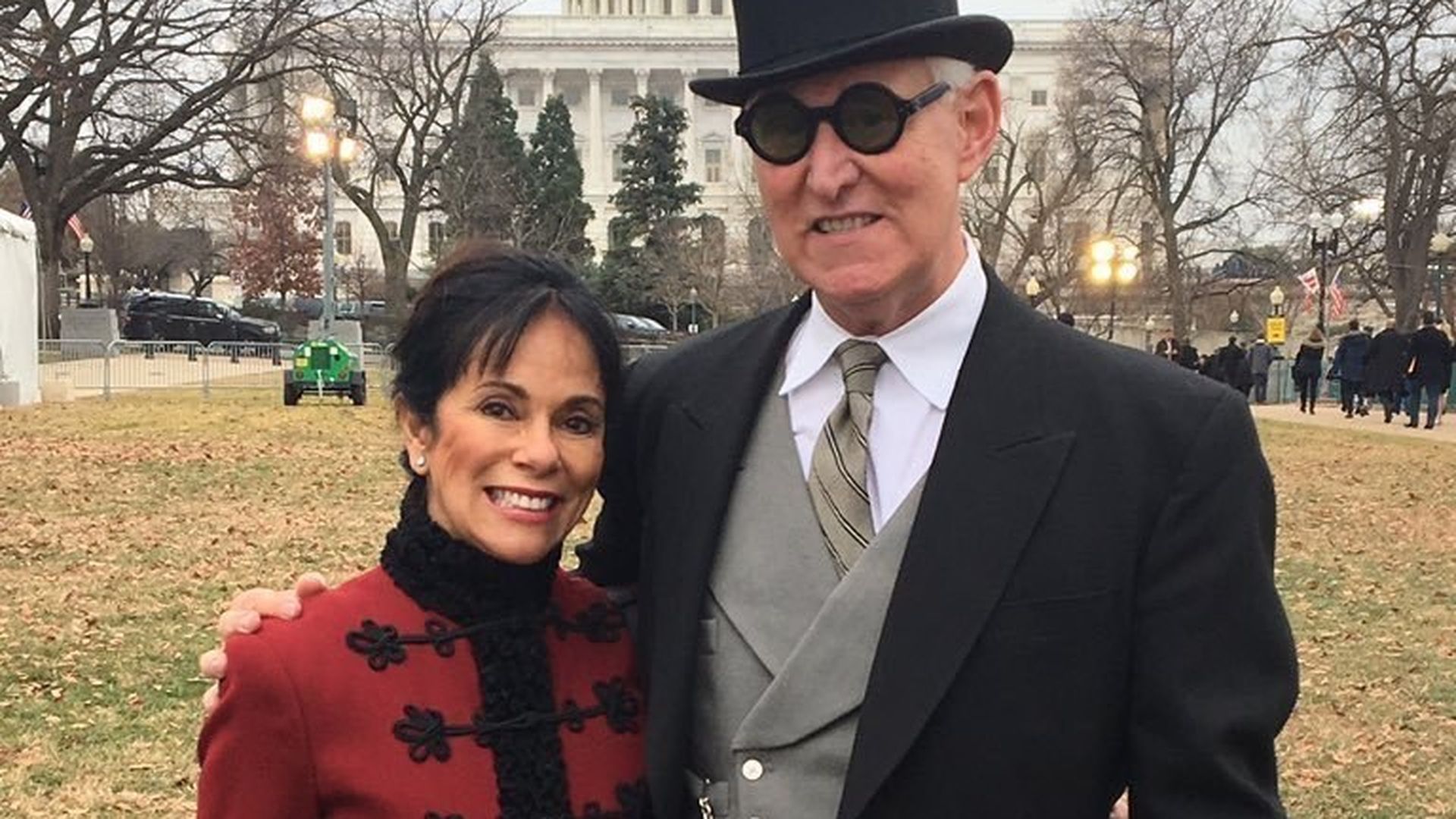
Trump surrogate Roger Stone's contacts with DNC hacker Guccifer 2.0 — now believed to be a Russian intelligence front — were the subject of a long line of questioning during today's House Intel Committee hearing with FBI Director James Comey. Stone called those questions "fear mongering" and "the new McCarthyism" during a SiriusXM interview this afternoon, per CNN:
"This one has been manufactured by the intelligence service with an assist from [George] Soros and [David] Brock."
NSA director openly says Trump complicating U.S. alliances
A stunning moment in today's House Intelligence hearing — the director of the National Security Agency, Admiral Michael Rogers, acknowledged on live television that President Trump's loose talk has complicated relationships with Britain and Germany.
- On Britain: Rogers was asked about Trump's repetition of an unsubstantiated claim that Britain's top spy agency wiretapped Trump on behalf of President Obama. Rogers gave a forceful "no," said he agreed with the British that the claims were nonsense, and acknowledged that Trump's allegation was unhelpful and "clearly frustrates a key ally of ours."
- On Germany: Rogers was asked about Trump's suggestion to German Chancellor Angela Merkel last week that they both had something in common because they'd been wiretapped by Obama. Rogers said it was unhelpful for Trump to raise this controversial incident, which became public due to leaks by Edward Snowden. "It certainly complicates things," Rogers said.
Why this matters: Germany and Britain are two of America's key allies, with foundational shared interests and intimate national security relationships. Britain belongs to the "Five Eyes" — the crucial intelligence alliance with Australia, Canada, and New Zealand. These relationships — as Rogers acknowledged today — are incredibly resilient and will withstand these presidential hiccups. But for an NSA director to publicly state that the President is straining key relationships...that's extraordinary.
The highlights from Spicer's Monday briefing
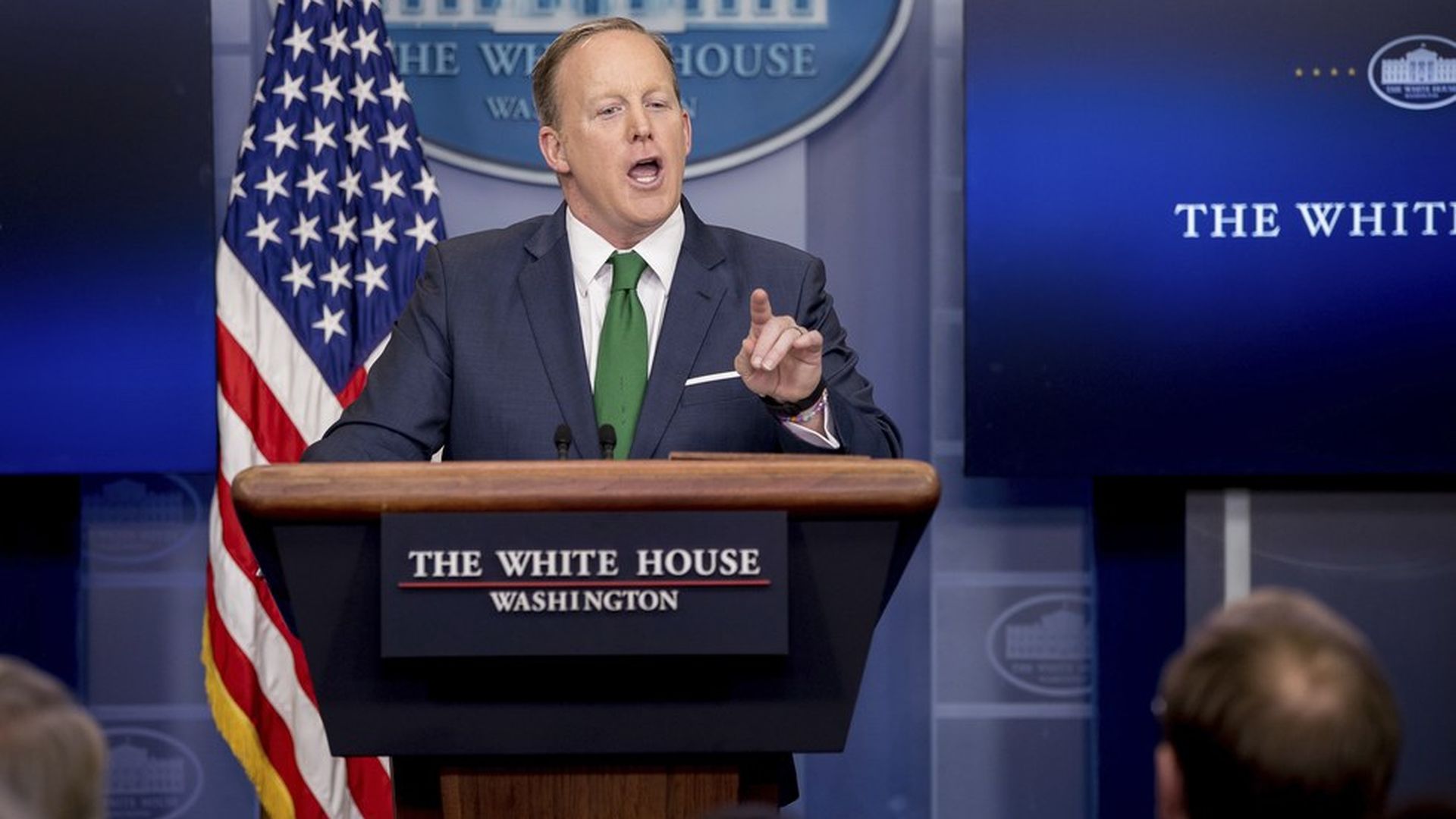
Spicer's briefing comes amid a host of other big events taking place today, including the House Intelligence Committee hearing on Russia's election meddling, as well as Supreme Court nominee Neil Gorsuch's confirmation hearing. The highlights:

Everything we learned at today's House hearing on Russia
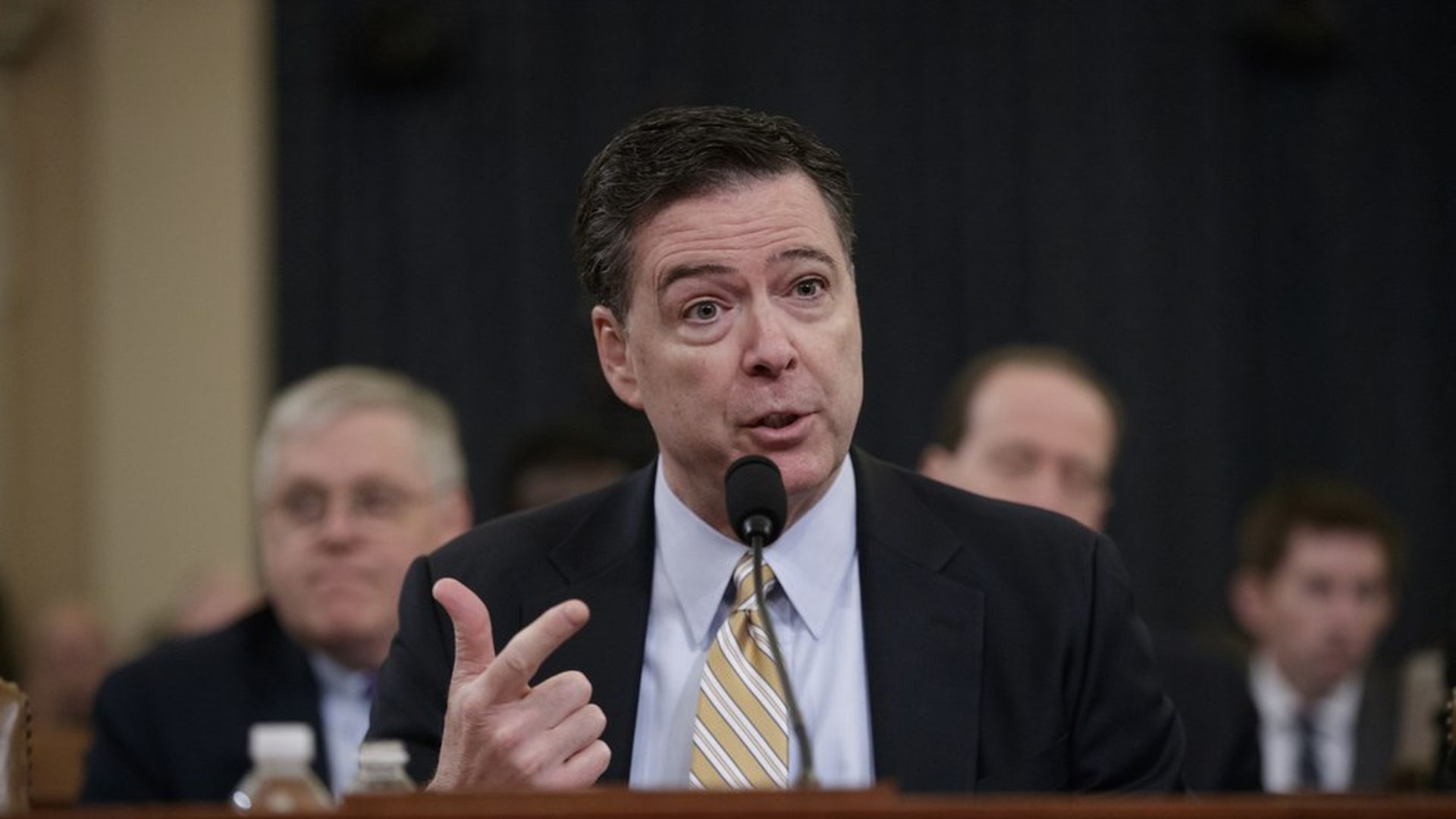
The key takeaways from the House Intelligence hearing with FBI Director Comey and NSA Director Rogers:
- Comey confirmed the FBI is investigating potential links between the Trump campaign and the Russian government. The investigation started in late July.
- FBI has "looked carefully" and found no evidence to support Trump's claim he was bugged by the Obama administration.
- Comey said there has been an "unusually active" stream of classified information leaking in recent weeks.
- He added that some media reports based on supposed leaks are "dead wrong" but that FBI does not correct them.
- No evidence that Russia altered vote tallies through its interference.
- US intelligence expects Russian interference in "2020, maybe 2018" elections to undermine US democracy.
- Russia hacked both parties, but only the Democratic emails were leaked.
5 important strikes against Trump's wiretapping tweets
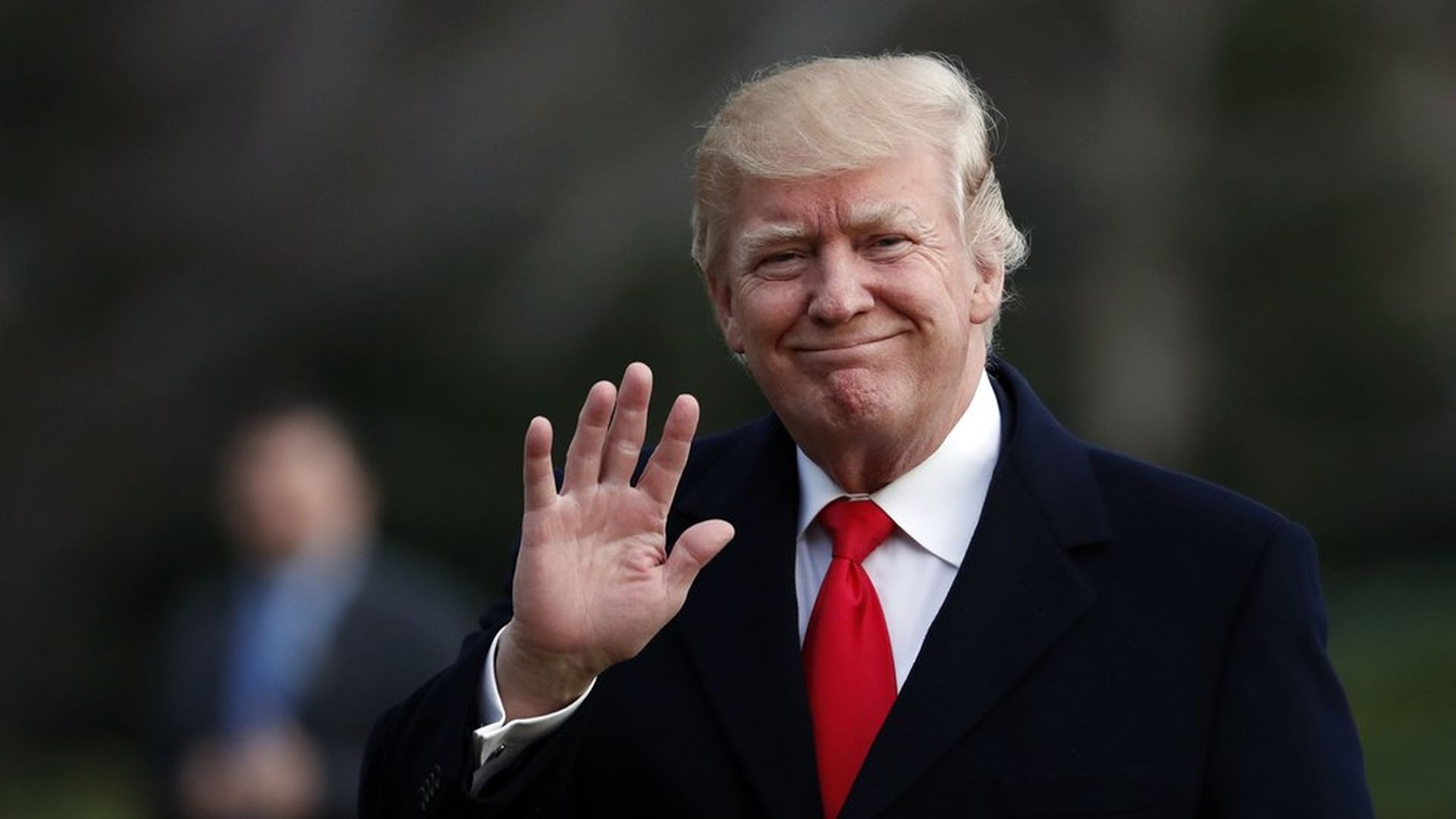
- FBI Director James Comey: "I have no information that supports those tweets," he said, referring to Trump's tweets accusing Obama of having his wires tapped.
- Admiral Mike Rogers: "I have seen nothing at the NSA that we engaged in such activity," he said at the House Intelligence Committee's hearing.
- House Intelligence Committee: "Was there a physical wiretap of Trump Tower? No, there never was," committee chair Devin Nunes (R) said on Fox on Sunday.
- Senate Intelligence Committee: Chairman Richard Burr (R)and ranking member Senator Mark Warner (D) released a statement: "Based on the information available to us, we see no indications that Trump Tower was the subject of surveillance by any element of the United States government either before or after Election Day 2016."
- Former DNI James Clapper: "There was no such wire tap activity amounted against [Donald Trump]," he told Meet the Press.
NSA head calls allegations of Brit wiretapping "utterly ridiculous"
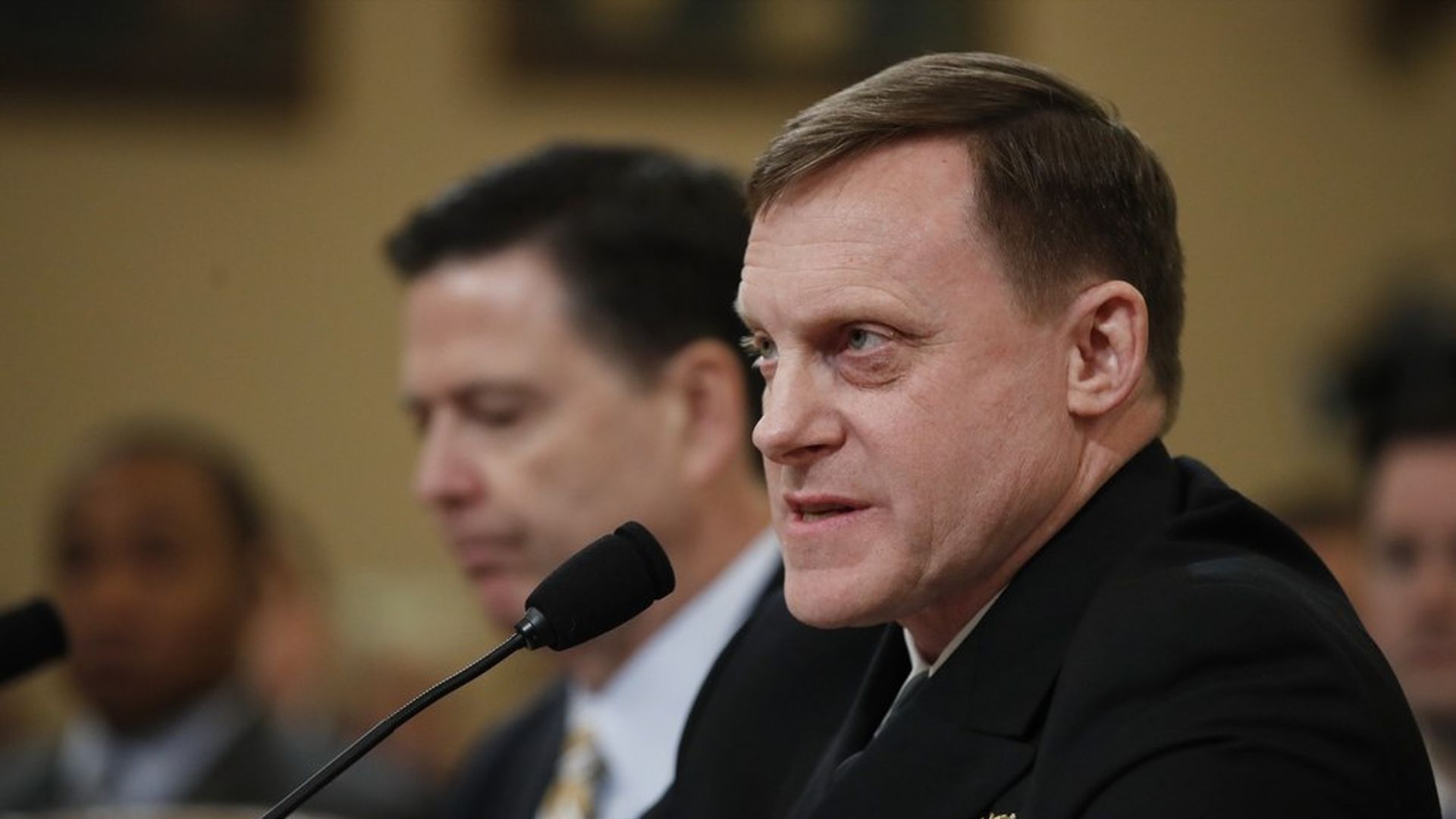
NSA Director Admiral Mike Rogers called allegations of an American request for British surveillance of Trump Tower "utterly ridiculous." He told House Intel Committee that such a request would be "expressly against the construct of the Five Eyes agreement that has been in place for decades."
The special relationship? Rogers: "I think it clearly frustrates a clear ally of ours."
FBI Director: "no information" supports Trump's wiretapping tweets
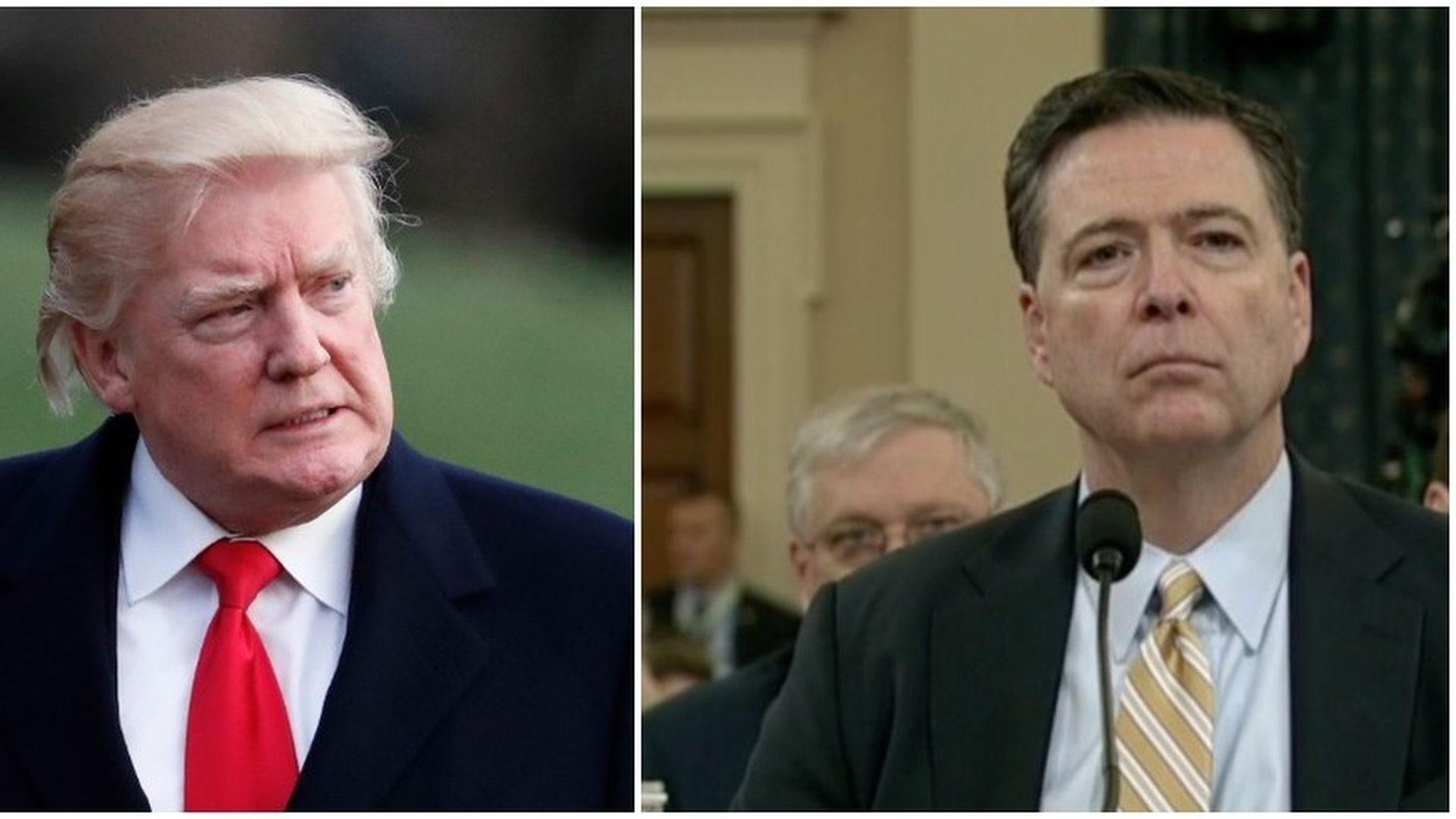
FBI Director James Comey confirmed that both the FBI and Department of Justice have "no information that supports" President Trump's tweets alleging wiretapping of Trump Tower by the Obama administration. NSA Director Admiral Mike Rogers also confirmed that his agency lacks any information that backs up the tweets.
On POTUS' tweeted allegation of "McCarthyism": "I try very hard not to engage in any -isms of any kind."
How to understand Comey at today's hearing
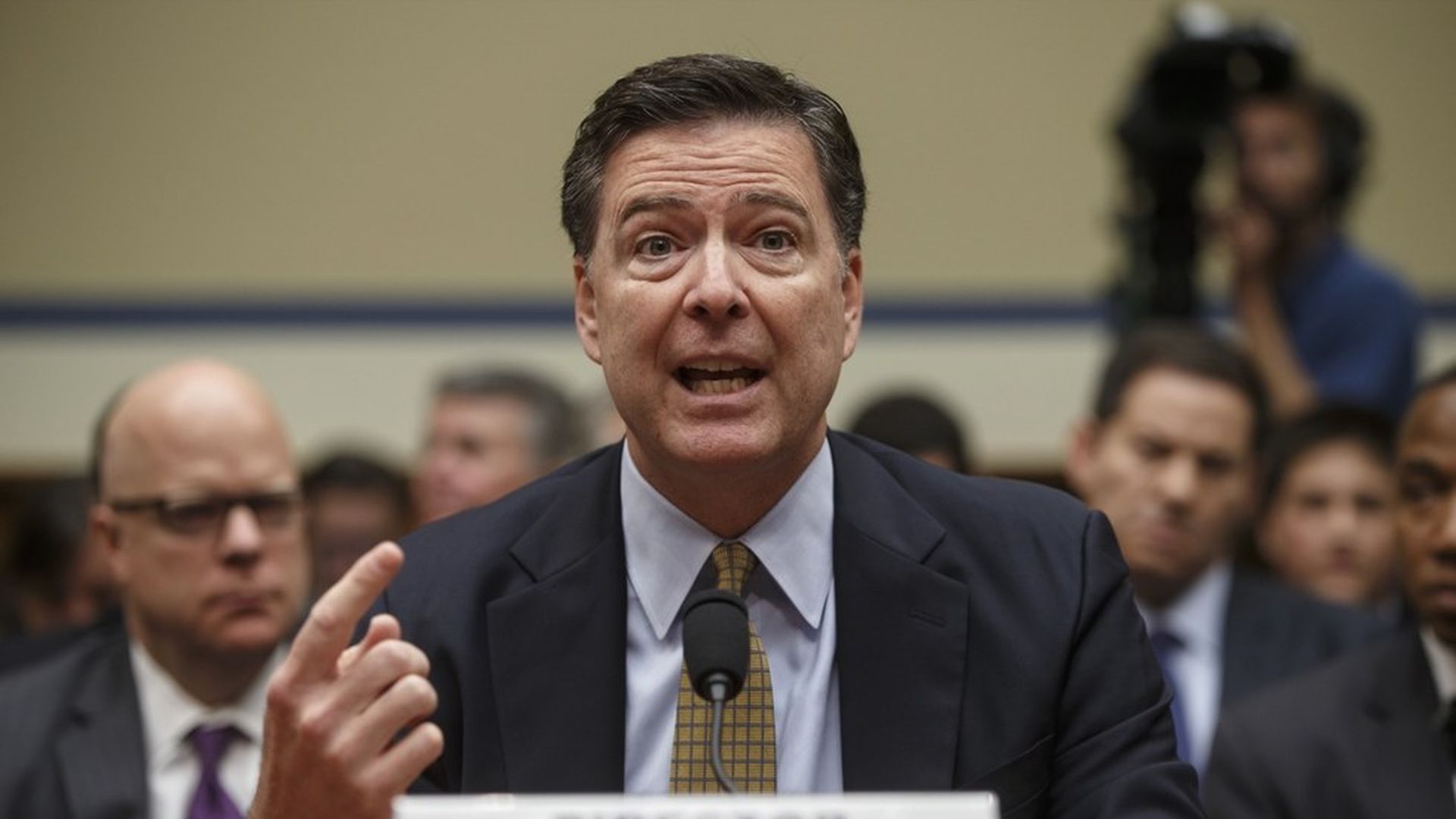
Benjamin Wittes at Lawfare has a simple rule for watching FBI Director James Comey's testimony to the House Intelligence Committee this morning: "Comey's communicativeness…will almost certainly be inversely proportional to the seriousness of the Russia investigation." He lays out three scenarios:
- The Trump/Russia connections are a bust, so there's nothing to lose. Expect a chatty Comey to go all-in on the details of the investigation. It could be firestorm for Trump in the short-term, but indicates there would be no long-term Russia issues for POTUS.
- The Russia investigation is still ongoing but not fruitful, so Comey would likely stick to a just-the-facts presentation — communicative on wiretapping, mum on Russia.
- Russia is major, so Comey needs to protect the investigation. If he attempts not to make news and leaves a lot of liberal pundits disappointed, this could actually be a worst-case scenario for Trump in the long run.

If you really want more broadband, cut taxes
If you want more of something, tax it less. And if you want less of it, tax it more.
That obvious formula explains why we offer lower capital gains taxes to encourage entrepreneurship and higher "sin" taxes to discourage smoking. The same goes for regulation.
Yet too many policy makers seem to forget this cardinal rule when it comes to broadband policy. A shocking number of self-proclaimed broadband boosters urge policy makers to heavily tax the companies investing in the infrastructure; regulate them as if they were common carrier monopolies rather than the competitive players they are; and then subsidize consumers who cannot afford broadband services whose prices have been inflated by all the taxes and regulation.
The White House looks for a trifecta
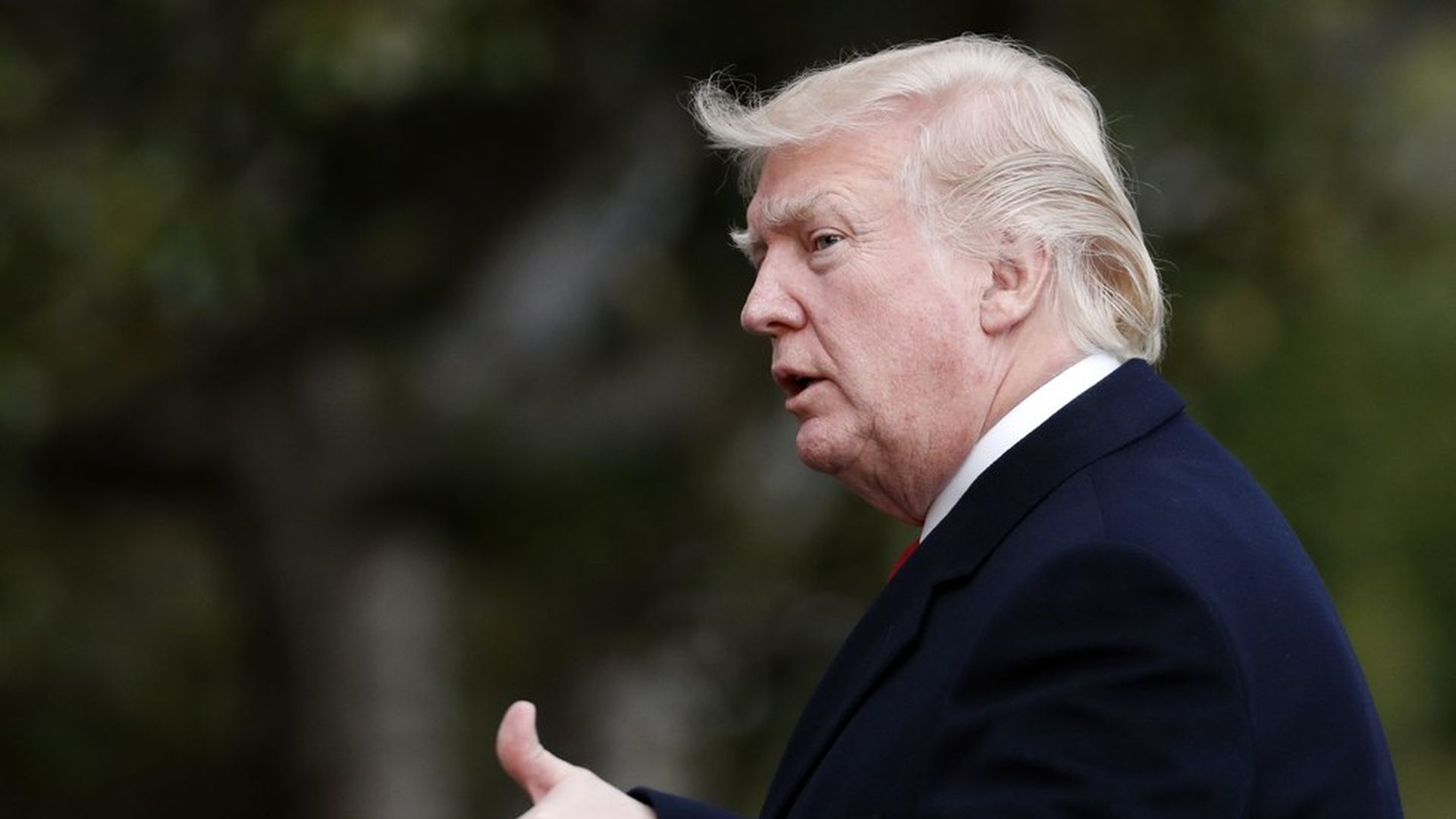
It's the first day of spring, and the White House hopes that a trifecta this week of trade, health care and the Supreme Court will be the start of a points-on-the-board phase — after a spate of tempests that helped push Trump's Gallup approval rating to a low of 37%, down 8 points from the week before:
- White House officials tell me that Commerce Secretary Wilbur Ross met with President Trump at Mar-a-Lago this weekend to walk POTUS through an aggressive trade agenda for the coming weeks, including five executive orders that are slated to begin rolling out this week.
- Thursday night is the epic House vote on health care. The votes aren't there yet, but a Republican lobbyist tells me Speaker Ryan had to be The Gambler: "It was either call the hand, or fold."
- And today at 11 a.m. is the start of an expected four days of Senate Judiciary Committee confirmation hearing for Judge Neil Gorsuch for the Supreme Court. Opponents admit it was a savvy pick that already looks like a win for the White House.
What it means: Trump has a new runway for showing capacity to lead, govern and cut deals — a chance for the Art of the Donald to prevail over the self-inflicted din. Allies pray that past performance is not an indicator of future outcomes.

Why Trump's coal comeback pledge is such a longshot
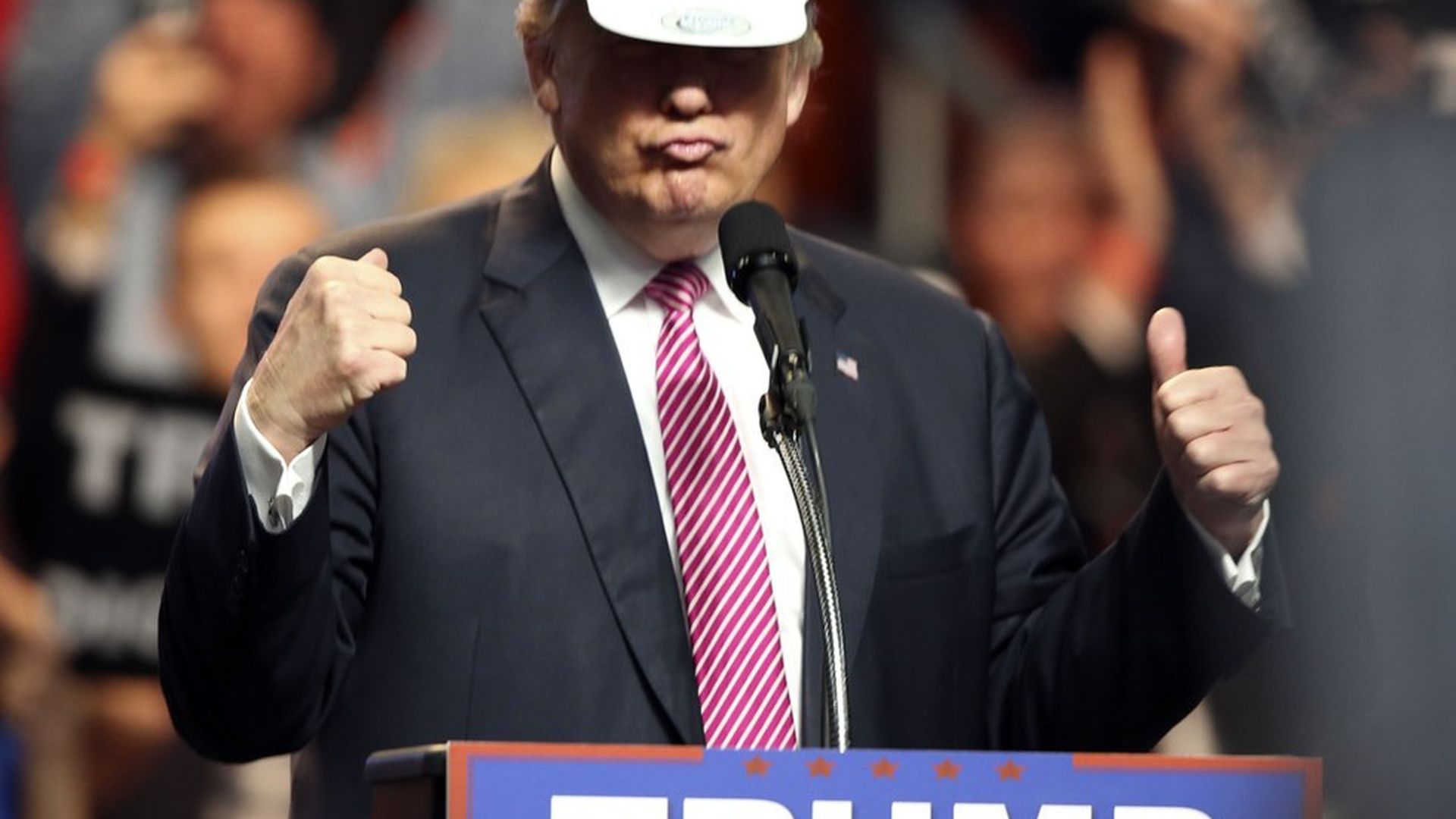
Two stories caught my eye that help explain why Trump's pledge to revive the U.S. coal industry is such a heavy lift. A lengthy piece that fronts Sunday's Washington Post biz section says some good signs—higher prices, a boost in deliveries—probably won't change underlying trends. Why?
- The big open-pit mines where the industry is focused in Wyoming and elsewhere need fewer workers than Appalachian mines.
- Cheap gas, cheap gas, cheap gas from the fracking boom.
- Softer than expected Asian demand.
- Trump has shown "no signs" of backing big federal cash for climate-friendly coal tech.
The Financial Times, meanwhile,
quotes
the International Energy Agency chief predicting that Trump's plans to ease infrastructure permitting could boost U.S. gas exports further, creating a drag on Chinese and Indian coal needs.

Slack CEO Stewart Butterfield: Tech alone can't stop Trump
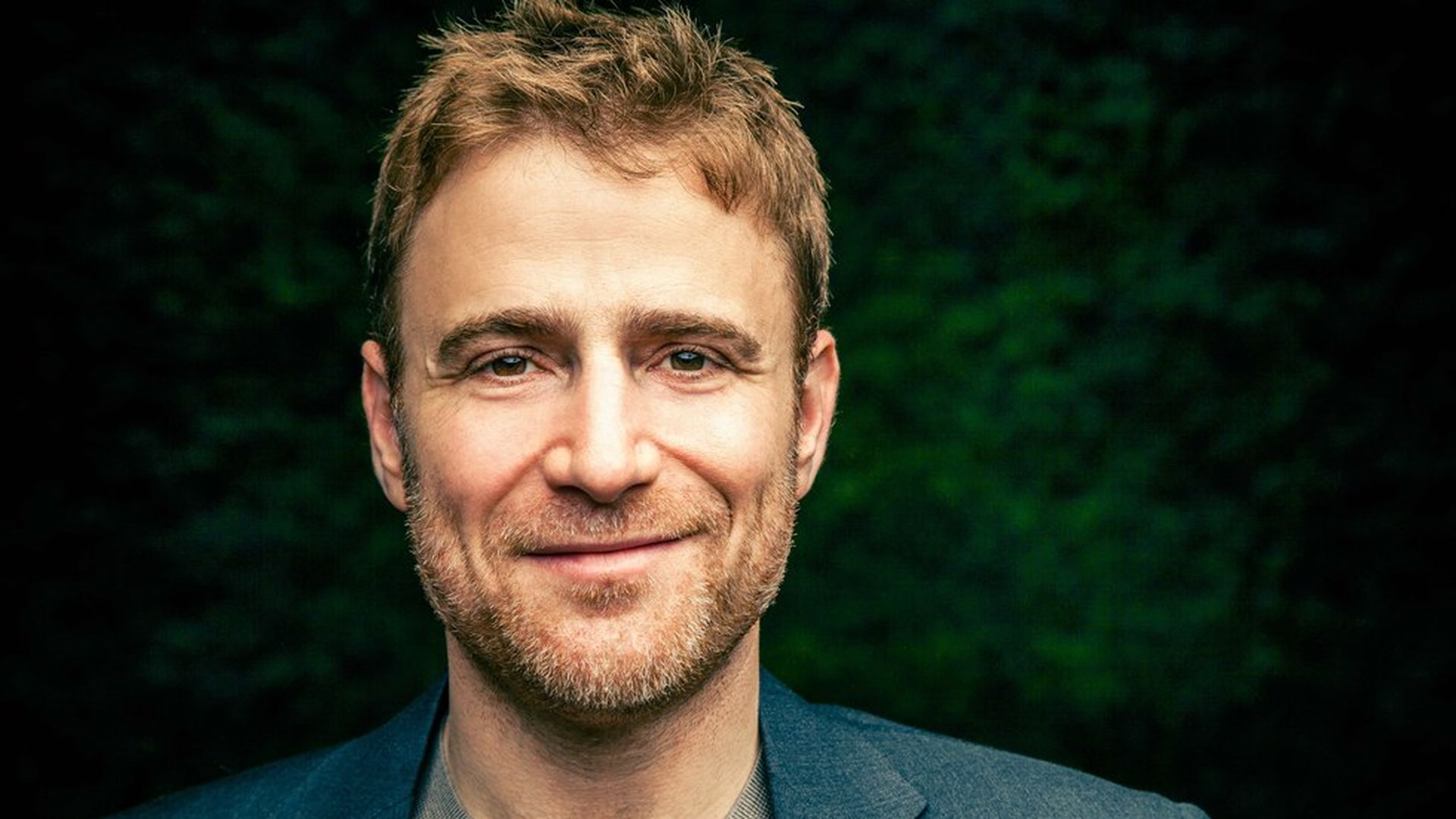
Slack CEO Stewart Butterfield hasn't shied away from a fight with Donald Trump. He joined a recent effort to support Planned Parenthood and Slack has also opposed the Trump Administration on both the travel ban and on transgender rights. But, he said, it's going to take more than the tech industry to fight Trump.
"It's not up to tech to save the world here," he said in an interview. "All industries, all people have to play a role in this."
While fighting Trump may be necessary, Butterfield said that battling the government is "exhausting" and a "big distraction."
Butterfield made several other points about the Trump effect as part of an interview with Axios. Read below for the full comments on the political scene. For his thoughts on Slack, click here