WWE chairman Vince McMahon is a playable character in the latest WWE 2K23 video game, despite controversies that have largely kept him out of the public eye.
Why it matters:McMahon announced last summer he would retire from the WWE shortly after the Wall Street Journal reported that the longtime wrestling promoter had secretly paid off a former employee with whom he allegedly had an affair.
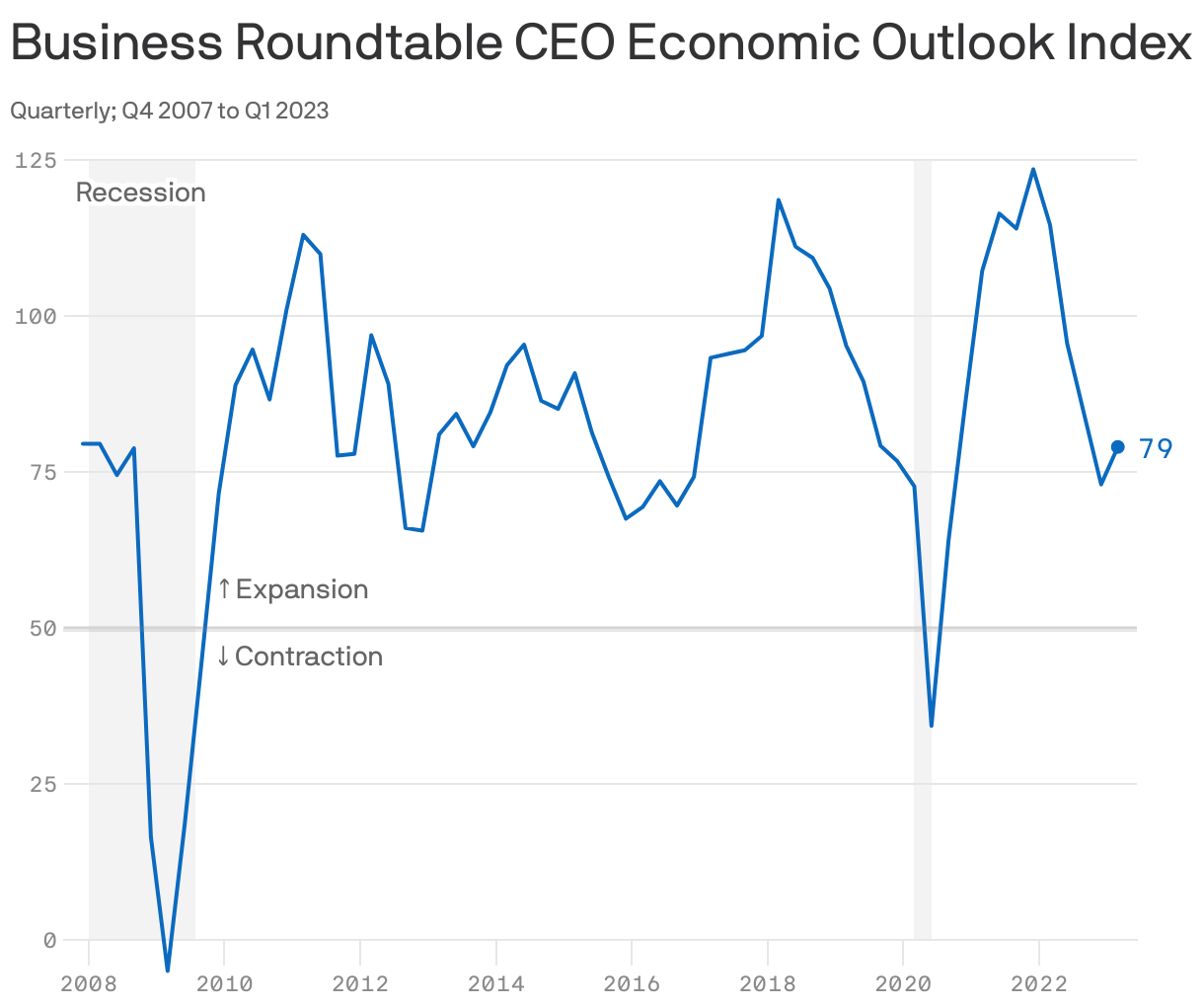
Corporate America started the year slightly more optimistic about the economy, and had plans to hire and spend at rates that would keep growth humming, according to a survey of more than 100 chief executives of America's biggest companies by the Business Roundtable (BRT).
Why it matters: Executives' outlook suggests the U.S. is not plunging into a recession. But it does imply slow growth and wariness around hiring, sales and capital spending.
Credit Suisse, the 167 year-old banking behemoth, is not a domino falling in reaction to bank failures in the U.S. — its troubles are of its own making, and have been cascading for over a decade. Still, its current dire predicament could hardly come at a worse time for the global financial system.
Why it matters: Credit Suisse is one of just 30 global financial institutions designated as being systemically important by the international Financial Stability Board. In other words, it's too big to fail.
Crypto staking is a way of maintaining consensus over bookkeeping systems with thousands of simultaneously updated copies — that is, a blockchain.
Why it matters: A massive amount of value is tied up in staking. On Ethereum alone, 17.6 million ethers (about $30 billion in value, or 14% of ether's total market cap) is staked on the network, guaranteeing its transactions are provably fair.
Consumers pulled back on spending at retail stores last month, after a burst of spending in January that was even stronger than previously estimated.
Driving the news: Shoppers spent less at furniture stores, restaurants and elsewhere, as retail sales fell 0.4% in February, according to data released by the Commerce Department on Wednesday. The figures are not adjusted for inflation.
Most of the finance world is looking to the great financial crisis for parallels to what happened to Silicon Valley Bank, but perhaps a better case study lies back in a time before bank runs went viral on Twitter. Before the internet, when roller rinks, "Flashdance," and big hair were in the air — and people talked on the phone ... We're talking about the 1980s.
The big picture: The savings and loans crisis.From 1980 to 1994, nearly 1,300 of these smaller, home loan-focused banks failed.
The Federal Reserve doesn't just set monetary policy. It's also the primary regulator for many banks — including the failed Silicon Valley Bank. Now, progressives and the banking industry — unlikely bedfellows to be sure — are blaming the Fed for that bank's epic collapse.
Why it matters: Calls for tighter regulation typically follow any kind of big banking crisis, but details matter. With SVB's failure, one question is, was it the laws on the books that failed, or a lapse in their enforcement? The answer, in theory, helps prevent the next crisis.
At most banks, roughly half of all deposits are uninsured. Silicon Valley Bank was not most banks.
By the numbers: At the end of the fourth quarter, a whopping 93.9% of its domestic deposits were uninsured, per an analysis from S&P Global. Signature Bank, which also failed last week, had a similarly high 89.7% ratio of uninsured deposits.
Driving the news: The coalition alleges that the administration approved the project despite knowing the harm posed to Arctic communities, wildlife and climate, and argues that it will spew toxic emissions and greenhouse gas pollution, undermining President Biden's climate promises.
Both parties are drawing battle linesover the collapses of Silicon Valley Bank and Signature Bank, while acknowledging regulatory reform faces a steep — if not impossible — climb in Congress.
Why it matters: Democrats are preparing to introduce legislation that would reverse a GOP-led rollback of Dodd-Frank banking regulations in 2018 that many of them, including President Biden, see as a culprit for the bank failures.
Bally Sports owner Diamond Sports Group filed for Chapter 11 bankruptcy protection on Tuesday.
Why it matters: How Diamond emerges — or doesn't — from this process will be viewed as a bellwether for the increasingly dire future of regional sports networks.