Tesla CEO Elon Musk announced at a shareholder meeting Thursday that the Tesla headquarters will move from Palo Alto, California, to Austin, Texas.
Why it matters: Tesla isn't the first tech company to leave California. Oracle and Hewlett-Packard Enterprise moved their headquarters from Silicon Valley to Texas in December 2020.
A COVID emergency relief program improperly paid $4.5 billion to self-employed people — a reflection of the Small Business Administration's (SBA) inability to detect fraud, SBA Inspector General Hannibal Ware wrote in a report released Thursday.
Supply chain constraints have gotten so bad that even throwing more people at the problems wouldn’t make them go away immediately. A new snapshot of port activity in California is the latest indication.
Driving the news: The number of workers in the ports of Los Angeles and Long Beach is down roughly 30% from pre-COVID levels, according to RBC Capital Markets data shared with Axios. RBC approximates foot traffic based on anonymized cellphone location data from geospatial intelligence company Orbital Insight.
Google and YouTube on Thursday announced a new policy that prohibits climate deniers from being able to monetize their content on its platforms via ads or creator payments.
Why it matters: It's one of the most aggressive measures any major tech platform has taken to combat climate change misinformation.
Something very rare has just happened in financial markets: A startup called Daffy is challenging Vanguard Group on price. And by a huge margin.
Why it matters: Vanguard Group is renowned for its low fees. It has saved investors billions, not only by charging them very little to manage their money, but also by forcing its competitors to lower their own fees in response. So it's astonishing to see a startup offering a rival product to Vanguard's at a tenth of the cost.
The McDonald's Happy Meal has become a childhood staple around the world, but few know the marketing idea began in Guatemala as "Ronald's menu."
What happened: Jose Maria Cofiño and Yolanda Fernándezde Cofiño founded the first McDonald's in Guatemala in 1974. Fernández de Cofiño noticed that children were not able to finish the meals the restaurant offered, so she came up with the idea of offering smaller portions for kids and including a toy to make the meal more fun.
Why it matters: "Forza Horizon 5", scheduled for release Nov. 9 by UK-based Playground Games, is the latest game to hire consultants and local artists to craft a culturally sensitive experience around Latino themes.
Ozy Media might have a securities fraud situation that has nothing to do with its infamous conference call.
Driving the news: Axios has learned that Ozy this year solicited prospective investors by saying Google Ventures has agreed to lead a new funding round, but three sources close to GV say that no such offer was made.
Zum Services, a Redwood City, Calif.-based student transportation startup, raised $130 million at an $800 million pre-money valuation led by SoftBank.
Why it matters: School bus transportation has become a nationwide problem, due to driver shortages, with some states even calling in the National Guard to help.
Less than 1% of funds from the top 25 venture capital and private equity firms wind up in the hands of Latino-owned businesses despite the fast pace of Hispanics opening up new enterprises, a study found.
Why it matters: The meager VC and PE investment going to Latinos highlights the lack of capital Hispanics face when trying to launch businesses, and prevents growth in one of the fastest-growing segments of the U.S. economy.
Rent the Runway’s IPO filing on Monday is selling both a story of a post-pandemic rebound that investors can get in on early — and one of eye-popping losses that even greatly massaged non-GAAP metrics can’t hide.
Why it matters: Venture-backed companies have gotten pretty good at going public and selling investors on their ongoing lack of profits. But Rent the Runway is turning up the dial.
China’s energy crisis shows no signs of slowing, and it’s poised to impact the flow of goods that the nation sends stateside.
Why it matters: Supply chain disruptions are a huge part of what’s holding back the world’s economic growth as it recovers from the pandemic lockdown era. Electricity blackouts in China spawned by a power shortage could make that worse.
Snapchat on Thursday publicly addressed reports about young users buying fentanyl-laced counterfeit pills from drug dealers via its platform, announcing a new in-app tool called "Heads Up" that provides content to users from substance abuse experts when they search for drug-related keywords.
Why it matters: Snapchat has been able to avoid most of the regulatory and public relations headaches that its competitors have faced in the past few years by focusing on connections between close friends. But because its platform caters to young users, it's also vulnerable to problems related to minors and safety.
A shortage of agriculture workers is forcing winemakers in the U.S. and Europe to turn to robots for their autumn grape harvest, reports the Wall Street Journal.
Why it matters: Pandemic-related travel restrictions have cut down on the availability of migrant workers, exacerbating an existing labor shortage in viticulture.
While crops like soybeans and corn are routinely harvested by machine, winemakers have been slower to make the switch for fear of damaging the grapes.
In some wine-making regions of France, like Champagne, there are bans on machine harvesting in favor of traditional handpicking.
Yes, but: New research at UC Davis shows that not only can vineyards safely replace manual laborers by switching to machinery, they can also make better-tasting wine.
“The new system entails different trellises so the vine is higher up off the ground, so it has better flavor, it has better color, which winemakers desire,” one researcher told CBS Sacramento.
What's happening: French manufacturer Pellenc told the Journal that demand for automated grape harvesters, which had been going up 5% to 10% a year, shot up about 20% this year.
The machines can be expensive — about $100,000 or more — but growers can recoup the cost over several seasons.
The bottom line: Labor shortages everywhere — including vineyards — are pushing producers toward automation.
Openings for tech jobs like engineer or software developer have spiked as an already tight U.S. job market weathers the economy-wide effects of the pandemic.
The big picture: Tech workers were in high demand pre-pandemic, and the COVID era's rapid moves to digital further intensified that need.
Masterworks is a company that buys paintings and securitizes them, selling off partial ownership to individual investors. It was valued this week at more than $1 billion — which is more than the aggregate value of all the art it has ever bought.
Why it matters: The value of Masterworks itself is growing much more quickly than the value of any of the art it's investing in. As a result, there's a strong case that Scott Lynn, its CEO, has created the most lucrative art-dealing business model of all time.
Digital ad prices are soaring, forcing businesses to rethink their entire marketing strategies.
Why it matters: At the same time digital ads are getting more expensive, they're also getting harder to target, creating big barriers to entry for startup digital-native brands trying to find their first customers.
The Biden administration announced plans Wednesday to restore climate change protections to the National Environmental Policy Act (NEPA) that were dismantled when former President Trump was in office.
Why it matters: The White House Council on Environmental Quality plans to bring back a requirement for federal agencies to "evaluate all the relevant environmental impacts of the decisions they are making" for projects such as highways, mines, gas pipelines and water infrastructure, per a CEQ statement.
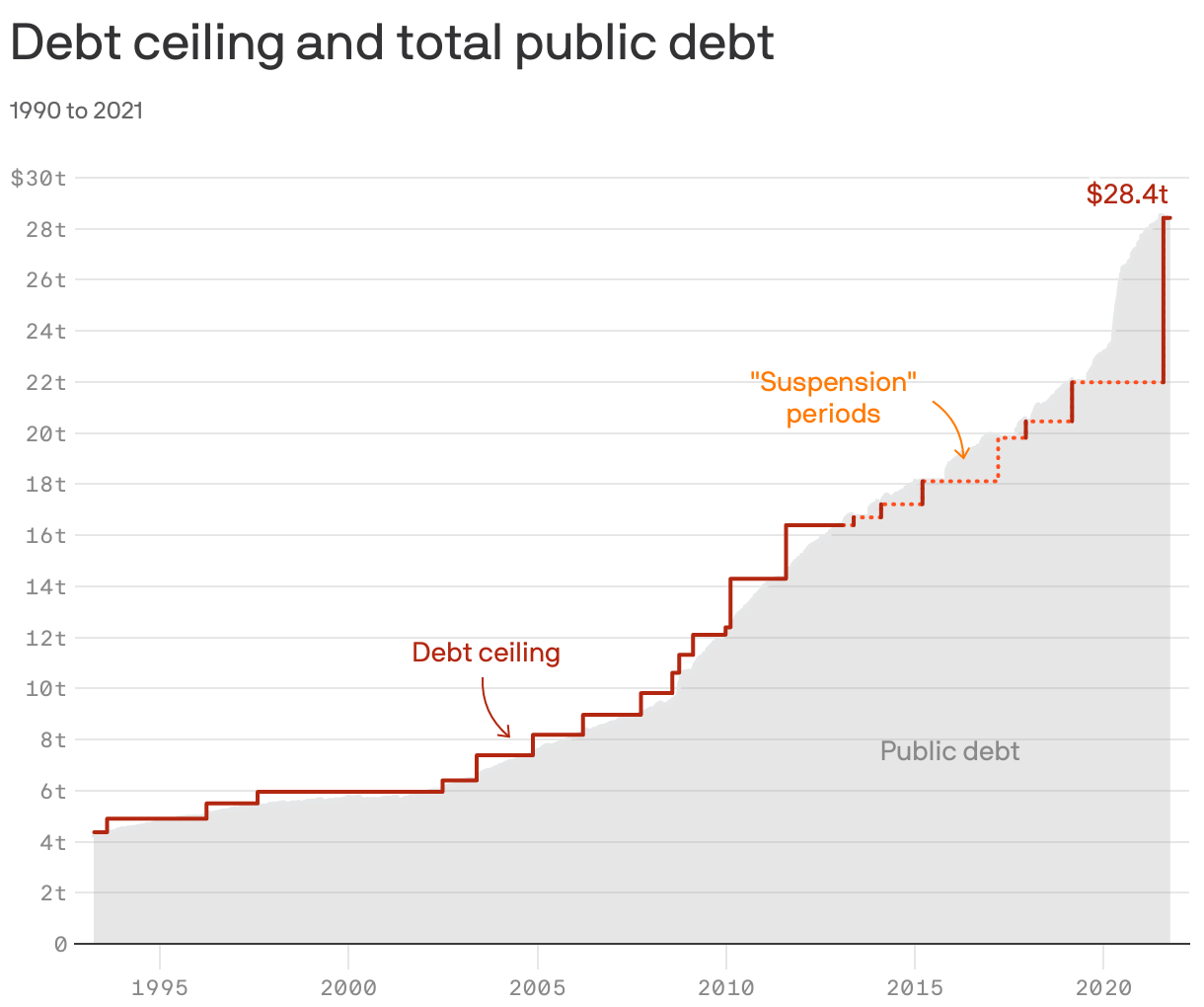
Data: U.S. Department of the Treasury, Congressional Research Service; Chart: Axios Visuals
Congress made its first moves Wednesday toward raising or suspending the debt ceiling, as the country faced the prospect of defaulting on its obligations in less than two weeks.
Why it matters: Although it's not the first time Congress has waited until the last minute to deal with the federal debt ceiling, the U.S. has never defaulted. Treasury Secretary Janet Yellen recently said defaulting would likely trigger a recession.


























/2021/10/06/1633561212989.gif?w=3840)