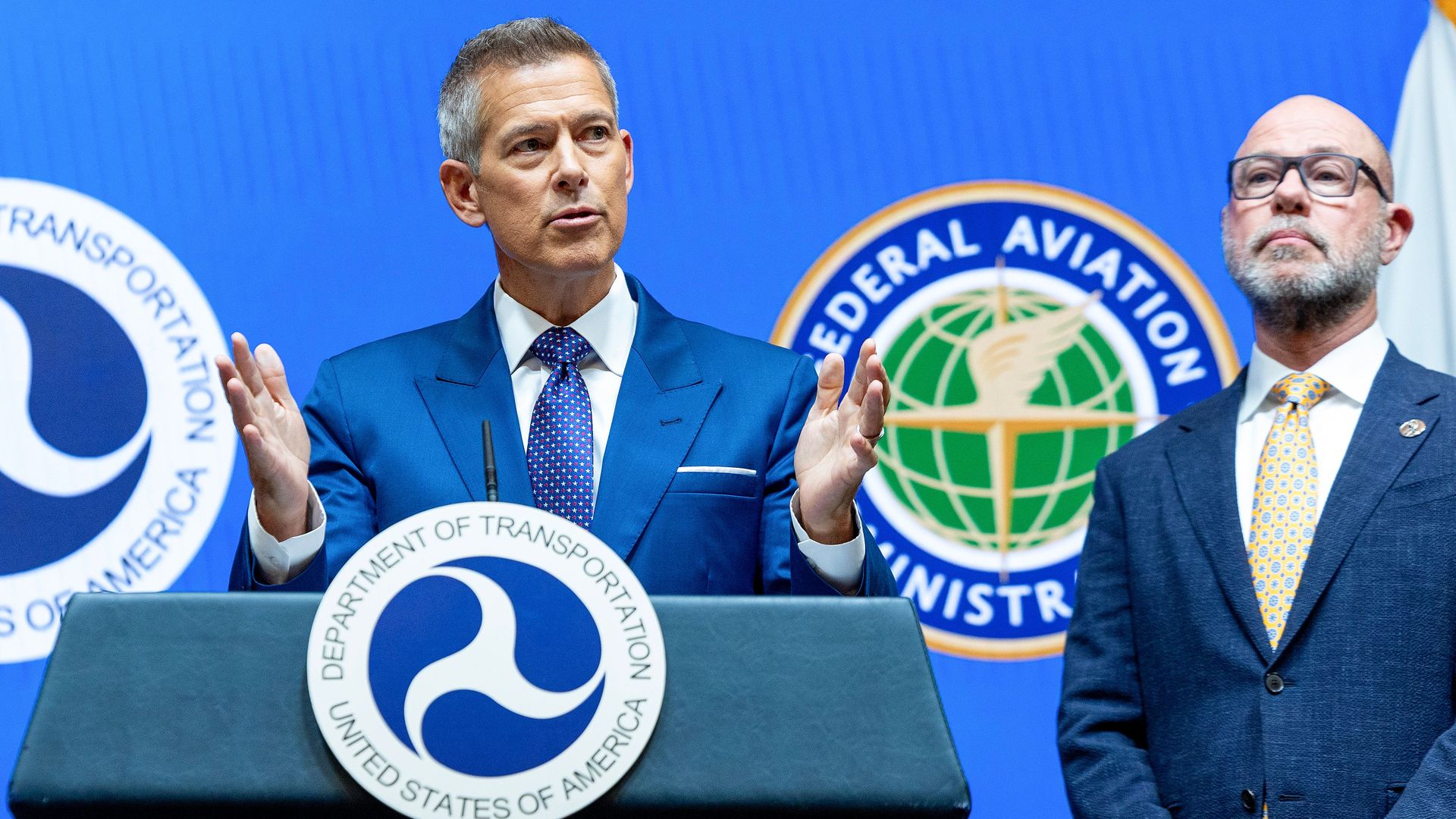
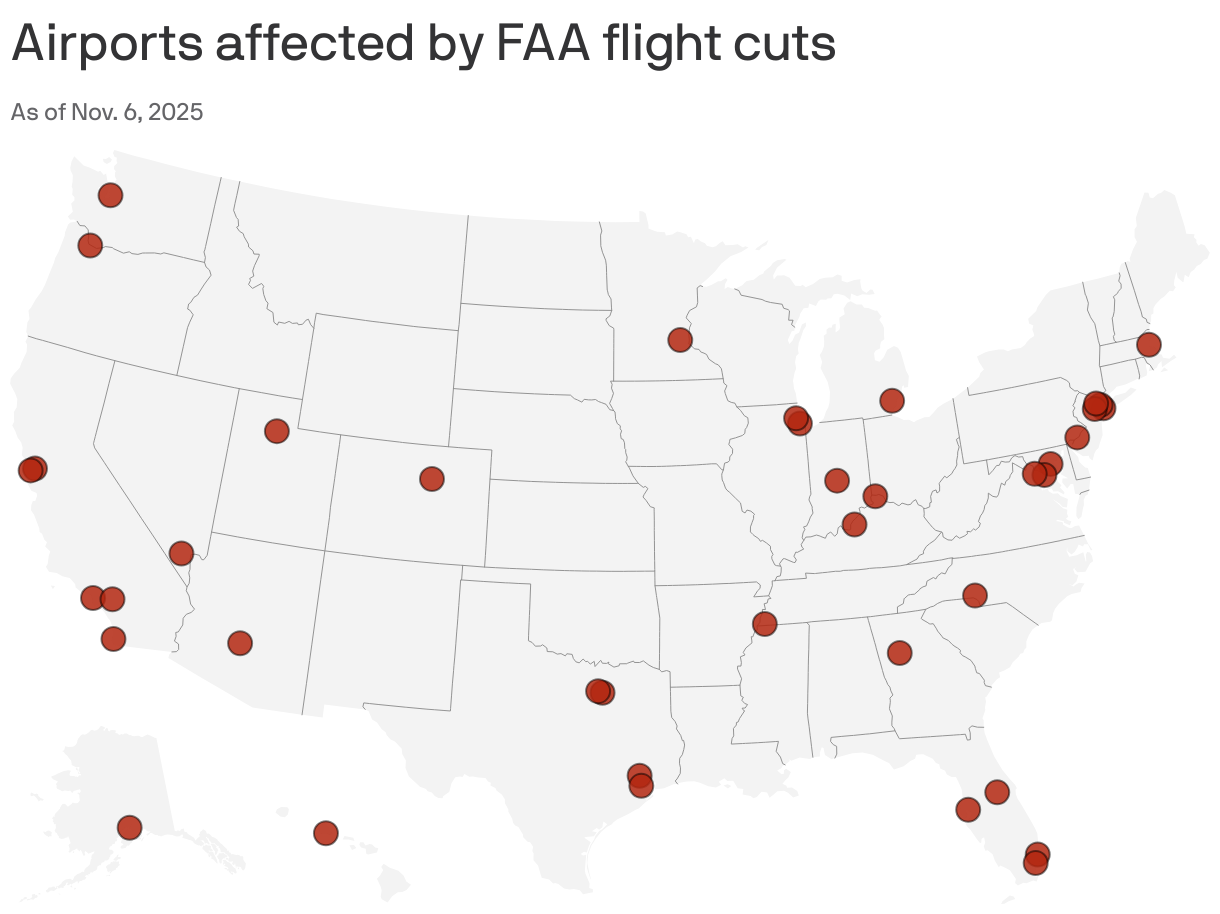
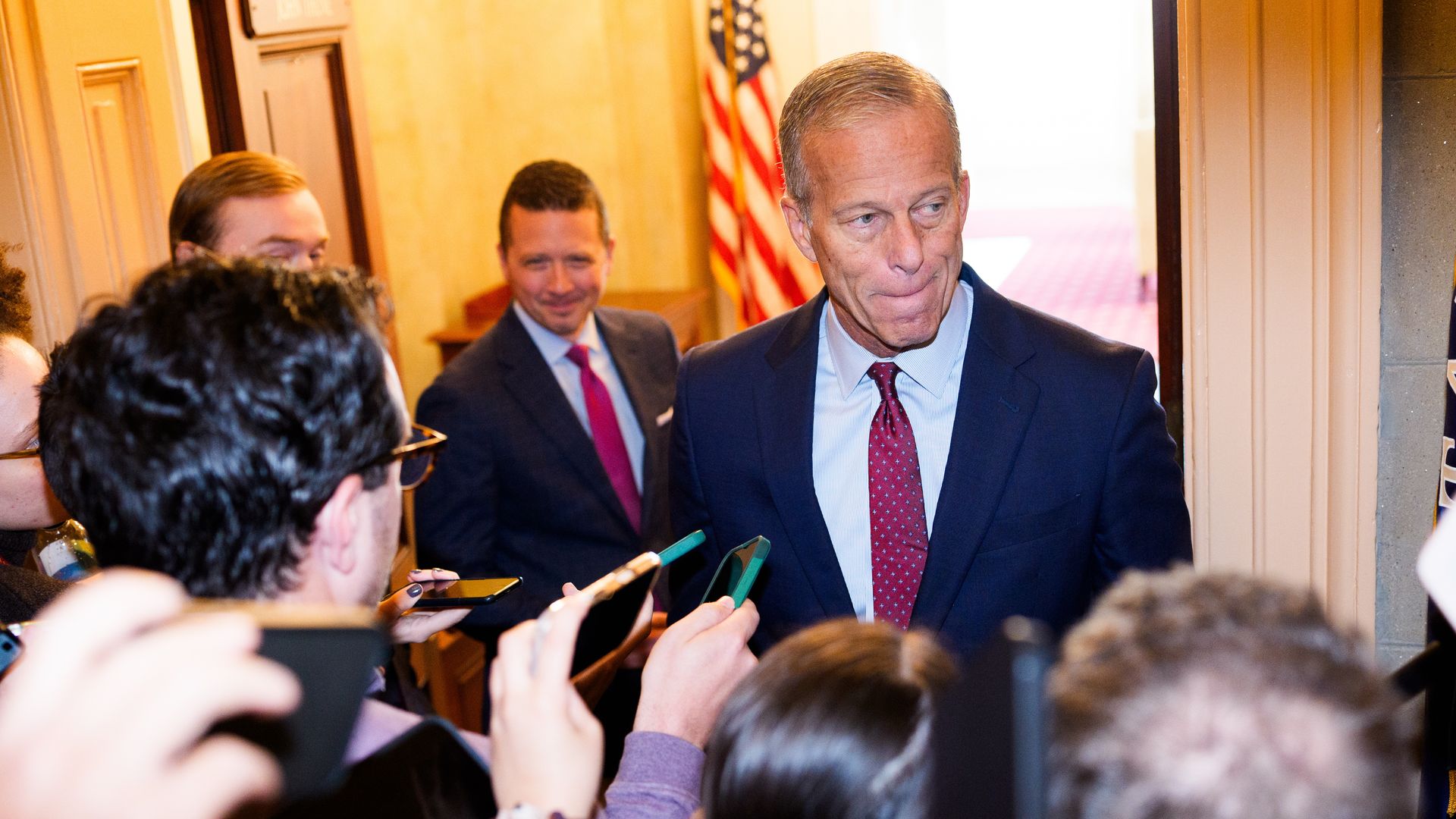
Air travelers faced more flight delays and cancellations on Tuesday and Transportation Secretary Sean Duffy warned if the record-long government shutdown doesn't end soon, "we're not going to get to Thanksgiving."
The big picture: The Senate passed a bill Monday to reopen government and Duffy urged the House to follow suit as a Federal Aviation Administration mandate forced airlines to cut 6% of flights at 40 major airports on Tuesday. That number is set to hit 10% on Friday.
Businesses are saluting veterans and active-duty military personnel this Veterans Day with free meals, drinks and discounts.
The big picture: The federal holiday honors those who have served in the military — past and present — by showing appreciation for what they have sacrificed.
Why it matters: The Minneapolis-based retailer is fighting to hold onto price-sensitive consumers as Walmart, Aldi and discount chains win share during the growing affordability crisis.
President Trump's first 296 days of his second term, while precedent-shattering, are producing a lot more one-off, giveth-or-taketh-away deals than actual new U.S. laws.
Why it matters: It's the Santa and Grinch presidency, in which almost every day reveals a new promise to give something of financial value to a nation, group or individual — or take it away. But rarely do these transactions cement new laws.
This reality reflects Trump's improvisational and dealmaking impulses. But it also means that a lot of what he does will be easily reversible.
The last few days show the pattern: Trump, increasingly vocal about affordability after the Democratic romp in Tuesday's elections, called for two actions — tariff rebate checks and 50-year mortgages.
Both were in-the-moment ideas, tossed out by the president on social media, that don't require new laws.
Zoom in: On Truth Social on Saturday afternoon, Trump floated the idea of a 50-year mortgage to improve housing affordability. Bill Pulte, the powerful director of the Federal Housing Finance Agency (FHFA), then tweeted: "Thanks to President Trump, we are indeed working on The 50 year Mortgage — a complete game changer." Rep. Marjorie Taylor Greene (R-Ga.) argued on X that the idea would "ultimately reward the banks, mortgage lenders and home builders while people pay far more in interest over time."
Then on Truth Social on Sunday morning, Trump said: "A dividend of at least $2000 a person (not including high income people!) will be paid to everyone." (An idea he's floated on and off since July, without any concrete plans.)
In a real-time reflection of Trump improv, Treasury Secretary Scott Bessent told George Stephanopoulos shortly thereafter on "This Week": "I haven't spoken to the president about this yet ... [T]he $2,000 dividend could come in lots of forms ... [I]t could be just the tax decreases that we are seeing on the president's agenda." (Trump later clarified that it would, in fact, be a direct payment to people.)
Herein lies the downside to Trump's approach: Anything not codified by law can be easily undone by the courts — or by Democrats when they win back the White House.
The intrigue: These measures can also be undone by Trump himself, if the winds shift the right way. Auto companies, for instance, now get a partial refund for the tariffs that Trump imposed on the industry.
Another case in point: Trump has pushed for lower prescription drug prices — not by seeking legislation, but by directly pressuring pharmaceutical companies, including last week's Oval Office announcement that they'll reduce the price of GLP-1 weight loss drugs.
He has attacked health insurance companies in recent days and over the weekend called for Americans to receive cash directly with which to buy health insurance.
But he hasn't engaged in negotiations with congressional Democrats over extending Affordable Care Act subsidies that currently help millions afford insurance — the core of the shutdown fight.
The bottom line: Almost all of Trump's astonishing expansions of precedent-stretching presidential power flow not from law, or even congressional approval. It's just Trump doing what he wants ... to whoever he wants ... when he wants.
Axios' Tal Axelrod, Ben Berkowitz, Courtenay Brown and Neil Irwin contributed reporting.
Correction: This version removes an outdated GovTrack tally that was from Trump's first term, not this term.
As the federal food assistance cutoff strains food banks, neighbors are feeding neighbors with a network of front yard aid.
The big picture: The abrupt halt to full federal benefits anditssubsequent chaos has forced families to choosebetween paying bills and putting food on the table.But with aid in limbo, community goodwill is providing a homemade lifeline.
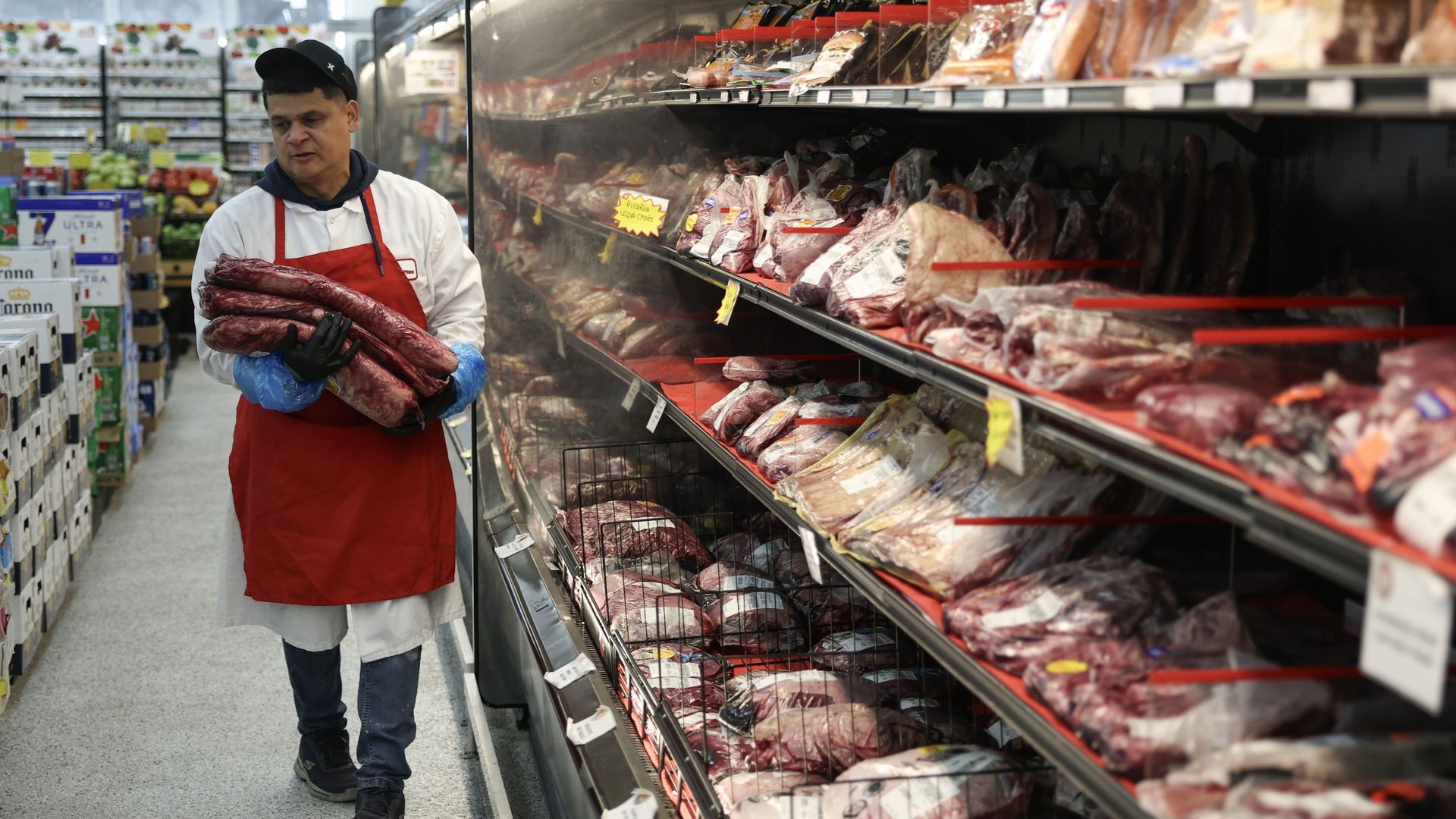
Soaring beef prices took a bite out of Tyson Foods in its most recent quarter, but penny-pinching consumers flocked to chicken, offsetting red ink from red meat.
Why it matters: The meatpacking industry is taking heat from President Trump over the surging price of beef, which experts attribute to a record global shortage of cattle.
Investors are rejoicing over what they see as an end to the government shutdown nearing — yet the positive vibes probably won't last for long.
Why it matters: A reopening would ease one pocket of worry for Wall Street, but swing attention to the others, like sky-high valuations and signs of an AI bubble.
Investors will also have to make sense soon of newly resumed government data, coming late at first and in some cases maybe not at all. (Just don't hold your breath for October CPI.)
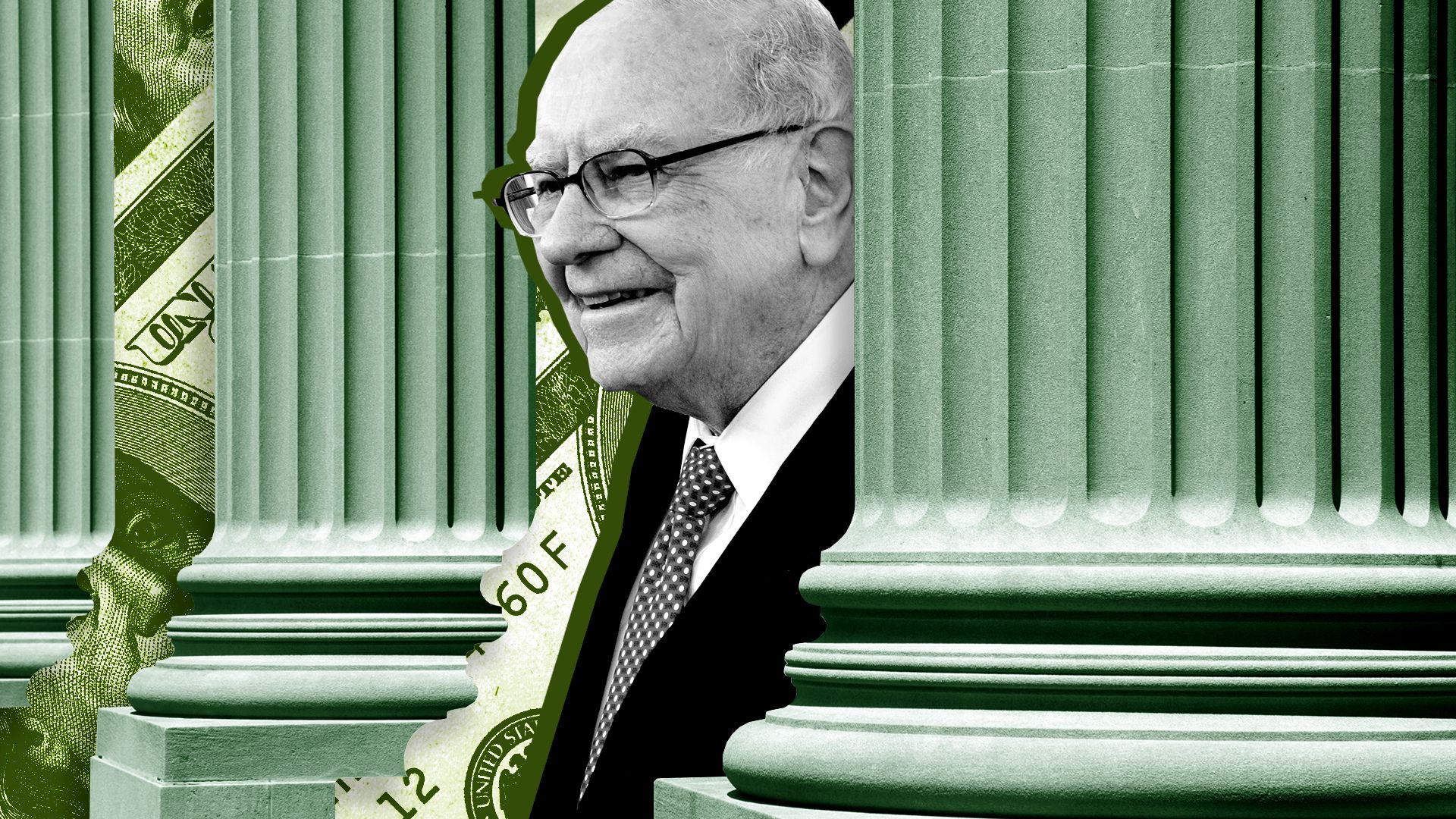
Why it matters: Investors monitor Buffett's annual letter religiously for insight into the market, and this will be the one of the last opportunities to do that as "Oracle of Omaha" prepares to retire.
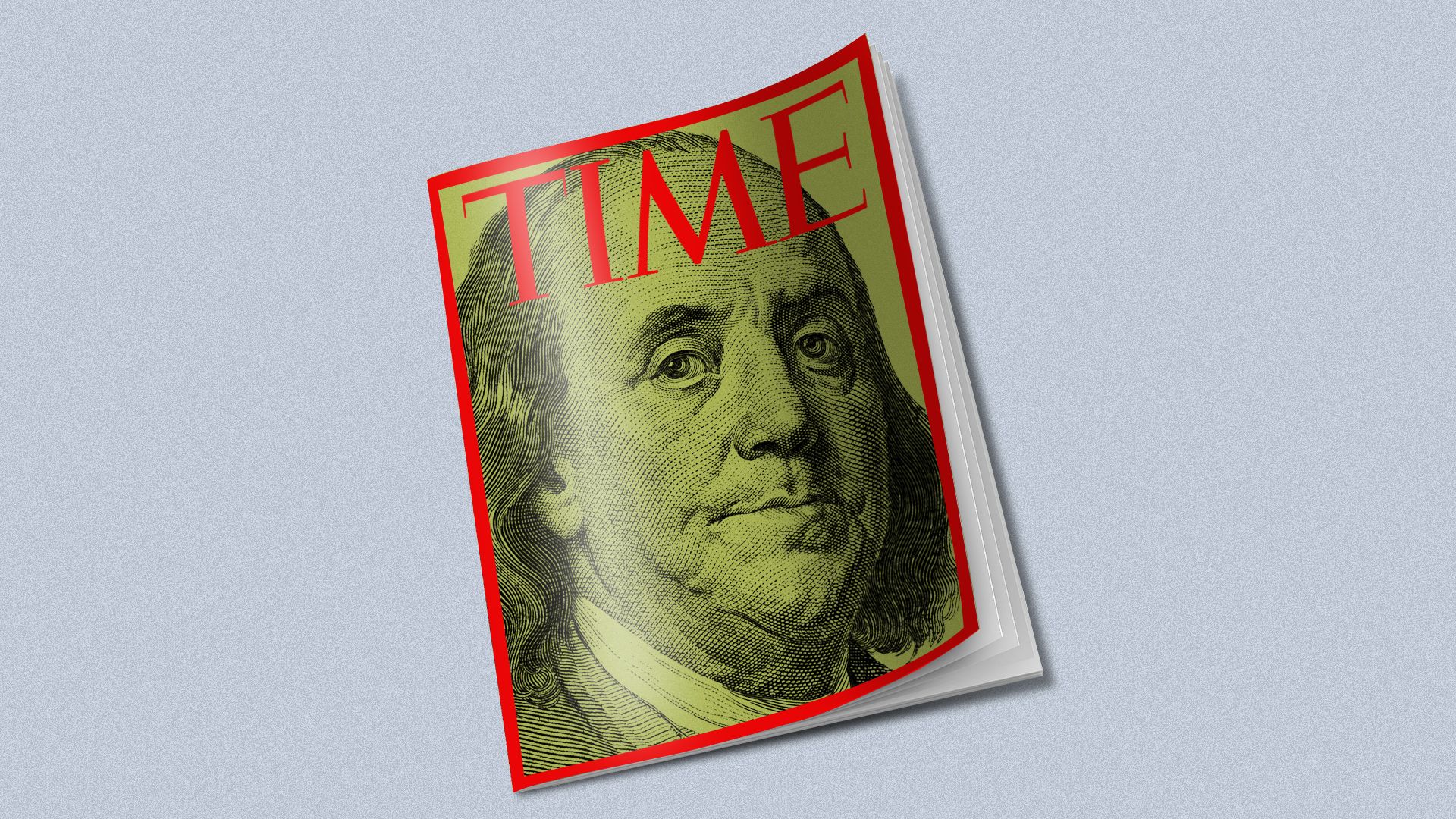
Time has launched an AI agent that lets people ask questions and generate text summaries and audio briefs drawn entirely from its 102-year-old archive.
Why it matters: The tool marks Time's biggest bet yet on AI as the publication looks to not only deepen reader engagement but also grow enterprise revenue.
President Trump on Monday threatened to dock pay for air traffic controllers missing work during the government shutdown.
Why it matters: The air traffic control system, already strained before the government shutdown, faces more pressure as the record-breaking funding lapse continues.
Carbon Direct, which provides a suite of data-driven climate management services to companies, is acquiring Pachama, a major player in the nature-based carbon credits market, the company tells Axios exclusively.
Why it matters: Demand for credits from rainforest preservation and other projects is rising, driven partly by tech giants trying to juggle climate goals with the data center boom.
Amazon is stretching Black Friday and Cyber Monday into nearly two weeks of sales — starting Nov. 20 and running through Dec. 1 — promising "millions of deals" across categories.
Gen Z is not buying the dip, while boomers are, per the latest Charles Schwab STAX index, which analyzes the trading activity of millions of customers.
Why it matters: There is a generational divide in dip buying, as younger investors appear to be skittish as their riskier investments start to fade.
Richmond International Airport officials say they haven't been directly impacted by the FAA's planned 10% reduction in flights across major U.S. markets.
Why it matters: Ripple effects are still reaching Central Virginia travelers, and could strand Richmond's air travelers across the country.
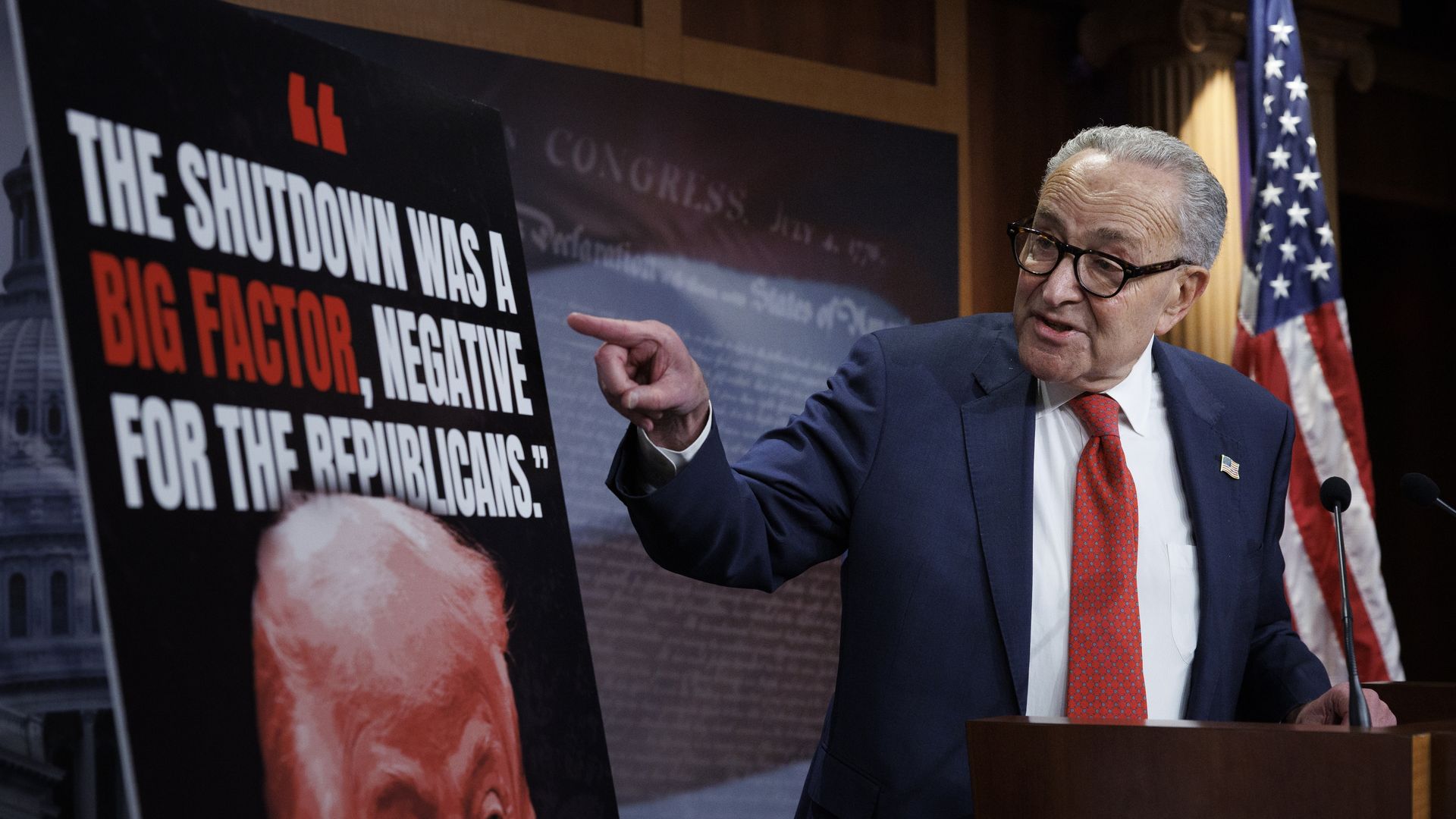
Enough Senate Democrats are poised to accept a deal to reopen the government without a concrete agreement to extend Affordable Care Act subsidies — but with the promise of a showdown vote on the assistance next month.
Why it matters: If a bill to temporarily fund the government passes this week, it would be a relief for much of the country buta major letdown for many Democrats who made ACA financial assistance a centerpiece of the shutdown fight.
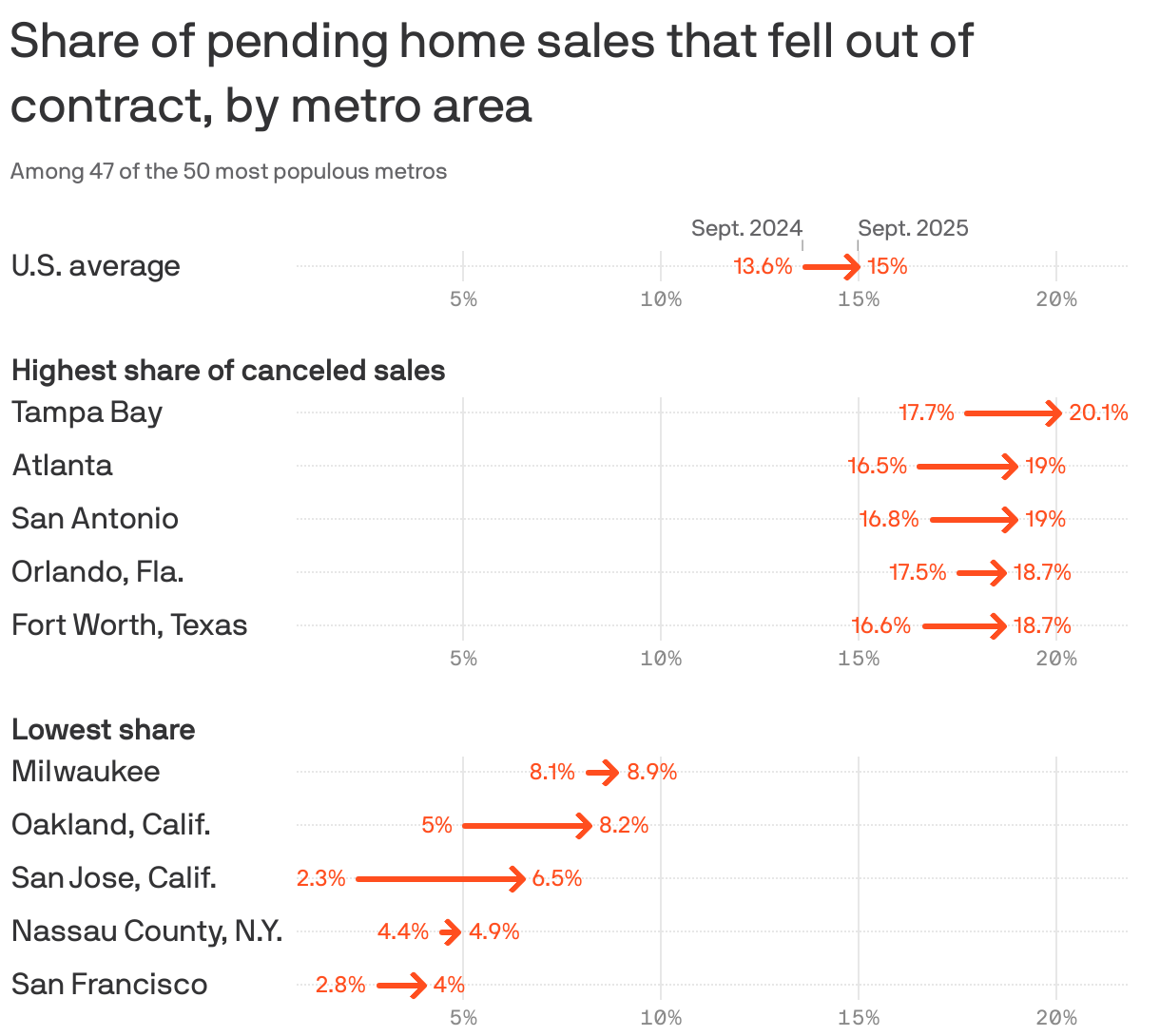
More U.S. homebuying contracts are being canceled, according to a Redfin report.
The big picture: Homebuyers are backing out of deals at "a fairly high rate" as their negotiating power grows and economic uncertainty mounts, among other reasons.
We've asked the top AI executives for their private take on the American rival they fear most. Without pause, they all coughed up the same name: Google.
Why it matters: The search giant has been somewhat sleepy so far in the race for AI dominance.
OpenAI's newest initiative gives U.S. service members free ChatGPT Plus for a year to aid post-military transitions.
Why it matters: Roughly 200,000 American military service members transition into civilian life each year, a confusing adjustment potentially made easier with AI.
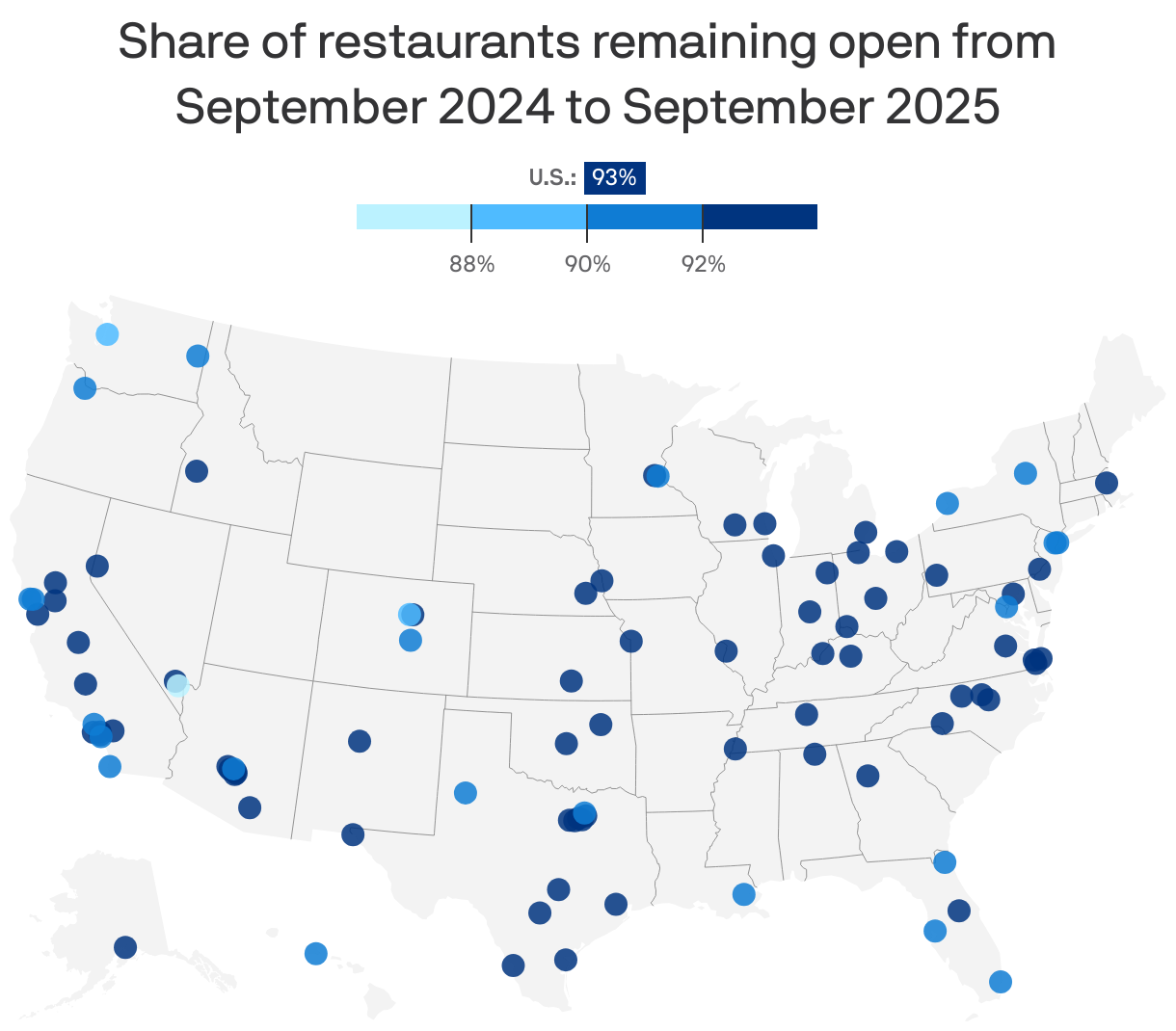
The vast majority of restaurants using DoorDash in the biggest U.S. cities that were open in September 2024 remained open in September 2025, per new data from the company shared exclusively with Axios.
Why it matters: Some churn is normal, even healthy. But especially low rates of restaurant survival in any given city may suggest something rotten in the state of the local industry.
Democratic lawmakers and liberal grassroots groups erupted Sunday night as moderate Senate Democrats moved to cut a deal with Republicans that would put an end to the government shutdown.
Why it matters: The deal threatens to reopen the deep divisions that have been roiling the Democratic Party all year, and the widespread opposition to it among House Democrats could complicate its path to passage.
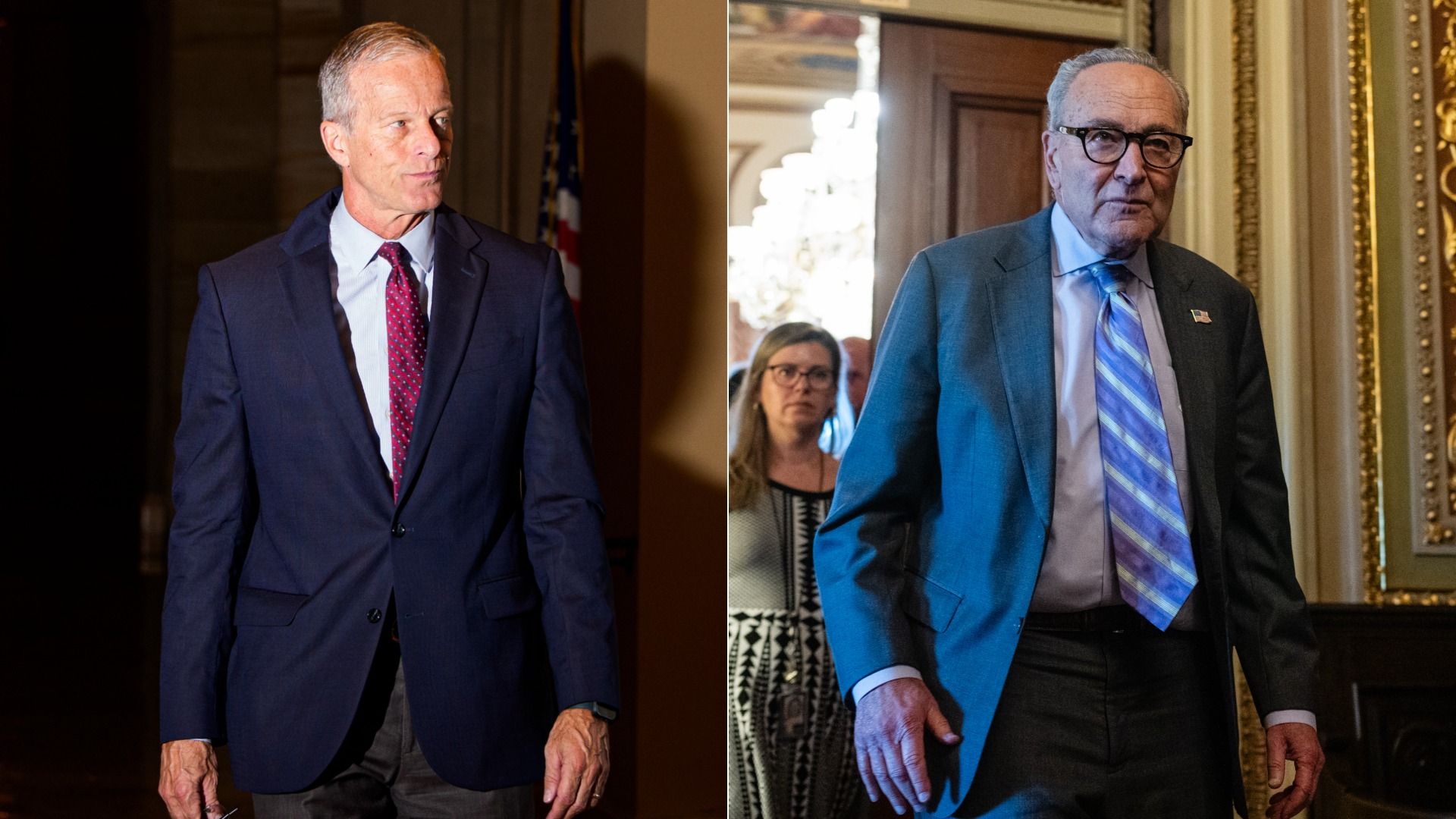
Eight Senate Democrats voted with Republicans on Sunday night to move forward with a package that would reopen the federal government.
Why it matters: It's a critical procedural vote that serves as a clear sign that a bipartisan deal has been reached to fund agencies, eventually vote on health care subsidies, undo federal layoffs — and end the record-breaking shutdown.
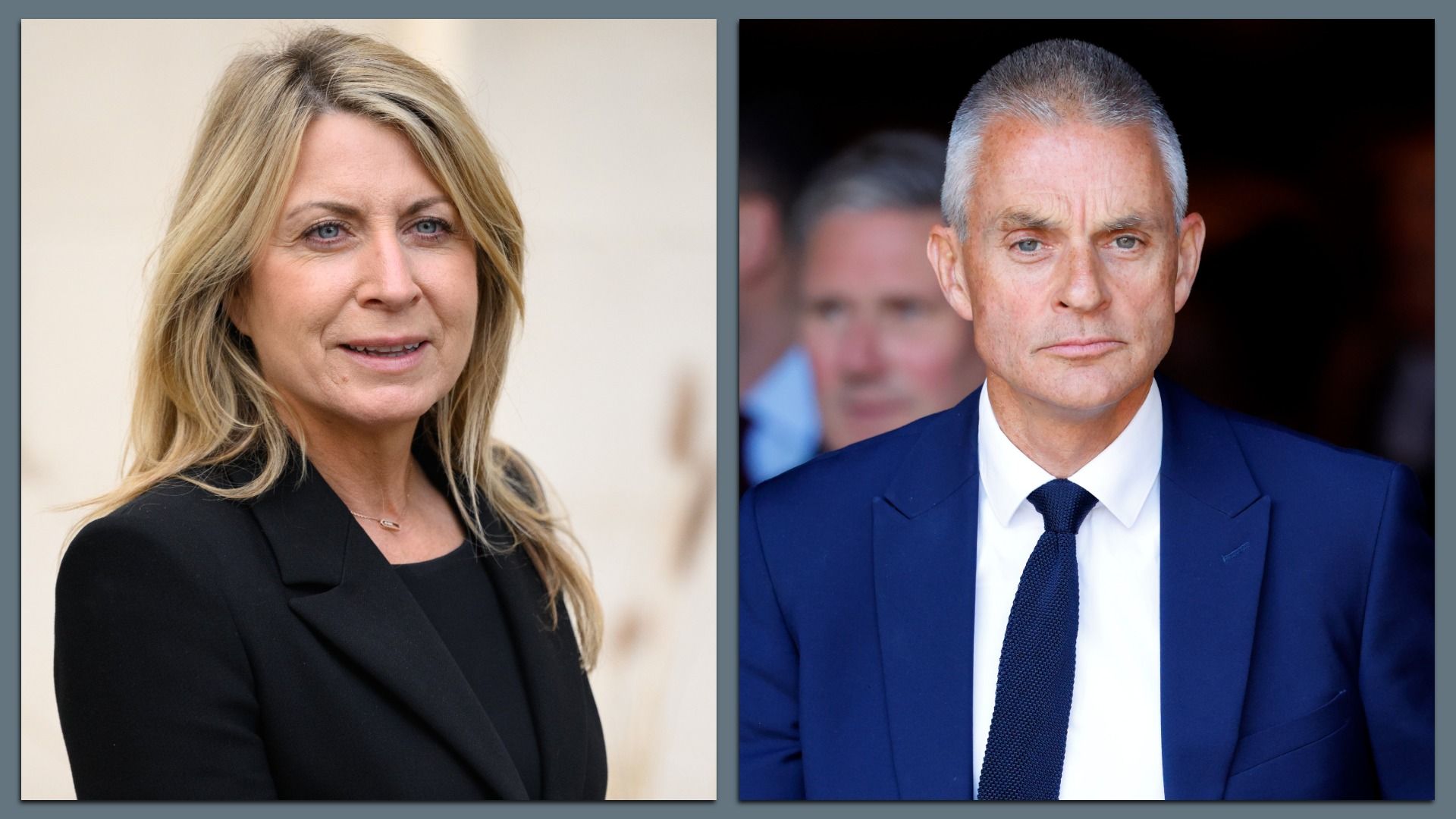
Two top BBC leaders resigned Sunday following criticism over the way a documentary edited a speech by President Trump on Jan. 6 and other matters raised in a leaked internal memo.
Why it matters: White House Press Secretary Karoline Leavitt and others accused the public service broadcaster of dishonesty following the leak to the Telegraph of the memo that raised concerns about impartiality and called the edited Trump clip in the BBC "Panorama" documentary "misleading."
The deal reached in the Senate Sunday would reverse the mass firings initiated during the government shutdown — and guarantee backpay for furloughed government workers.
Why it matters: The provisions stymie the Trump White House effort to slash the federal workforce in the shutdown.