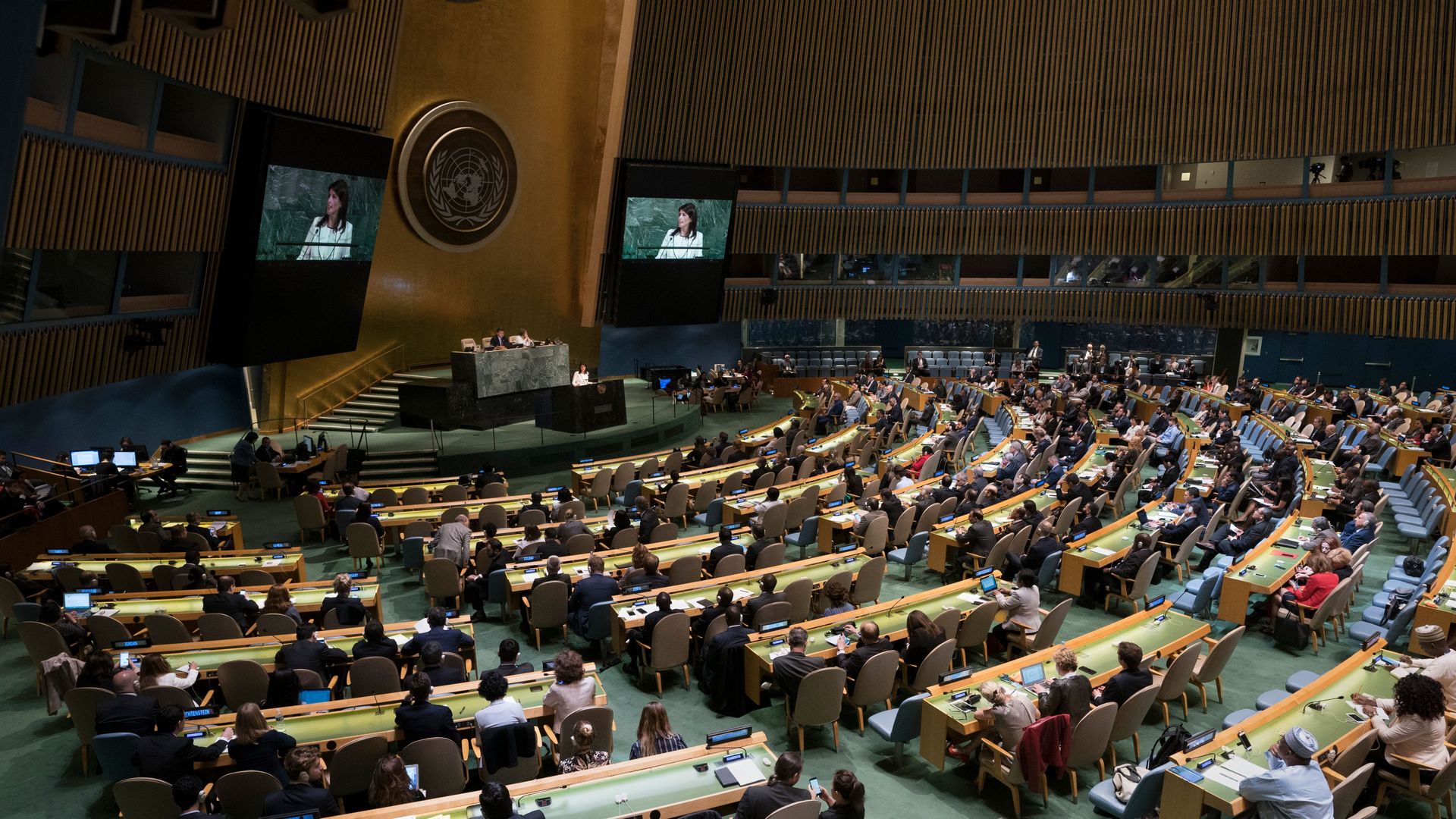
The U.N. General Assembly on Wednesday condemned Israel for using excessive force against Palestinians as it passed a resolution that berated the Middle Eastern country for recent deadly violence at the Gaza border, per the AP.
The details: The body also rejected a U.S.-backed amendment, which condemns Hamas for firing rockets from Gaza into Israeli civilian areas. Over 100 rockets were fired at Israel, per the AP. More than 120 Palestinians were reportedly killed by Israeli military fire.
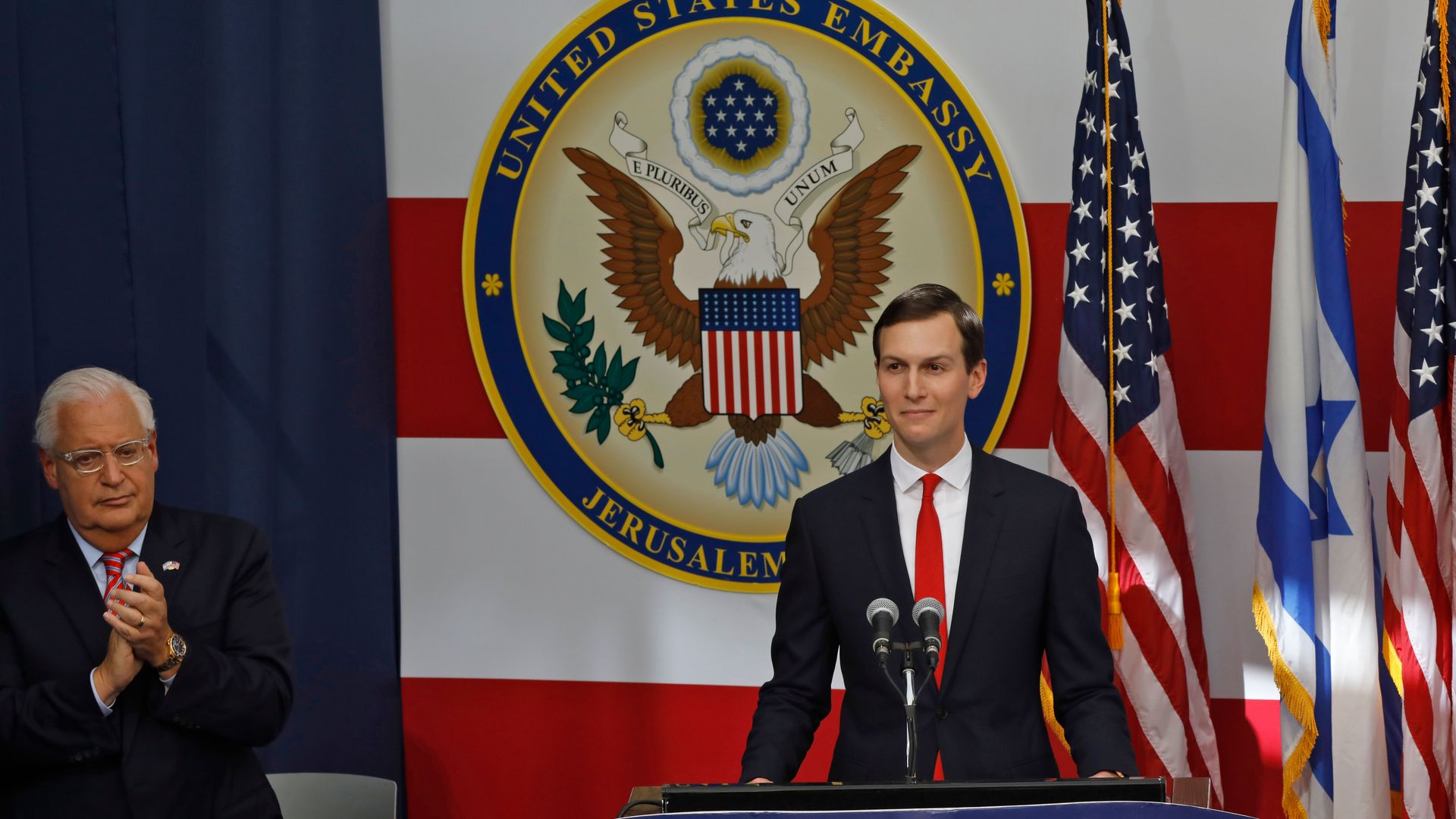
Senior U.S. officials involved in drafting President Trump's Middle East peace plan pushed back on claims from Palestinian leadership and from some officials in Europe that the plan will be biased in favor of Israel. One official told me, "Our peace plan is not a 'Bibi plan,'" referring to Israeli Prime Minister Benjamin Netanyahu.
Why it matters: Palestinian President Abbas' aides have said the U.S. peace plan will be "dead on arrival" and claimed the U.S. team has essentially been carrying Netanyahu's water for the last year and a half. The U.S. has been trying to pass messages to the Palestinians in public and in private through several Arab countries, asking them not to reject the peace plan out of hand.
One of many questions in the aftermath of the Singapore summit is whether President Trump might seek a similar breakthrough with Iran.
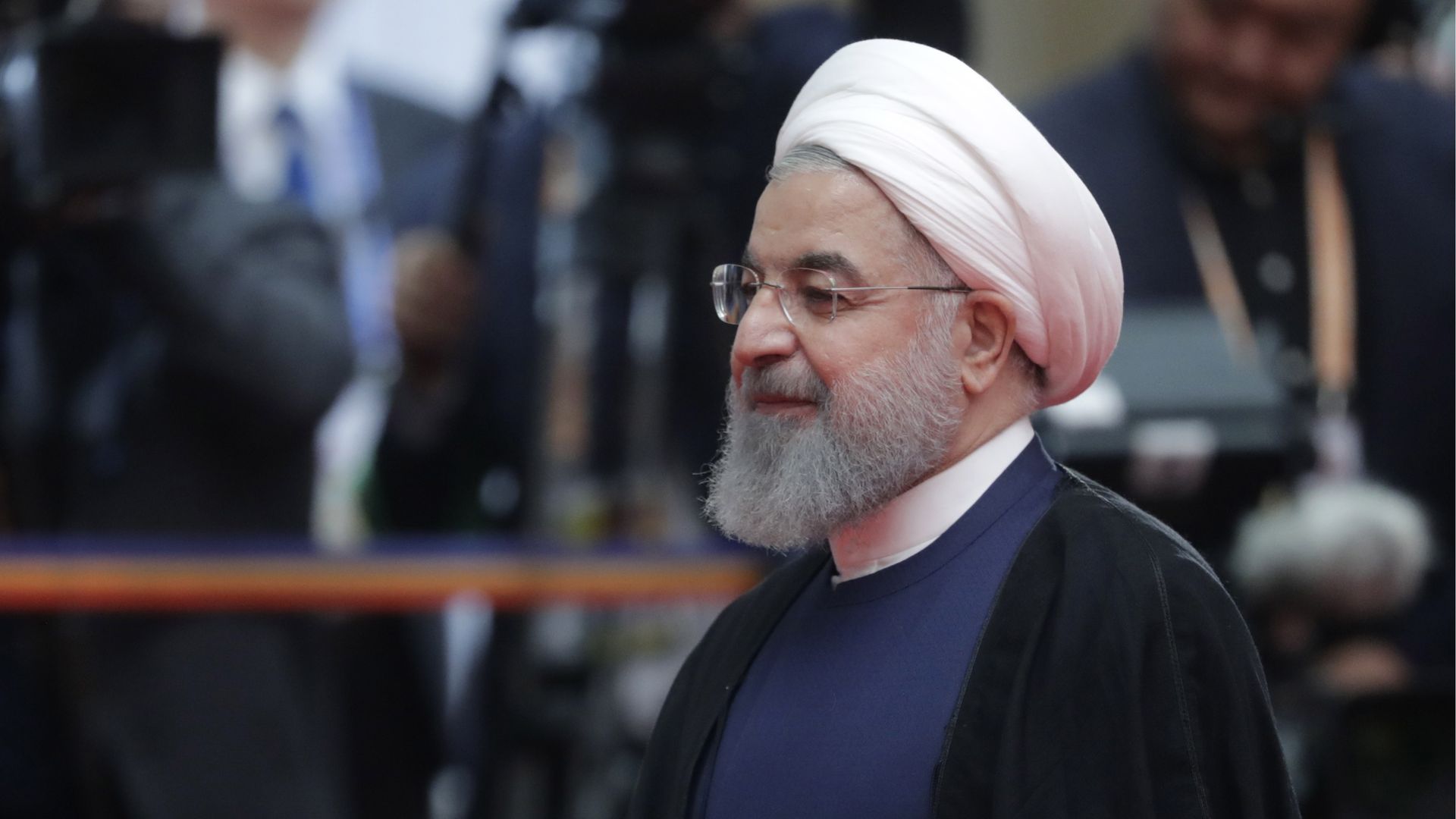
The big picture: Such a meeting would be just as unprecedented as the Trump-Kim encounter: No American president has met an Iranian president since the 1979 revolution. Even President Obama, whose administration negotiated a major nuclear agreement with Iran, was spurned when he sought a handshake with President Hassan Rouhani at the UN.
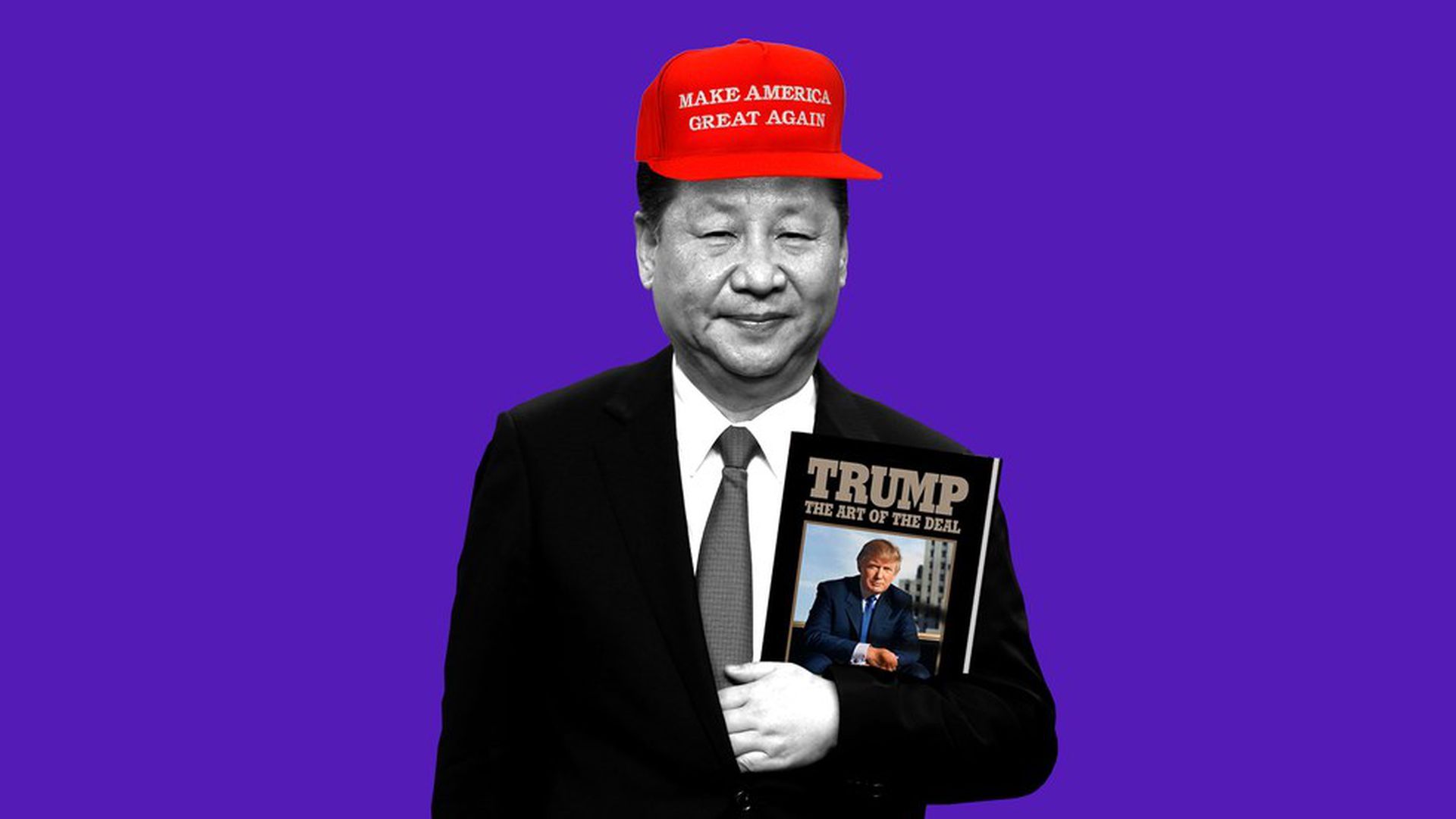
American and Chinese corporate titans share something in common: jittery slavishness to their president, and sometimes even each other's president. In the U.S., presidential tweets, and even the threat of one, send powerful CEOs scrambling to announce hiring sprees, factory openings, and profit repatriation.
Secretary of State Mike Pompeo told reporters today that the U.S. hopes North Korea will take major steps toward dismantling its nuclear weapons program by the end of President Trump’s first term, per Bloomberg.
Between the lines: Pompeo bristled at what he called the “ludicrous” and “insulting” suggestion that Trump had not secured specific commitments from North Korea on denuclearization. He also sought to counter criticism that Trump had made the only major concession of the summit — freezing military exercises with South Korea. Pompeo said Trump “made very clear” to Kim Jong-un that the policy would only hold so long as “good faith” talks continue.
President Trump tweeted Wednesday morning to argue that suspending military exercises between the United States and South Korea — announced yesterday as a part of his summit with North Korean leader Kim Jong-un — would save the U.S. "a fortune."
What they're saying: Experts view Trump's argument as geopolitically short-sighted, acknowledging that — while it might technically reduce costs in the short-term — it could stand to reduce the country's military readiness and force projection in Asia, which could create massive long-term consequences and costs.
You're an older New Yorker trying to bond with a culture-obsessed young gun who's less than half your age. There's a language barrier. You're tall; he's squat. You've had words in the past. Everyone's watching to see how you'll pull this off. This is the first time you've met, and you don't have much time. Everything about this could be awkward. Why not a movie?
What happened: President Trump's wooing of Kim Jong-un at the Singapore summit included the iPad showing (in English and Korean) of a "Destiny Pictures" movie trailer, made by the White House's National Security Council, starring themselves saving the world.
President Trump landed back in the Washington, D.C. area on Wednesday morning, announcing his arrival with a tweet touting the results of his summit with North Korean leader Kim Jong-un.
Yes, but: Many experts believe that the joint statement Trump signed with Kim is quite vague — and it fails to include concrete, verifiable steps toward denuclearization for North Korea.
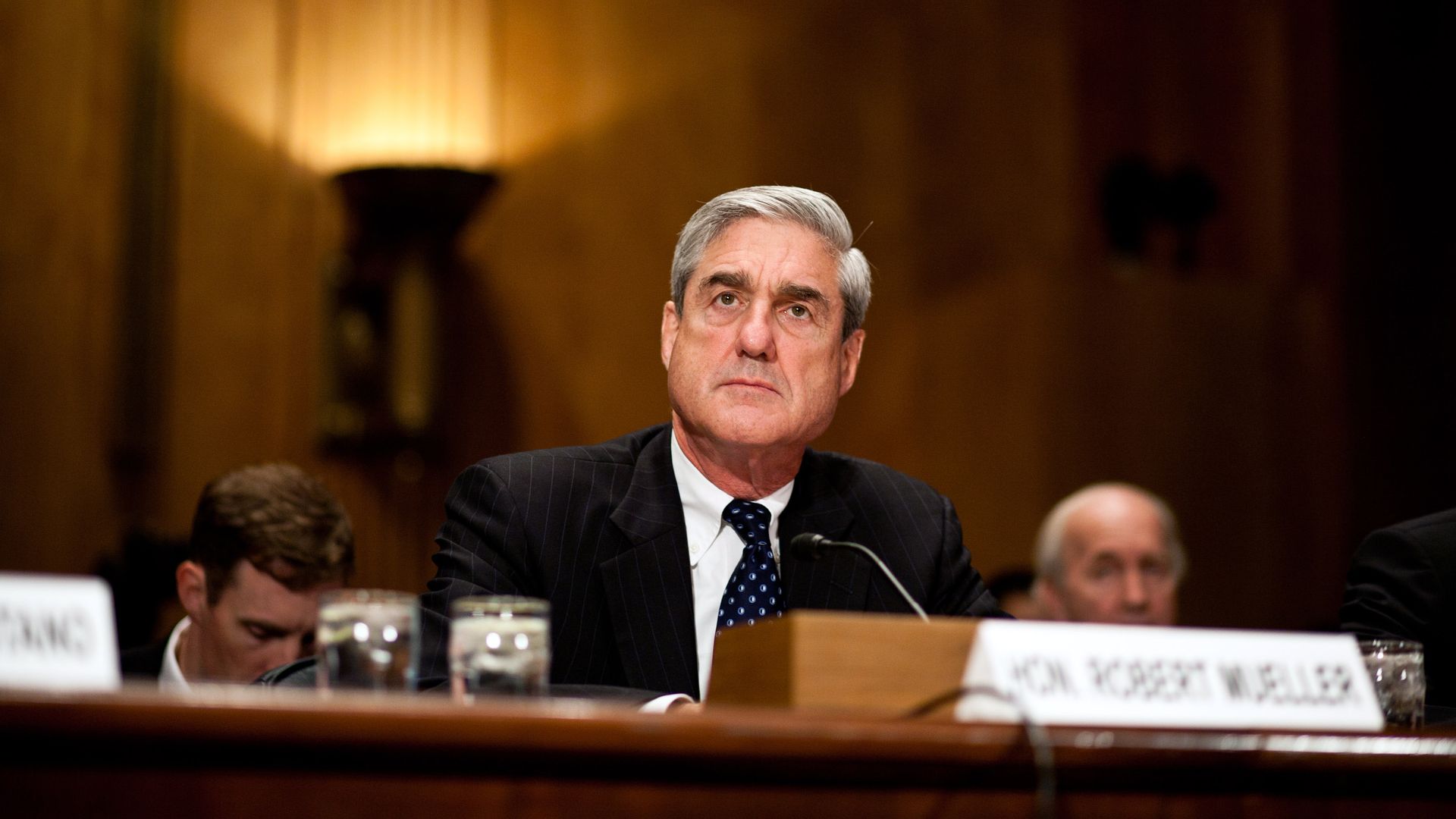
Special counsel Robert Mueller's team has requested that a federal D.C. judge order to secure a heap of documents that have been shared with Russian-run Concord Management and Consulting LLC, "because of the potential for the information to be shared with foreign nationals and intelligence officials still working to sow discord" in the United States, CNN reports.
Why it matters: Mueller is warning that Russian intelligence agencies still have "interference operations" regarding U.S. election systems. The company in dispute was one of three companies that Mueller had charged in February along with 13 Russian nationals citing election meddling. Bloomberg adds that prosecutors "have uncovered evidence of other individuals and entities who are 'continuing to engage' in similar activities."
The leaders of the U.S. and North Korea, who only six months ago appeared to be heading for war, have now declared their commitment to “a lasting and stable peace regime on the Korean Peninsula.” However, the joint statement from last night’s meeting did not mention a formal framework for denuclearization.
The big picture: Although it feels like watching an old movie again, with new actors and some twists in the context, we have yet to see how this version ends. Despite mounting disappointments, Trump’s North Korea diplomacy still deserves the benefit of the doubt as it continues to evolve.
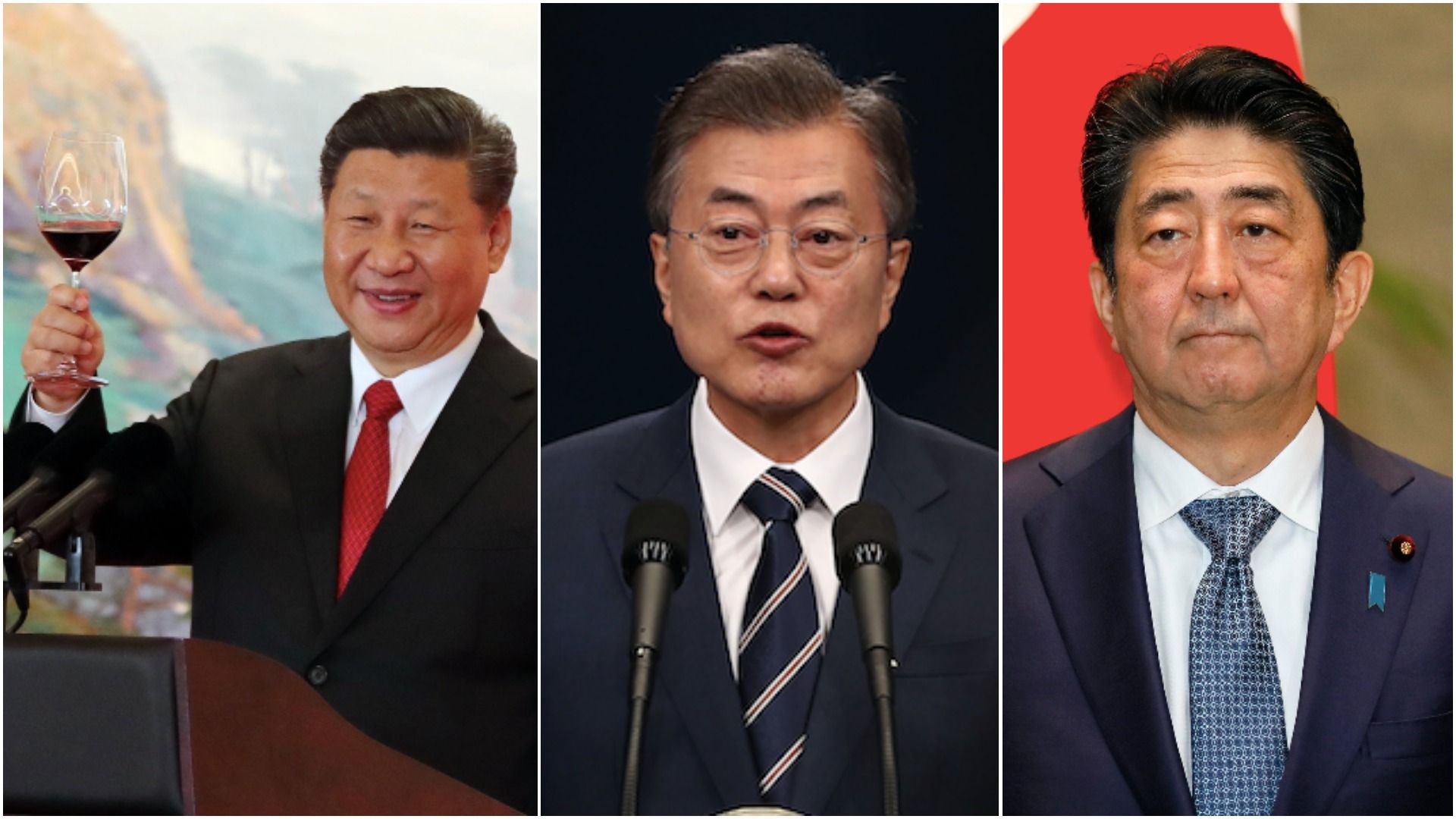
China and North Korea are the clear winners from the Trump-Kim summit, while U.S. allies South Korea and Japan emerged the losers.
Why it matters: Experts are concerned that the terms of President Trump and North Korean leader Kim Jong-un’s Singapore agreement help U.S. adversaries and hurt allies.
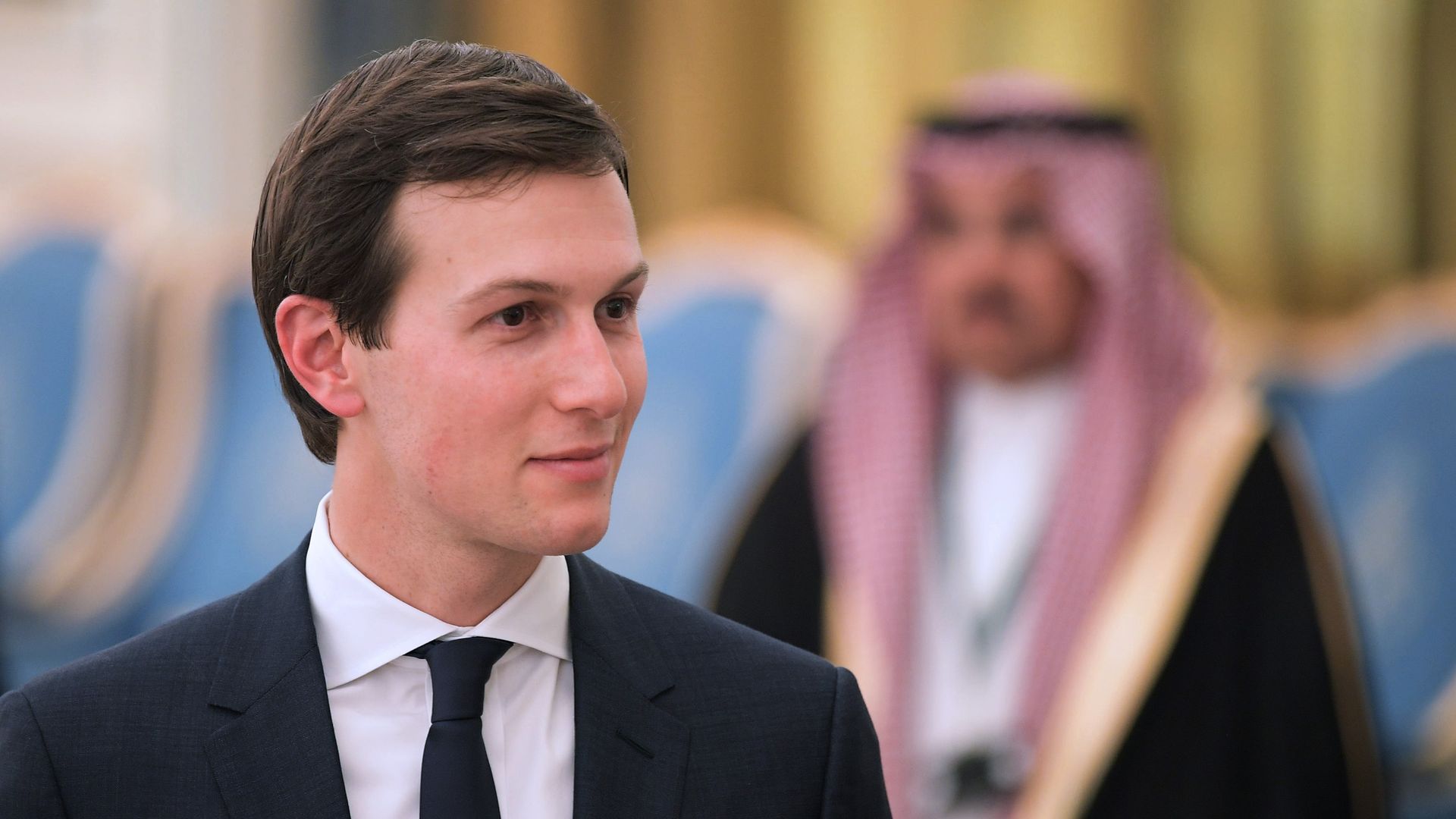
President Trump's Middle East peace team, senior adviser Jared Kushner and special envoy Jason Greenblatt, will travel to Israel, Egypt and Saudi Arabia next week to discuss the next stages of the peace effort and the crisis in Gaza, a senior U.S. official tells me.
Why it matters: The official said Kushner and Greenblatt want to discuss lingering questions they have as they finish drafting the peace plan, including the optimal time for launching it. The U.S. official added the trip may include other stops as well, but does not include a meeting with Palestinian officials — who are refusing to meet following Trump's decision to move the U.S. embassy to Jerusalem.
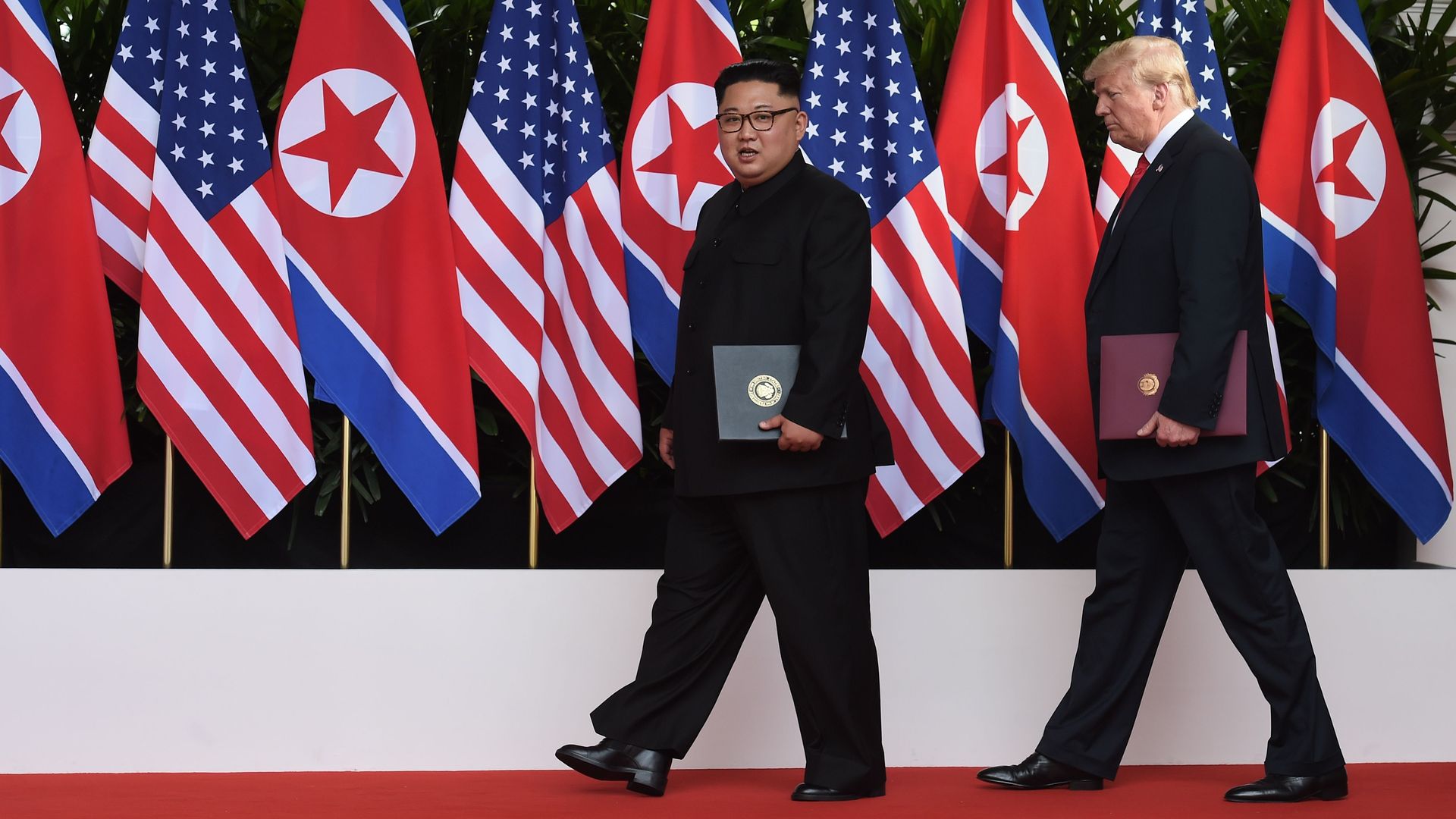
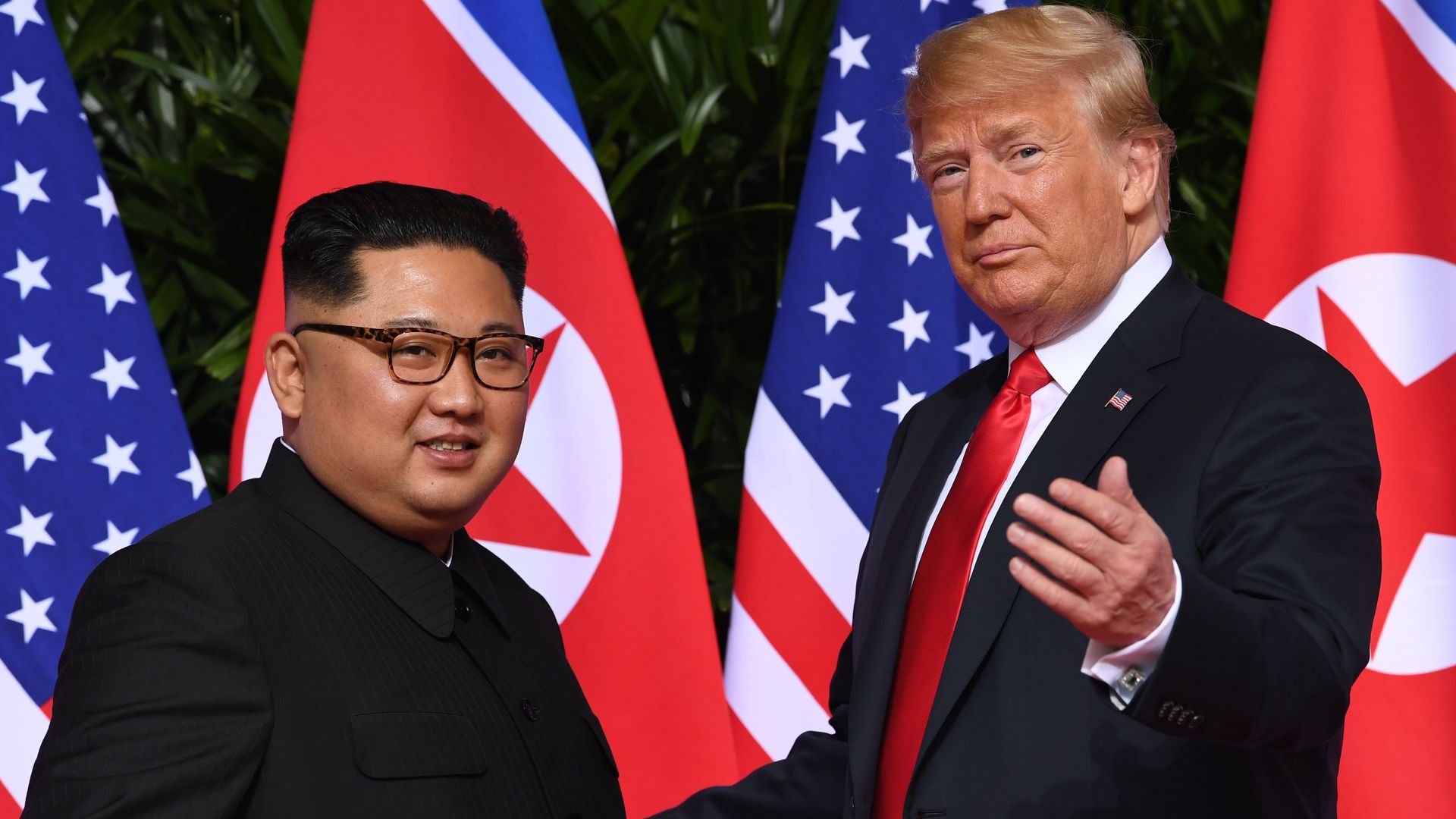
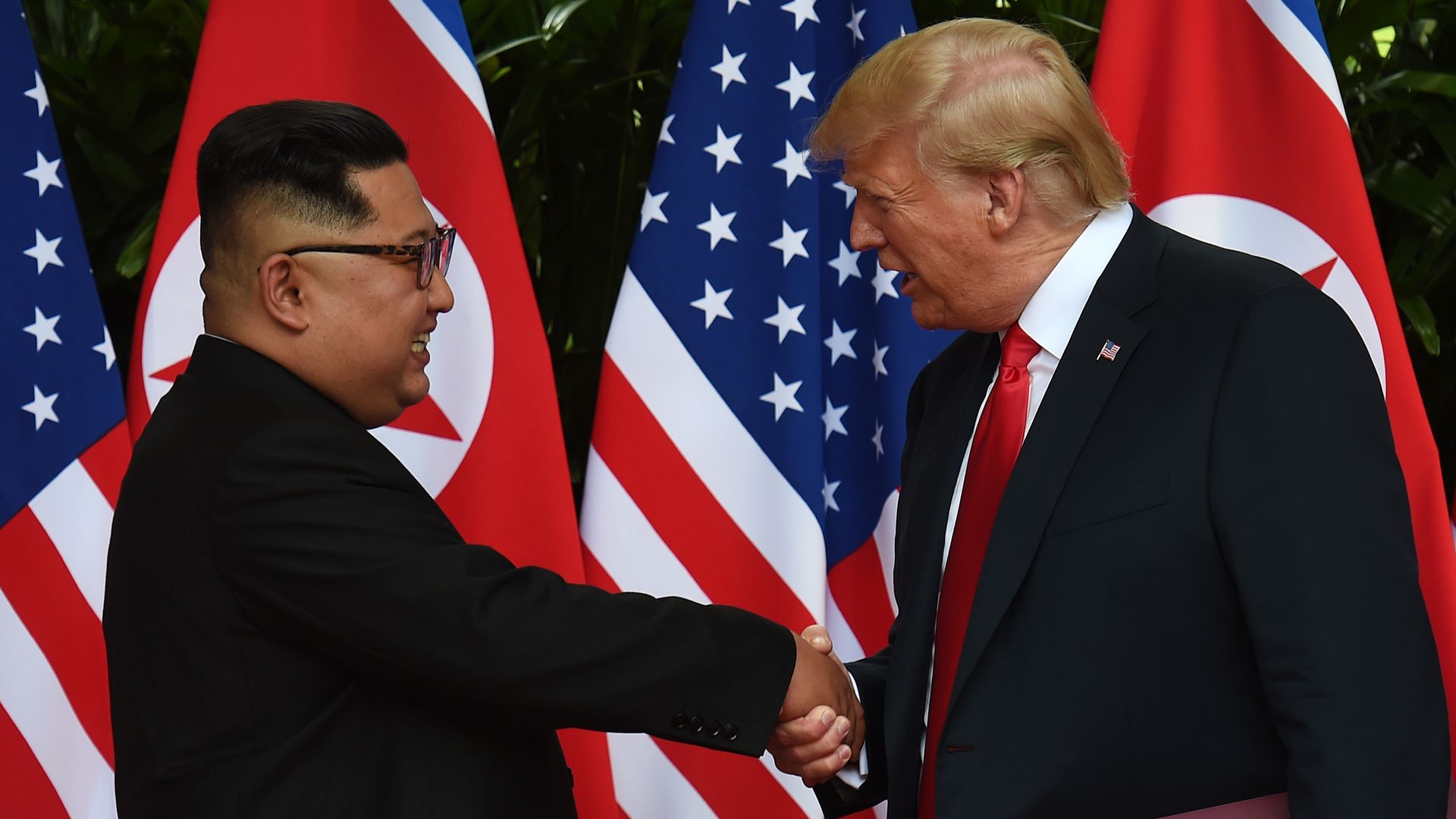
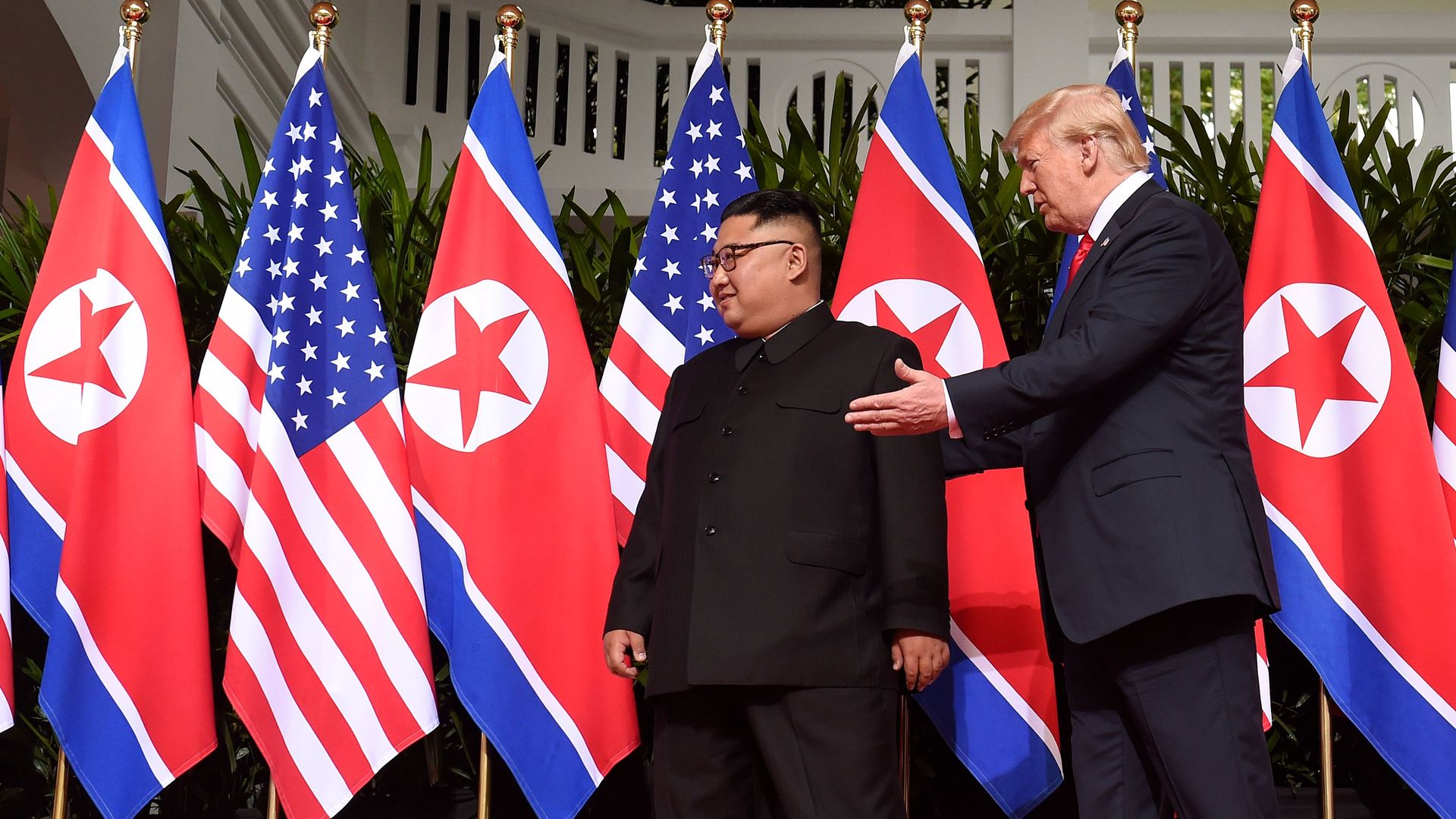
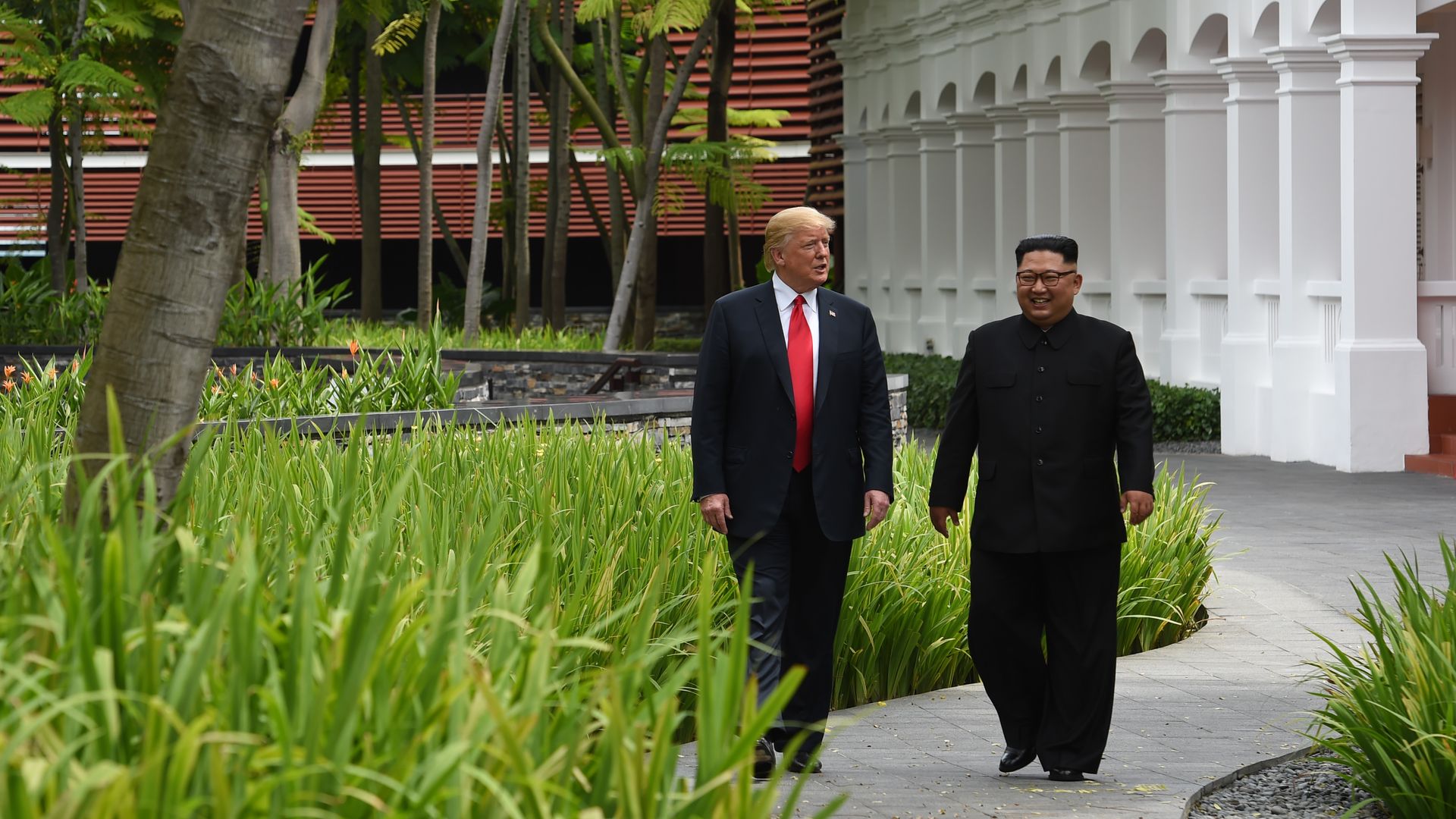
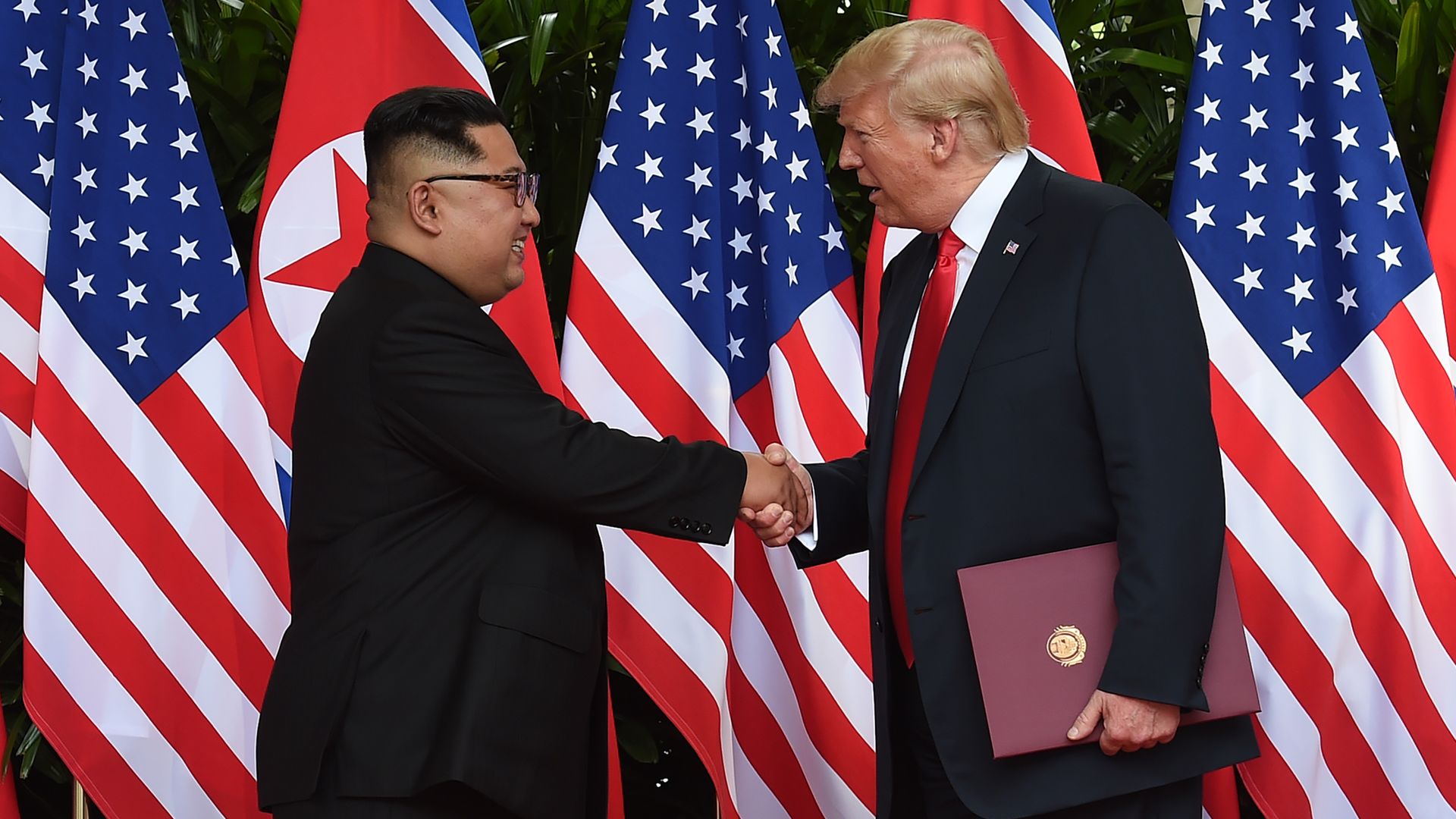
President Trump just concluded a meeting with Kim Jong-un that would have been unimaginable even a few months ago.
Where it stands: Much still needs to be worked out, including the specifics of denuclearization, security commitments to South Korea and Japan and some acknowledgment of concerns about human rights. But one point is clear: Talking is now the currency of U.S. relations with North Korea. And that’s a good thing.
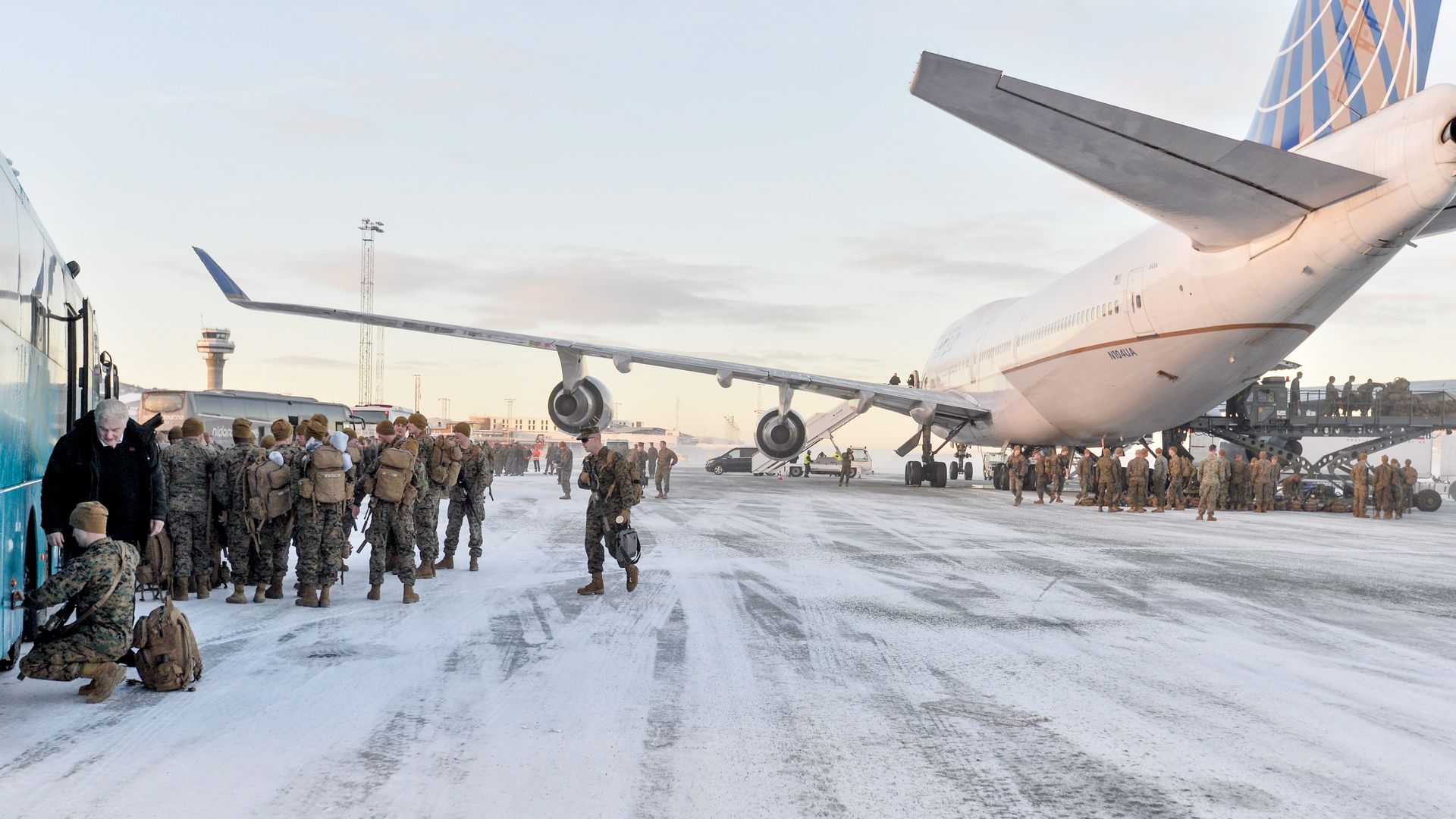
Norway will be asking the U.S. to station more Marines in the country, likely over concerns about Russia’s aggressive behavior following its annexation of Crimea in 2014, Reuters reports. There are 330 Marines currently there, and Oslo wants to more than double that number to 700 by 2019.
Why it matters: The Marines' arrival last year was the first time that foreign troops had been stationed in Norway since WWII. Norway's request would seek to place more Marines closer to the Russian border than those currently in the country — potentially raising tensions with Moscow and Russian President Vladimir Putin.
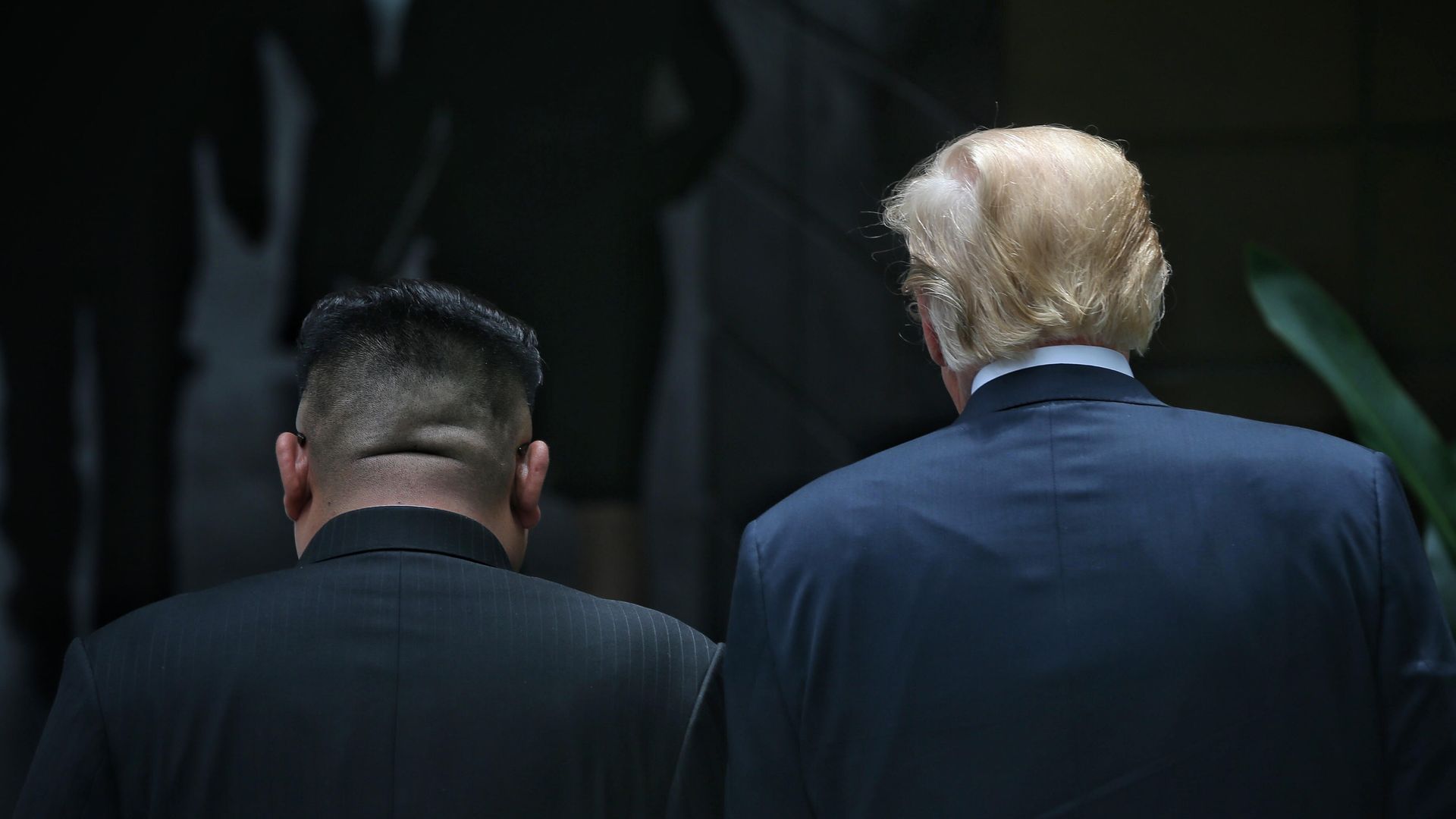
With President Trump and North Korea's Kim Jong-un signing a vague but hopeful document following their historic summit, experts are weighing in on what it means for both countries — and the world.
The general consensus: We are much further from war than we were six months ago, but the U.S. made a significant concession by cancelling joint military exercises with South Korea, while North Korea didn't give up much of anything.
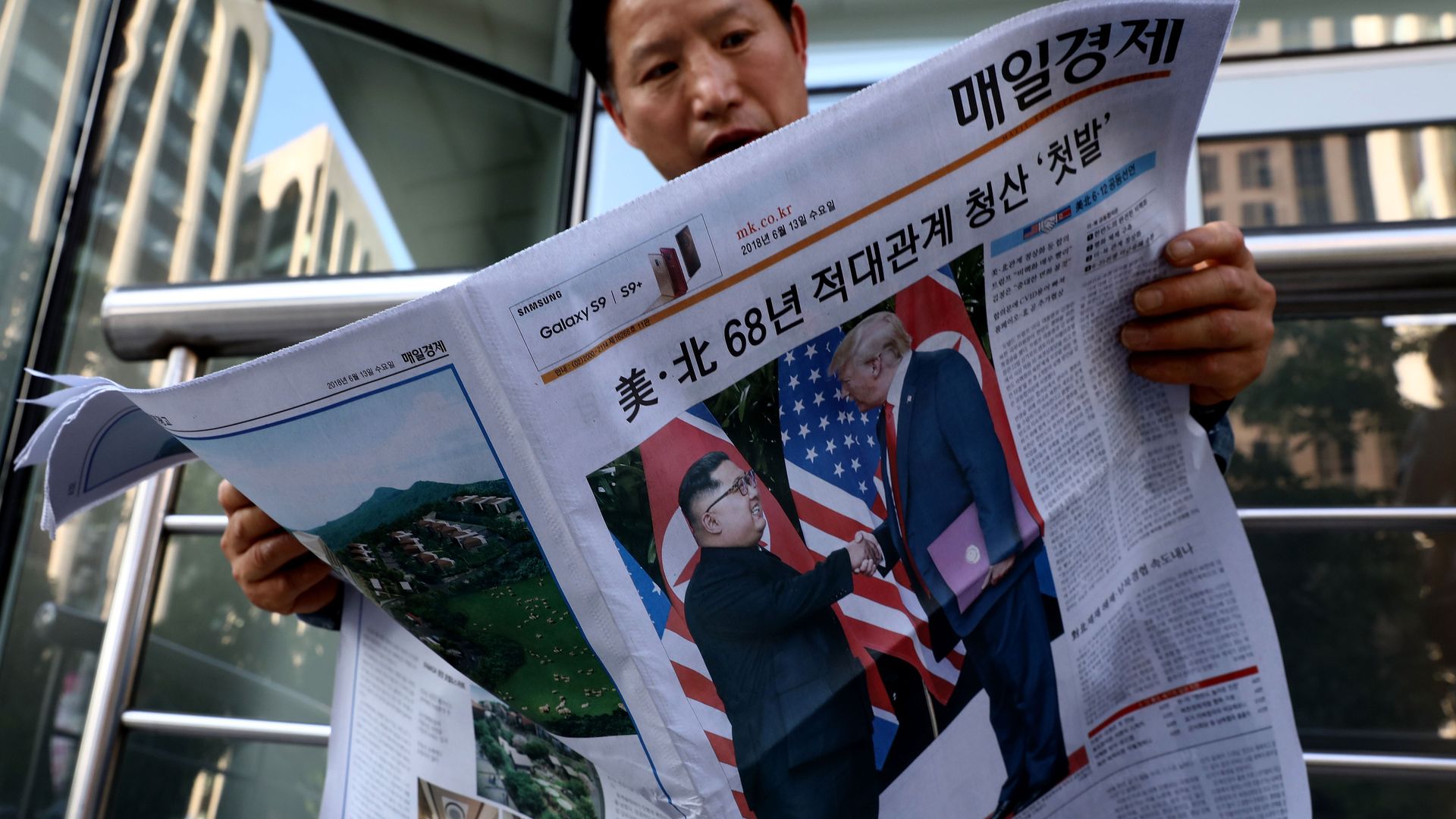
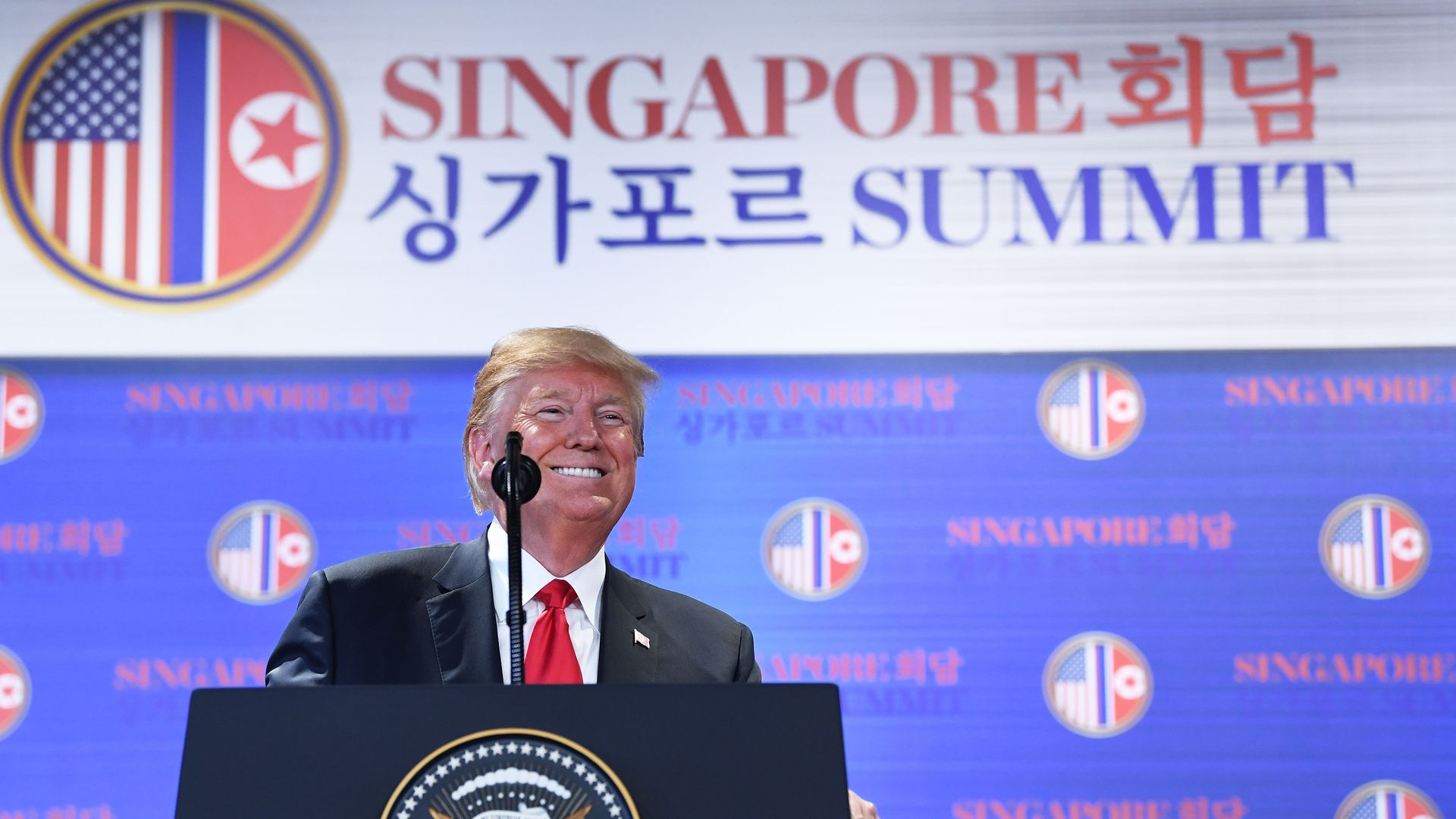
President Trump's summit with North Korean dictator Kim Jong-un, who he called "rocket man" just a year ago, has finally happened, and Trump is hailing it a success.
One big quote: "North Korea has great beaches. You see that whenever they're exploding cannons into the ocean... Wouldn't that make a great condo? ... You could have the best hotels in the world right there. Think of it from a real estate perspective. You have South Korea. You have China. And they own the land in the middle. How bad is that? Right? It's great."
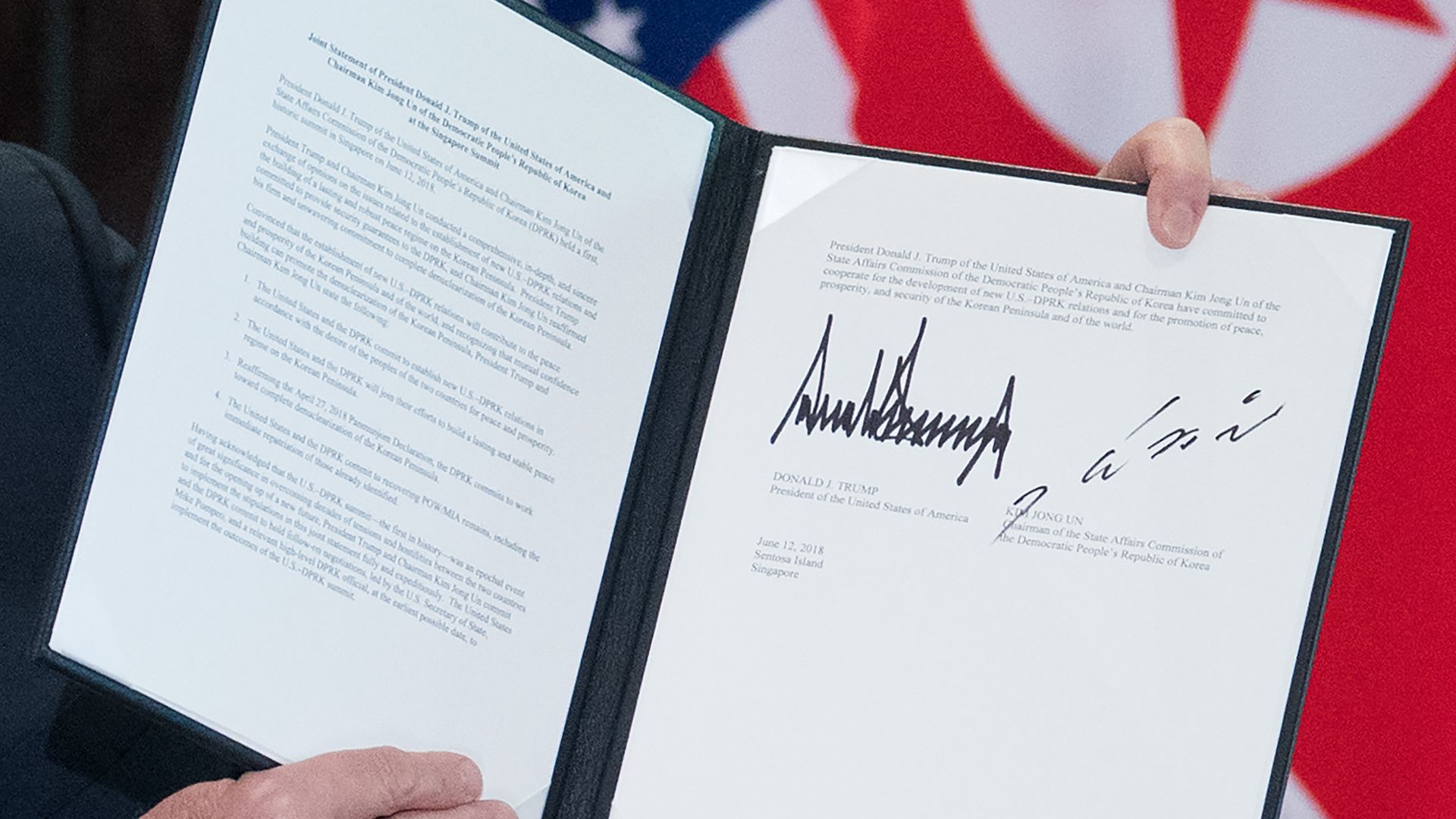
The big takeaway from the Singapore summit between President Trump and North Korean leader Kim Jong-un was a four-point document, signed by both leaders, committing their governments to the pursuit of peace.
The big picture: The deal's language around the process of denuclearization is vague, as North Korea wanted it to be. But experts say the short-term risk of military conflict between the two countries has dropped from "fire and fury" levels to nearly zero — a win for both sides, and the rest of the world.
The Singapore summit was textbook Trump, namely, his equation of the personal and chemistry with policy and accomplishment. The problem is less (as so many are saying) the legitimacy the president accorded the North Korean leader, so much as the one-sided outcome that yielded little in the way of substance.
Between the lines: The released statement is almost entirely aspirational. There are no definitions of denuclearization, no specifics as to the requirements of verification, and no timelines. History would suggest that implementation is everything when it comes to North Korea, yet there is nothing firm about what is to be done or when or how.
President Trump announced early Tuesday morning that the U.S. would be ending "war games" (joint military exercises) with South Korea, a significant concession to North Korea that does not appear to have been made in consultation with Seoul.
How it's playing: South Korea is reportedly seeking more information about what Trump meant. Bill Neely, NBC News' Chief Global Correspondent, tweets: "There is every indication from Seoul that the South Korean leadership and military did not know the US was about to cancel Joint Military exercises. 'We need to find out' they say. Stunning if true."
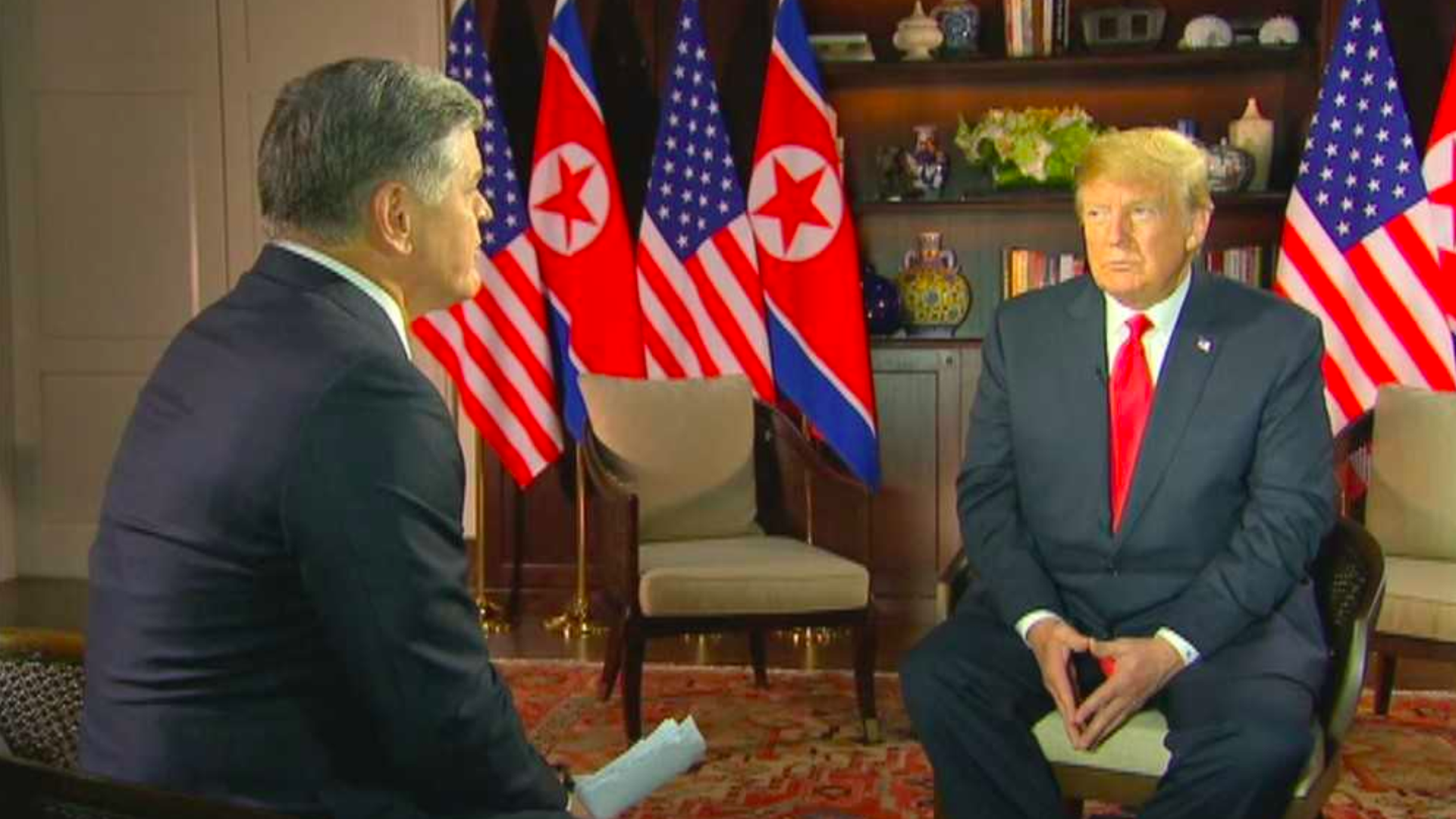
A first look at President Trump's interview with Fox News' Sean Hannity immediately after his Singapore summit with North Korean leader Kim Jong-un (airing in full at 9 p.m. ET):
"[O]ther administrations, I don’t want to get specific on that, but you know they had a policy of silence. If [North Korea] said something very bad and very threatening and horrible, just don’t answer. That’s not the answer. That’s not what you have to do. So I think the rhetoric — I hated to do it, sometimes I felt foolish doing it — but we had no choice."
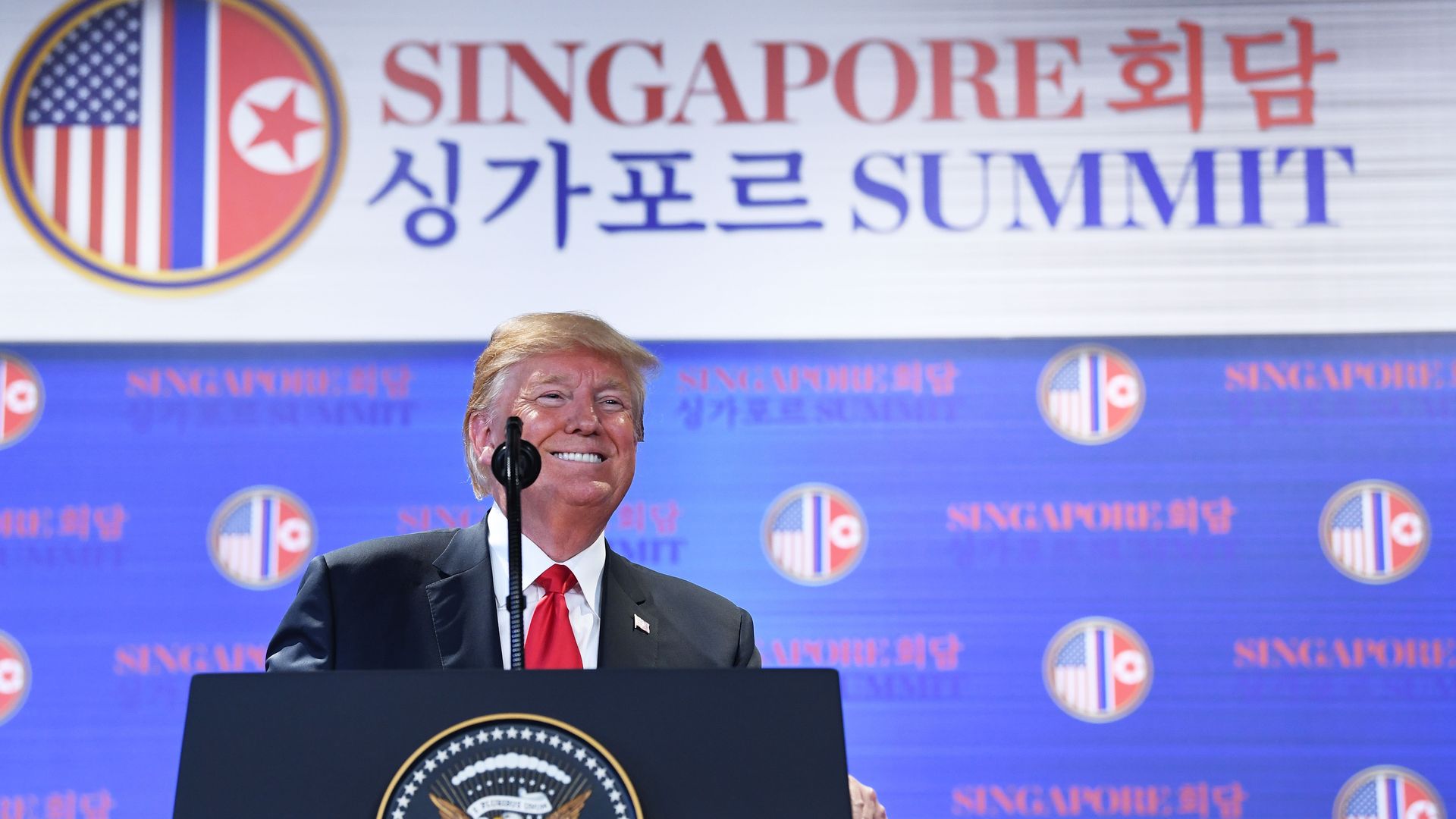
President Trump declared in Singapore at 4 a.m. ET that "real change is indeed possible," after a stunning summit with North Korean leader Kim Jong-un that was much longer on symbolism than substance.
What we're hearing: Ian Bremmer of Eurasia Group tells me, with his trademark punctuation, that the summit "benefits north korea more than the united states ... this is the same fuzzy formulation on 'denuclearization' that they promised the south koreans during their two summits."
The flash commentary immediately after the long awaited summit between President Trump and North Korean leader Kim Jong-un called the joint statement signed by both leaders a home run for Kim, with Trump basically signing a weak memorandum of understanding.
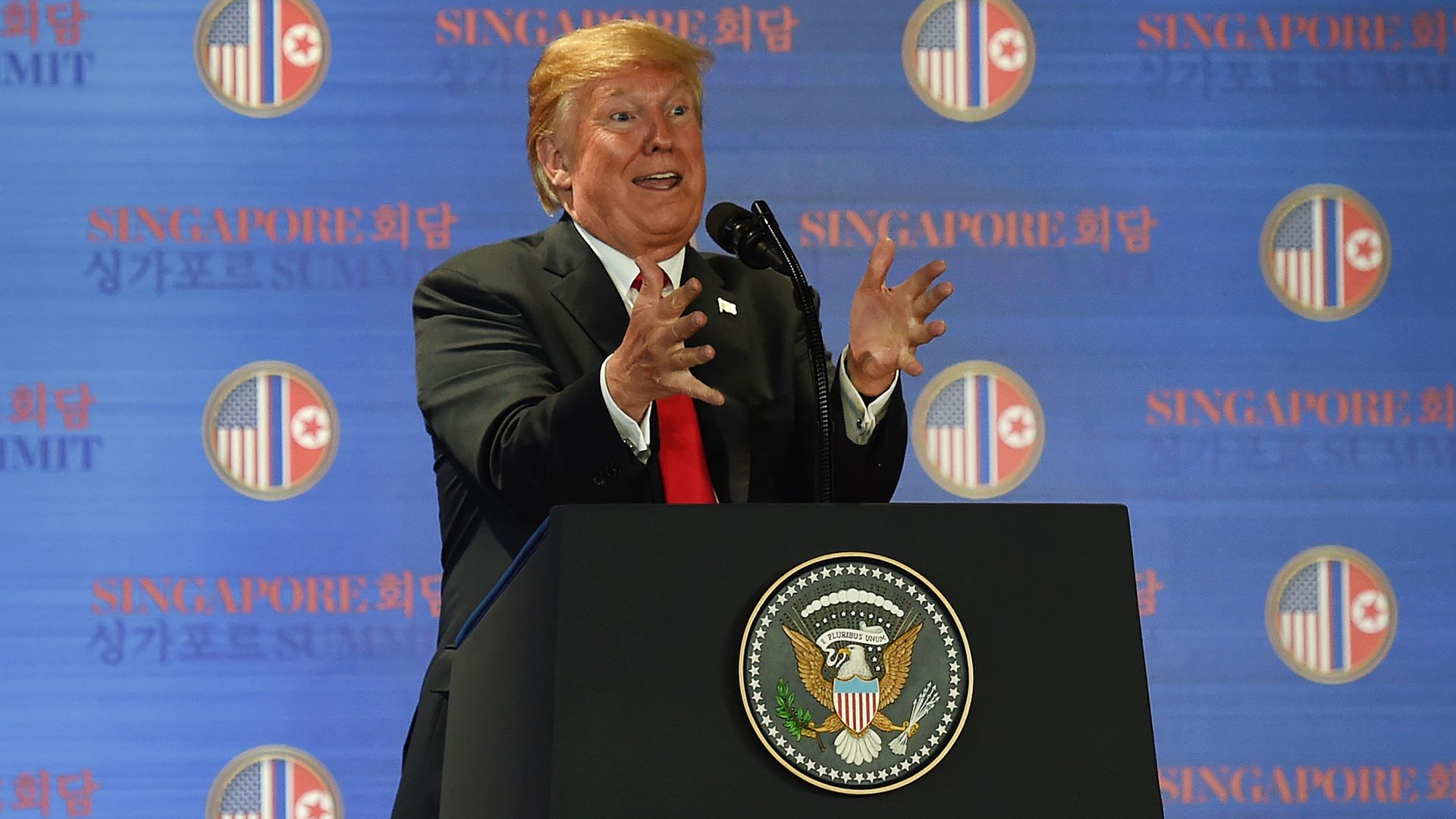
The big picture: Trump himself brushed back against that criticism at his post-summit press conference, painting it as a first step that would hopefully lead to substantial outcomes in the future: "[W]e haven't given up anything other than — you're right — I agreed to meet. … Only a person that dislikes Donald Trump would say that I’ve made a big commitment."
President Trump confirmed that the United States would be ending its joint military exercises with South Korea at a press conference after his summit with North Korean leader Kim Jong-un, calling them "a very provocative situation."
Why it matters: While North Korea has agreed to "complete denuclearization" of the Korean peninsula as its major concession, Trump was light on details about what that process might look like or how it could be verified.
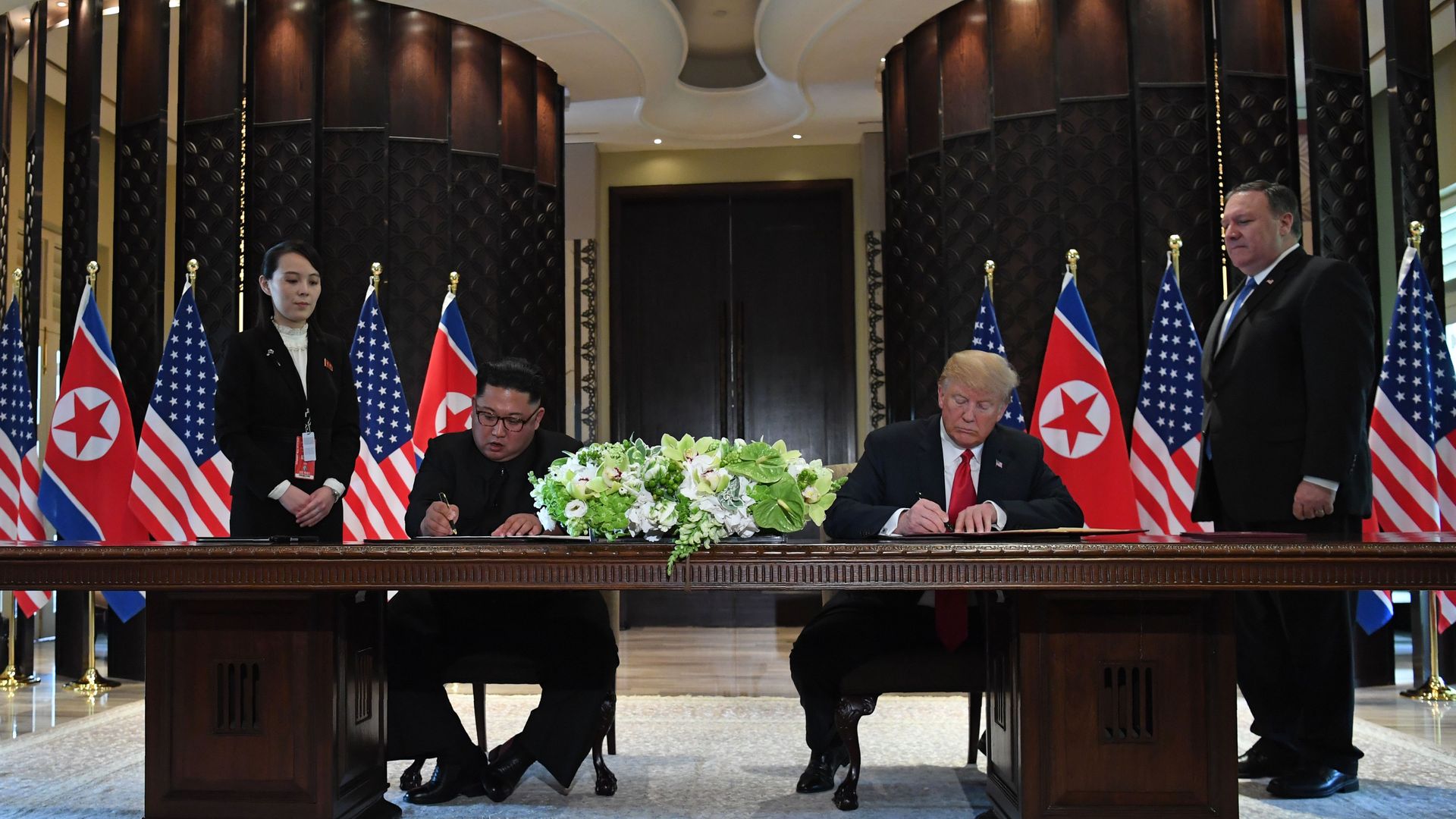
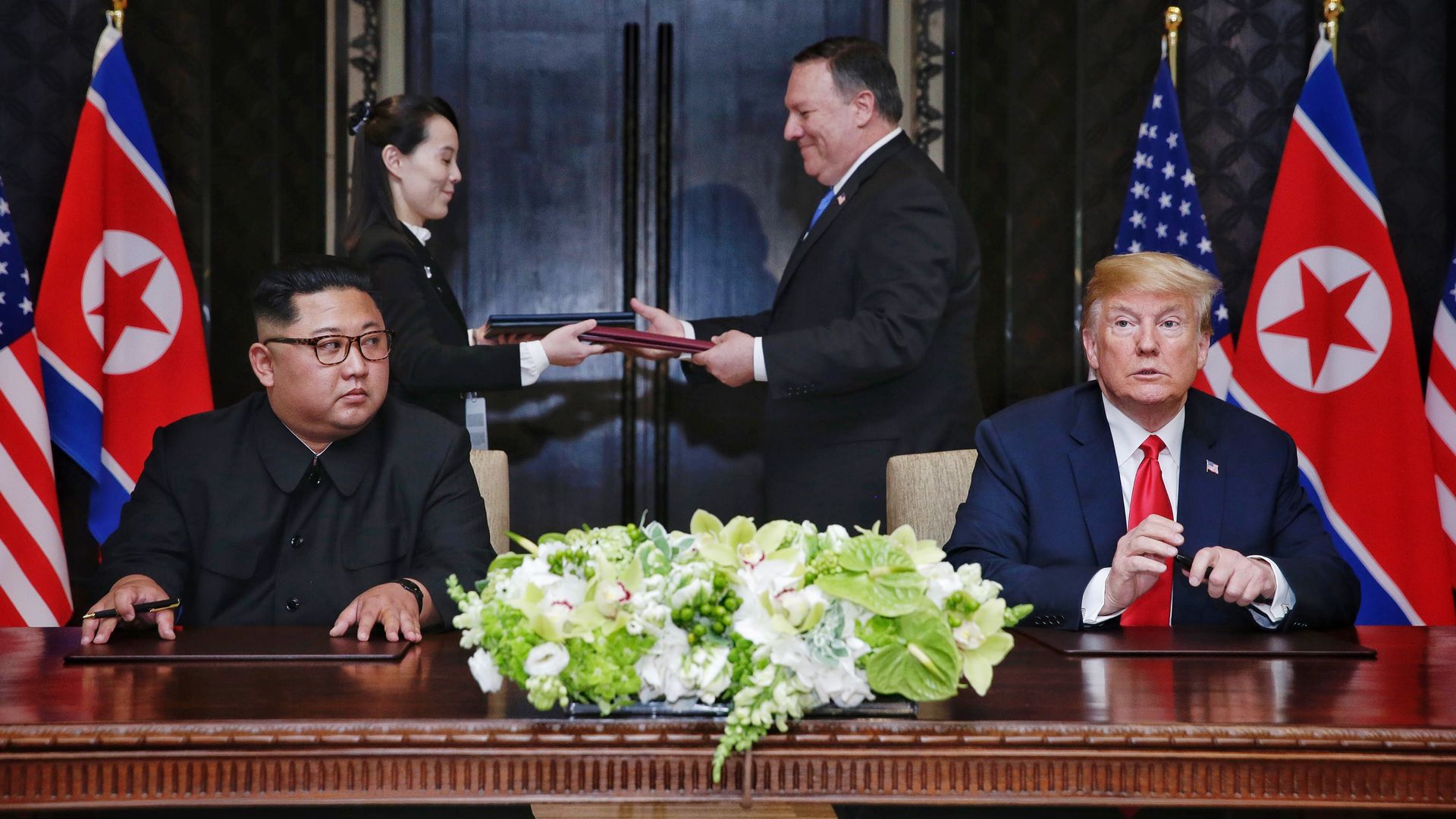
Following their day of meetings, President Trump and North Korean leader Kim Jong-un signed a document that Trump described as "very comprehensive," and Kim called "historic."
The details: At first, the leaders did not disclose what the document entailed, but a photo later revealed that it declares the North Korean regime will work toward the “complete denuclearization of the Korean peninsula” and commit to a “lasting and stable peace.” In return, Trump vowed to provide unspecified “security guarantees” to North Korea.
At the conclusion of their historic summit in Singapore Tuesday, President Trump and Kim Jong-un signed a document declaring the North Korean regime will work toward the “complete denuclearization of the Korean peninsula” and commit to a “lasting and stable peace.” In return, Trump vowed to provide unspecified “security guarantees” to North Korea.
Why it matters: The agreement, while a large step forward in what will likely be a lengthy process to normalize relations between the two countries, provides no details about how the U.S. and North Korea plan to achieve these goals. It also fails to define "complete denuclearization."
Dennis Rodman, the former NBA star and one of the few westerners to have met Kim Jong-un, spoke from Singapore to CNN's Chris Cuomo tonight, and said an aide to President Trump had called to pass on a message: "Donald Trump is so proud of you, he thanks you a lot."
Why it matters: Rodman said in one of their meetings Kim gave him conditions that could help improve relations with the U.S., but the Obama administration "didn’t give me the time of day." He also discussed his impressions of Kim, saying he seemed to understand some English, and is "like a big kid" who "loves to have a good time." Rodman also said Kim "wants to be around the world. He wants to come to America," but "politics" have stood in the way.