Democratic lawmakers, united in their fury over DOGE, are diverging on how to use President Trump's address to Congress next week as the effective launchpad for Resistance 2.0.
Why it matters: It's a question that has repeatedly splintered party members when faced with inflammatory speecheson Capitol Hill: Should they show up and protest from within, or boycott and counterprogram on the outside?
A parade of European leaders issued statements of solidarity with Ukrainian President Volodymyr Zelensky after his stunning confrontation with President Trump in the Oval Office on Friday.
Why it matters: Trump has plunged the U.S. into a state of unprecedented isolation on the world stage. Ukraine's fate is deeply uncertain, as the country is now at risk of losing its most important partner in the three-year fight against Russia's invasion.
President Trump and his top advisers huddled in the Oval Office after the on-camera shouting match with Ukrainian President Volodymyr Zelensky on Friday before Trump came to a decision: Zelensky had to go.
Behind the scenes: The delegation from Kyiv waited in another room for about an hour, still hoping to sign the minerals deal that prompted Zelensky's trip and to salvage the visit. Trump and Zelensky were still scheduled to have lunch and hold a joint press conference.
Sen. Lindsey Graham (R-S.C.) said Ukrainian President Volodymyr Zelensky will have to "fundamentally change or go" after a contentious meeting with President Trump on Friday.
Why it matters: Graham has been outspoken in support of Ukraine and for ending Russia's war, but he said he doubts Zelensky can redeem Americans' perception of him after the meeting.
President Trump's explosive Oval Office meeting with Ukrainian President Volodymyr Zelensky shocked hawkish Republican lawmakers and led one prominent GOP backer of Ukraine to suggest that Zelensky should resign.
Why it matters: The meeting angered Democrats, who were horrified by Trump and Vice President Vance's conduct. It offended some Republicans, with most of them reserving their ire for Zelensky.
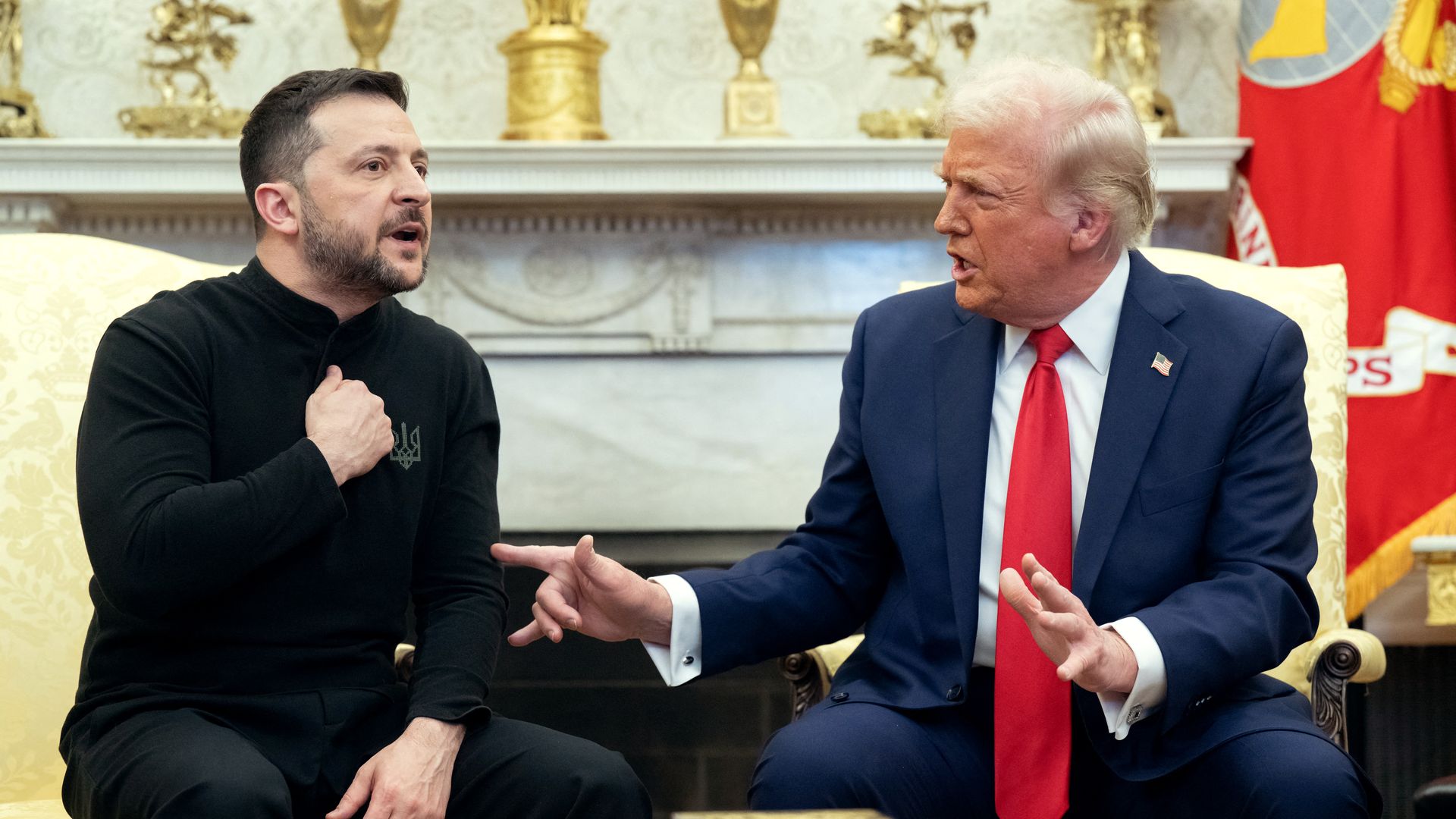
The main event of Ukrainian President Volodymyr Zelensky's visit to the White House was supposed to be the signing of a minerals deal, but it quickly devolved into a heated argument with President Trump and Vice President Vance.
The latest: After an explosive Oval Office meeting in front of the press, Trump released a statement saying that he had determined Zelensky is "not ready for Peace if America is involved." Lunch and a joint press conference between the two leaders were canceled.
The number of immigrants held in detention under U.S. Immigration and Customs Enforcement (ICE) has hit the highest level in more than five years, new data show.
Why it matters: The detention surge comes as the Trump administration steps up immigration enforcement and seeks to expand the capacity to detain more immigrants amid a months-long backlog with immigration judges.
President Trump and Vice President Vance's Oval Office meeting with Ukrainian President Volodymyr Zelensky Friday quickly turned into a heated argument.
Why it matters: The meeting devolved into a shouting match, with Vance accusing Zelensky of disrespect and of misleading visitors by taking them on "propaganda tours," and Zelensky retorting that Vance had never visited Ukraine.
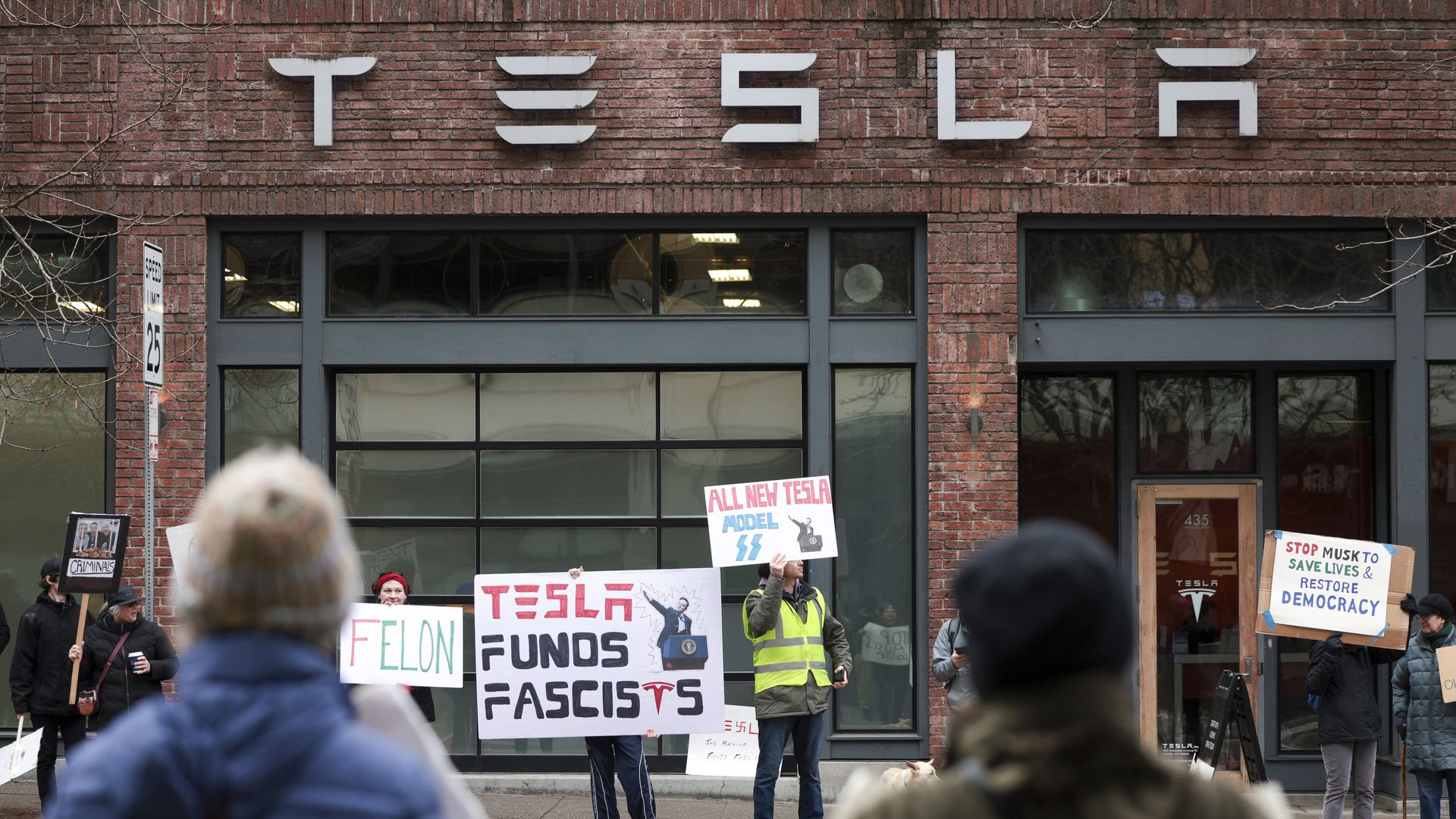
Elon Musk's Tesla has become a rallying point for protestors outraged with how the world's richest man has insinuated himself into President Trump's administration and led efforts to slash government agencies.
Why it matters: The #TeslaTakedown protests at Tesla locations nationwide are one of the first signs of grassroots backlash to Musk's role in the Trump administration, targeting his flagship company.
It's that time again: Washington is coming to its periodic realization that there is no real way to address the nation's spiraling debt without touching health programs. And Republicans are relearning that even Medicaid — the program deemed least politically risky to change — is a lightning rod.
Why it matters: Policymakers really have two choices outside of major tax increases. They can leave health care and entitlement programs alone and see what happens as the debt continues to balloon, or they can launch a war on spending that will make recent health care battles seem like child's play.
In the meantime, powerful and wealthy health care industry groups are really just vying to shoulder the least pain if and when the real cuts come.
Driving the news: The House GOP narrowly passed its budget resolution this week, meaning its quest to reduce the federal deficit by somewhere between $1.5 and $2 trillion — while extending trillions of dollars in tax cuts passed during Trump's first term — lives another week.
It still seems pretty likely that members will have to turn to Medicaid for some of that money if they remain serious about their cost-cutting goals.
But it's hard to say for sure how much Medicaid spending will end up being reduced, if at all. Many Republicans have now expressed their qualms about cutting the program too deeply amid significant backlash, and a key committee chairman said this week that one leading policy idea — per capita caps — is moving toward the back burner.
President Trump, for his part, said once again that Medicaid won't be touched, but that "we are going to look for fraud." (So be on the lookout for certain Medicaid reforms to be framed as addressing fraud!)
This is all a familiar song and dance: Ambitious ideas about reducing health care spending quickly run into political reality, which includes heavy backlash from the health care industry.
If anything, it's worse now for Republicans than it's ever been, as more and more of their voters include the low-income working class people who depend on Medicaid (and more hospitals benefit from expanded Medicaid coverage).
The program covers 1 in 5 Americans, including low-income people, people with disabilities and millions of children. It also accounts for a fifth of all health care spending and more than half of long-term care spending, per KFF.
At the same time, Americans want their health care spending reduced. A recent Pew survey on American's economic concerns found that 67% of respondents said the affordability of health care is a very big problem for the country — ranking above inflation and the federal budget deficit.
That's a 10 percentage point rise from last year, when 57% said health care affordability was a big national problem.
Any federal policy changes resulting in more uninsured Americans, fewer covered benefits or more out-of-pocket expenses would just make care less — not more — affordable for the people impacted.
But policy changes that cause massive disruption or more limited access to top-of-the-line services also tend to be unpopular, historically tying the hands of policymakers.
The big picture: If you remember two things about the U.S. health care system, let them be that it's the most expensive in the world by far, and yet it produces worse health outcomes in the U.S. than in other wealthy countries.
Americans are — and have been — sick of paying ever-rising health care costs, and yet year after year they keep going up for both patients and taxpayers without actual health results to justify the prices.
Meanwhile, many of the biggest health care companies have continued to see their stock prices soar.
Between the lines: The solution to unaffordable health care costs for consumers has usually been some version of new government spending.
There's only one way to reduce what both the government and patients pay for care: reducing prices.
And that means policy that would directly target the health care industry.
The bottom line: The screaming you hear now from patient advocacy and hospital groups is nothing compared with the uproar that would be caused if Congress ever went after Medicare or commercial insurance.
But the source of that uproar may depend on what kind of spending cuts we're talking about. For example, when Democrats went after pharma and drug prices by allowing Medicare to negotiate with manufacturers, consumer groups cheered them on.
The more public sentiment sours on any one particular group, the easier it is for policymakers to make changes that group doesn't like.
And in a world where patients are enraged with insurers for care denials or hospitals for their billing practices, those groups may not be as protected as they used to be if lawmakers decide to turn their attention to prices.
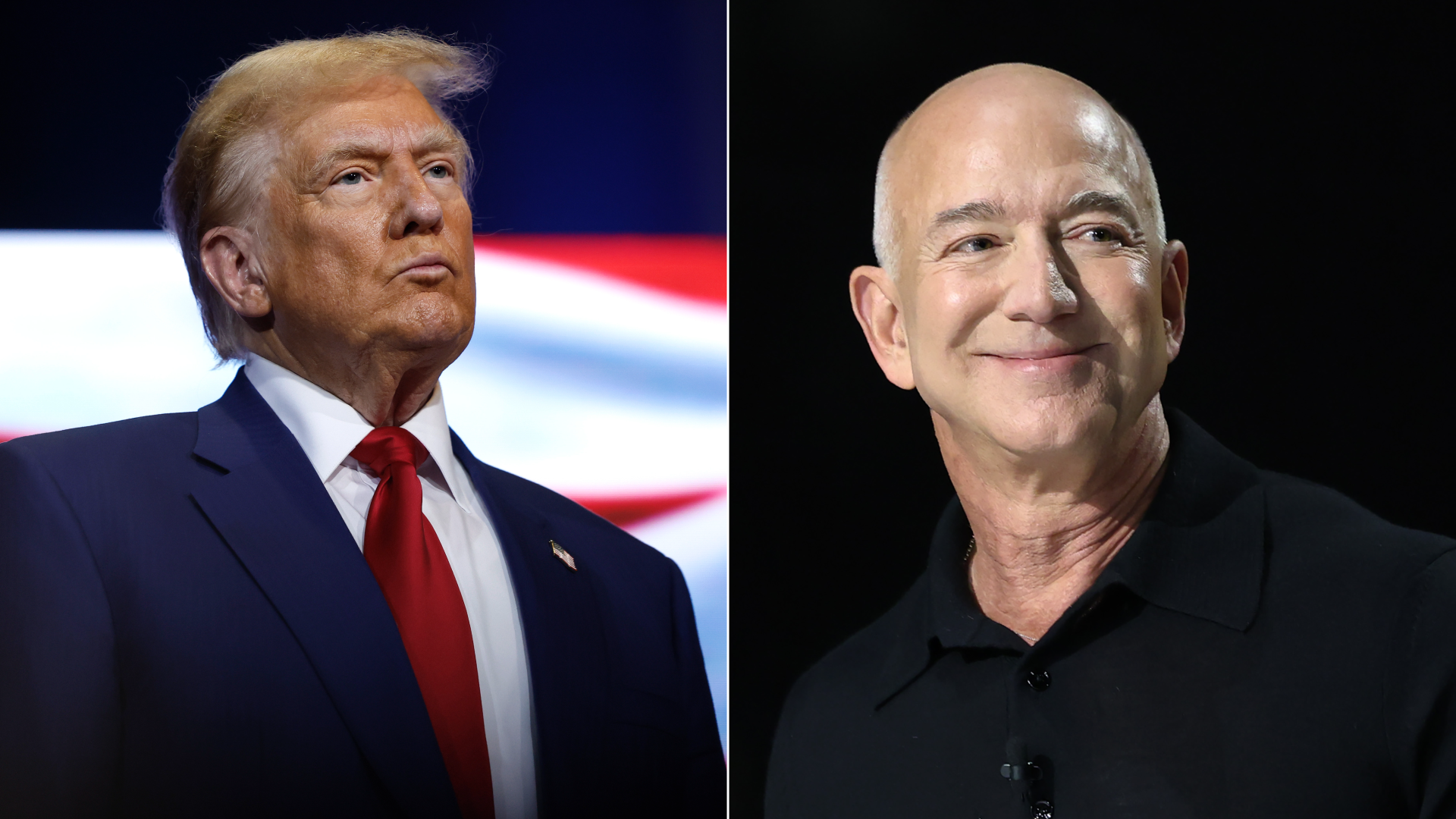
Why it matters: The dinner between Trump and Bezos happened the night Bezos announced changes to the Washington Post opinion section. It's another sign of Trump and Bezos' growing closeness.
The U.S. trade deficit for goods widened sharply in January, a result of a record surge of products imported into the country, the Commerce Department said on Friday.
Why it matters: For yet another month, manufacturers and businesses raced to bring goods into the country to get ahead of potential tariffs implemented by President Trump.
The cuts of about 800 probationary employees at the National Oceanic and Atmospheric Administration sliced deep into the agency tasked with a range of safety missions.
Why it matters: The cuts spared "only some" specialists at its National Weather Service, according to a congressional aide speaking on condition of anonymity.
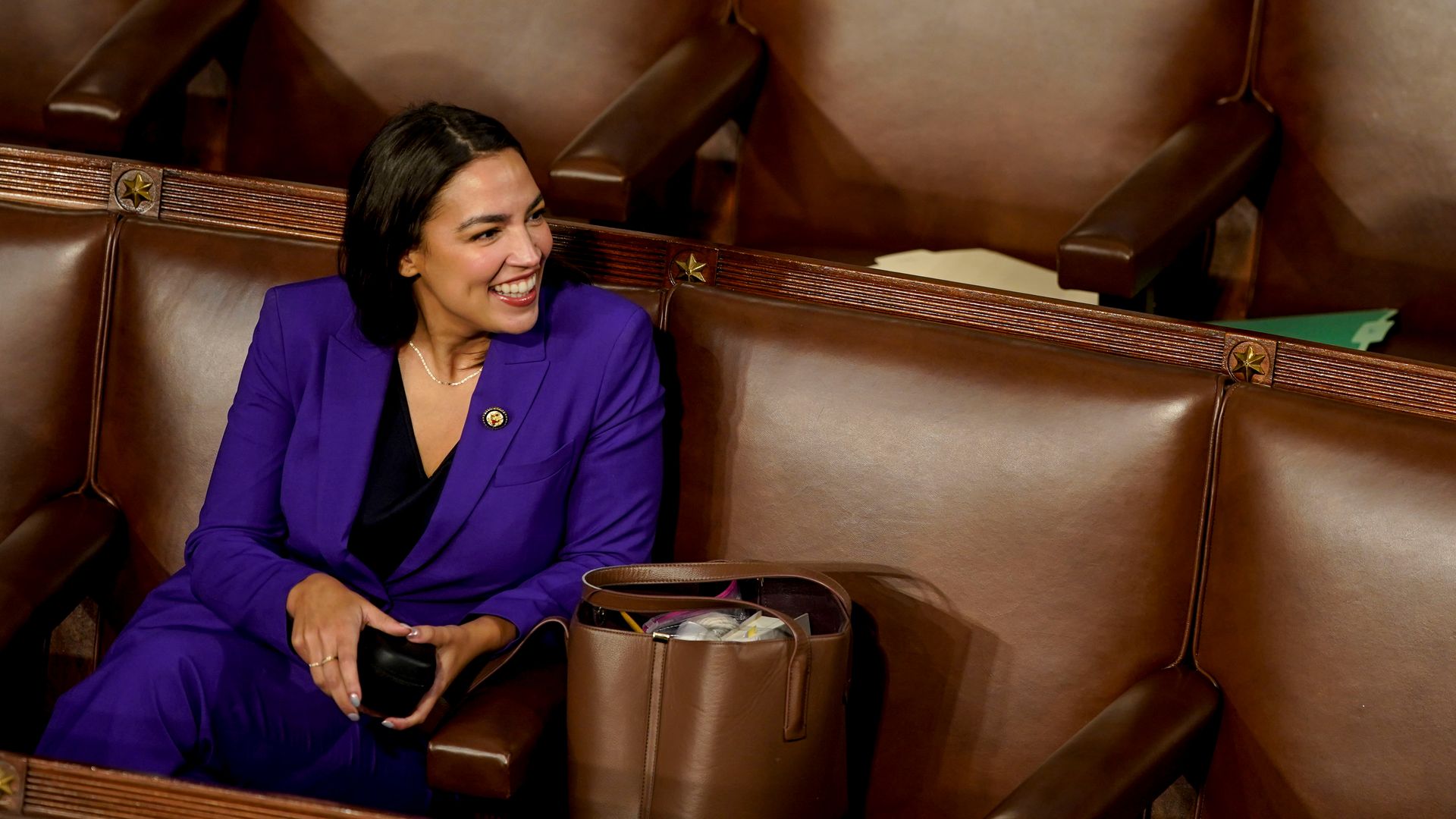
Rep. Alexandria Ocasio-Cortez (D-N.Y.) on Friday wrote to Attorney General Pam Bondi asking if she is under investigation for advising constituents on how to communicate with immigration officers.
Why it matters: Ocasio-Cortez is not the first congressional Democrat to accuse the Trump administration of unfairly targeting them with the threat of federal prosecution.
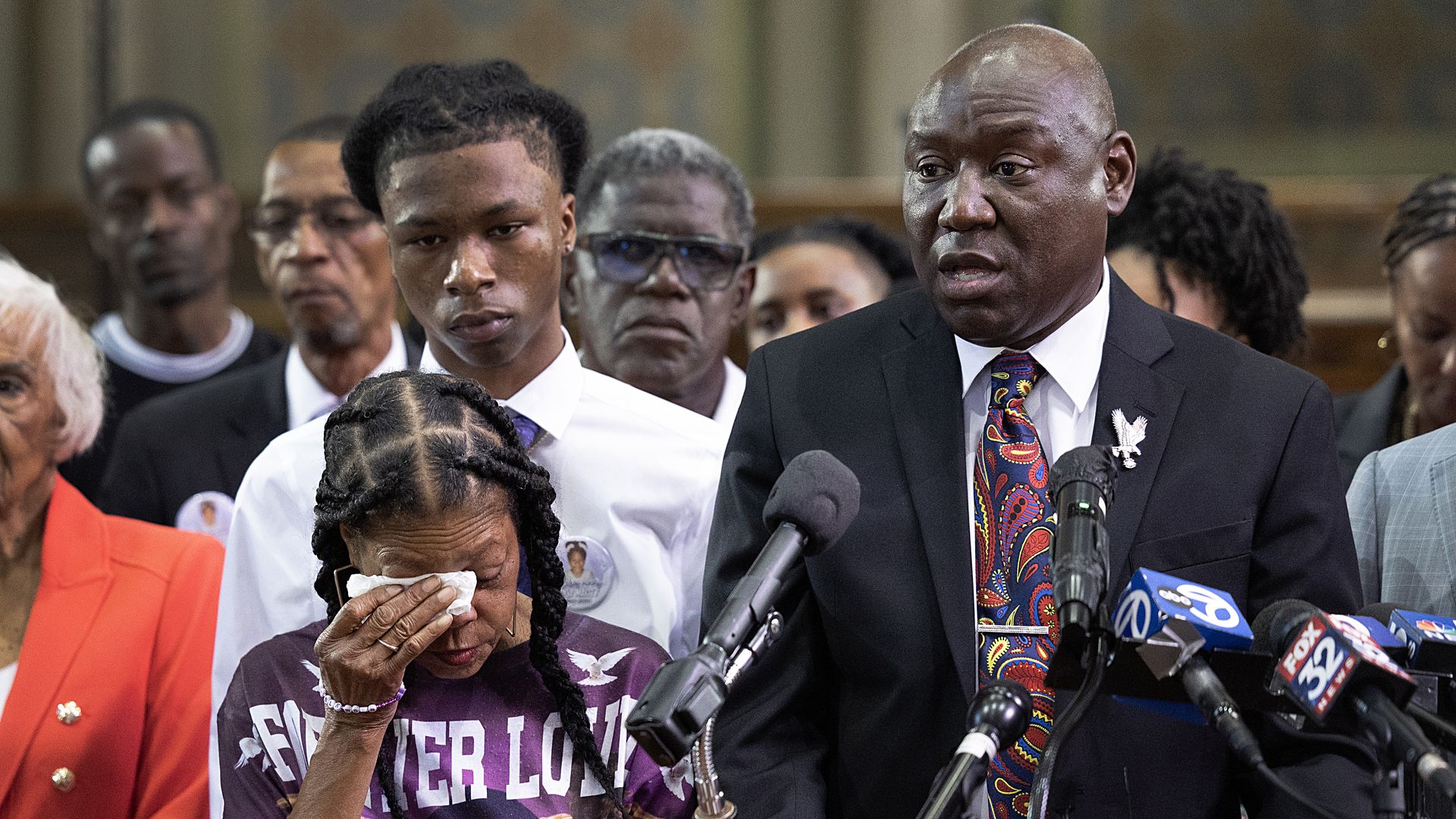
Civil rights attorney Benjamin Crump is calling for the expansion of crisis intervention programs as new data shows police killings hit a record high in 2024 — despite a national decline in violent crime.
Why it matters: Crump and Cheyenne Bryant are pushing for nationwide crisis intervention models that divert mental health-related 911 calls to trained professionals instead of police.
It'll be a long, uncertain road from Friday's signing of the U.S.-Ukraineminerals deal to development of resources and revenue that President Trump covets.
The big picture: The pact would create a joint reconstruction fund, partly used to reinvest in Ukrainian minerals, energy and infrastructure projects.
President Trump has proposed abolishing the EB-5 visa for immigrants willing to invest in the U.S., and replacing it with a "gold card" that, he said, could see enough demand to eliminate the national debt.
Why it matters: For all of Trump's debt-busting dreams, realistic demand for any such program is likely to be in the thousands of people, not the millions.
While President's Trump nominee for Consumer Financial Protection Bureau director, Jonathan McKernan, was earnestly taking questions from senators about the job on Thursday, the agency made some other news.
The CFPB dropped five lawsuits filed against financial institutions under the previous director.
Why it matters: McKernan is likely to get the gig, but as the White House moves to gut the agency it is not totally clear what he can even do with the job.
Evan Osnos, a staff writer at The New Yorker since 2008, will be out June 3 with "The Haves and Have-Yachts," which he calls a "field guide to the ultrarich."
Why it matters: The book, a collection of his New Yorker pieces, "aims to capture the thinking and behavior of some of the world's most powerful people," Osnos tells Axios.
"By assessing their tactics and obsessions, their manners and delusions, it attempts to show how the very rich see themselves and how they see the world that they increasingly control."
The international order forged after World War II is imploding, squeezed on all sides by the return of strongmen, nationalism and spheres of influence — with President Trump leading the charge.
Why it matters: Trump is openly scornful of international institutions and traditional alliances. Instead, he sees great opportunity in a world dominated by superpowers and dictated through dealmaking.
Vice President Vance will give a keynote address at a tech summit in Washington next month, underscoring the Trump administration's focus on artificial intelligence and advanced computing.
Why it matters: Vance, a former venture capitalist, has helped draw Silicon Valley's tech sector more closely than ever to the nation's capital.
Ontario Premier Doug Ford said in claiming a third straight victory for his Progressive Conservatives in the province's election Thursday he'd been given a "mandate" to "stand up" to President Trump's threats to hit Canada with tariffs.
What he's saying: "Donald Trump thinks he can break us," said Ford, who called a snap election this month in response to Trump's threat to impose 25% tariffs on all Canadian and Mexican imports unless they tighten border security.
The human papillomavirus (HPV) vaccine is having a huge impact on cervical cancer prevention among young women, a U.S. government report published Thursday suggests.
Why it matters: The CDC report shows that rates of precancerous lesions among women aged 20-24 screened for cervical cancer dropped by about 80% from 2008 to 2022. The report comes just days after Robert F. Kennedy Jr. — who once called the HPV vaccine "dangerous and defective" — was confirmed as health and human services secretary.
Mexico extradited 29 people accused of being involved in drug cartels to the U.S. on Thursday, the Department of Justice announced.
The big picture: The move is a part ofPresident Trump's vow to crack down on cartels for what he called in an executive order a "campaign of violence and terror" that saw him designate eight drug cartels as global terrorist organizations last week.
Data: Pew Research Center; Chart: Jacque Schrag/Axios.
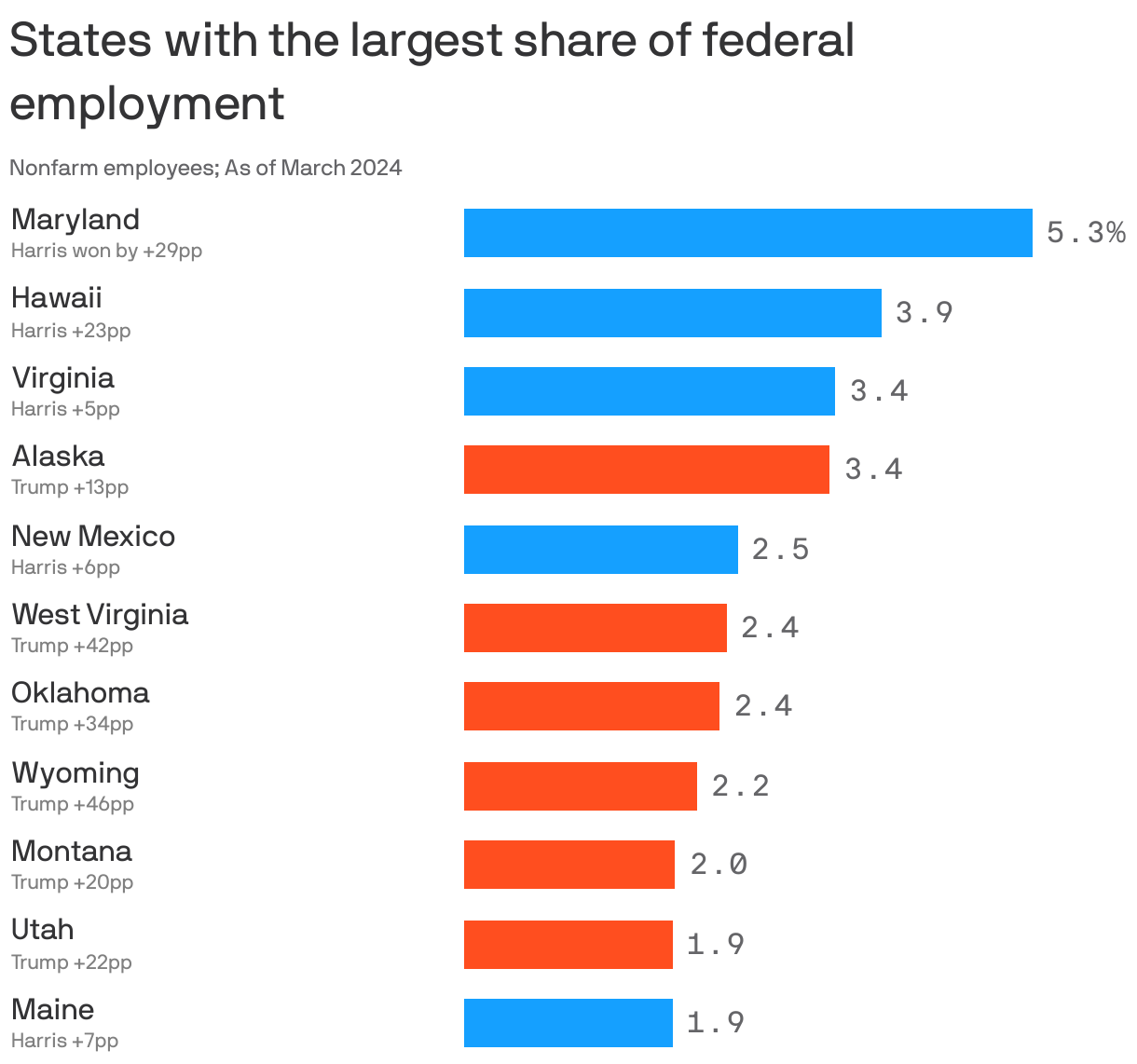
President Trump and Elon Musk's campaign to shrink the federal government will be felt far outside the nation's capital — in deep red states as well as blue.
Why it matters: Some GOP lawmakers are already hearing from constituents and raising the alarm about the haphazard way federal employees are getting canned.
Senate Democrats are quietly discussing how to avoid a government shutdown by adjusting some of their demands on President Trump and Elon Musk's spending freezes and mass firings.
Why it matters: A shutdown could make life even worse for federal workers, and appearing to want a shutdown is bad politics for Democrats.
House Republicans notched a major legislative victory this week when they passed their budget resolution. Now comes the hard part: Crafting a fiscal package that doesn't doom them in the 2026 election.
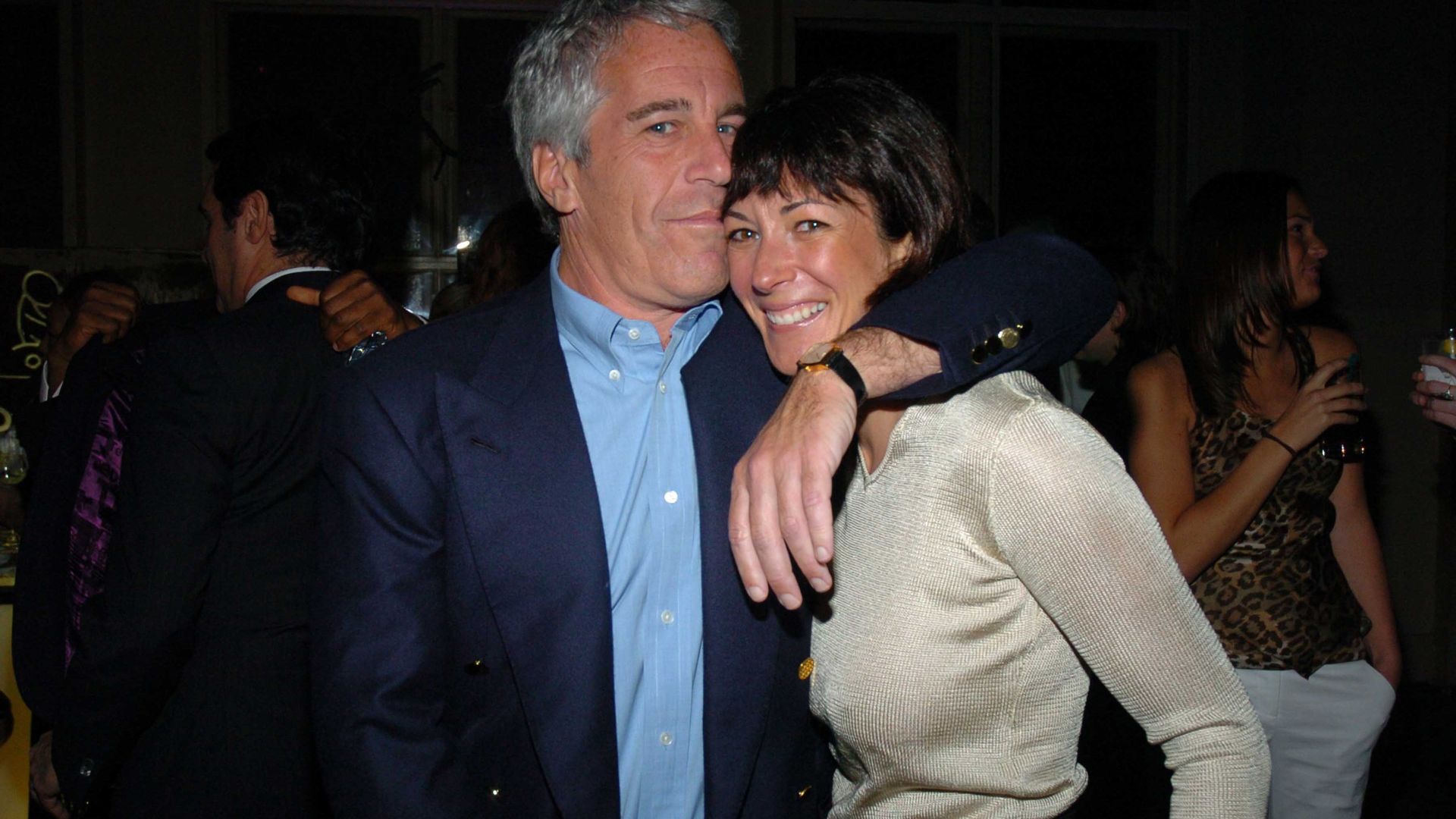
The Department of Justice released more than 100pages of documents related to Jeffrey Epstein on Thursday. The documents released by Attorney General Pam Bondi include flight logs, a redacted contact book and masseuse list and an evidence list.
Zoom out: The Trump administration is moving to release documents in a range of high-profile cases, such as the JFK assassination.
A federal judge ordered the Office of Personnel Management on Thursday to revoke instructions to fire probationary government workers across several agencies.
The big picture: The ruling fromU.S. District Judge William Alsup, which found that the firings were likely illegal, poses one of the largest hurdles yet to President Trump's goal of shrinking the federal workforce.


























/2025/02/28/1740712784324.gif?w=3840)