Civil rights lawyer Ben Crump calls for mental health reform in policing

Add Axios as your preferred source to
see more of our stories on Google.
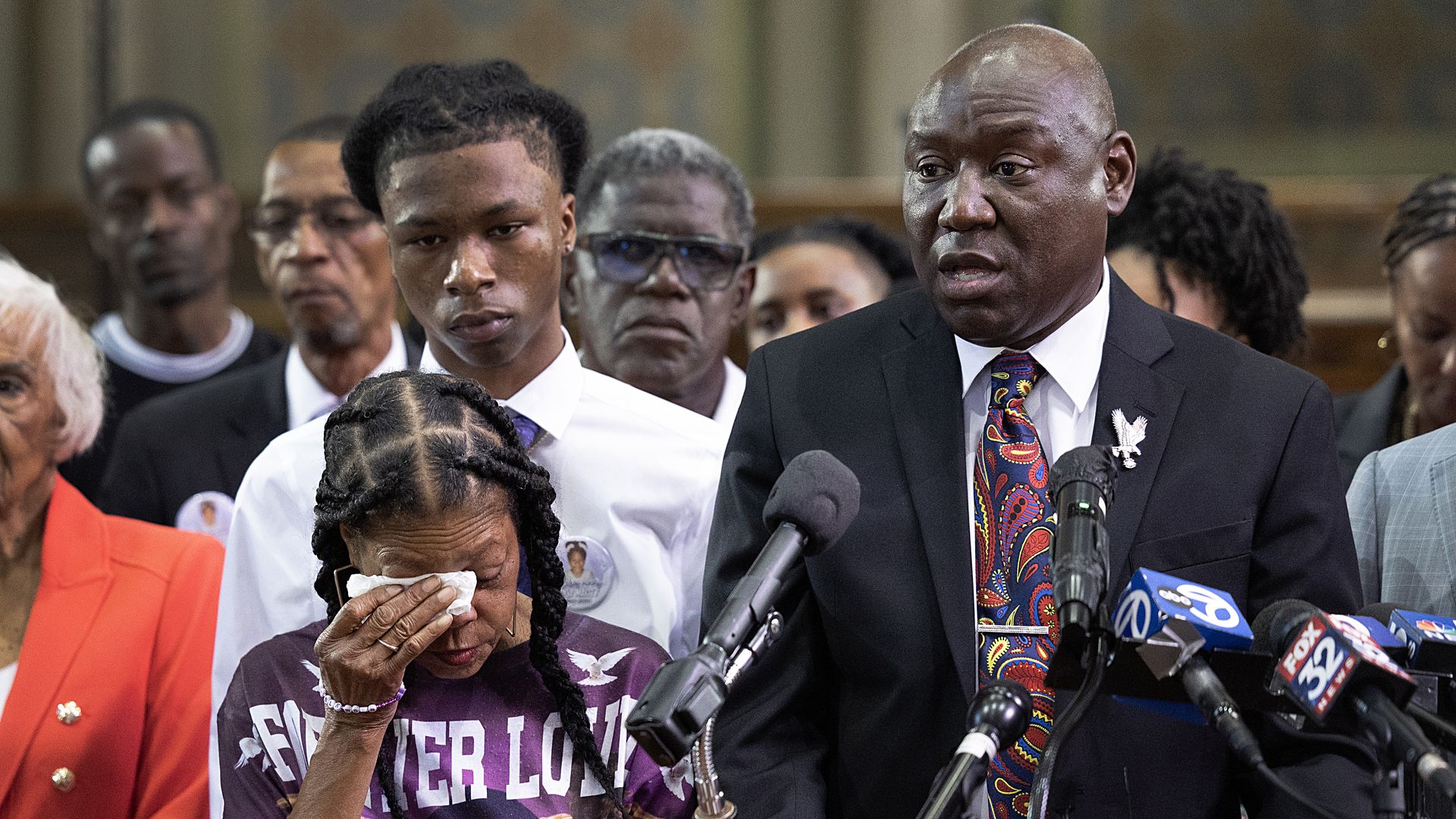
Donna Massey, the mother of shooting victim Sonya Massey, wipes away tears during a press conference with attorney Ben Crump at New Mount Pilgrim Church in Chicago last July. Photo: Scott Olson/Getty Images
Civil rights attorney Benjamin Crump is calling for the expansion of crisis intervention programs as new data shows police killings hit a record high in 2024 — despite a national decline in violent crime.
Why it matters: Crump and Cheyenne Bryant are pushing for nationwide crisis intervention models that divert mental health-related 911 calls to trained professionals instead of police.
- As the fifth anniversary of George Floyd's murder nears, data suggests a need for police reforms, clashing with President Trump's termination of misconduct reduction initiatives.
Earlier this year, Crump and Bryant, a psychologist and NAACP leader, convened a critical panel discussion on mental health and bail reform at Paul Quinn College in Dallas, emphasizing the urgent need for systemic change in law enforcement practices.
- Crump, who is based in Houston, and Bryant spotlighted the disproportionate impact of these issues on Black communities and offered actionable solutions to prevent future tragedies.
- "Reform isn't just necessary — it's urgent. Bail reform and mental health interventions can save lives and restore fairness to a system that has failed too many for too long," Crump told Axios.
Friction point: Campaign Zero says most of those killed had called the police for help, and nearly a quarter had shown signs of mental illness before dying at the hands of law enforcement.
By the numbers: The new data indicates that 2024 was the deadliest year for police violence since 2013, with 1,365 individuals killed by law enforcement.
- Most police killings stemmed from 911 calls — 64.6% of incidents happened when someone called the police for help, according to the report.
- Among cases in which victims' mental health information was available, 1 in 5 people killed by police showed signs of mental illness.
What they're saying: Abdul Nasser Rad, managing director of research and data at Campaign Zero, said the increase in police violence, despite the nationwide decline in homicides and violent crime, is "a deeply troubling trend that requires data-driven solutions."
Notable cases, including the deaths of Pamela Turner and Sonya Massey, underscore how insufficient mental health support can lead to fatal police encounters.
Zoom out: A growing number of law enforcement agencies, including Denver, Des Moines, Minneapolis and San Antonio, have created units that:
- Typically dispatch mental health professionals and paramedics alongside police officers to 911 calls by making staff available 24 hours a day.
- Team an officer with a clinician who evaluates and determines whether hospitalization, clinical treatment or medication is needed.
- Send a behavioral health clinician and a paramedic to low-level calls for welfare checks and trespassing.
- Work with a city contractor that sends vans of small teams to aid people experiencing mental health crises.
San Antonio expanded its program, which sends mental health professionals and paramedics alongside police officers to some 911 calls, after police killed Melissa Perez, who was experiencing a mental health crisis, in 2023.
- Mental health clinicians with the program did not reach Perez in part because of the program's limited hours.
Between the lines: Crump observed that some efforts to address behavioral health are still limited and inconsistent. However, he emphasized the significance of expanding these initiatives.
- "When mental health professionals are involved, it prevents excessive-force tragedies and promotes smarter policing," he said.
Bryant framed the issue as one requiring cultural competence and preventive measures in policing. She argued for the implementation of mandated mental health training for officers and diversion programs to steer individuals away from incarceration and toward treatment.
- "Trauma manifests differently in Black communities," she said. "Officers must be trained not only in cultural competence but also in recognizing trauma responses. Without this understanding, we risk escalating situations that could otherwise be de-escalated."
- Bryant called for quarterly mental health evaluations for law enforcement officers, citing studies that show they are twice as likely as the general population to experience depression.
- "If officers are impaired by untreated mental health issues, how can they safely and effectively police our communities?" she asked.
What's next: Crump and Bryant plan to expand this conversation to other cities profoundly affected by police violence, including Los Angeles, Chicago and Atlanta.
- Reflecting on the toll of his work, Crump emphasized the need for collective action. "Nobody is going to save us but us," he said. "We must remain strategic and focused on creating lasting solutions."
