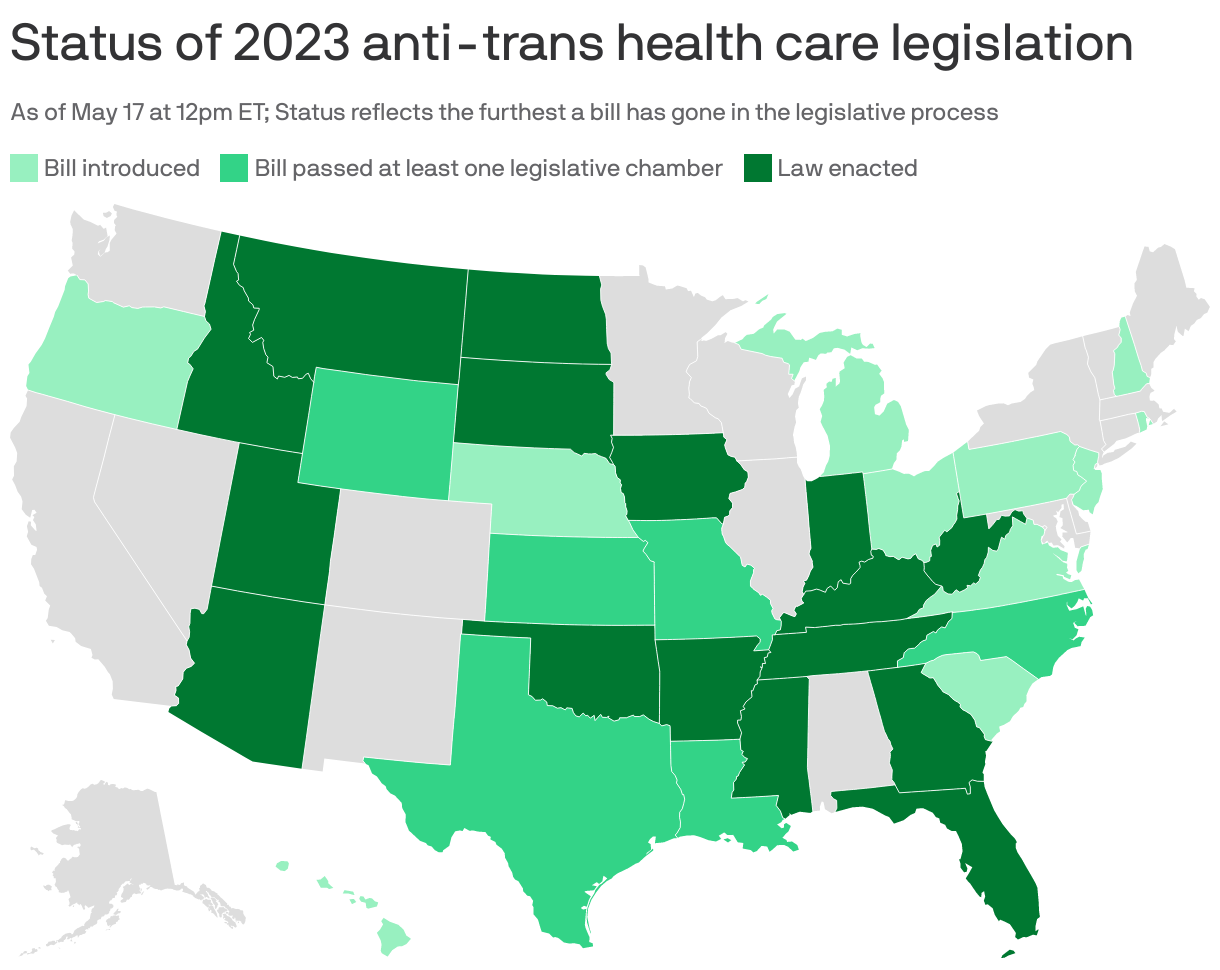
A bill that would prohibit doctors from providing some gender-affirming care to children under 18 is headed to Texas Gov. Greg Abbott's desk after the legislation passed in the state's Republican-controlled Senate on Wednesday.
Food and Drug Administration advisers on Thursday endorsed giving pregnant people an experimental Pfizer vaccine to protect infants against respiratory syncytial virus, despite concerns about insufficient data on safety risks.
Why it matters: RSV is a leading cause of death for infants worldwide, particularly those under six months, but finding an effective vaccine has challenged scientists for decades.
How it works: Pfizer’s vaccine would prevent severe illness in infants in their first six months by creating neutralizing antibodies that can be transferred in the womb.
Trial data analyzed by federal regulators found that the shot had an 82% efficacy rate at protecting infants in their first three months.
It had a 69% efficacy rate at preventing severe illness at six months.
Yes, but: While the FDA’s 14 outside advisers unanimously voted the shot was effective, four voted no on the question of whether it was safe, saying there wasn't enough data.
Some panelists noted concerns about preterm births — a safety risk which led GlaxoSmithKline to halt a trial of an RSV vaccine last year. A Pfizer official said there is no definitive evidence of increased risk.
Other members, including Holly Janes, a biostatistician at Fred Hutchinson Cancer Center, said the stated optimal timing for administering the vaccine is still unclear.
“I’m uncomfortable with the notion of kicking the can down the road” and relying on surveillance studies instead of trial data to confirm its safety, Janes said.
Amanda Cohn, the CDC director of the division of birth defects and infant disorders, who voted yes for safety, worried about the FDA's ability to have a post-marketing surveillance system in place to track maternal health outcomes.
What they’re saying: Determining whether the benefits outweighs the risk is a “very complicated question because the person that we’re vaccinating is not the person who's receiving the benefit,” said Jay Portnoy, a professor of pediatrics at the University of Missouri-Kansas City.
“I wish we had an explicit vote on maternal safety “ instead of one solely focused on the infant, said Saad Omer, an epidemiologist who leads the Yale Institute for Global Health. “Women are not just vessels.”
RSV treatment costs nearly $710 million per year, with public sources paying more for than half of infant RSV medical costs, according to an August analysis from the Journal of Infectious Diseases.
The FDA earlier this month approved GlaxoSmithKline’s RSV vaccine for people 60 and older, another high-risk group.
The Federal Trade Commission has charged the developer of period tracking app Premom with deceiving users by sharing their health data with third parties, including Google and two China-based firms.
Why it matters: Legal protections for sensitive personal health data that can include information such as medications, mental health and pregnancy status have not kept up with the digital health sector's explosive growth.
Driving the news: The ruling is part of a concentrated recent effort by the FTC under activist chair Lina Khan to target a growing class of companies that are not subject to HIPAA yet nonetheless share and sell health data.
Details: According to the FTC, Premom shared users' reproductive health information and precise geolocation data with companies including Google and Alibaba subsidiary Umeng via tracking tools known as software development kits (SDKs).
That data sharing "led to the unauthorized disclosure of facts about an individual user’s sexual and reproductive health, parental and pregnancy status," per the agency, as well as users' social media account data, precise geolocation data, and information about users' mobile devices and Wi-Fi network identifiers, the FTC says.
What's happening: The FTC is fining Premom $100,000 in civil penalties.
If approved by the federal court, the order would bar Premom's parent company, Easy Healthcare Corporation, from sharing users' personal health data with third parties for advertising.
It would also require Premom to get user consent before sharing such data.
What they're saying: "Premom broke its promises and compromised consumers’ privacy," Samuel Levine, director of the FTC’s Bureau of Consumer Protection, said in a statement.
Catch up quick: Wednesday's ruling follows similar actions against companies including period tracking app Flo, prescription discount startup GoodRx, and Teladoc mental health subsidiary BetterHelp.
Yes, and:Health privacy in the post-Roe digital age is fraught as prosecutors seeking to enforce anti-abortion laws are free to go after reproductive health data in mobile apps, where it is unprotected by federal law.
As many as one-third of women use digital tools to track their periods, which can be for monitoring their cycles, planning to avoid a pregnancy or trying to conceive.
The bottom line: The FTC's moves directly challenge the way digital health companies operate and could significantly alter the future health tech landscape.
Insurers will have to rebate about $1.1 billion to enrollees this year for not spending enough of their premium revenues on medical claims under the Affordable Care Act, a KFF analysis shows.
Why it matters: Since rebates are based on a three-year average of insurers' experience, the givebacks reflects the pandemic experience, when patients canceled elective procedures and generally used less care.
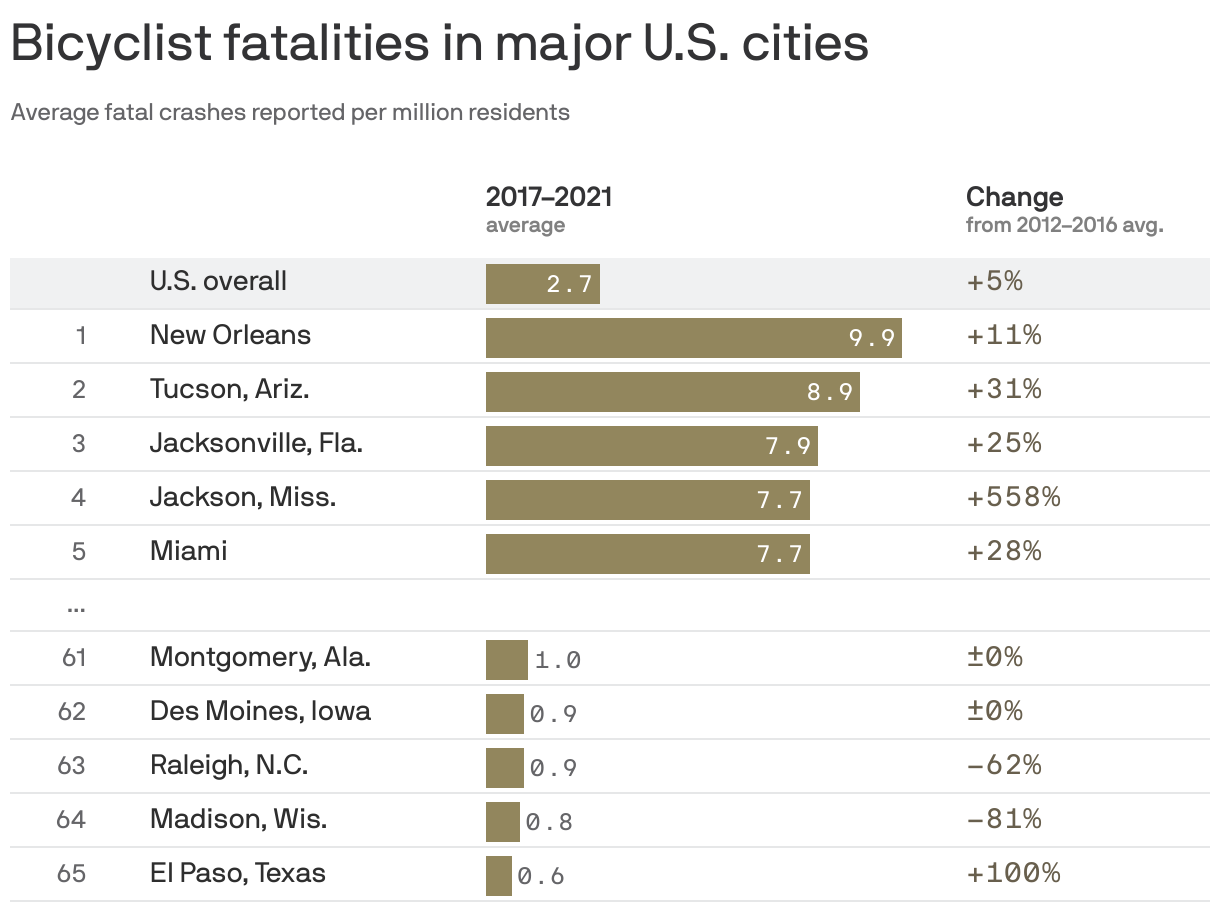
Data: The League of American Bicyclists via NHTSA; Chart: Kavya Beheraj/Axios
There were 2.7 fatal bicycle crashes on average for every million U.S. residents between 2017-2021, per data from the League of American Bicyclists via the National Highway Traffic Safety Administration — up 5% from 2012-2016.
New Orleans (9.9), Tucson (8.9) and Jacksonville (7.9) had the country's highest rates of fatal accidents per million residents among major metro areas.
A House Energy and Commerce Committee health markup on Wednesday offered more evidence that price transparency and pharmacy benefit manager regulation are two issues that have enough bipartisan support to move ahead in this Congress.
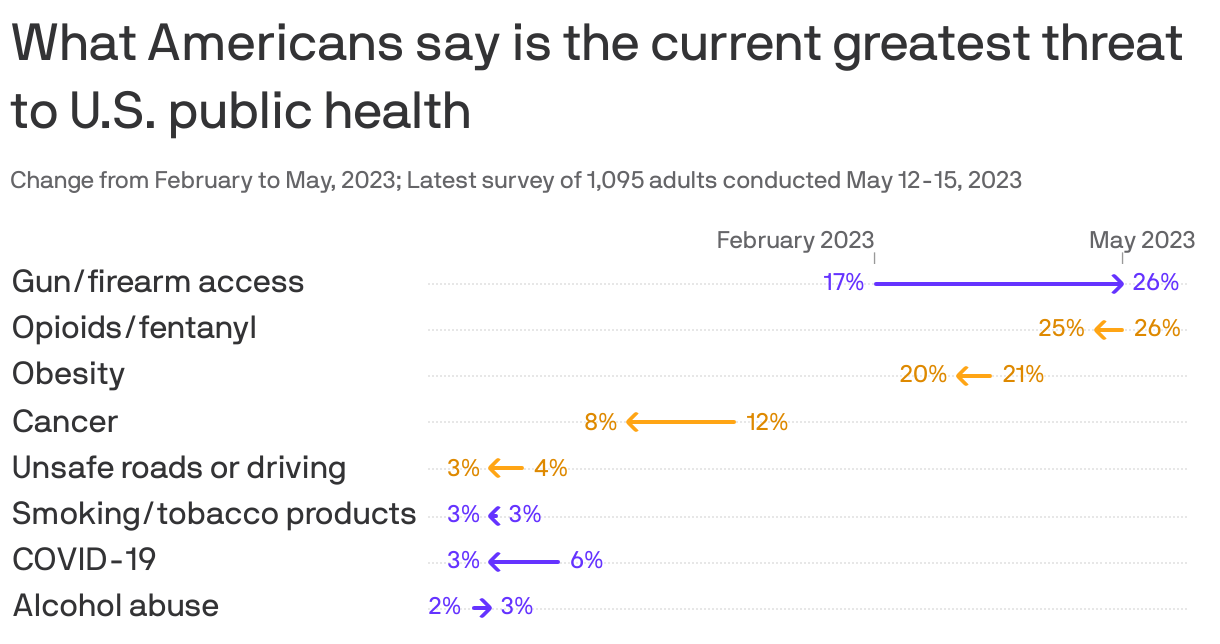
Gun violence has surged ahead of the opioid crisis as Americans' top public health concern, according to the latest edition of the Axios-Ipsos American Health Index.
Why it matters: A spate of recent mass shootings may have focused attention on the issue in ways that weren't apparent in our last poll in February.
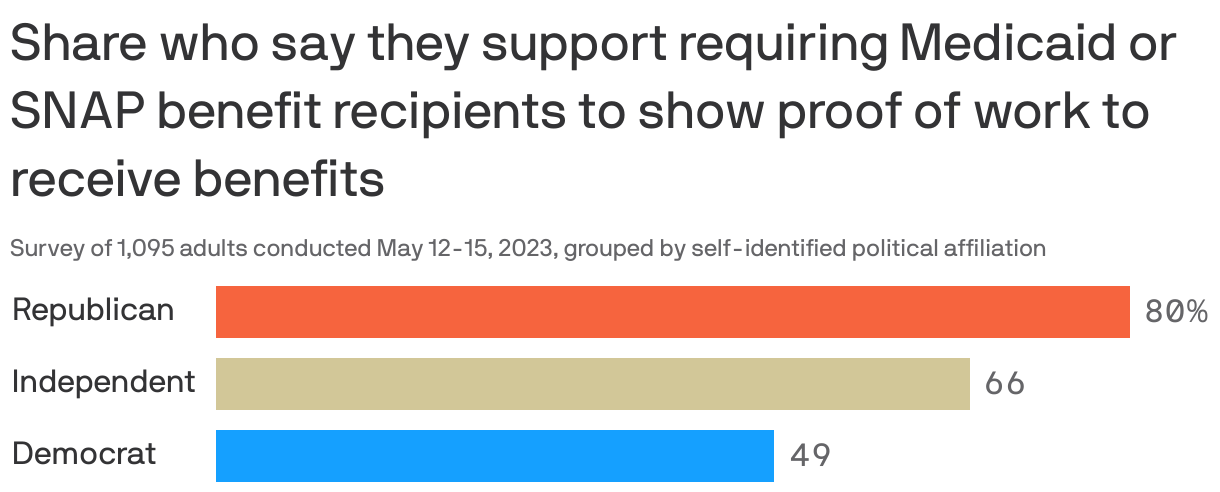
Nearly two-thirds of Americans — including half of Democrats — back work requirements for Medicaid and Supplemental Nutritional Assistance Program benefits, as House Republicans want in a debt limit deal, according to the latest Axios-Ipsos American Health Index.
Why it matters: Work requirements are a major sticking point in debt ceiling talks.
Theranos founder Elizabeth Holmes must begin serving her prison sentence by May 30 while she appeals her conviction on charges of defrauding investors in her failed blood-testing startup, a federal judge ruled Wednesday.
Driving the news: U.S. District Court Judge Edward Davila issued the order after the United States Court of Appeals for the Ninth Circuit on Tuesday rejected Holmes' request to remain on bail as she appeals the case.
A federal appellate court on Wednesday seemed skeptical of nearly every argument from the Biden administration as it defended the Food and Drug Administration's power to approve a widely used abortion pill.
Why it matters: The New Orleans-based U.S. 5th Circuit Court of Appeals could decide in the coming weeks to uphold a Texas federal court ruling that ordered the FDA to withdraw its authorization of mifepristone, used in medication abortion, and set a precedent that could diminish the agency's authority in regulating medical treatments.
Politicians in red states are placing new limits on gender-affirming care for transgender people, creating a patchwork of sanctions on health providers who offer such services and limits onaccess.
By the numbers: Over 100 pieces of legislation introduced in state legislatures in 2023 focus on banning aspects of gender-affirming medical care, according to data from the American Civil Liberties Union.
Missouri Attorney General Andrew Bailey on late Tuesday withdrew his order that imposed restrictions on gender-affirming care for transgender youth and adults in the state.
Driving the news: Bailey's move effectively ends a state legal case that challenged the order, which hadn't yet taken effect due to a judge temporarily blocking it until July.
Black Americans experienced more than 1.6 million excess deaths compared to the white population over about two decades, along with more than 80 million potential years of life lost, a Yale-led study published Tuesday in JAMA shows.
Why it matters: The study quantifies the effects of poorer health outcomes in Black communities that have been documented in a growing body of research.
A surge in the uninsured population from Medicaid redetermination could swamp some health systems that struggled to stay afloat during the pandemic. But experts say it could also translate into a financial boost for networks, if enough individuals find new sources of coverage.
Why it matters: Even the temporary loss of coverage as states unwind their COVID-era Medicaid enrollment requirements means more people will go without checkups and other primary care, increasing the likelihood they'll wait until they're sick to seek help.
After decades of research and multiple failed attempts, Americans could find themselves with several respiratory syncytial virus vaccines to choose from by next winter.
Driving the news: FDA advisers tomorrow will weigh whether it's safe to protect infants against the respiratory virus by giving pregnant people an experimental Pfizer shot.
Across the country, Democratic lawmakers in GOP states have struggled to stop an onslaught of bills restricting gender-affirming health care for transgender minors.
Driving the news: A Texas bill to ban hormone therapy, puberty blockers and surgeries for minors could reach the governor's desk this week.
Driving the news: The state's GOP-controlled legislature Tuesday nightcarried out a razor-thin override of Democratic Gov. Roy Cooper's veto of a 46-page bill that tightens restrictions on abortion care here.