How abortion pills work and where they're available


Add Axios as your preferred source to
see more of our stories on Google.
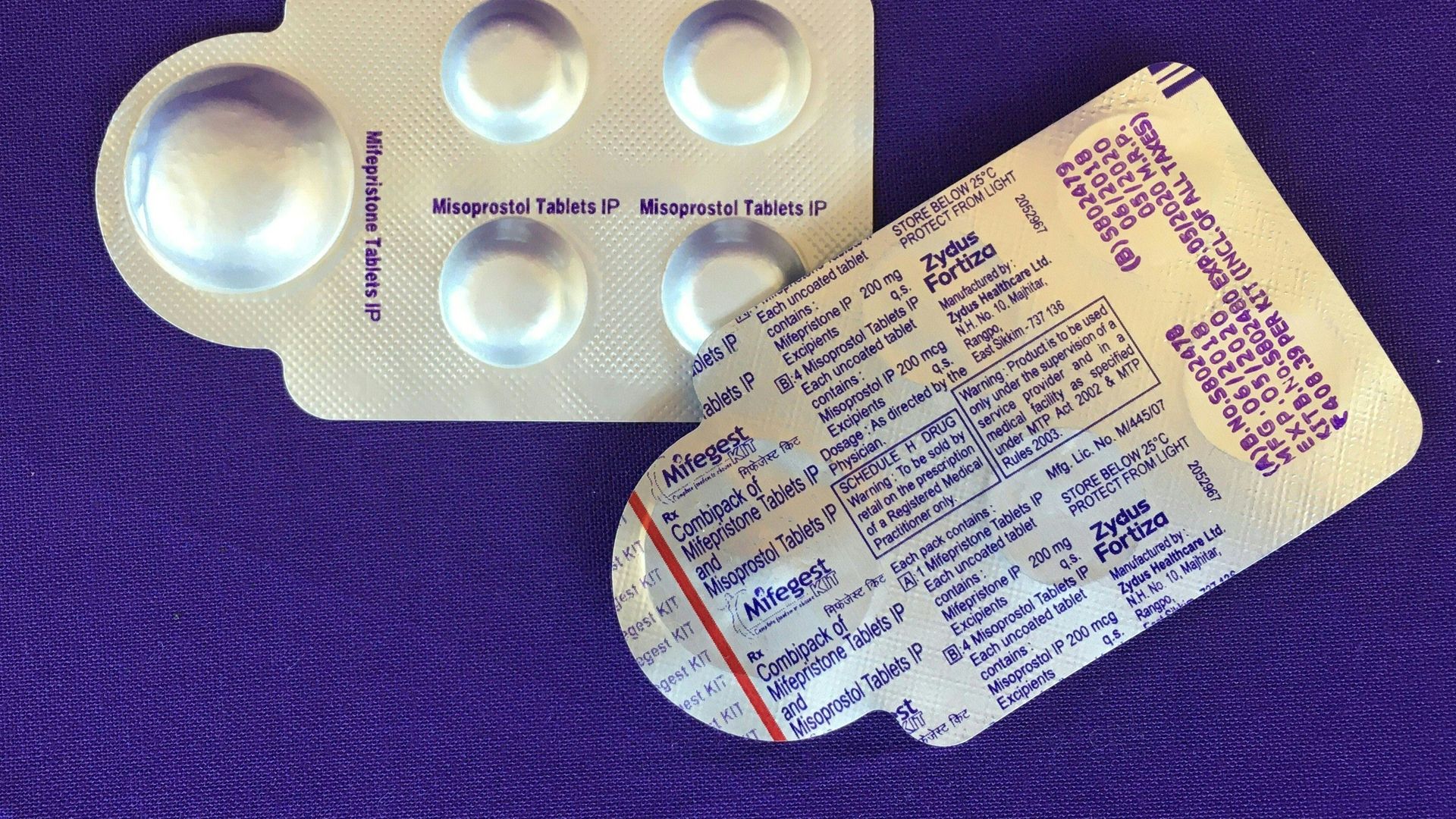
A combination pack of mifepristone (left) and misoprostol tablets, two medicines used together as the abortion pill. Photo: Elisa Wells/ Plan C/AFP via Getty Images
The fight over abortion pills has been escalating since before Roe v. Wade was overturned, but the Supreme Court on Thursday threw out one of the most significant challenges to date to the widely used drug mifepristone.
Why it matters: Nearly two years after its seismic Dobbs decision, which ended the right to federal abortion in the U.S., the Supreme Court tossed a challenge aimed at curtailing mifepristone access.
- The high court rejected a suit challenging the Food and Drug Administration's approach to regulating mifepristone, avoiding ruling on the merits of the case.
- The court's initial decision to hear the case set the stage for another major ruling that could have limited abortion access — even in states that protect it.
- The federal government had argued during oral arguments in March that the group of doctors who objected to abortion and brought the case against the FDA didn't have the legal standing to do so.
State of play: With pills now accounting for the majority of abortions, opponents of the procedure have focused on legislatures and courts to erect barriers.
- But that triggered thorny legal questions over whether the Food and Drug Administration had the final say on whether the pills are safe.
The intrigue: Abortion pills have been available in the U.S. for decades, and while the FDA says that medical evidence shows they are safe and effective, the drugs have been subject of fights over manufacturing, distribution, insurance coverage and who can provide them.
- Confusion around the drugs continues in the U.S., where nearly half of adults say they are not sure whether medication abortion is legal in the state they live in, according to a recent KFF survey.
The big picture: The FDA last year made a regulatory change to allow retail pharmacies to offer abortion pills, an update that looked to expand access as more red states move to ban or restrict access to abortion.
- Walgreens and CVS, two of the largest U.S. pharmacy chains, said earlier this year that they would start selling the pills.
How often are abortion pills used?
Over half of abortions in the U.S. occur via abortion pills, according to the Guttmacher Institute, a research organization that supports abortion rights.
- Abortion pills are often accessed online and mailed to patients, effectively working to circumvent state bans and restrictions that took effect after Roe was overturned.
How do abortion pills work?
Medication abortion normally consists of two pills: mifepristone and misoprostol.
- Mifepristone is approved by the FDA to be used alongside misoprostol to end a pregnancy during the first 10 weeks. This includes elective abortions and miscarriages.
- A patient first takes 200 milligrams of mifepristone orally to stop the pregnancy from growing. This is followed 1-2 days later by 800 milligrams of misoprostol taken buccally — placed between the gums and cheek — which causes cramping and bleeding to empty the uterus.
- The mifepristone-misoprostol combination regimen has been found to be at least 95% effective at terminating a pregnancy.
Zoom in: Misoprostol — which is approved for the prevention and treatment of gastric ulcers — can also be taken on its own for medication abortion, a method that is supported by the World Health Organization.
- While misoprostol is not specifically FDA-approved for abortions, it can still be used to terminate a pregnancy. A health provider has the authority to prescribe the drug for off-label use if they consider it to be medically appropriate.
- The misoprostol-only method is slightly less effective than the combination regimen. A February study with over 1,000 U.S. participants found that using misoprostol alone was 88% effective at ending a pregnancy.
How are the pills used in miscarriage care?
The mifepristone-misoprostol method is considered the most effective medication regimen for managing early miscarriages, per Planned Parenthood.
- The drugs are used to make sure that pregnancy tissue passes after there has been a miscarriage, which makes the patient experience bleeding.
- While pregnancy tissue can pass naturally and take a few weeks to do so, the experience can be incredibly distressing for the pregnant person, so they can take mifepristone and misoprostol to ease and speed up that process.
Details: A 2018 study from the New England Journal of Medicine found that the combination regimen was more effective than the use of misoprostol alone, and reduced the likelihood for additional treatments — which might include additional doses of misoprostol or potentially surgical intervention.
How safe are abortion pills?
Abortion pills are considered safe and effective by major medical groups, such as the American Medical Association and the American College of Obstetricians and Gynecologists.
- "Medication abortion using mifepristone and misoprostol has always been part of my practice. It's incredibly safe and effective for people to end their pregnancies or to treat their pregnancy losses or miscarriages," said Jamila Perritt, president and CEO of Physicians for Reproductive Health and an OB-GYN in Washington, D.C., during a roundtable with abortion providers.
Zoom out: Mifepristone is approved for abortion use in over 80 countries.
How do you access medication abortion?
The FDA first approved mifepristone for pregnancy termination in 2000 under the agency's Risk Evaluation and Mitigation Strategy, a program that adds dispensing restrictions to certain drugs, including requiring specific certifications for those who prescribe them.
- Since its initial approval, the FDA has loosened mifepristone's REMS restrictions over the years, including getting rid of the original in-person requirement and allowing the drug to be accessible via telehealth, as well as letting pharmacists become dispensing-certified.
State of play: Patients can go on websites like Aid Access, Hey Jane and Choix to get the drugs online and have them mailed.
Yes, but: At least a dozen states have laws in place that limit medication abortion access in some way, such as by requiring an in-person visit with a physician.
- So-called trigger laws took effect that can make it impossible for people to access abortion pills. Since then, pill providers have experienced soaring demand online.
- Most of these bans and restrictions are specific to the pill provider, not the patient. As a result, a user could travel across state lines to pick up the pills.
- Some telemedicine providers — such as Aid Access — are located overseas and mail the pills to all 50 states. However, people who live in red states face a higher risk of prosecution.
Why was mifepristone at risk of becoming unavailable?
Trump-appointed Judge Matthew Kacsmaryk last year temporarily blocked the FDA's approval of mifepristone, which made the medication unavailable even in states that protect access to abortion.
- Within hours of his ruling, a federal court in Washington state handed down a contradictory order prohibiting the FDA from making any changes to mifepristone's availability.
A coalition of anti-abortion groups in late 2022 had filed a lawsuit in Northern District of Texas, arguing that that the FDA did not properly authorize mifepristone for terminating pregnancies.
- Democratic attorneys general in early 2023 filed suit in the Eastern District of Washington, challenging the FDA's dispensing restrictions on mifepristone, arguing that they are "unnecessary" because they drug is considered to be safe and effective.
Editor's note: This story has been updated with new details and developments throughout.
