"Saturday Night Live" will return to the air this weekend with a remotely produced episode after NBC suspended the comedy show's production due to the coronavirus pandemic.
The state of play: The show will include its signature “Weekend Update” sketch and original cast content, AP reports. The network said the episode will be produced remotely to abide by the Centers for Disease Control and Prevention's social distancing guidelines.
The United States' biggest media trade groups, representing thousands of publishers and broadcasters, asked Congress on Thursday to provide extensive relief to local news outlets in its next stimulus bill.
Why it matters: While the $2 trillion rescue package that already passed covers small businesses, including some news companies, advocates argue it's not enough to cover the long-lasting damages coronavirus will have on the news business' models and products.
Hospitals, doctors' offices, suppliers and other health care facilities have now received $51 billion in "advance payments" from Medicare, the Centers for Medicare & Medicaid Services said Thursday.
The bottom line: Those funds, which act as a loan and have to be repaid, are up from $34 billion earlier this week. CMS has processed 21,000 of the 32,000 requests.
It's one of the biggest and fastest stock market rallies in living memory. In the 12 trading sessions since its low point on March 23, the S&P 500 has rallied by 25%, with its component companies increasing in value by more than $4.4 trillion.
The state of play: The tech-heavy Nasdaq index is now higher than it was a mere 6 months ago: If you bought it at the beginning of October, you'd be sitting on a profit right now.
Investors expect the earnings season that kicks off on Tuesday to be ugly.
What to watch: The banks are among the first to report. They still made a ton of money, but the results — and the companies' outlooks — will give insight into our current unprecedented halt in economic activity.
All companies want to be cash-rich — and as big as possible — heading into an era of extreme uncertainty.
The big picture: Companies raised an astonishing $287 billion through bond issuance between March 17 and April 3 alone. That's more than they raised in the entire second quarter of last year.
The Federal Reserve is pouring trillions of dollars into programs making it easy for big companies to access liquidity on capital markets, and the Fed's new Main Street Lending Program is designed to target medium-sized businesses that need between $1 million and $150 million in marginal new debt. But the state of affairs for small businesses is still bad.
Driving the news: The government has pledged $350 billion, and probably will commit another $250 billion on top of that, for small businesses to keep their employees on payroll. But the program got off to a very rocky start, and it's still extremely rare to find businesses that have actually received any funds.
Governments have forcibly put much of the U.S. and the global economy on pause in recent weeks, for very good reason. Factories, offices, sporting arenas, restaurants, airports and myriad other institutions have closed down. But one thing hasn't been paused: monthly debt-service obligations.
The big picture: The less movement and activity there is in an economy, the more the coronavirus curve is flattened. But the obligations in bond and loan contracts can't be paused. That's worrying CEOs who fear a wave of business failures if economic activity doesn't pick up next month.
Universa Investments, the "black swan" hedge fund, had a pretty good March.
Why it matters: While the coronavirus pandemic isn't really a black swan — a lot of people knew such a thing would come at some point — the slump in the markets was severe enough that the fund's out-of-the-money options trades suddenly became extremely profitable.
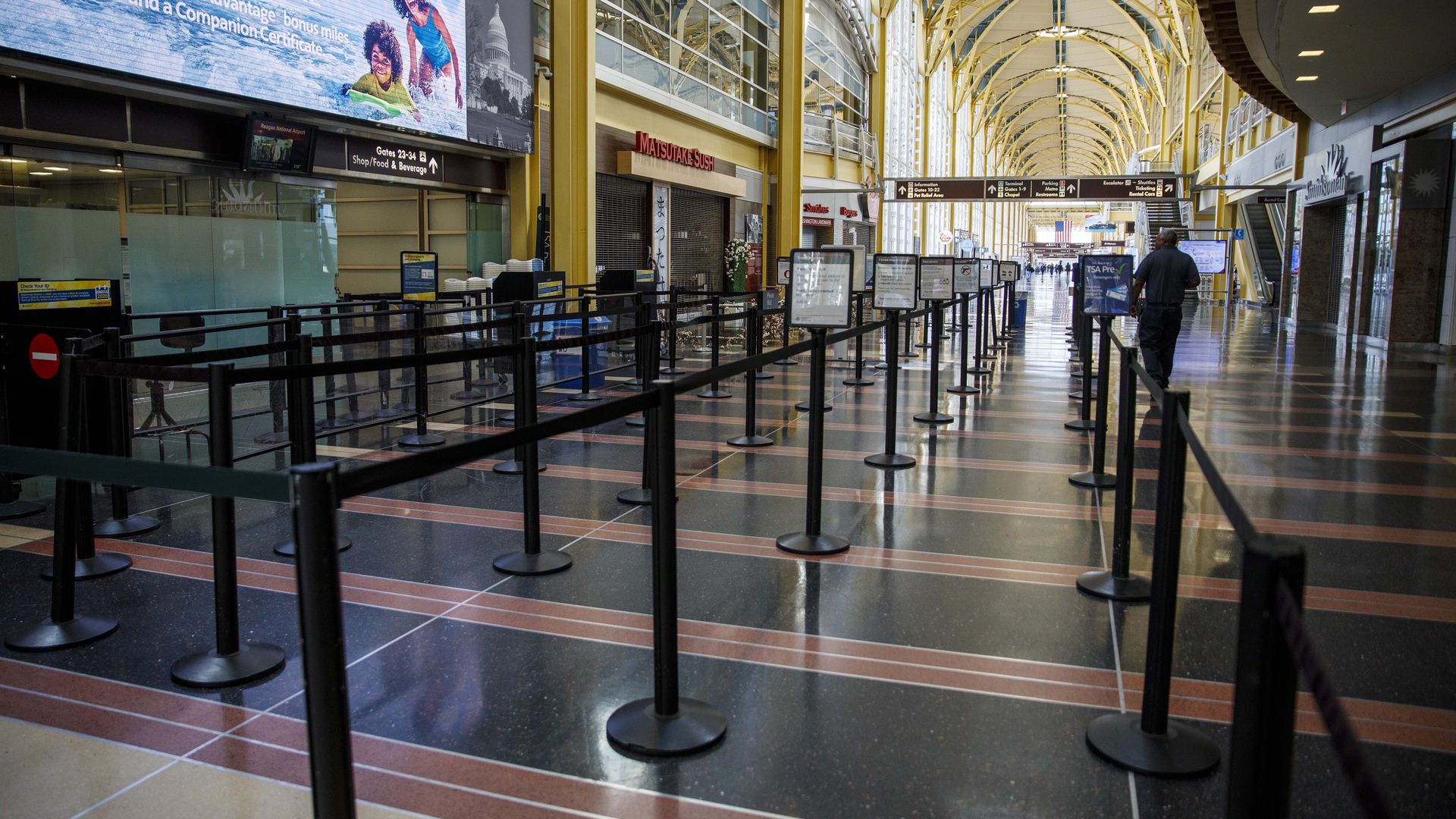
The Transportation Security Administration screened fewer than 100,000 people at airports around the U.S. on both Tuesday and Wednesday, per agency data.
The state of play: The 94,931 people screened on Wednesday is down from 2,229,276 on a comparable weekday a year ago. The last time the nation averaged fewer than 100,000 air passengers was in 1954, notes the AP.
The Federal Reserve announced Thursday that it will support the coronavirus-hit economy with up to $2.3 trillion in loans to businesses, state and city governments — made possible in part by Treasury funds set aside in the government stimulus package.
Why it matters: It adds to the number of huge, unprecedented steps the Fed has taken during the coronavirus outbreak to blunt the effects of the resulting economic shutdown. Its actions to date are bigger than any seen during other crises in U.S. history.
Before the Paycheck Protection Program formally launched last Friday, we knew two things: The rollout would be rocky, and the initial $350 billion wouldn't be enough for America's small businesses.
The state of play: Banks and government officials have been working to smooth out the process. On Thursday, Senate Majority Leader Mitch McConnell's (R-Ky.) attempt to pump another $250 billion into the program via unanimous consent was blocked by Democrats, who are proposing an alternative that includes billions more for hospitals and states.
Pacific Collective, a California retail developer, is asking a court to declare the state's coronavirus lockdown to be an act of God, or force majeure, that prevented it from completing a $4.2 million property purchase from ExxonMobil, per Reuters.
Why it matters: This is the leading edge of what could become a flood of similar lawsuits. Force majeure is a common term in M&A contracts, but there is no legal consensus that it covers a pandemic — let alone government action in response to a pandemic.
Teamworks, an athlete engagement platform that grew up in the college sports space and has since expanded to the professional ranks, announced yesterday that it has raised $25 million in Series C funding led by Delta-v Capital.
The big picture: The round also includes participation from new investors Afia Capital, a private investment platform backed by pro athletes, and Stadia Ventures, a global sports innovation hub.
Another 6.6 million Americans filed for unemployment last week, the Labor Department announced Thursday.
Why it matters: It adds to the staggering 10 million jobless claims in recent weeks — by far the sharpest spikes in American history — as the world economy has ground to a halt in an effort to contain the coronavirus outbreak.
The $2.2 trillion coronavirus stimulus is helping existing homeowners but also causing dislocations in the U.S. mortgage market. This, combined with the pandemic, is weakening access to and demand for mortgages even with rates at record lows.
Why it matters: In addition to the expected downturn in the housing market from nationwide shelter-in-place orders, the current shock is making it harder and more expensive for individuals, especially those with lower credit scores and less cash, to get a mortgage.
The stock market continues to bounce back and analysts and investors are lining up on opposing sides of the market's big new question — whether stocks have hit the bottom. The one thing they both agree on is that there will be significant volatility ahead.
On one side: The rebound from this recession may come at warp speed because the fall came at warp speed, Jim Paulsen, chief investment strategist at the Leuthold Group, tells Axios.
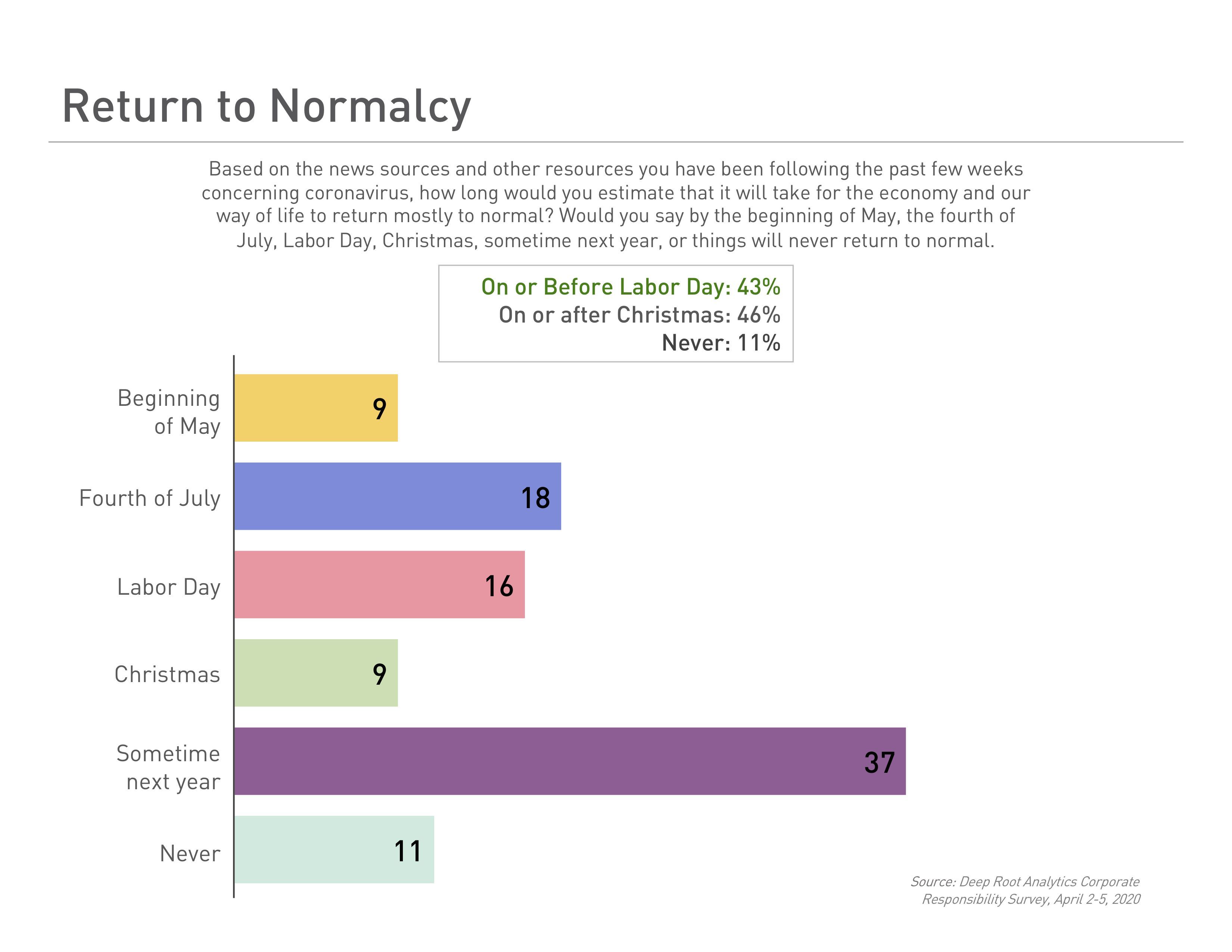
Deep Root Analytics of Arlington, Va., surveyed its corporate social responsibility audience — consumers who say a company's stance on key issues is important to their buying decisions.
By the numbers: They found that 47% believe that it will be on or after Christmas before the economy and the American way of life return to mostly normal. 11% saidit will never return to normal.
Methodology: 843 U.S. voters were interviewed April 2-5, with 604 interviews online and 239 via automated telephone technology. Margin of error: ±3.4%.
As the coronavirus continues to paralyze much of American daily life, startups that aren’t directly affected by the sudden shift in consumer behavior are now laying off employees too, worried that their products and services won't be in demand anytime soon.
Why it matters: Startups create a lot of jobs — in 2015 alone they created 2.5 million — and their pain could make a recovery from the virus downturn harder.
WeWork — the driver of America's shift to smaller, shared office spaces — is planning layout changes at its nearly 900 locations for life after the coronavirus pandemic, according to company documents reviewed by Axios.
Why it matters: After months of paranoia, social distancing and working from home, the millions who work from WeWorks will be wary of returning to shared kitchens, phone booths and desks. WeWorks have 75 square feet of space per worker, compared to the national average of 214.
The federal government is sending $64 billion to hospitals, post-acute facilities and other medical providers to help cope with the coronavirus fallout.
Yes, but: Even though more funding is coming, safety net and rural hospitals fear they are getting a raw deal from the way some of the money is being distributed.
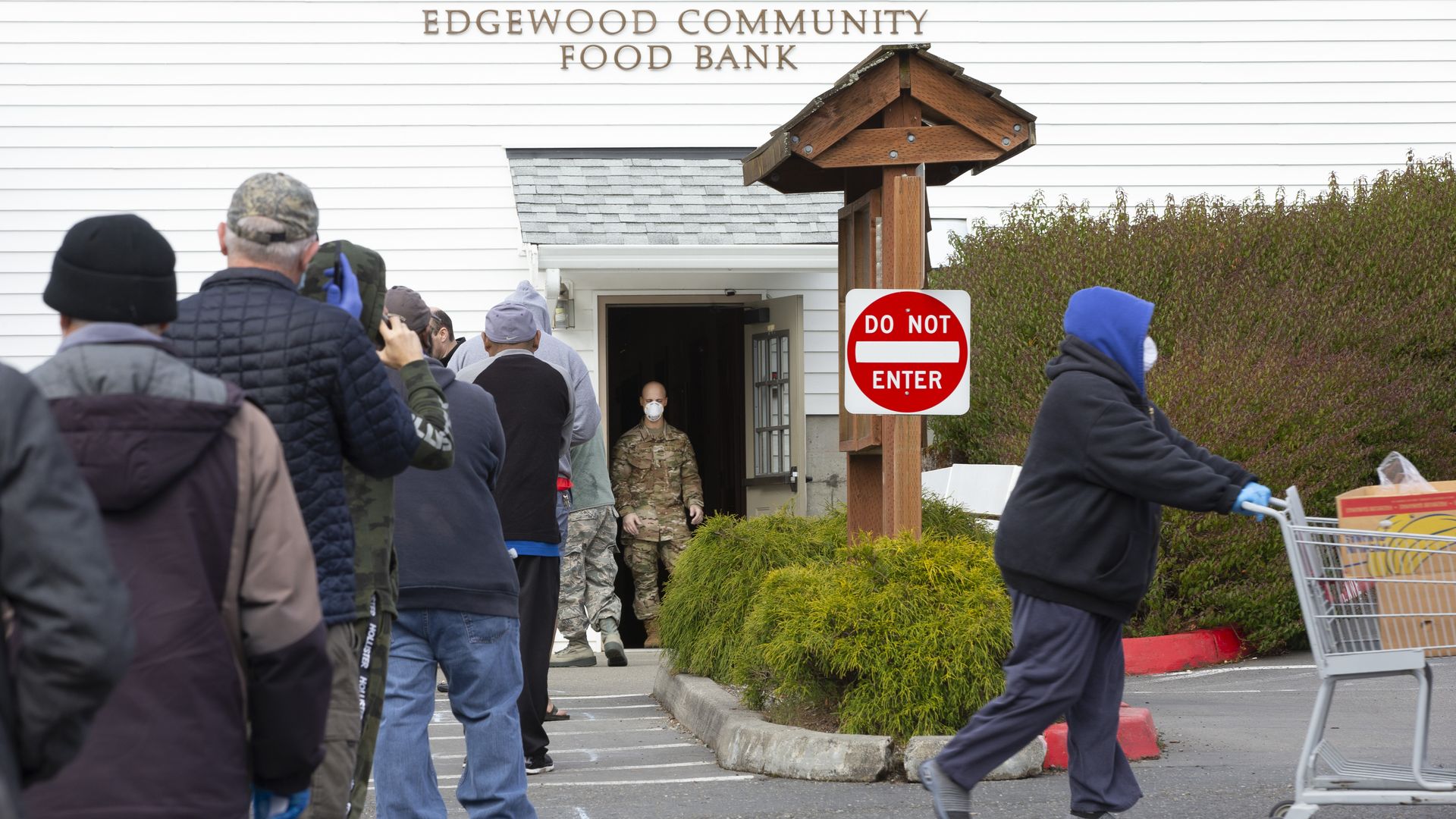
There's been an upsurge in demand for food banks across the U.S. because of the impact of the novel coronavirus outbreak.
Why it matters: Feeding America, the largest network of food banks in the U.S., projects a $1.4 billion shortfall over the next six months. "School closures, rising unemployment and rising poverty due to quarantine and stay-at-home orders will disproportionately impact people already at risk of hunger and could result in an estimated additional 17.1 million people experiencing food insecurity, an increase of 46%," the nonprofit said in a statement.


/2020/04/09/1586467103425.gif?w=3840)






















/2020/04/08/1586373662637.gif?w=3840)