At least 10 U.S. airlines will accept federal aid to help keep employees on the payroll during the coronavirus crisis, in exchange for stock warrants that could give the U.S. government an equity stake in each company.
Why it matters: The deal puts an end to nearly a week of intense negotiations between the airline industry and Treasury Secretary Steven Mnuchin, who insisted that airlines pay back a portion of the payroll aid and that taxpayers get some potential upside in exchange for helping the industry.
More than 10,000 people have died in New York City due to the coronavirus in confirmed and probable cases, per newly released data from the city's health department.
The big picture: New York City's revised toll means that over 28,000 Americans have died from the coronavirus as of Tuesday, per data from Johns Hopkins.
The coronavirus pandemic is hitting doctors, nurses and other health care personnel in the U.S., with 10–20% infected, a new analysis from the Centers for Disease Control and Prevention shows.
Why it matters: Medical workers are on the front lines, consistently coming in close contact with coronavirus patients. Due to supply shortages, these workers also may not have gloves or face masks to adequately protect themselves.
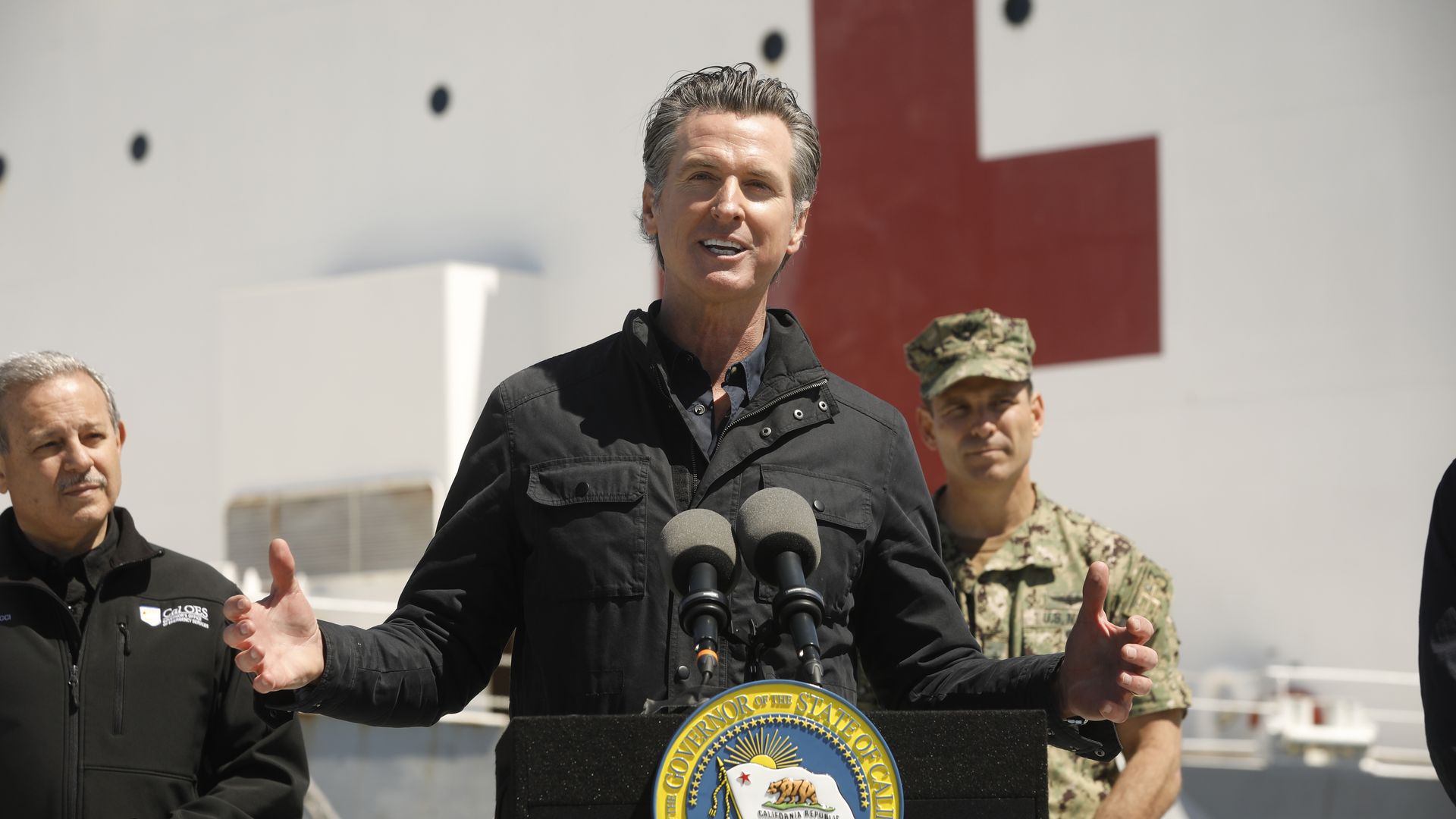
California Gov. Gavin Newsom released a roadmap on Tuesday that will guide how he will make the decision to relax the stay-at-home policies his state implemented to combat the spread of the coronavirus.
The big picture: While there is no timeline for modifying the stay-at-home order, Newsom's office said California would use a "gradual, science-based and data-driven framework" to determine when it would be safe to do so. Newsom indicated efforts to flatten the curve in California "have yielded positive results."
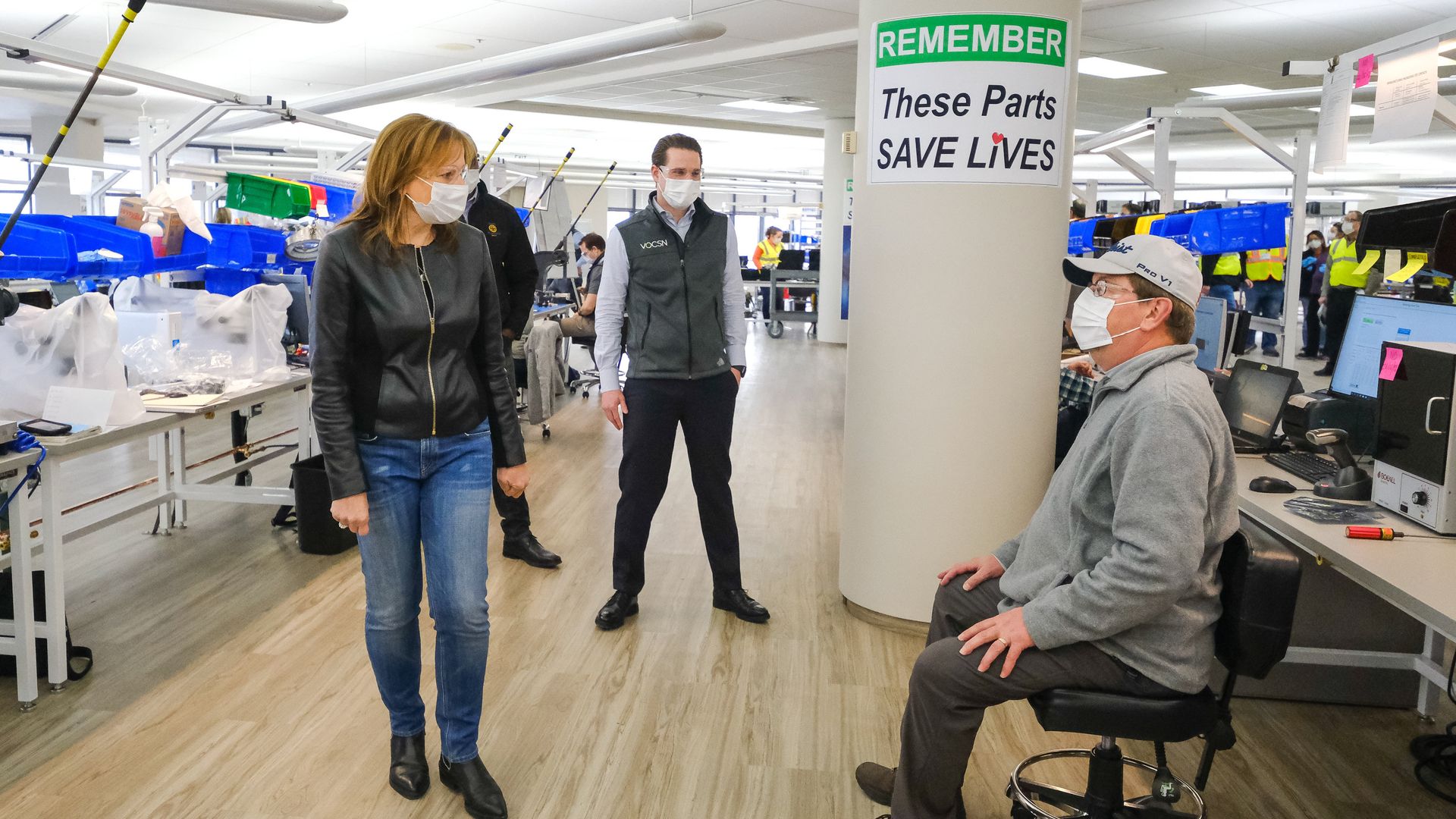
General Motors on Tuesday began mass production of critical care ventilators that will be delivered to the federal government to replenish depleted U.S. stockpiles in the fight against the coronavirus.
Why it matters: The automaker has a $489.4 million contract to produce 30,000 ventilators by August under the Defense Production Act, which President Trump invoked on March 27 in an effort to meet exploding demand for the life-saving devices.
Sen. Elizabeth Warren (D-Mass.) and Rep. Ro Khanna (D-Calif.) have proposed a "bill of rights" for essential workers, including everything from guaranteed protective equipment to universal paid sick leave and child care. Rep. Khanna joins Dan to discuss.
U.S. mayors have banded together to ask Congress for $250 billion in direct funding to help cities deal with the enormous costs of fighting the coronavirus pandemic while also facing significant revenue loss from shutdowns of local economies.
The big picture: Last month's CARES Act allocated $150 billion to state and local governments, which was $100 billion shy of the ask from the U.S. Conference of Mayors.
President Trump's team will present him imminently with options to snub the World Health Organization over its coronavirus approach — from outright cuts to redirecting funding — people familiar with the plans tell Axios.
Driving the news: Trump vowed a week ago to put "a very powerful hold" on money to the WHO, which he's targeted for blame as the pandemic has spread.
Space-focused organizations around the U.S. are now looking to manufacture ventilators and other much-needed health equipment to aid the pandemic relief effort.
Why it matters: With high-minded ideals centered on delivering humanity to orbit, the space industry can feel removed from the machinations of everyday life. The coronavirus crisis is bringing it down to Earth.
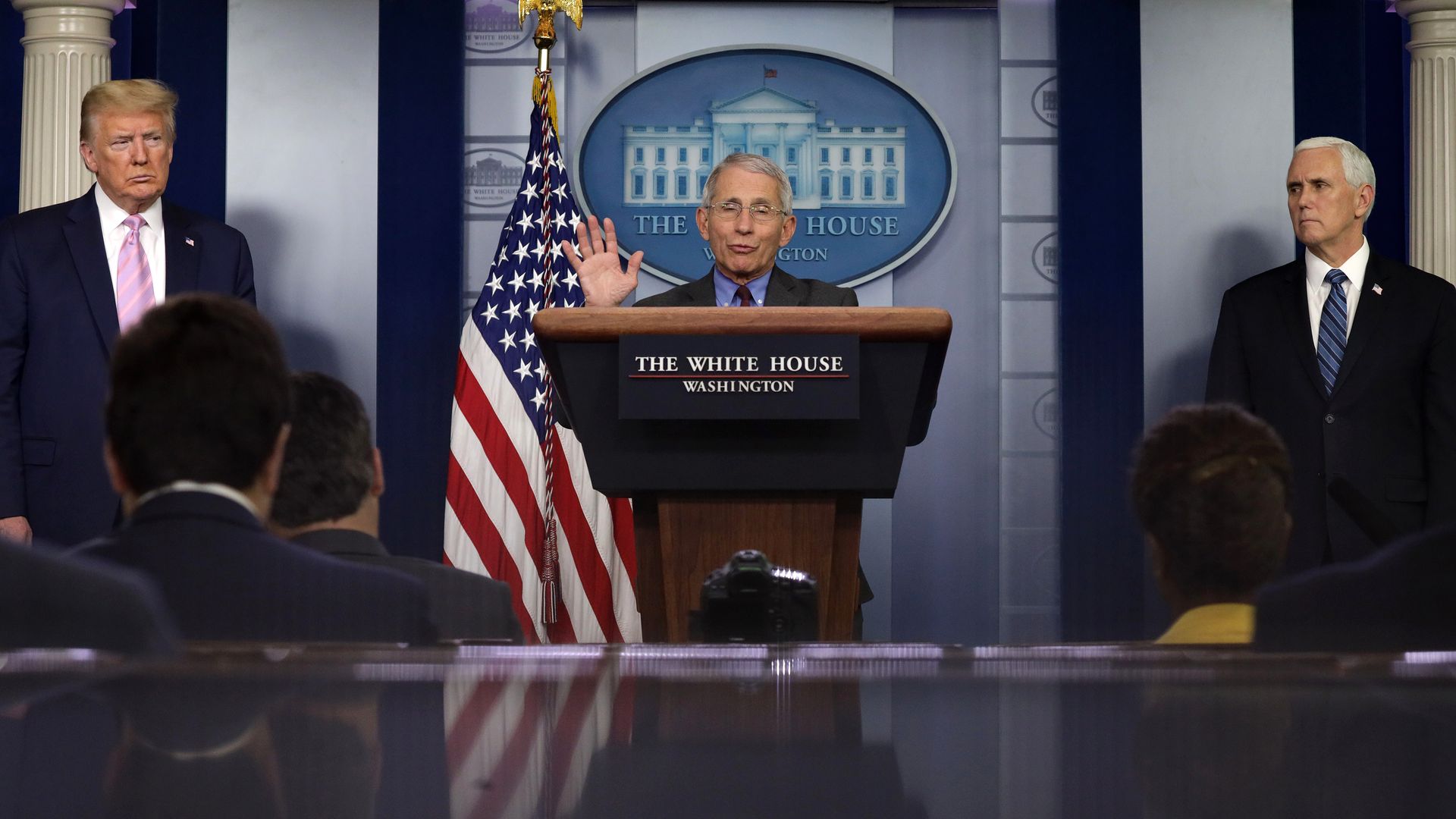
Anthony Fauci, director of the National Institute of Allergy and Infectious Diseases, said in an interview with AP Tuesday that the United States does not yet have the testing and contact tracing capacity to reopen its economy.
The big picture: The Trump administration has been encouraged by data showing fewer deaths than models earlier predicted, and some aides have pushed for a May 1 reopening. But Fauci cautioned against that target, saying it's “a bit overly optimistic" for much of the country until there's rapid testing in place.
New York Gov. Andrew Cuomo took to MSNBC's "Morning Joe" Tuesday to push back on President Trump's assertion that he has the sole authority to end states' stay-at-home measures and move to reopen the economy from the coronavirus crisis.
The big picture: Cuomo said Trump "basically declared himself King Trump" with his claim, adding that he would oppose a too-early reopening that put public health at risk and would create "a constitutional crisis like you haven't seen in decades."
The Environmental Protection Agency proposed Tuesday to keep air quality standards for soot pollution unchanged from 2012.
Why it matters: This action has relevance to today's pandemic, according to Axios energy reporter Amy Harder. Scientists say soot air pollution exacerbates the effects of respiratory diseases, like the one caused by the coronavirus.
Bishop Gerald O. Glenn in 2011. Screenshot: YouTube
Pastor Gerald O. Glenn, founder and bishop of the New Deliverance Evangelistic Church in Chesterfield, Virginia, died on Saturday evening after contracting the novel coronavirus, his church announced on Facebook.
Why it matters: Glenn snubbed social distancing guidelines and warnings about the danger of religious gatherings during the COVID-19 pandemic, even after Virginia Gov. Ralph Northam issued a stay-at-home order on March 30.
The XFL filed for Chapter 11 bankruptcy on Monday, marking the second straight year that an upstart football league has shuttered without finishing its debut season.
Yes, but: Unlike the Alliance of American Football, which folded due to mismanagement and a lack of funding, the XFL — which was off to a surprisingly strong start — fell victim to the coronavirus.
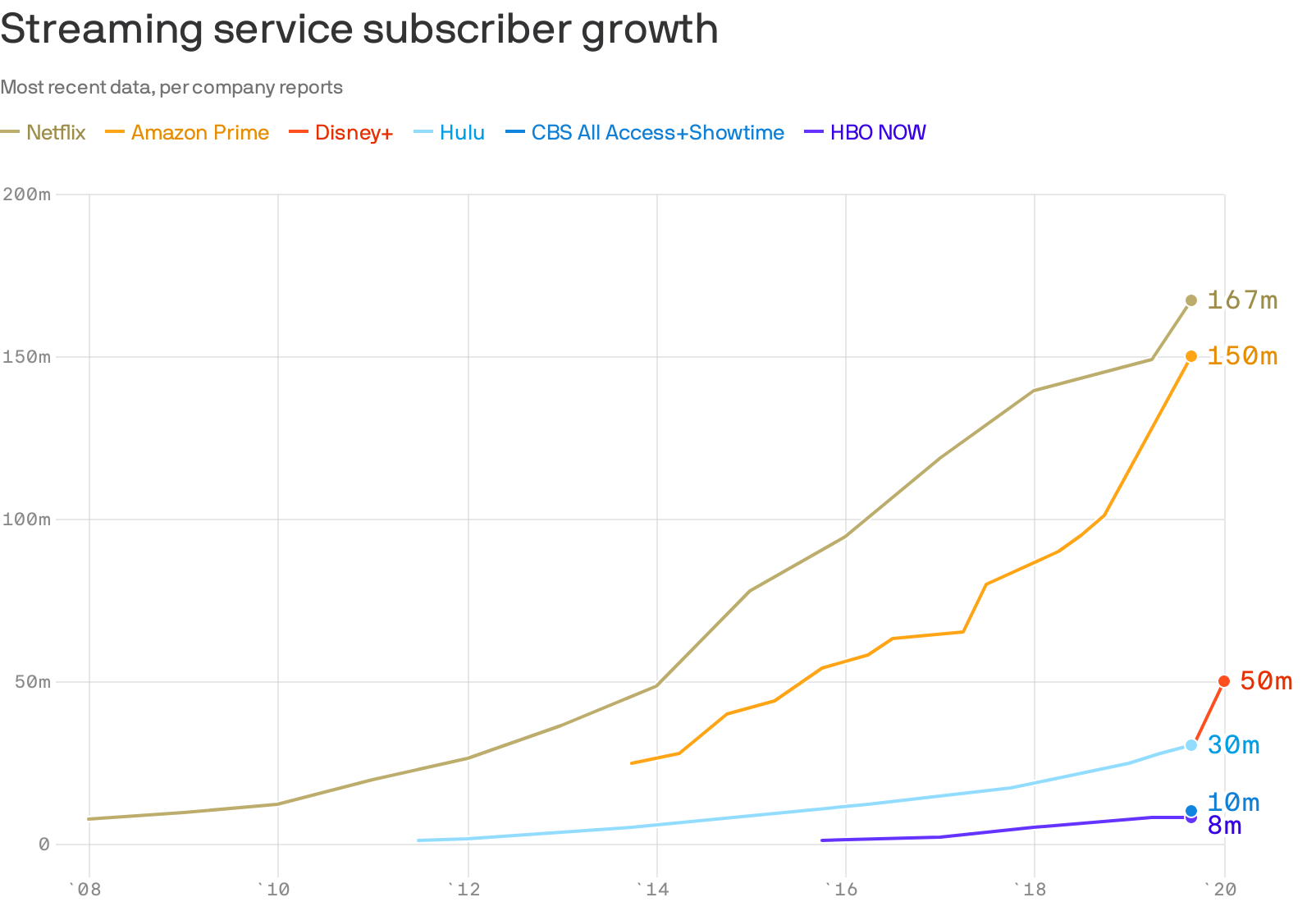
Disney's kingdom is losing its magic to the coronavirus pandemic.
Why it matters: Analysts point to Disney's healthy balance as proof that the company will weather the storm, but its experience dealing with coronavirus will fundamentally alter the way the nearly 100-year-old business operates moving forward.
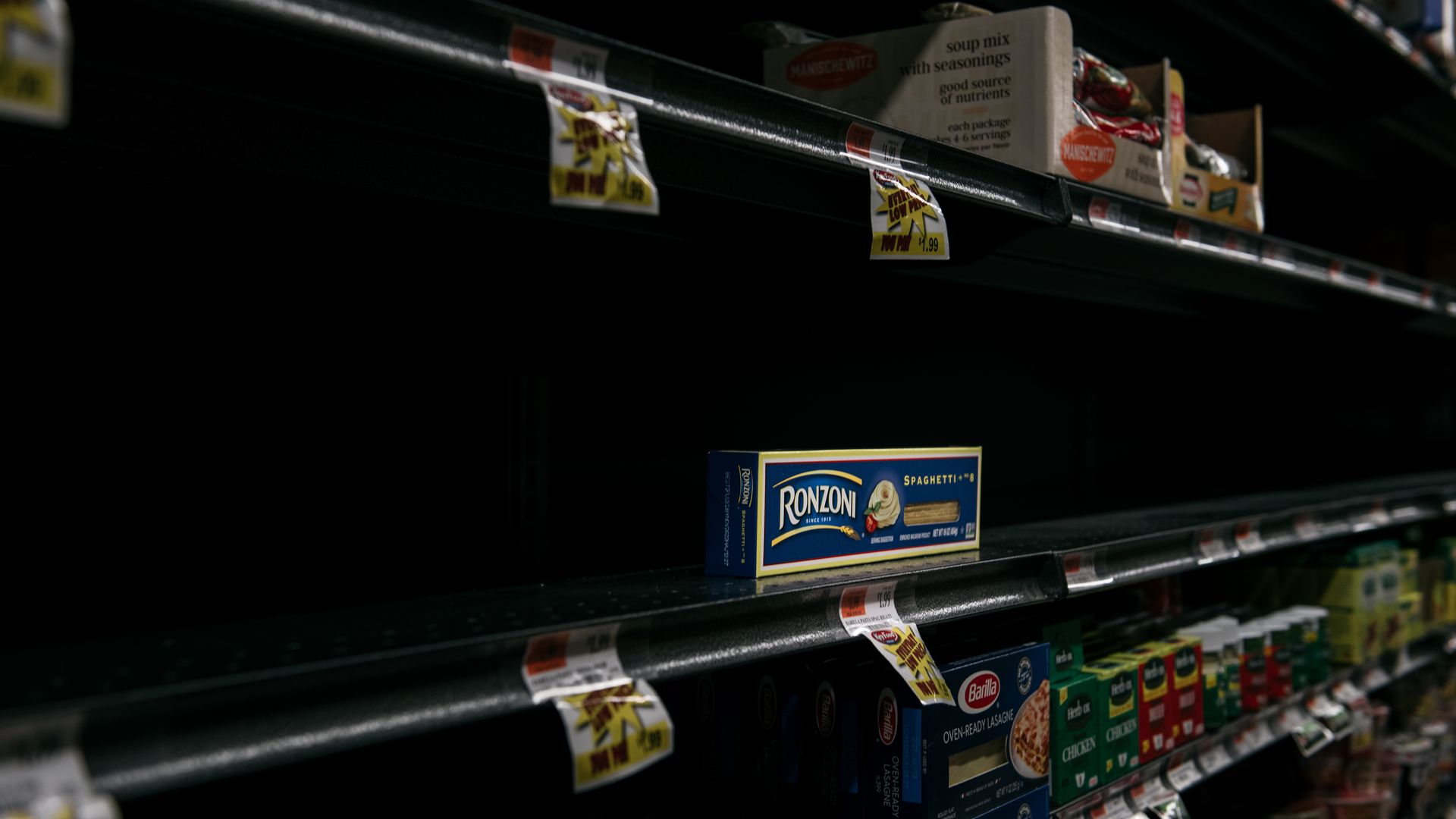
While industry giants reassure shoppers there is enough food during the coronavirus pandemic, people continue to be met with empty supermarket shelves due to stresses on established supply chains, the Washington Post reports.
The state of play: With restaurants closed, distributors are struggling to retool their product from bulk supply for restaurants and industrial-scale operations to smaller, consumer-focused packaging as Americans cook from home.
Consumers are looking for fun and lighthearted entertainment to relieve stress during the coronavirus crisis, instead of categories like true crime or suspense.
Why it matters: Some mediums, like podcasting, that over-index on genres like true crime, may be partially impacted by the fact that consumers need a break from their regular content routines.
A bipartisan group of lawmakers is circulating a draft letter to be sent to the White House requesting additional relief targeted specifically at local newsrooms, according to a draft of the letter obtained by Axios.
Why it matters: Local news was already facing dire strains in the U.S., but the coronavirus and a pending recession have pushed the industry into near collapse at a time when people need access to news and information more than ever.
Having initially predicted they could get through the coronavirus pandemic with their businesses largely unscathed and workforces intact, U.S. corporate leaders are now starting to change their tune.
What it means: Top financial officers have consistently written down their expectations for the economy, their company's financial situation, and how many of their employees they will be able to keep on staff in recent weeks.
New data from CrowdTangle shows that engagement for national and local news sources on Facebook is exploding during the coronavirus pandemic, while engagement with hyper-partisan publishers is hardly growing.
Why it matters: Consumers are looking to local and national outlets with authority to understand the impact of the virus on their health, the economy and their communities. This is different from the past few years, when hyper-partisan publishers dominated engagement on Facebook.
Hospitals have been clearing beds to care for the influx of coronavirus patients, but there's a looming capacity and equipment problem for the vast majority of patients who recover and need to be discharged to another facility.
Reality check: "I don't know that there's a nursing home in the country right now that is really able to admit an individual who is COVID-19-positive," said David Grabowski, a Harvard professor who studies post-acute care.
Widespread contact tracing will be key to the next phase of our coronavirus response, but the U.S. is severely behind.
Why it matters: Contact tracing — tracking down the people who have interacted with a coronavirus patient, so they can quarantine — helps prevent the virus from spreading.
Seven in 10 people now consider going to the grocery store a risky act — and a majority of Americans say they've started wearing masks outside their homes at least sometimes — in the latest installment of the Axios-Ipsos Coronavirus Index.
The big picture: In Week 5 of our national poll, we're seeing in more detail just how people are adapting to common fears and changes about the "new normal."
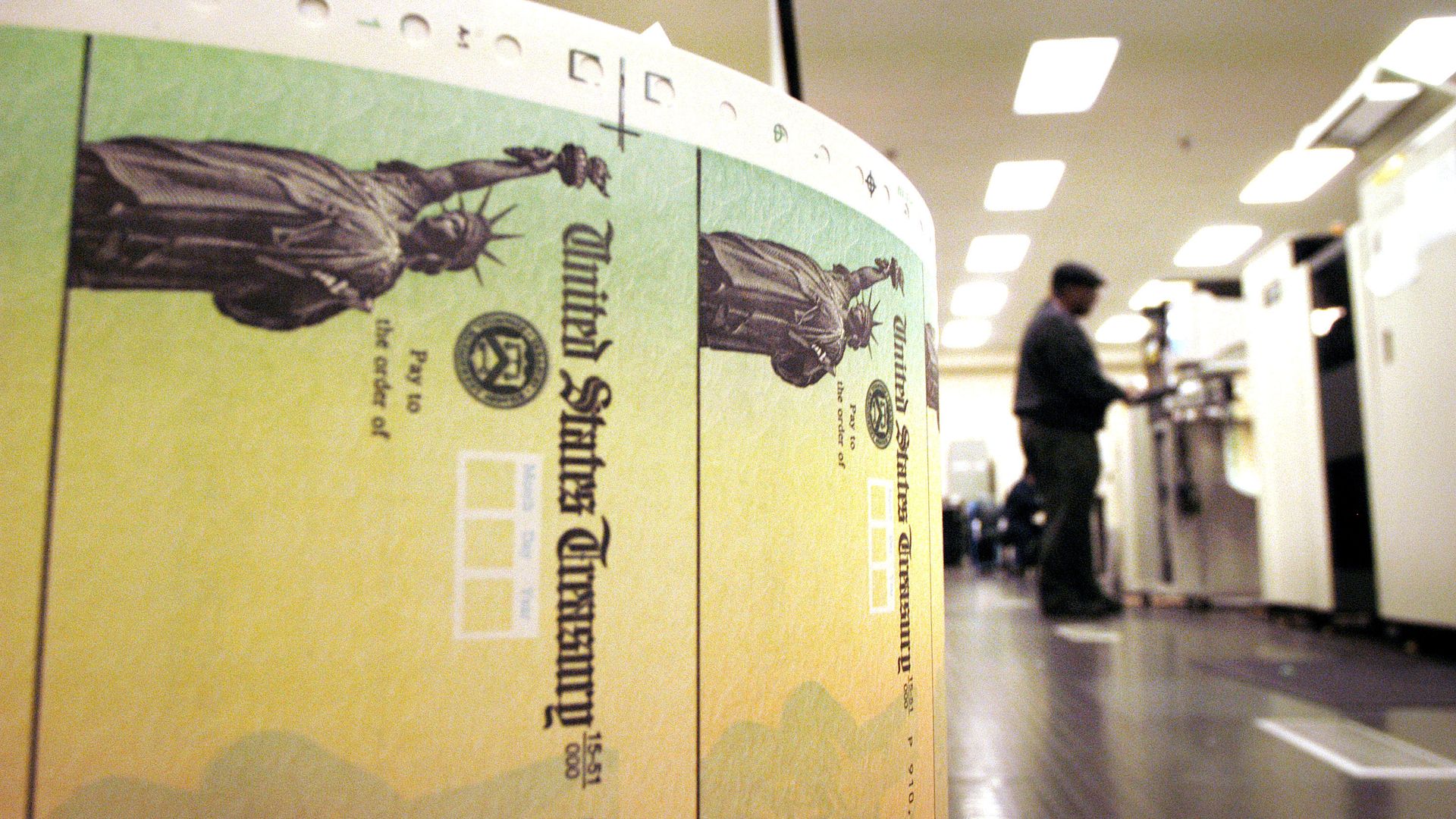
The big picture: Americans began to receive their stimulus payments on Saturday, per the IRS. The Treasury said payment was being automatically issued to eligible 2019 or 2018 federal tax return filers who received a refund using direct deposit.
Pressed on how he will force governors to reopen their state economies during the coronavirus crisis, President Trump said at a press briefing Monday: "When somebody is the president of the United States, the authority is total."
Why it matters: It's not totally clear under what authority Trump is talking about, as the 10th Amendment to the Constitution gives states the "police powers" to regulate behavior during a public health crisis.