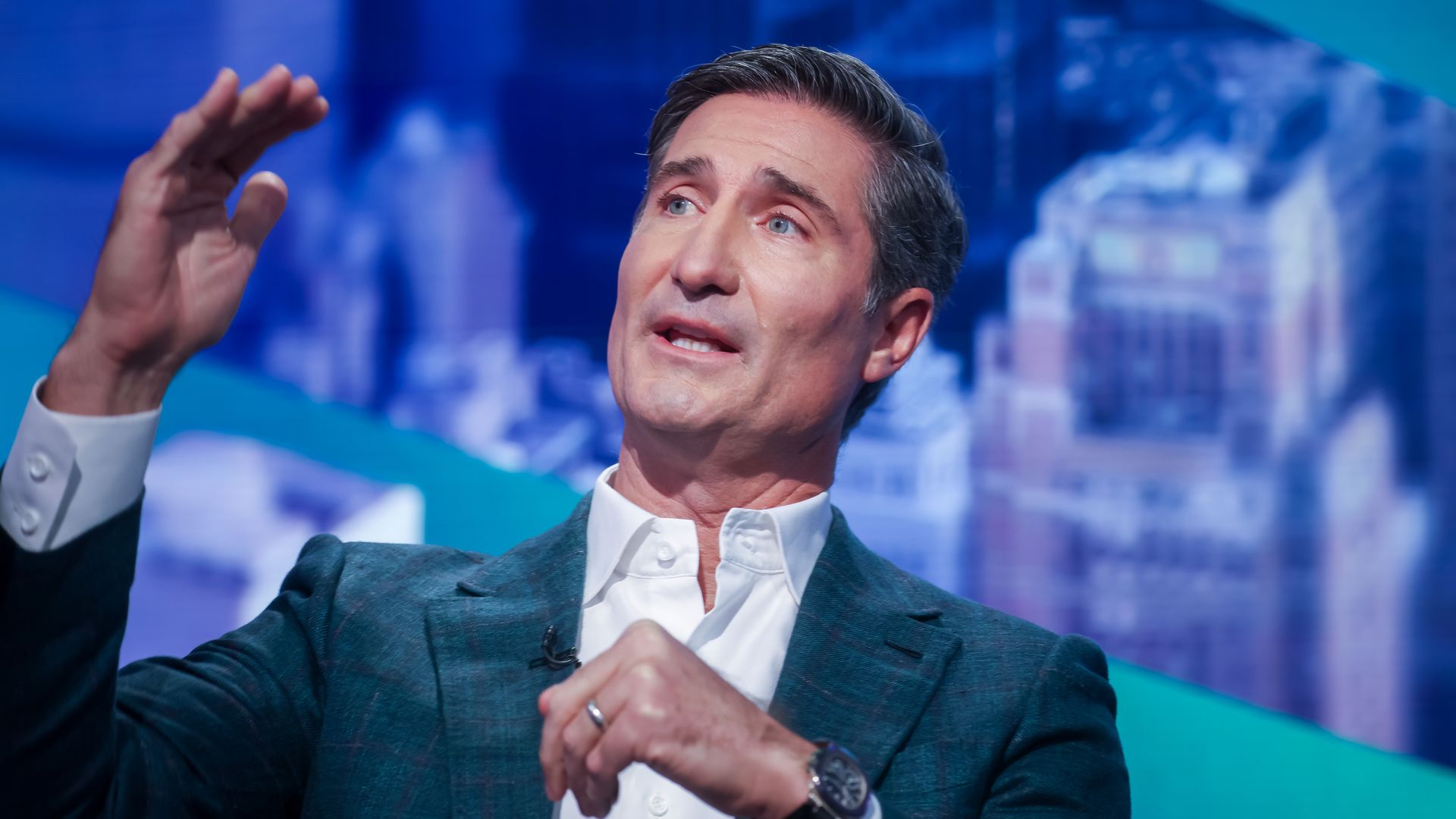
Chipotle shares jumped Thursday after a report that Starbucks has considered a bid to acquire the burrito chain.
Why it matters: The potentially seismic deal would pair the world's biggest coffee chain with one of the most powerful players in the fast-casual sector.
President Trump said Thursday the U.S. will not attack Iran ahead of the Nov. 3 midterm elections.
Why it matters:Trump had been considering for several days resuming major combat operations before the midterms. However, his past statements about his intentions in Iran haven't always matched what he ultimately did.
If major combat operations resume, they're expected to include large-scale strikes on Iranian energy facilities, infrastructure and nuclear targets, sources say.
Why it matters: It points to a remarkable stability on the "firing" side of the labor market, even amid a slower pace of hiring on the other side of the equation.
A couple more interest rate hikes are probably on the way. But the Federal Reserve is in no great hurry to deliver them. That's the takeaway from the latest round of communications out of the central bank.
Why it matters: It implies that the Fed is not in a full-scale effort to tighten the screws on the economy, but rather a cautious recalibration in light of inflationary pressures and robust growth.
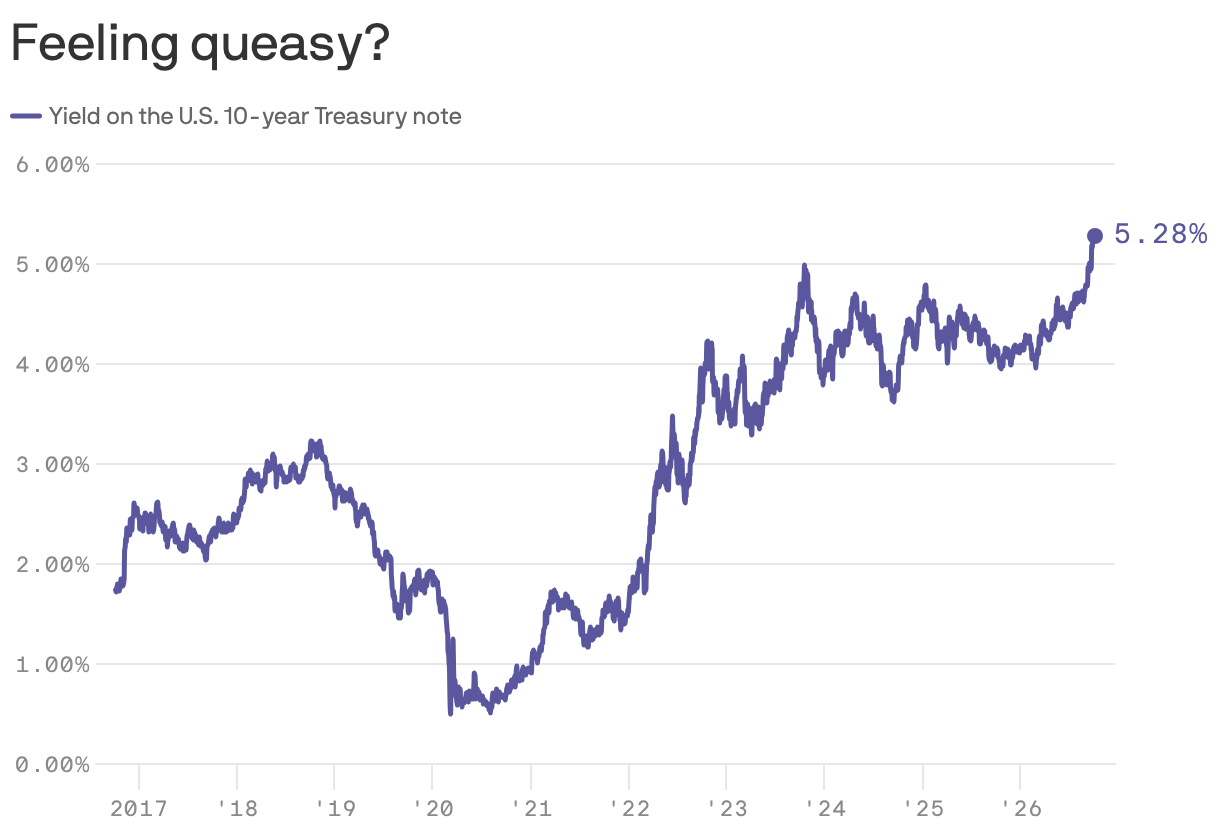
The recent sharp surge in Treasury yields may reflect the feedback loop dynamics that can sometimes take over in the bond market.
Why it matters: The spike in yields represents a big shift in the financial terrain beneath investors' feet.
The impact of so-called convexity hedging could be playing an important role in it.
How it works: Bond prices fall when interest rates rise.
But for technical reasons, the prices of some kinds of bonds — like packages of U.S. home loans wrapped up into mortgage bonds — can fall harder and harder as rates go higher and higher.
This particularly tricky feature of mortgage bonds is known as convexity, or more properly, negative convexity, because price drops get more extreme as rates rise.
Zoom in: Anyhoo, these mortgage bonds contain a sizable chunk of the roughly $13 trillion U.S. mortgage market. And their value has been falling fast as yields on Treasury notes and bonds have surged.
Without going into too much detail, one thing mortgage bond investors do when they find themselves in this situation is to try to sell Treasury bonds, thus reducing some of their portfolio's exposure to rising rates.
Or they can effectively do the same thing, via the derivatives market, with a product known as a swap from a Wall Street trading desk. (Often, the trading desk will then have to go into the market and sell Treasury securities to offset its own risk as a result of the swap.)
The big picture: You can see how this would increase pressure on the Treasury market, thereby worsening the yield increases that started the whole thing going in the first place.
This is a negative convexity loop, or as one of the greatest quotes in the history of the Treasury market put it back in 2007: "This is a good old-fashioned mortgage puke."
The bottom line: It's impossible to say that the recent run-up in rates is directly attributable to any one dynamic.
But the chatter in the bond market is that a good old-fashioned mortgage puke has likely played a role.
AI may have a woman problem — the latest evidence comes from a newly released survey from Morgan Stanley that finds women are far more negative about the new technology than men.
Why it matters: Women don't seem to be feeling the benefits of the AI boom, particularly in the job market, and the polling reveals that they're more concerned than men with safety risks and data center buildouts.
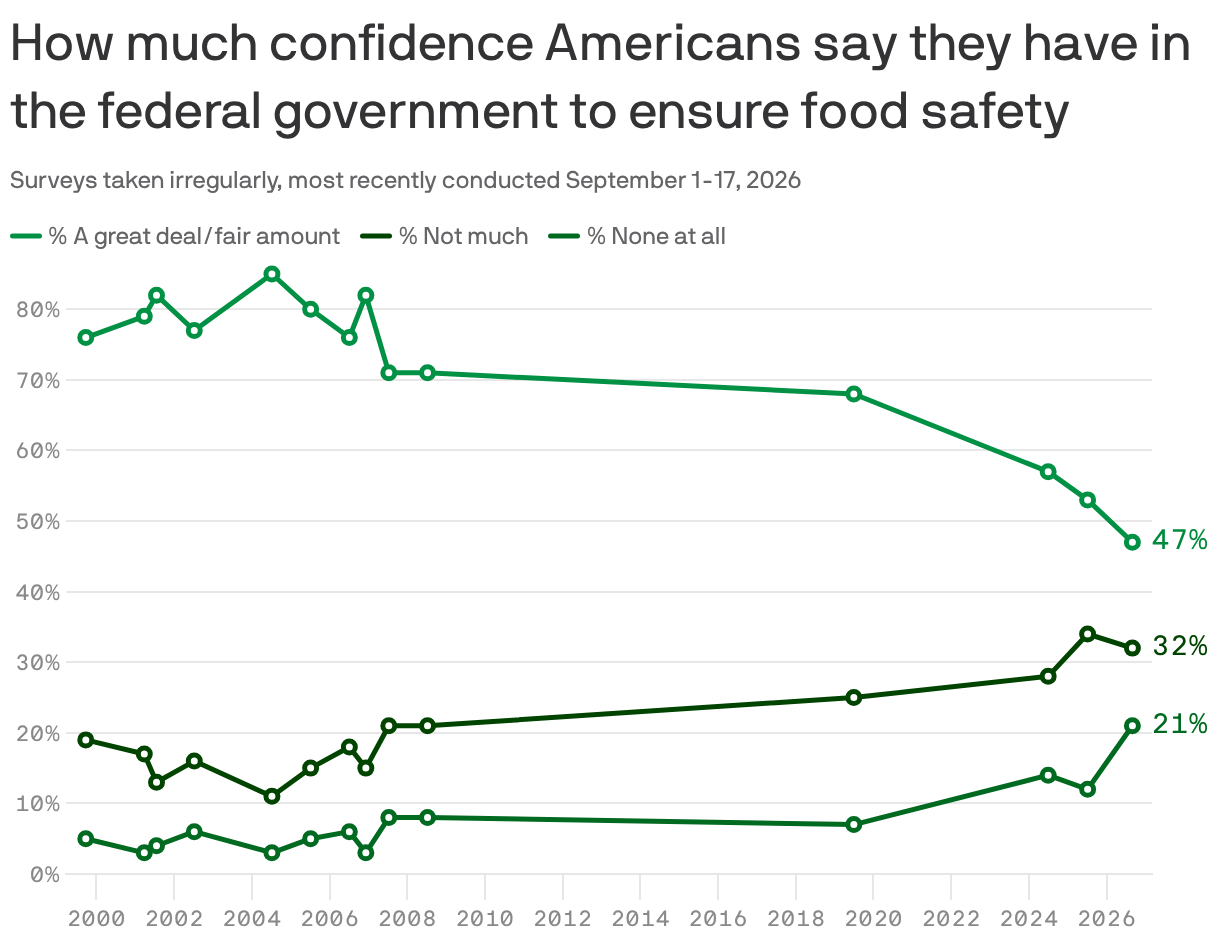
Americans' confidence in the safety of food on grocery store shelves — and in the federal government's ability to regulate it — has plummeted to new lows according to a new Gallup poll.
The big picture: Simultaneous illness outbreaks put federal regulators under a microscope earlier this year, as layoffs across the nation's health apparatus were already causing food safety angst.
Police and protesters clashed in Liège, Belgium, on Wednesday as student anger over education costs and school conditions grew, echoing massive protestsin neighboring France.
Why it matters: The protests are exposing broader anger across Europe over school funding and classroom conditions.
Sriram Krishnan, who stepped down in June as the White House's senior policy advisor on AI, is seeking to raise around $500 million for a new venture capital fund, Axios has learned.
Zoom in: The fund, which is in its early stages, is expected to focus on growth-stage AI companies that have relevance to national security for the U.S. or allied nations.
Federal Reserve officials worried that higher costs tied to energy, AI investment and other shocks could spill over into broader, more persistent inflation, according to the minutes from the central bank's Sept. 15-16 meeting.
Why it matters: That meeting concluded with the Fed's first interest rate increase in three years. The minutes show that "several" officials thought rates were doing little to restrain the economy, raising the stakes for further increases down the line.
Michigan Republican Senate nominee Mike Rogers called for an immediate end to President Trump's tariff war with Canada in a new ad Wednesday.
Why it matters:Trump endorsed Rogers, but Rogers has increasingly broken with the president as he fights to win a tight race against Democratic nominee Abdul El-Sayed.
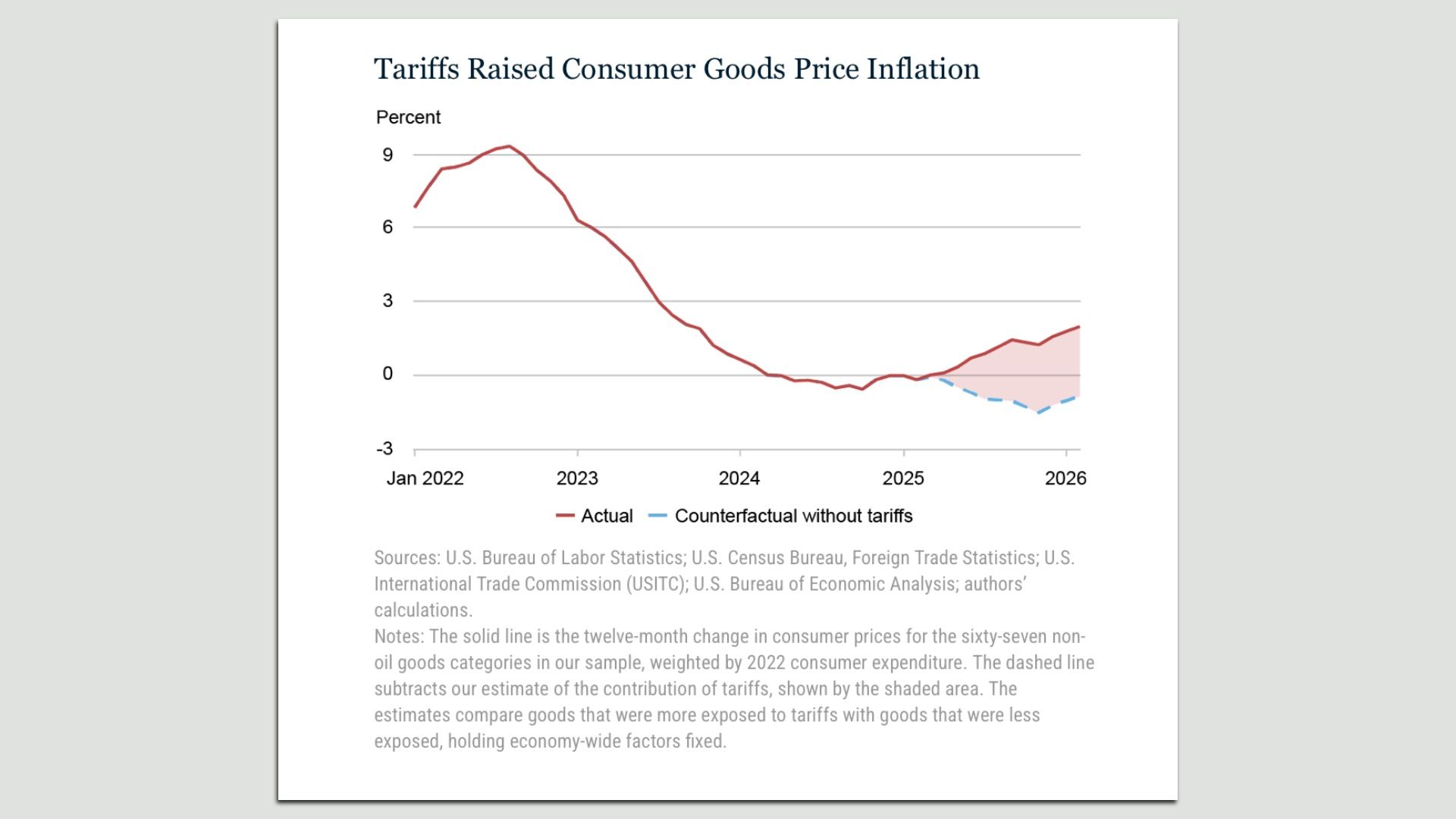
Tariff inflation has a long tail. Higher import costs can ripple through U.S. supply chains, with effects on domestically produced goods emerging as much as a year later, according to Federal Reserve Bank of New York researchers.
Why it matters: The inflation hit from 2025 tariffs is fading, but newer levies are still feeding through to prices as inflation is already too high for policymakers' comfort.
The Trump administration is pledging to modernize headlight standards, addressing a growing complaint among drivers about glare from powerful LED lights.
Why it matters: Industry experts say U.S. headlight regulations are severely outdated, creating dangerous driving conditions.
The German auto industry — long renowned for its engineering prowess and marketing genius — is reeling from stiffening competition, trade threats and shifting consumer tastes.
Why it matters: Volkswagen, Mercedes-Benz and BMW have been a powerful force on the global auto market for decades — but the market has shifted sharply.
The good news about the epic shifts in global bond markets is that they mostly reflect economic fundamentals, not the kinds of panicky swings seen in a crisis.
The bad news is that there's a risk the disruptions metastasize into a broader crisis in an era of fractured politics across major democracies.
The big picture: Turmoil in the streets this week in France is the latest sign of hazards that await elected leaders who try to address yawning fiscal deficits head-on.
They are squeezed between voters who want to maintain public benefit levels and tax levels and a bond market that is resetting long-term interest rates higher — meaning that carrying on with wide deficits will come at a greater and greater cost to service debt.
That's why even what has been a relatively orderly repricing so far carries risks that are bigger than just high mortgage or corporate borrowing rates.
Driving the news: The relentless upward march of bond yields continued Wednesday morning. The French 10-year yield soared 0.18 percentage point, to 4.93%.
French yields are also surging relative to other countries that use the euro, especially Germany — the kind of fragmentation seen in the eurozone debt crisis of the early 2010s that originated in Greece.
But France is not alone. U.K. 10-year yields are up 0.12 point, to 5.49%, while the 10-year U.S. Treasury yield is up 0.08 point Wednesday morning, reaching 5.36%, the highest since 2002.
Reality check: These are massive moves in markets that form the bedrock of global financial markets. And yet they don't appear to be driven by the kind of crisis dynamics and forced selling that fueled bond market volatilityin the 2008 crisis, the 2014 Treasury flash crash and the March 2020 pandemic.
Rather, they've been driven by bottomless demand for capital from AI hyperscalers and deficit-running sovereign governments, exacerbated by surging energy prices that increase inflation risk.
What they're saying: "When you look at outright yield levels and/or spreads, a lot of this is still quite rational, and within the realm of what fair valuation should be, just given where nominal growth is and where we are in the cycle," Kunal Shah, the co-CEO of Goldman Sachs International, tells Axios.
"At this point, I still wouldn't say that we're anywhere close to the point of this being a broad financial stability risk or issue," says Shah, who is also co-head of fixed income, currency and commodities.
"What policymakers in Europe have shown us, though, is that when there's broader issues on contagion and/or disorderly functioning markets, that's when they can be quick to respond."
"Whilst the move in spreads has been very quick and sharp, in the broader context, we're still nowhere close to where we had got to in that previous European crisis," he says. "Financial conditions are tightening, but it's still not, I'd say, flashing red to the point that you need a backstop from the policymakers."
Yes, but: The European Central Bank has more powerful tools than it did in 2010 to address imbalances between European countries, and has shown willingness to use them. But it can't do much about the fundamentals of governments spending consistently far more than they raise in taxes.
And the global nature of the yield surge shows the common fiscal challenge across major economies.
State of play: In France, there have been violent clashes with police as teachers and students protest proposed wage freezes and school funding cuts.
In the U.K., a central political dispute is over the future of the "triple lock" pension adjustment mechanism, which all but guarantees pension costs will grow faster than the overall economy.
The rate adjustment of the last several weeks will increase already-onerous debt service costs for all advanced countries.
Of note: Those forces can create destabilizing effects for business even apart from the impact on rates. Shah, for example, says that U.K. governments lurching from budget to budget has made it hard for businesses making long-term decisions.
"I hope that at some point we'll be able to break out of this cycle, because it does stifle confidence and it just makes planning for the long term very hard," Shah says.
Russia's war on Ukraine has sparked a boom in global defense-tech investing, particularly around drones. But very few of those startups are actually based and building in Ukraine.
Buntar Aerospace is an exception.
Driving the news: Buntar this week raised $16 million led by U.S.-based Freedom Fund VC, following a $10.4 million round earlier this year.
Hedge funds are playing an increasingly important role in the two hottest markets of the moment — U.S. Treasury securities and AI stocks — and they're doing it with a lot of borrowed money.
Why it matters: In times of stress, unwinding that borrowing, or leverage, can turn a sell-off into a crisis that spreads beyond hedge funds into the banking system and the wider economy.
The future ofAmerican fighter aircraft is now Boeing's to decide.
The big picture: The world's sixth-largest defense contractor by revenue has secured a monopoly on these sixth-generation warplanes, with the rights to build not only the U.S. Air Force's F-47 but also the Navy's F/A-XX.
A coalition of AI startups, cloud providers, researchers and investors is launching a National Compute Grid, an effort to pool AI computing to help address a supply crunch driving enormous spending on AI infrastructure.
Why it matters: Building AI infrastructure has become a multitrillion-dollar bet largely because of the high cost of accessing scarce computing resources. Yet many data centers run well below capacity, meaning extremely valuable chips sit idle while some startups and researchers struggle to get access.
The creators of the compute grid want to make it easier for idle computing capacity to be used, a goal that could significantly alter the direction of the AI boom if it were to take off.