Why it matters: The data sheds granular new information on a much-contested question: What happened to Americans' real incomes during the post-pandemic period? It featured an exceptionally tight job market and the highest inflation in decades, followed by aggressive Fed rate hikes.
President Trump on Friday ordered a new investigation into allegations of mortgage fraud against Federal Reserve governor Lisa Cook, directing a committee to question the central bank official at a White House hearing next month.
Why it matters: Trump is pursuing another path to remove Cook after the Supreme Court blocked his initial attempt earlier this year.
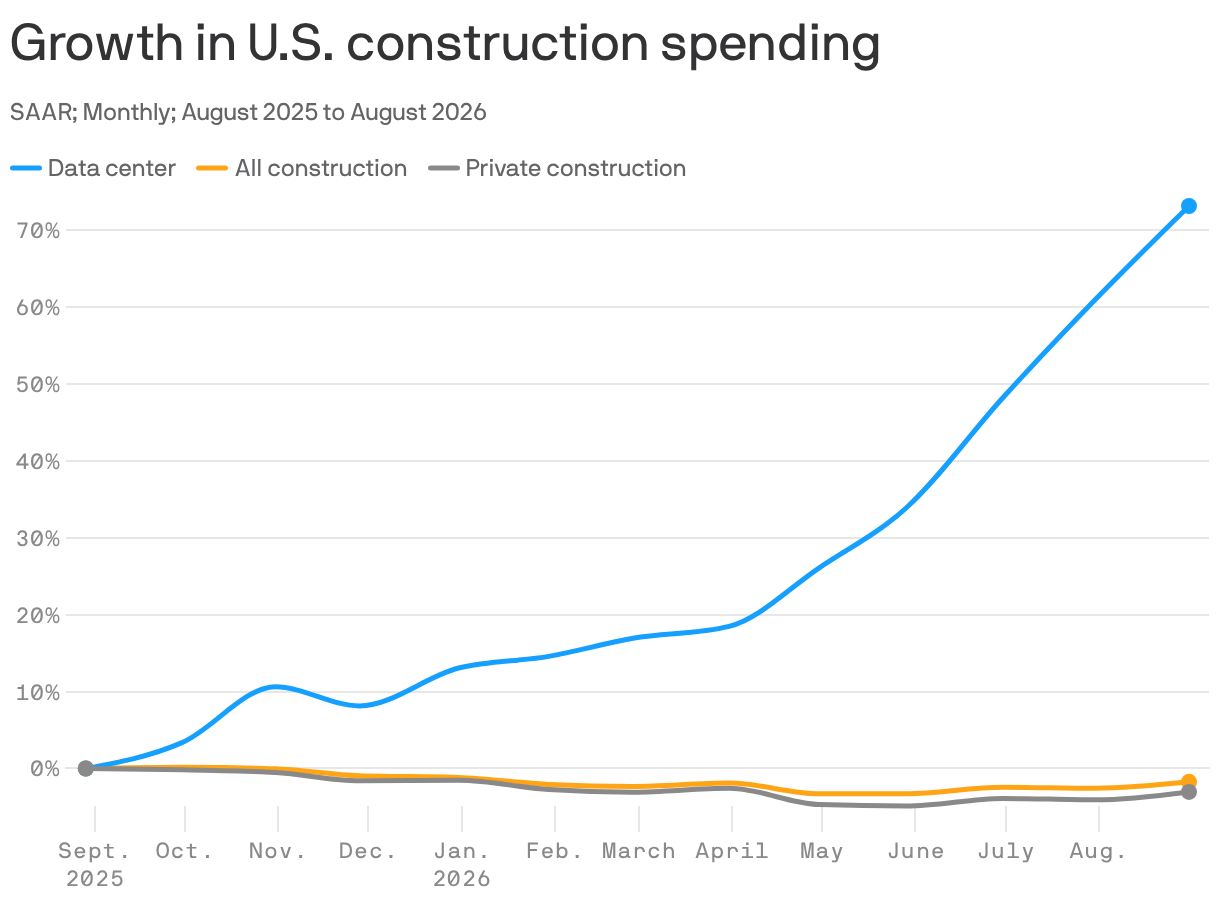
Data: U.S. Bureau of Labor Statistics, FactSet; Chart: Axios/Matt Phillips; Note: Data center construction includes construction costs, such as labor, materials, profits of contractors, architectural and engineering work and miscellaneous overhead, interest and taxes. Does not include servers, racks, chips or memory.
More and more, it seems as if there's the AI economy — and everything else.
Why it matters: The growing chasm between the breakneck growth of the AI world and the slower pace of the economy where most Americans work and live has huge implications, especially for the markets.
The Trump administration said Thursday that it was suspending Microsoft froma key program used to sponsor employees for green cards. Later that day, the administration honored the tech giant's CEO with a medal for innovation.
Why it matters: The split-screen day highlights the tension between the administration's championing of Big Tech and its immigration policies, which constrain an industry that has long relied on hiring foreign-born workers.
Tech leaders have said that restrictions on hiring hamper the country's ability to compete — especially at a moment when the U.S. is in a race with China on AI.
Chipotle shares jumped Thursday after a report that Starbucks has considered a bid to acquire the burrito chain.
Why it matters: The potentially seismic deal would pair the world's biggest coffee chain with one of the most powerful players in the fast-casual sector.
President Trump said Thursday the U.S. will not attack Iran ahead of the Nov. 3 midterm elections.
Why it matters:Trump had been considering for several days resuming major combat operations before the midterms. However, his past statements about his intentions in Iran haven't always matched what he ultimately did.
If major combat operations resume, they're expected to include large-scale strikes on Iranian energy facilities, infrastructure and nuclear targets, sources say.
Why it matters: It points to a remarkable stability on the "firing" side of the labor market, even amid a slower pace of hiring on the other side of the equation.
A couple more interest rate hikes are probably on the way. But the Federal Reserve is in no great hurry to deliver them. That's the takeaway from the latest round of communications out of the central bank.
Why it matters: It implies that the Fed is not in a full-scale effort to tighten the screws on the economy, but rather a cautious recalibration in light of inflationary pressures and robust growth.
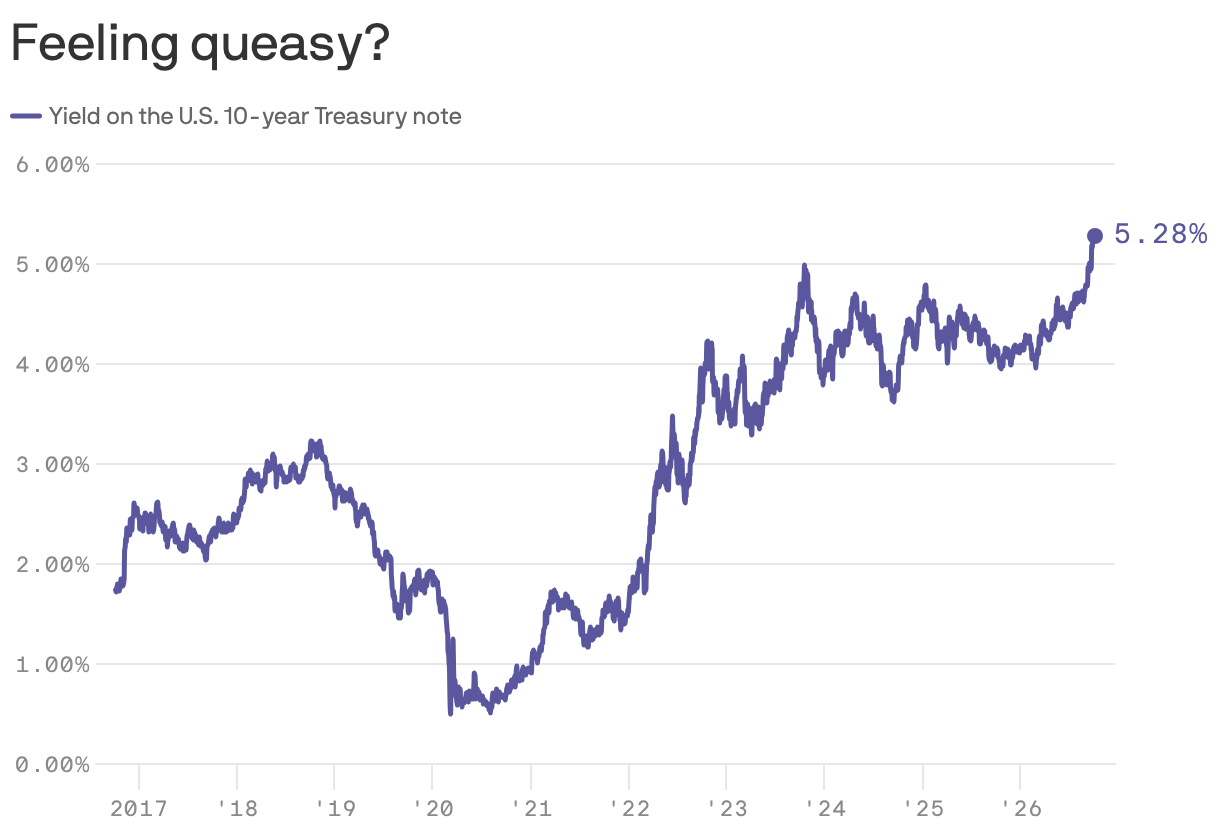
The recent sharp surge in Treasury yields may reflect the feedback loop dynamics that can sometimes take over in the bond market.
Why it matters: The spike in yields represents a big shift in the financial terrain beneath investors' feet.
The impact of so-called convexity hedging could be playing an important role in it.
How it works: Bond prices fall when interest rates rise.
But for technical reasons, the prices of some kinds of bonds — like packages of U.S. home loans wrapped up into mortgage bonds — can fall harder and harder as rates go higher and higher.
This particularly tricky feature of mortgage bonds is known as convexity, or more properly, negative convexity, because price drops get more extreme as rates rise.
Zoom in: Anyhoo, these mortgage bonds contain a sizable chunk of the roughly $13 trillion U.S. mortgage market. And their value has been falling fast as yields on Treasury notes and bonds have surged.
Without going into too much detail, one thing mortgage bond investors do when they find themselves in this situation is to try to sell Treasury bonds, thus reducing some of their portfolio's exposure to rising rates.
Or they can effectively do the same thing, via the derivatives market, with a product known as a swap from a Wall Street trading desk. (Often, the trading desk will then have to go into the market and sell Treasury securities to offset its own risk as a result of the swap.)
The big picture: You can see how this would increase pressure on the Treasury market, thereby worsening the yield increases that started the whole thing going in the first place.
This is a negative convexity loop, or as one of the greatest quotes in the history of the Treasury market put it back in 2007: "This is a good old-fashioned mortgage puke."
The bottom line: It's impossible to say that the recent run-up in rates is directly attributable to any one dynamic.
But the chatter in the bond market is that a good old-fashioned mortgage puke has likely played a role.
AI may have a woman problem — the latest evidence comes from a newly released survey from Morgan Stanley that finds women are far more negative about the new technology than men.
Why it matters: Women don't seem to be feeling the benefits of the AI boom, particularly in the job market, and the polling reveals that they're more concerned than men with safety risks and data center buildouts.
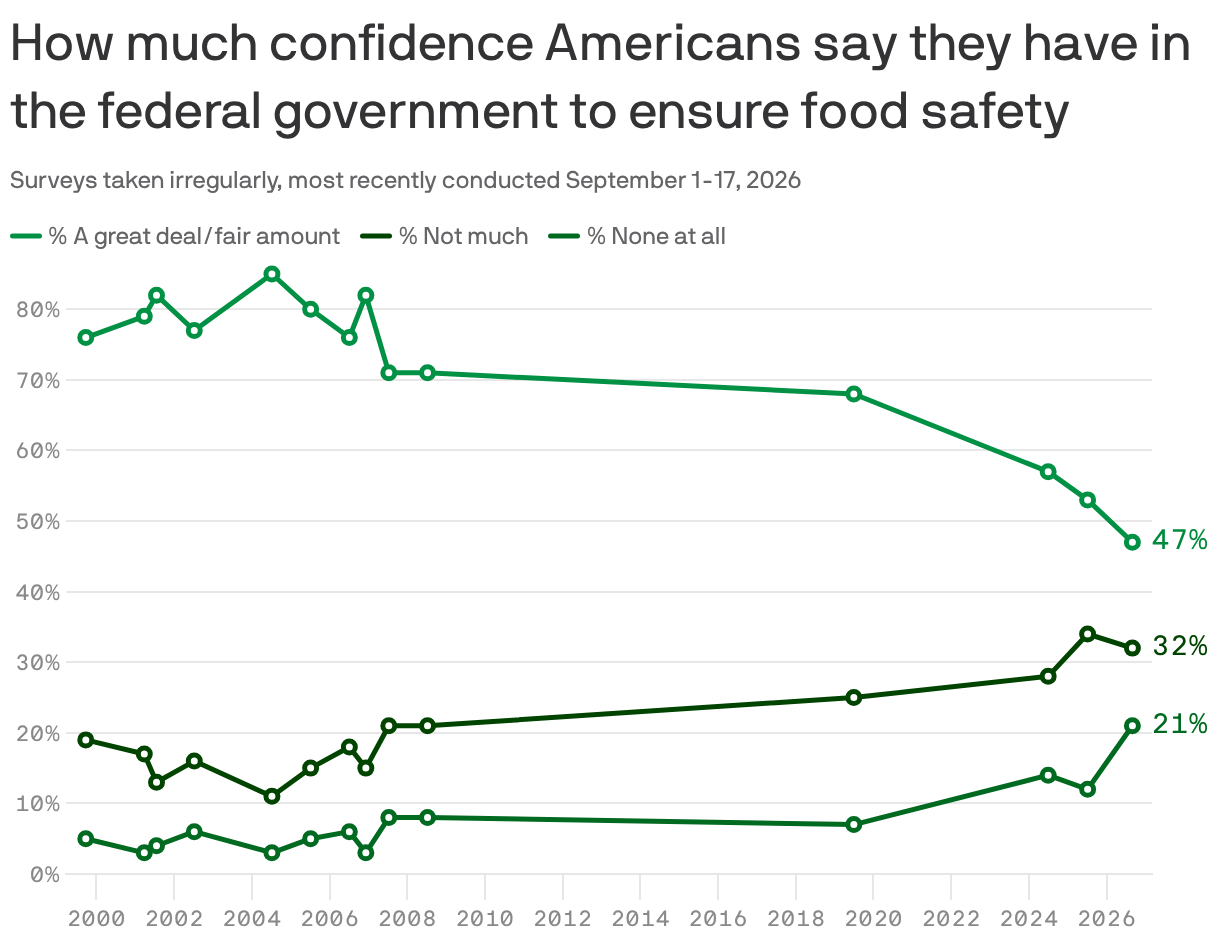
Americans' confidence in the safety of food on grocery store shelves — and in the federal government's ability to regulate it — has plummeted to new lows according to a new Gallup poll.
The big picture: Simultaneous illness outbreaks put federal regulators under a microscope earlier this year, as layoffs across the nation's health apparatus were already causing food safety angst.