"Mortgage puke" could be a factor in rate rise

Add Axios as your preferred source to
see more of our stories on Google.
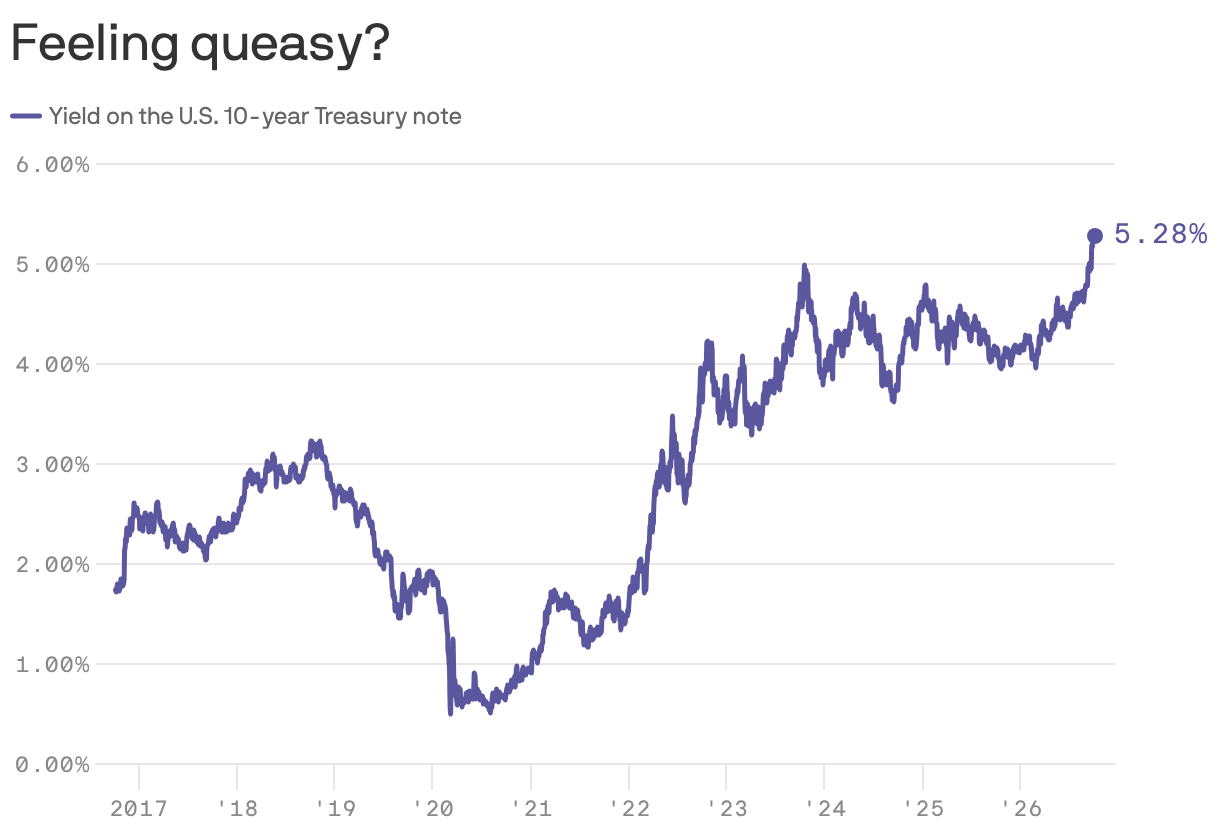
The recent sharp surge in Treasury yields may reflect the feedback loop dynamics that can sometimes take over in the bond market.
Why it matters: The spike in yields represents a big shift in the financial terrain beneath investors' feet.
- The impact of so-called convexity hedging could be playing an important role in it.
How it works: Bond prices fall when interest rates rise.
- But for technical reasons, the prices of some kinds of bonds — like packages of U.S. home loans wrapped up into mortgage bonds — can fall harder and harder as rates go higher and higher.
- This particularly tricky feature of mortgage bonds is known as convexity, or more properly, negative convexity, because price drops get more extreme as rates rise.
- (My colleague Emily Peck spotted this dynamic last week; another tip of the hat to the Financial Times, which discussed its peculiar mechanics yesterday.)
Zoom in: Anyhoo, these mortgage bonds contain a sizable chunk of the roughly $13 trillion U.S. mortgage market. And their value has been falling fast as yields on Treasury notes and bonds have surged.
- Without going into too much detail, one thing mortgage bond investors do when they find themselves in this situation is to try to sell Treasury bonds, thus reducing some of their portfolio's exposure to rising rates.
- Or they can effectively do the same thing, via the derivatives market, with a product known as a swap from a Wall Street trading desk. (Often, the trading desk will then have to go into the market and sell Treasury securities to offset its own risk as a result of the swap.)
The big picture: You can see how this would increase pressure on the Treasury market, thereby worsening the yield increases that started the whole thing going in the first place.
- This is a negative convexity loop, or as one of the greatest quotes in the history of the Treasury market put it back in 2007: "This is a good old-fashioned mortgage puke."
The bottom line: It's impossible to say that the recent run-up in rates is directly attributable to any one dynamic.
- But the chatter in the bond market is that a good old-fashioned mortgage puke has likely played a role.
