The great global rate reset

Add Axios as your preferred source to
see more of our stories on Google.
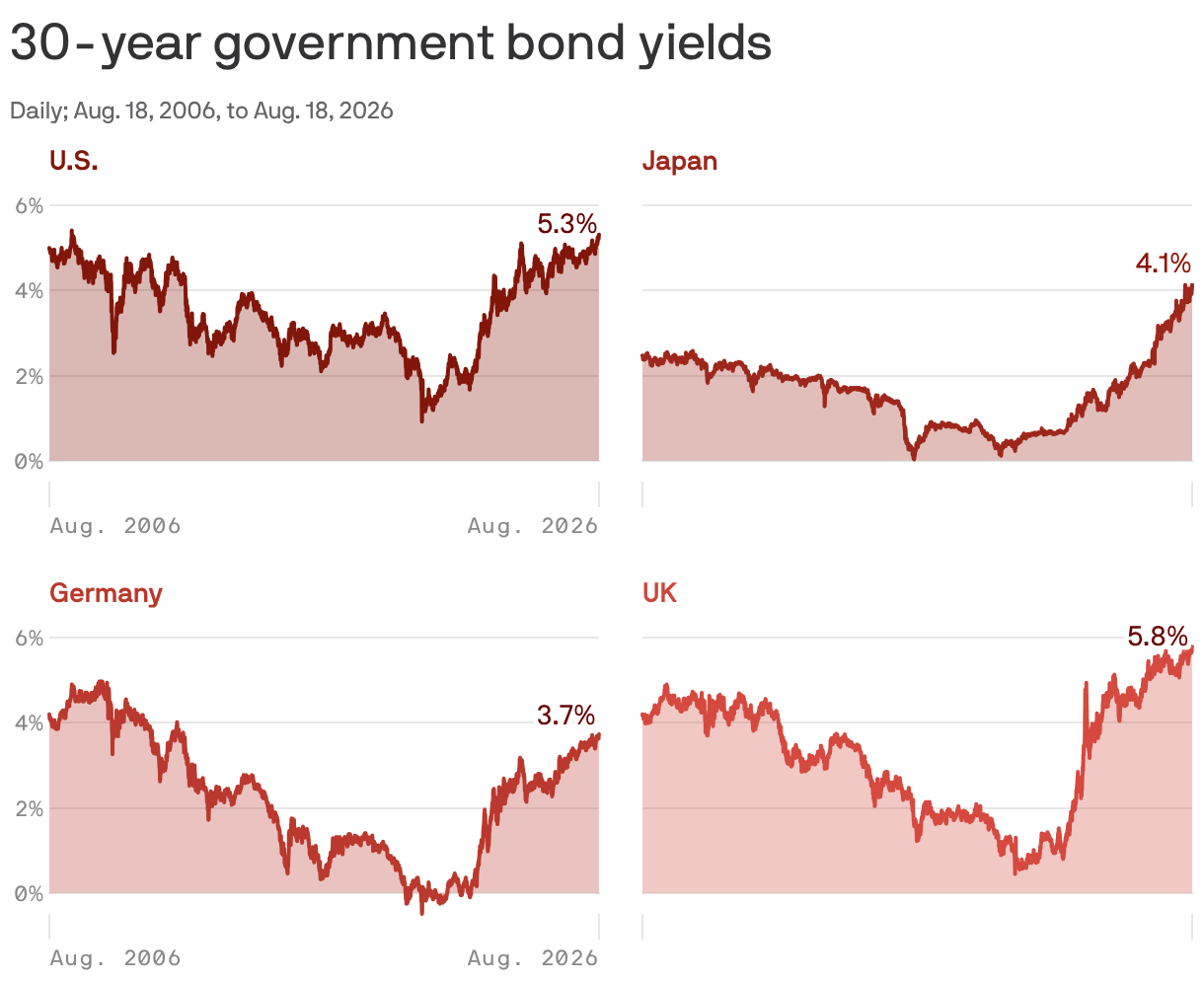
The world has a new, expensive problem: The cost of borrowing money for decades keeps going up, making it getting harder to dismiss as a temporary market tantrum.
Why it matters: The relentless rise in borrowing costs in recent months makes a long-feared scenario harder to dismiss: that investors demand higher and higher returns in ways that make it prohibitively expensive to finance investments meant to power the next era of economic growth.
- The consequences extend far beyond financial markets.
- Pricier money could mean businesses investing and hiring less, governments having less room to spend and households paying more to borrow for homes and cars.
What they're saying: "Global bond markets have caught on fire. ... Reckless fiscal policy is catching up with governments," Brookings Institution fellow Robin Brooks wrote on X Tuesday morning.
- "At this point, it should be clear that something very unusual is going on in global bond markets," Brooks wrote in a separate post.
- He noted that investors are betting U.S. interest rates will stay unusually high for years to come — even higher than they anticipated when global central banks were raising rates aggressively in 2022.
Driving the news: From the U.S. to Japan, long-term interest rates are pushing into territory not seen in years or decades at one of the most consequential moments for the global economy.
- 🇺🇸 The 30-year Treasury yield hit 5.3%, the highest since June 2007.
- 🇯🇵 Japan's 30-year yield climbed to 4.1%, near a record high.
- 🇪🇺 France's hit 4.9%, the highest since 2008, while Germany's comparable rate hit 3.7%, the highest since the euro-area debt crisis in 2011.
- 🇬🇧 Britain's reached 5.8%, nearing the highest since 1998.
The big picture: The Middle East conflict has intensified the sell-off, pushing oil prices back above $90 a barrel and reviving inflation fears.
Yes, but: The surge in long-term borrowing costs predates the latest oil spike.
- It's colliding with other sources of investor angst, like enormous government borrowing and AI-fueled corporate debt, meaning that more bonds are competing for buyers.
- (Axios' Matt Phillips explained another factor, driven by Federal Reserve chairman Kevin Warsh.)
"These are not new forces, and the rise in long-term yields has been gradual rather than sudden," Anshul Pradhan, head of U.S. rates at Barclays, wrote in a note.
- In the U.S., three reports — sluggish consumer spending data, an unexpectedly bad jobs report and a cool inflation report — trimmed bets of a Fed rate hike, but they did not stem the sell-off.
- "What is notable today is not the existence of these pressures, but that they appear strong enough to overwhelm individual soft-data releases. Three independent releases argued for lower yields this month; long-end yields moved higher anyway," Pradhan wrote.
Friction point: The price of money is soaring just as the world's biggest economies require huge sums of money for major transformations.
- AI: Tech giants are borrowing vast amounts to finance data centers, chips and power infrastructure, putting them in direct competition with governments and other borrowers for investors' money.
- Demographics: Governments face mounting costs for pensions, health care and other benefits as their societies age, putting more pressure on already stretched public finances.
- Geopolitical chaos: Wars and geopolitical instability are forcing governments to rebuild military capacity and new energy infrastructure to rely less on adversaries.
The bottom line: The world is trying to finance some of its most expensive ambitions in decades just as cheap money is disappearing.
- There's also the risk that something breaks as higher rates expose vulnerabilities.
- The regional bank failures of 2023, for example, came after surging interest rates hammered Silicon Valley Bank's bond portfolio (which compounded poor risk management and vulnerabilities in its deposit base).
