The U.S. Securities and Exchange Commission charged Terraform Labs and co-founder Do Kwon with fraud.
What's happening: The SEC's complaint alleges that from April 2018 until its collapse in May 2022, Terra and Kwon raised billions of dollars from investors "offering and selling an inter-connected suite of crypto asset securities."
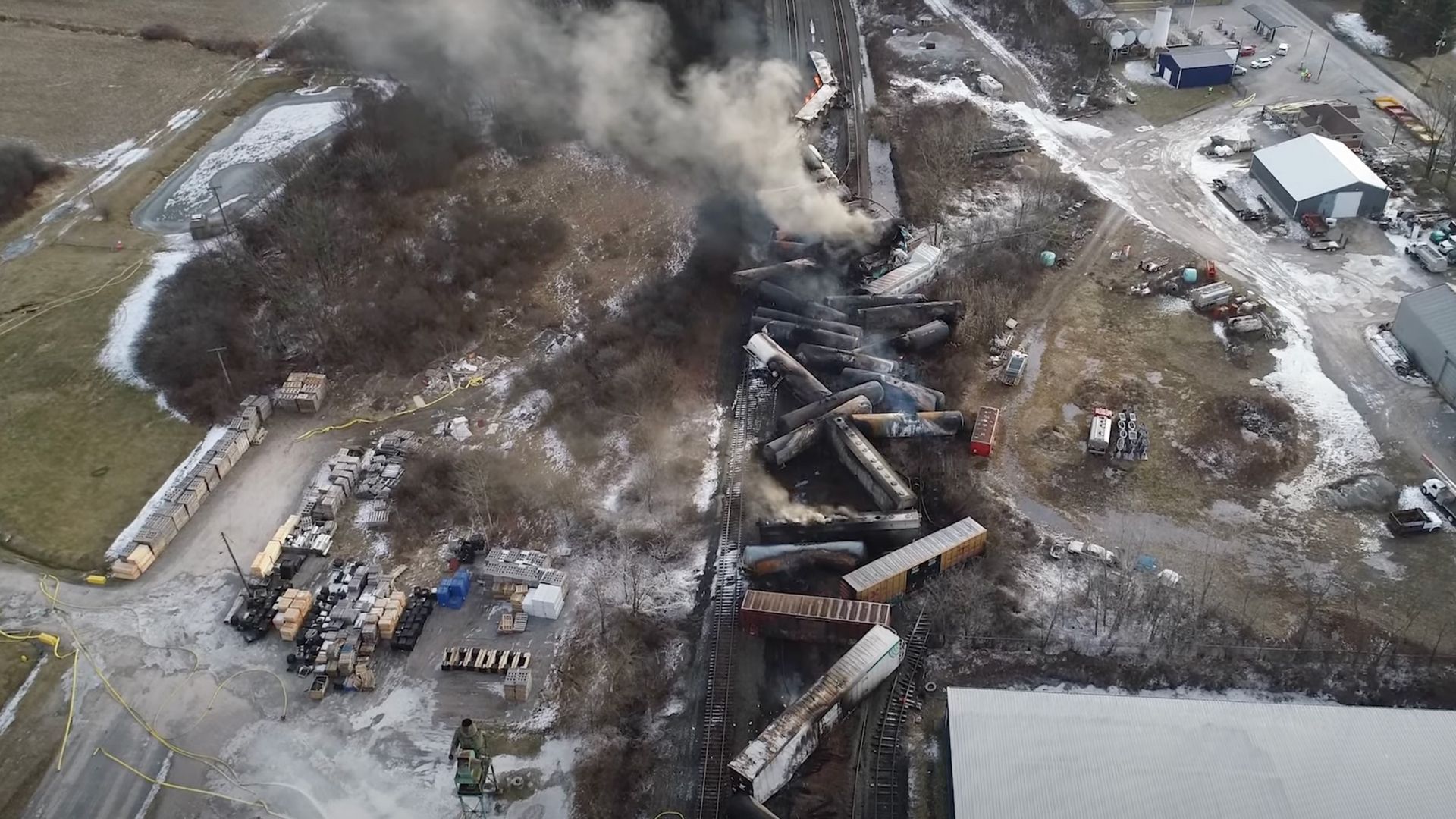
The Biden administration said Thursday that it will hold rail operator Norfolk Southern accountable for the derailment of a 150-car freight train in East Palestine, Ohio — a day after the town's mayor said he heard from the White House for the first time this week.
Driving the news: The comments — made by White House Press Secretary Karine Jean-Pierre at a briefing on Thursday — come almost two weeks after the Norfolk Southern train, which was pulling at least five tanker cars containing a hazardous gas, crashed and forced the company to vent and burn carcinogenic chemicals from train cars.
Why it matters: Software that allows some Tesla cars to exceed the speed limit or behave unpredictably at intersections could increase the risk of a crash, according to the National Highway Traffic Safety Administration (NHTSA), the nation's top safety agency.
Next Friday marks the one-year "anniversary" of Russia's invasion of Ukraine, which continues to cause death, destruction and global economic upheaval.
Zoom in: For Alex Iskold, a New York City venture capitalist who immigrated from Ukraine in the early 1990s, it's time to reflect on work already done and the continuing challenges.
There's more downbeat news on inflation this morning: Wholesale costs rose sharply in January, the latest indication of more persistent price pressures across the economy.
The producer price index, a measure of the change in costs of suppliers' goods and services, had been fairly benign in recent months, as supply chains healed and commodity costs came down. That changed last month.
Why it matters: The index is considered a leading indicator of what might happen to costs for consumers, as businesses pass along higher costs to shoppers.
Details: The PPI rose 0.7% in January — the largest monthly jump since last summer, and a slightly quicker pace than analysts anticipated. The index is up 6% in the 12 months through January, compared to 6.5% in December.
Stripping out energy, food and trade service costs, the index rose 0.6%, compared to the 0.2% in December, the biggest monthly rise since last March.
The bottom line: The Fed "is hoping for supply chains to clear up and for finished goods prices to slow sharply—there is no sign of this in today's report," Brean Economics' John Ryding and Conrad DeQuadros wrote in a note.
YouTube CEO Susan Wojcicki is stepping down from her role and will be replaced by Neal Mohan, she announced Thursday morning in a letter to staff first reported by Recode.
Why it matters: Wojcicki has been at the helm of the video streaming giant owned by Google for nine years, overseeing its explosive growth and some of its most controversial moments and policy changes.
The United States is suffering from rapid inflation, persistent labor shortages and — as new projections out yesterday show — public debt that's high and rising.
There's a pathway out that doesn't involve much pain, however: higher labor productivity.
Why it matters: If employers become more effective in converting labor hours into goods and services, as they have during past productivity spurts, it would enable robust growth. That would happen even in the face of deep demographic challenges that point to a shortage of necessary workers in the coming decade.
By the numbers: The McKinsey Global Institute, the research arm of the giant consulting firm, has new research out today that crunches the numbers.
It finds that if U.S. productivity growth returned to its 2.2% per year average since 1948 as opposed to the (subpar) 1.4% rate notched between 2005 and 2019, it would add $10 trillion to cumulative economic output between now and 2030.
That amounts to about $15,000 in additional output — and by extension, income — per household.
State of play: McKinsey's researchers find that even within the same industry, there are both high- and low-productivity companies. That implies some of this productivity growth could come from lower performers adopting best practices.
In manufacturing, for example, high-productivity companies achieve 5.4 times the economic output per hour of labor as the laggards.
There are also stark U.S. regional divides, with California, Colorado, Massachusetts, New York, North Dakota, Texas, and Washington experiencing strong productivity growth.
Flashback: A productivity surge wouldn't be unprecedented. A notable jump took place from 1995 to 2005, driven in large part by companies digitizing their supply chains and other information technology advances.
"It's going to be hard, but we've done it before," Olivia White, a McKinsey senior partner and co-author of the report, tells Axios.
"Technology matters, but our real focus is not just investing in technology, but unlocking the power of investments you've already made," White said. "That's what we saw in 1995 also. It's not a perfect parallel, but we see an analog right now."
Meanwhile, new projections from the Congressional Budget Office yesterday show the scale of the challenge America faces, with the national debt on track to soar from 98% to 118% of GDP over the coming decade.
CBO's economic projections assume labor productivity rises at only between 1.6% and 1.8% a year — in line with recent performance.
That means if the economy turns out to function at something more like the 2.2% rate that McKinsey analyzed, the GDP denominator would be bigger, therefore lowering the debt ratio.
The stock market reality for The RealReal is looking ugly.
The luxury consignment brand's shares were trading at $1.72 on Thursday morning, down from their intraday high of $30.22 in February 2021.
Driving the news: The company on Thursday announced plans to lay off 7% of its staff and close two flagship stores, two neighborhood stores and two consignment offices.
Latino-owned businesses in the U.S. are more likely than white non-Hispanic ones to say they've recovered from the pandemic and are performing better than before, according to a new report.
State of play: The annual Stanford Latino Entrepreneurship report, scheduled to be released today (Thursday), focuses on the fastest-growing segment of the U.S. business population.
Top communicatorsare increasingly taking to Twitter to explain, persuade and clap back on thorny issues.
Why it matters: While many in politics have been taking this approach for years, it's a new strategy for corporate communicators who typically opt for strategic silence.
As users test-drive Microsoft Bing's new AI-powered chat mode, they're finding example after example of the bot seeming to lose its mind — in different ways.
What's happening: In the past few days, Bing has displayed a whole therapeutic casebook's worth of human obsessions and delusions.
Three major investors in failed crypto company FTX have been sued in California, as part of a class action accusing them of fraudulent and deceptive practices that caused consumer harm.
The big picture: The plaintiff argues that the investment firms publicly hyped FTX, giving it an "air of legitimacy," and thus are liable for the consequences of its misdeeds.
Yields on six-month U.S. Treasury bills scrambled over 5% on Wednesday.
Why it matters: It's the first time since 2007 — during the go-go days before the Great Recession — that U.S. government securities were sporting a so-called 5-handle.
Why it matters: While private sector jobs have recovered — and then some — compared to their pre-pandemic numbers, the public sector is a different story. Worker shortages are an ongoing issue.
If you put money into a privately held tech company in 2021, did you lose money as tech valuations imploded in 2022? And if so, how much money did you lose? These somewhat metaphysical questions are bedeviling investors, all of whom have slightly conflicting incentives.
Why it matters: At stake is a messy admixture of fear, hubris, and attempted price arbitrage — not to mention ontological confusion over what a valuation even is.
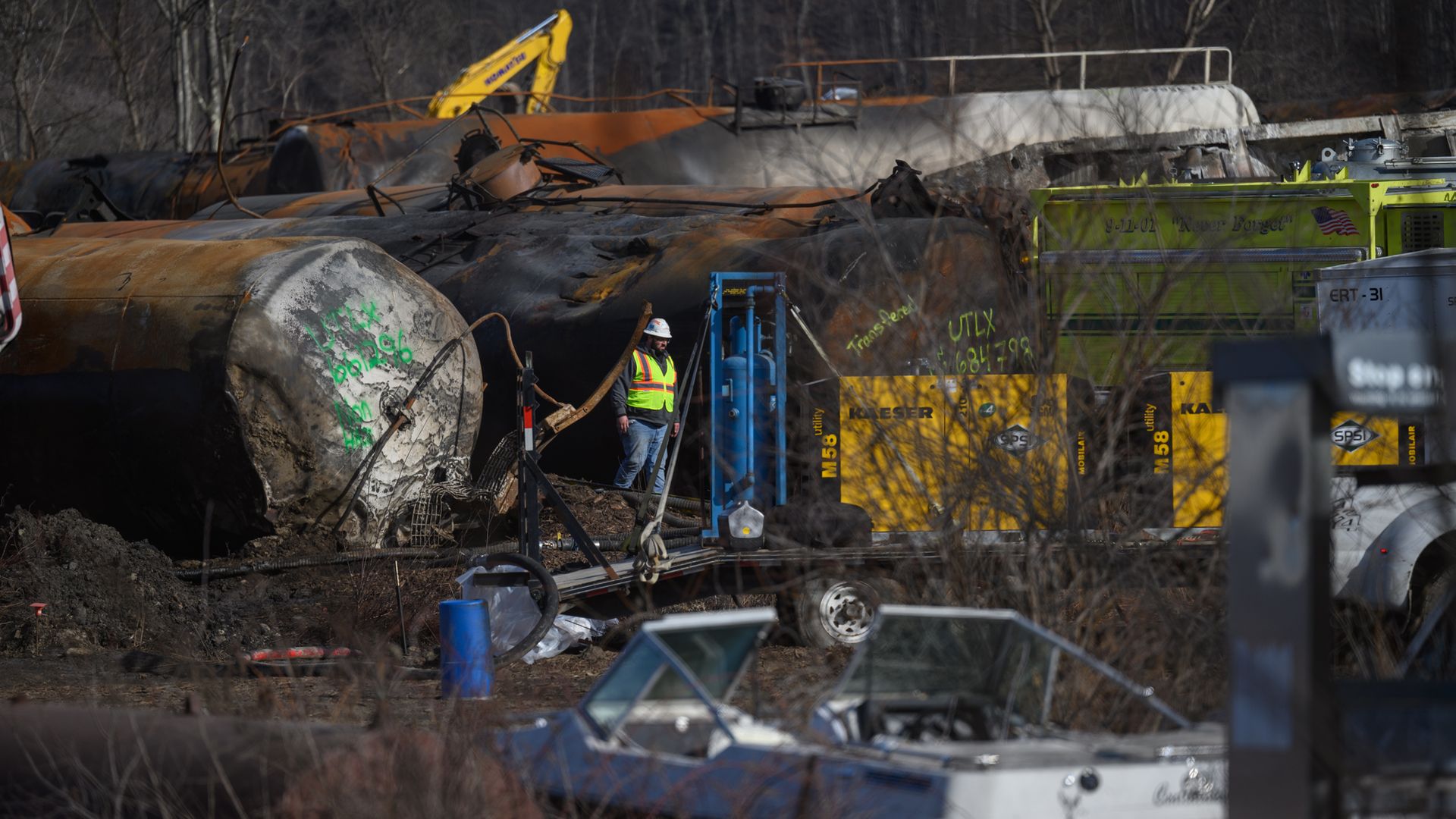
As emergency crews continue to clean up the site where a train carrying hazardous materials derailed in East Palestine, Ohio, several lawmakers are pushing for answers about government oversight of the freight train system.
Why it matters: The derailment and subsequent fire forced hundreds to evacuate and caused alarm about toxic fumes and water contamination from spilled materials.