Netflix’s new top show “Squid Game” has taken over the cultural zeitgeist.
Catch up quick: The dark South Korean drama centers around a group of people who play each other in life-or-death games to win an insane amount of money.
Despite what recruiting brochures or company ads might suggest, U.S. companies lag far behind most of the world when it comes to diversity and inclusion.
Why it matters: The pandemic compounded racial and gender gaps across the workforce at a time when more companies than ever before are trying to gain greater diversity on boards and in management.
The McRib is back — even though pork prices are much higher than they were during previous seasons.
Why it matters: A popular theory holds that the McRib only appears when hog prices hit a low point:
"The McRib’s unique aspects and impermanence, many of us believe, make it seem a likely candidate for being a sort of arbitrage strategy. ... In this equation, the undervalued good in question is hog meat."
Between the lines: The McRib seems to have been consistently introduced at low points in the price of pork. Even this time around, the reintroduction comes only after pork prices have fallen significantly.
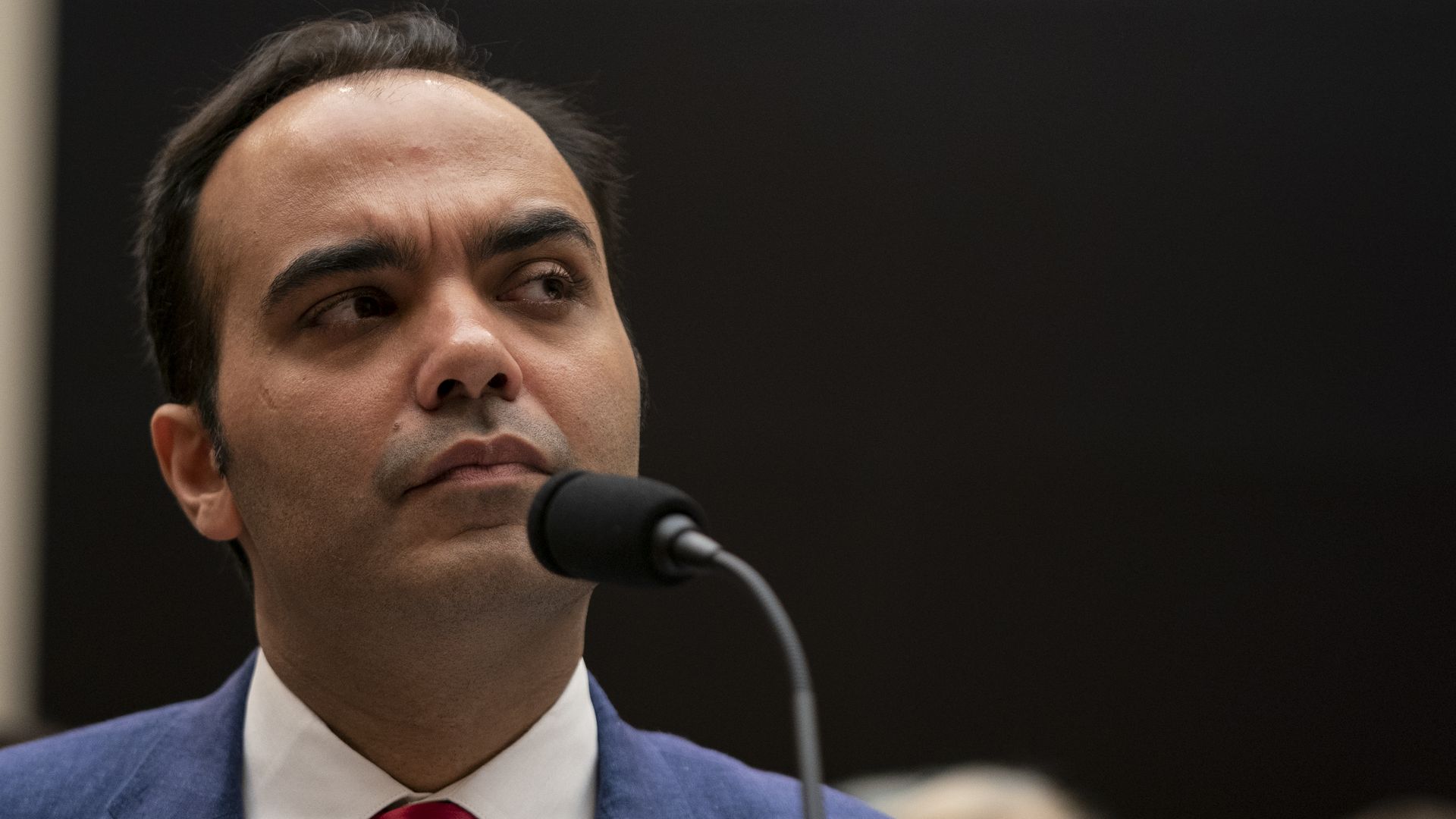
The Senate voted 50-48 on Thursday to approve Rohit Chopra as the third director of the Consumer Financial Protection Bureau.
Why it matters: Chopra, who served on the Federal Trade Commission, worked closely with Sen. Elizabeth Warren (D-Mass.) to establish the Bureau following the 2008 financial crisis.
Olaplex, the Southern California-based company known for its "miracle" anti-damage additive to hair bleach, went public Thursday morning after raising $1.5 billion in an initial public offering. It closed its first day of trading at $24.50 per share (up 17%), with a market cap of $15.9 billion.
Why it matters: In an age of unprofitable software and internet-driven companies going public, Olaplex stands out: it had $94.9 million in profit in the first half of 2021, on $270.2 million in sales — and it's a social media sensation.
Marc Lasry, the billionaire businessman and co-owner of the Milwaukee Bucks, said in a statement provided to Axios that he has stepped down from Ozy Media's board.
Why it matters: Lasry, who is also an investor in Ozy, was named chairman earlier this month. His departure comes as investors scramble to distance themselves from the company, after a New York Times report that suggested Ozy executives may have committed securities fraud.
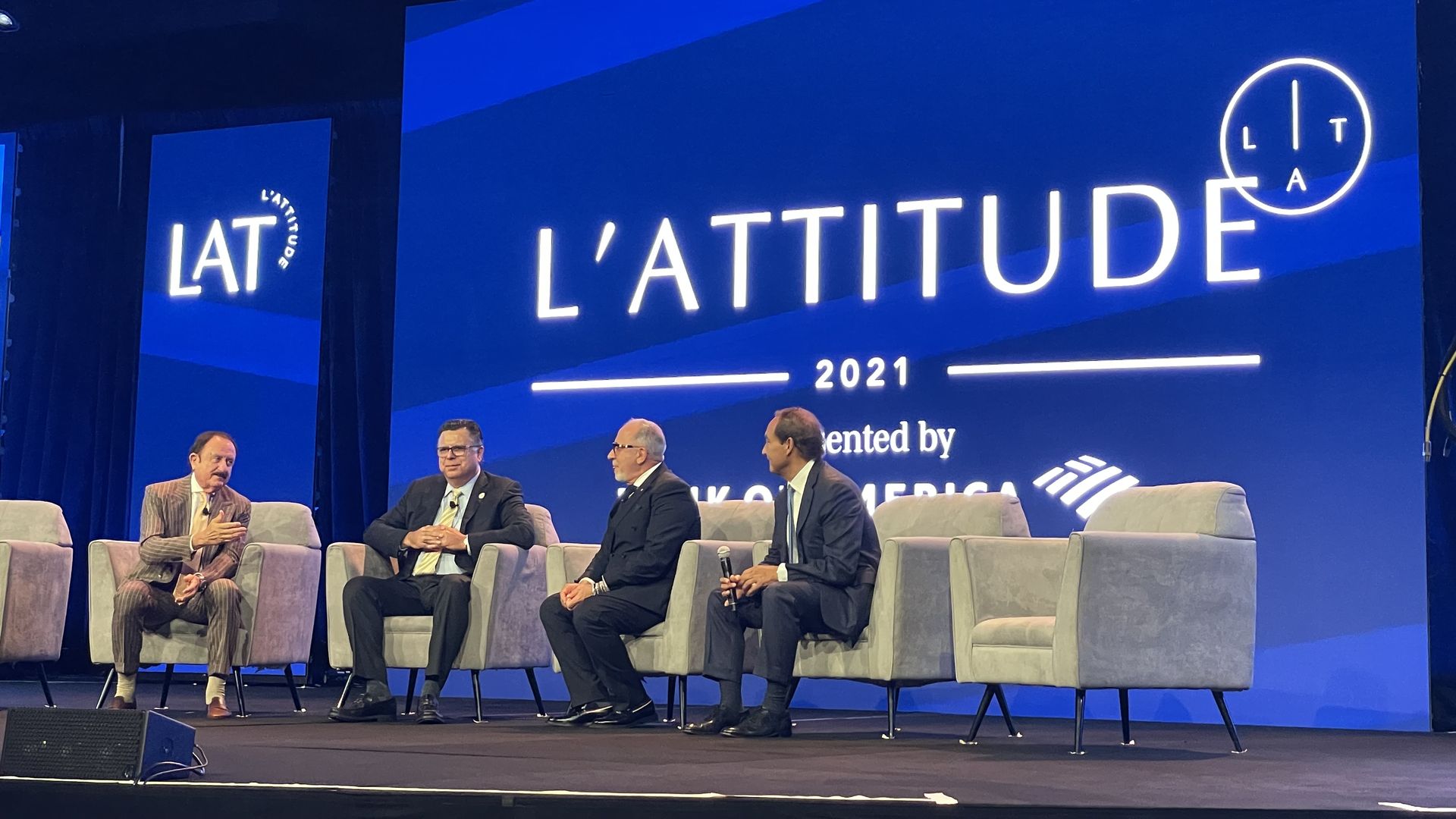
The total economic output of U.S. Latinos reached $2.7 trillion in 2019 and would be tied for the seventh-largest GDP in the world if U.S. Latinos were an independent country, according to a report released Wednesday.
Why it matters: The report showed U.S. Latino buying power continues to grow and is driven by U.S. births, not immigration.
Buying and selling individual stocks is a hobby for rich people that, over the course of the pandemic, also became a hobby for millions of new investors using free trading apps. But given the number of conflicts involved, it's a hobby that many people should probably give up.
Why it matters: In recent days we've seen shock headlines about the stock-trading activities of judges and corporate insiders. Two Federal Reserve presidents resigned after they were revealed to be actively trading the markets they were also influencing via monetary policy.
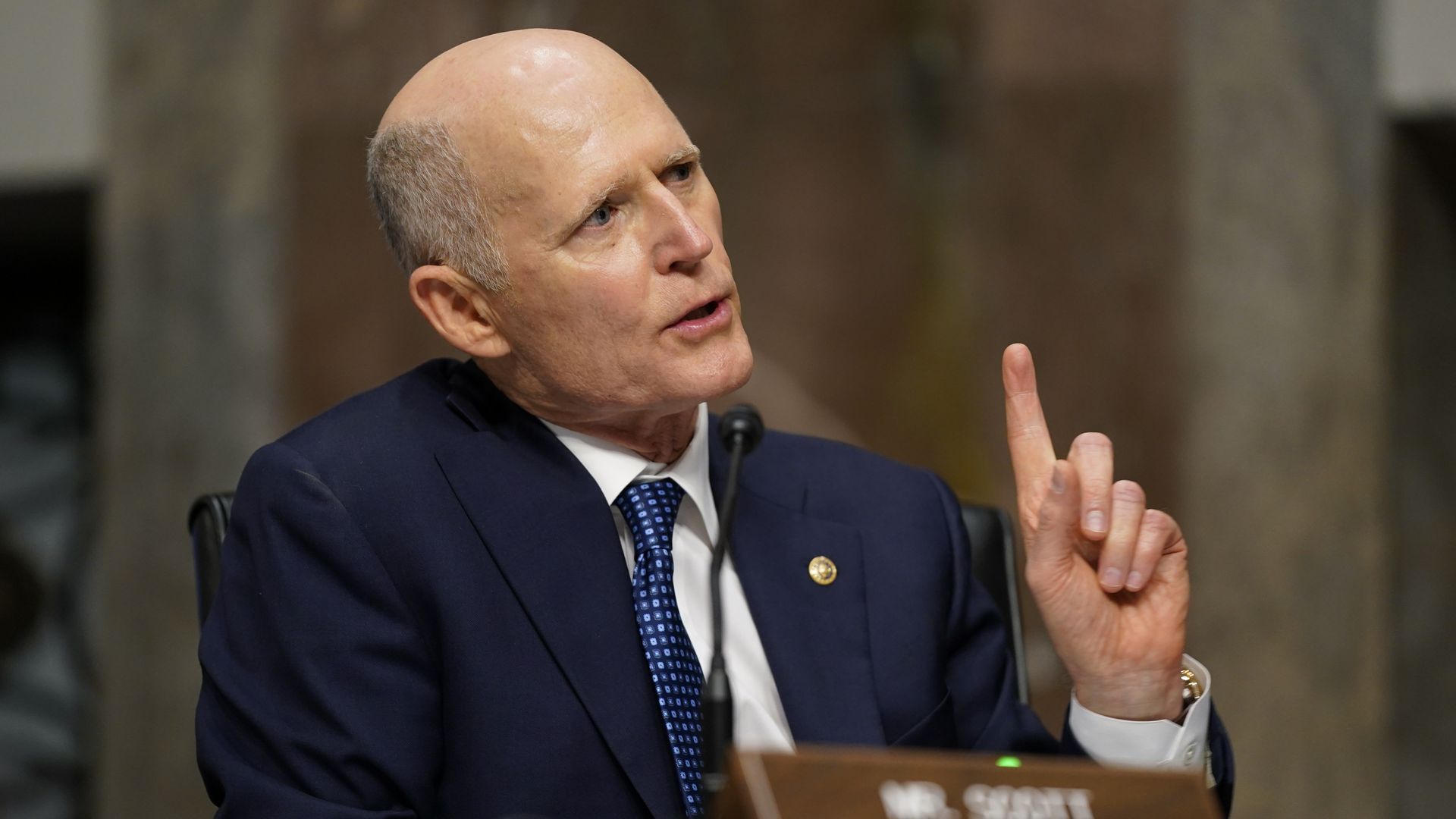
Sen. Rick Scott (R-Fla.) sent a letter to Microsoft and LinkedIn leadership on Thursday questioning why LinkedIn censored the profiles of U.S. journalists from the company's China-based platform this week, according to a letter obtained by Axios.
Driving the news: LinkedIn — which is owned by Microsoft — notified several U.S. journalists this week, including Axios' Bethany Allen-Ebrahimian, that their accounts will no longer be viewable in China due to "prohibited content" on their profile.
Fanatics Trading Cards, a new collectibles unit of sports merchandise retailer Fanatics, raised $350 million at a $10.4 billion valuation from Silver Lake, Insight Partners and Endeavor.
Why it matters: This is an extraordinary valuation for a consumer products company that hasn't made anything yet.
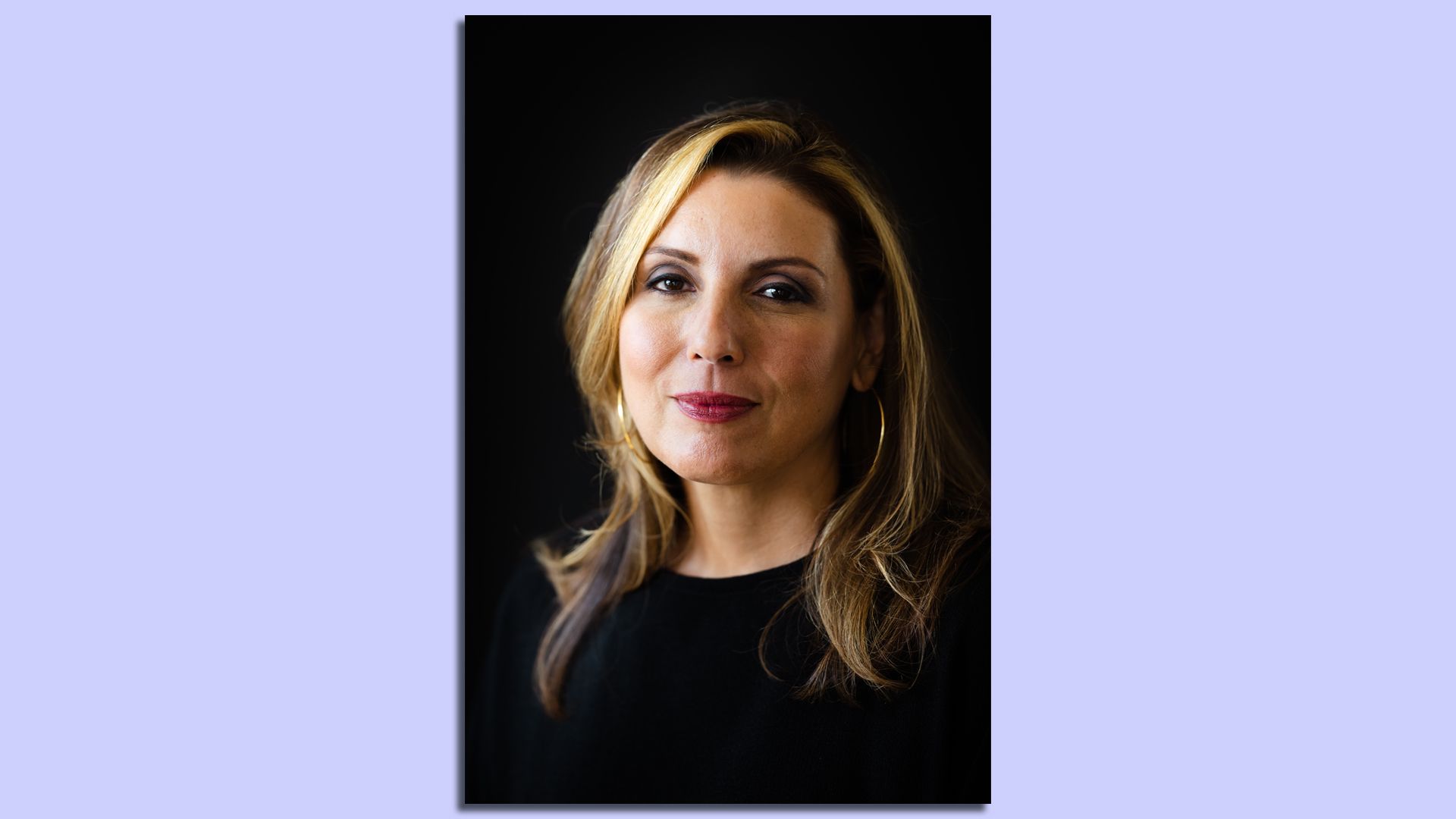
The New York Times on Thursday said it has hired Lourdes "Lulu" Garcia-Navarro, the former host of NPR’s Weekend Edition Sunday and a former co-host of NPR's morning news podcast Up First, to anchor a new Opinion podcast.
The big picture: The Times has invested heavily in building out a high-profile Opinion podcast roster in the last two years, hiring household names like Ezra Klein, Kara Swisher and Jane Coaston to launch their own shows.
The deal-making story of 2021 is up and to the right.
Driving the news: Global M&A activity is shattering all-time records through the first three quarters of 2021, according to preliminary data from Refinitiv.
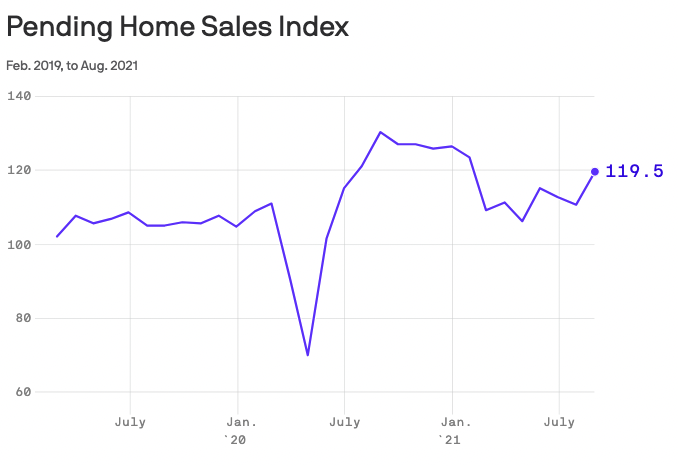
August saw the highest number of monthly home sales in central Ohio history — 3,694 — according to a report from Columbus Realtors.
Why it matters: Many Columbus residents are being priced out of houses due to a lack of affordable options, an issue exacerbated by the nationwide pandemic housing boom.
Bidding wars above asking price have become the norm, not the exception.
Fewer than 20% of people in most southeast Asian countries are fully vaccinated, which has led to COVID-19 outbreaks and forced apparel factories to shut down.
Why it matters: U.S. companies can't change international vaccination rates on their own, and the problem illustrates another reason Americans have a self-interest in supporting the effort to vaccinate other countries. Besides preventing more virus mutations, better vaccination rates in southeast Asia would improve the flow of consumer goods like sneakers and apparel.
Binance became the largest crypto exchange in the world by perfecting a stateless model that avoided highly-regulated activities. Now, its founder tells Axios that model is doomed.
Why it matters: No industry moves faster than crypto. "When the industry shifts, you’ve got to be willing to abandon your old business," says Changpeng Zhao, or CZ, the billionaire who founded Binance in China in July 2017.
Flashback: In early Septemberof the same year, China banned crypto exchanges, forcing Binance out of its country of origin at the age of a month and a half.
Since then, Binance has not really had a home, making it naturally aligned with crypto traders who mistrust structures built by nation-states.
The big picture: The uneasy and largely unspoken compromise in most of the crypto world is that national regulators can and will closely monitor all attempts to convert fiat currency into cryptocurrency, or vice-versa: the so-called "on-ramps and off-ramps". Binance is a purely crypto-to-crypto exchange, so it receives no such regulation.
Binance still has to deal with regulators, however — a lot of them. That takes a huge amount of time and effort. Meanwhile, it's competing against decentralized exchanges that, per CZ, are at heart just "500 lines of code on the blockchain".
What he's saying: CZ sees being regulated as a potential competitive advantage for Binance, if the company can ever get there. Current crypto investors are satisfied with relying on sophisticated technology, he says;the broad mass of the population, however, "would like to continue to trust a central party" — which is an area where regulators can help a lot.
The other side: Binance "cannot compete with" decentralized exchanges that have small teams doing little more than ensuring their code is secure, says CZ. "Their infrastructure is so much smaller. We cannot compete with them, cost-wise, personnel-wise."
"The future belongs to decentralized technology," he says. "It’s bearish for the Binance exchange, maybe. But there’s more opportunities in the decentralized space. Our past businesses will not always survive. Our centralized exchange might not exist in 10 or 20 years."
CZ is unfazed by the prospect of the demise of the Binance exchange. "It’s extremely bullish for us," he says, "as long as our business continues to evolve with the industry."
The bottom line: CZ wants to move in two directions simultaneously — towards a greater embrace of regulation and regulators, and also towards a greater reliance on decentralized finance protocols. In order for that strategy to succeed, there will need to be a lot more regulation of DeFi than currently exists.
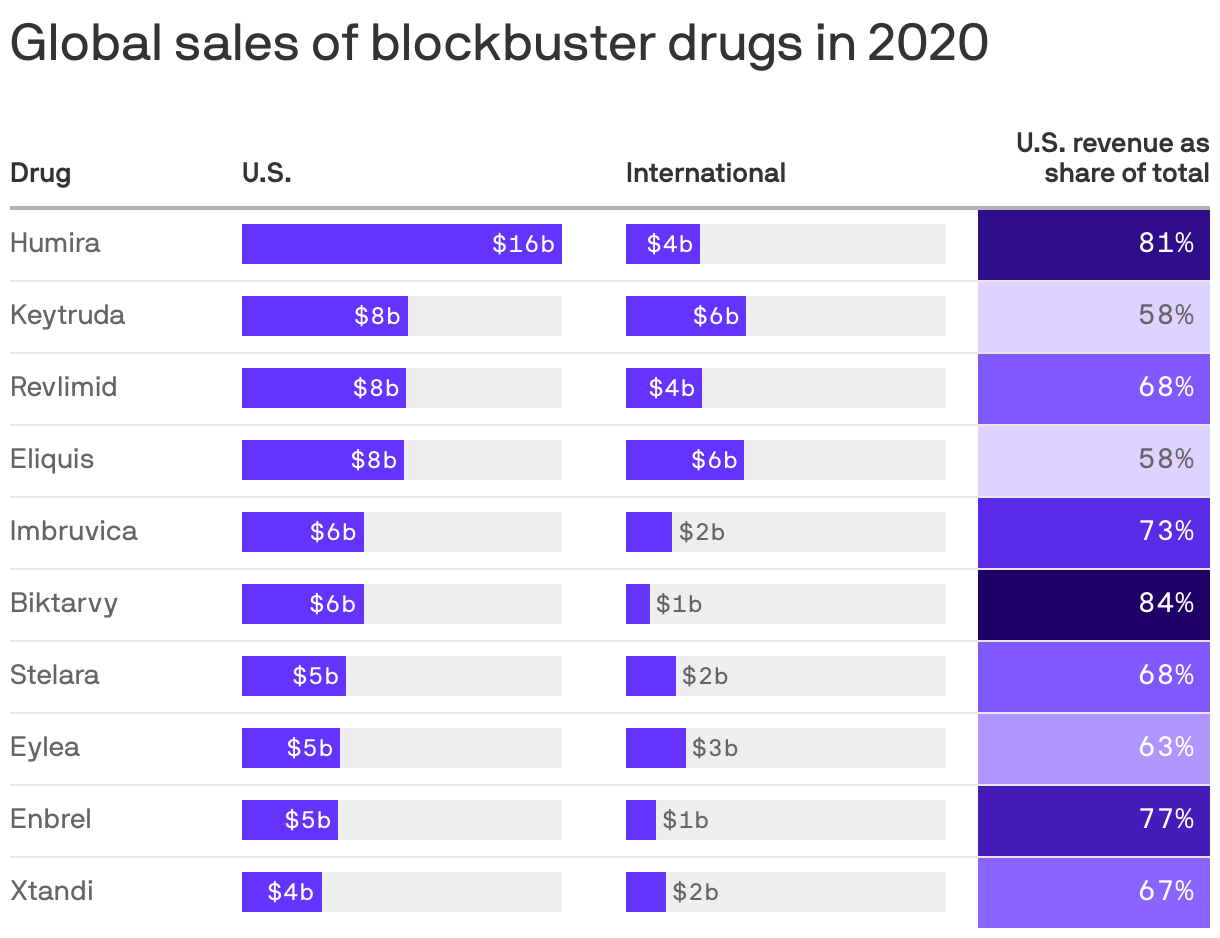
Data: Company filings and Public Citizen; Table: Danielle Alberti/Axios
Americans are paying pharmaceutical companies more for the world's 20 blockbuster drugs than the rest of the world combined, according to an analysis of company financial filings by Public Citizen.
Why it matters: The U.S. is the pharmaceutical industry's gold mine, and the analysis shows how much the industry has at stake as it fights Democrats' plan to allow Medicare to negotiate drug prices and let employers piggyback off those lower prices.
Holiday gifts are probably going to cost more this holiday season — a lot more, according to a new report from Salesforce.
Why it matters: Price increases, and consumers’ willingness to pay them, may help save manufacturers’ and retailers’ bottom lines in a season riddled with shipping and logistics logjams.
U.S. cities are seeing a dramatic surge of e-bike usage — driven in part by high-minded concerns (like the environment and pandemic safety) and in part by the coolness and fun factor.
Why it matters: The proliferation of e-bikes and push for more bike lanes are reshaping city geographies, social dynamics and even politics, as communities grapple with safety concerns and road-use jockeying.
The Kremlin on Wednesday threatened to ban YouTube unless it reinstates two of Russian state-backed broadcaster RT's German-language channels that were deleted for violating COVID-19 misinformation guidelines.
Why it matters: The threat is the latest example of Russian officials going to extreme lengths to assert greater control over the internet. The channels were deleted by YouTube on Tuesday, one day before the online video giant announced it would terminate channels spreading vaccine misinformation.
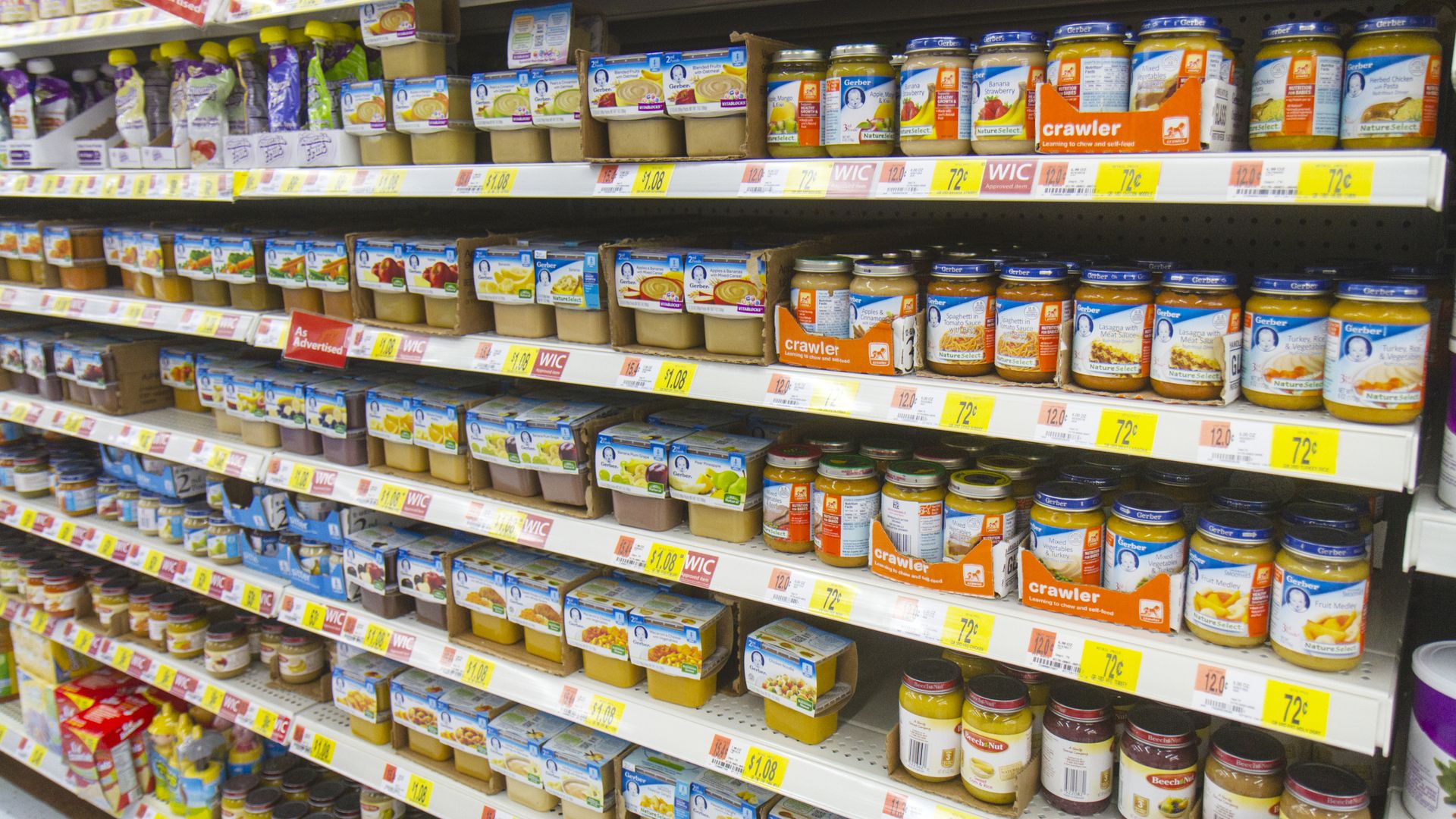
Manufacturers "knowingly" sold baby food that contained heavy metals, including arsenic, lead, cadmium and mercury, according to a House Oversight subcommittee report published Wednesday.
The big picture: These metals are in the World Health Organization's top 10 chemicals of concern for infants and children, and can affect brain development, according to Harvard Health Publishing. The companies cited either failed to recall contaminated food or were lax in testing, the report found.
AT&T expanded its COVID-19 vaccine mandate Wednesday to employees who are members of the Communications Workers of America (CWA) union.
Why it matters: The communications giant is one of the biggest employers in the U.S. to require frontline workers to be vaccinated against the virus. The union said it represents some 90,000 AT&T workers, per AP.
Amazon settled Wednesday with two former tech workers it fired after they criticized the e-commerce giant's management of warehouse workers and its impact on climate change.
Why it matters: The National Labor Relations Board (NLRB) found in April that Amazon had illegally fired Emily Cunningham and Maren Costa.














/2021/09/30/1633010960172.gif?w=3840)









/2021/09/29/1632951165597.gif?w=3840)