Twitter's stock was up nearly 5% in after-hours trading Thursday after the tech giant reported top- and bottom-line revenue growth. User growth also met Wall Street expectations.
Why it matters: Twitter attributed revenue growth to improvements in its products and sales execution as well as "a broad increase in advertiser demand." Twitter's ad revenue was up 87% year-over-year.
Space travel once unified Americans with the excitement of scientific discovery and wonderment. But the recent suborbital trips headlined by Richard Branson and Jeff Bezos have been much more divisive, with critics accusing the billionaires of taking pricey joyrides while the Earth below them literally burns.
Axios Re:Cap goes deeper with engineer and Virgin Galactic executive Sirisha Bandla, who flew alongside Branson, to better understand what space tourism could also mean for the future of science.
Google on Thursday said it's rolling out a new feature called the "About This Result panel," which will give users more context about their search results, and help them find the most useful information.
Why it matters: The update gives everyday users much more visibility into how Google's search algorithm works.
GoPuff, a Philadelphia-based instant delivery platform for everyday items, is raising $1 billion in new funding at a $15 billion post-money valuation, Axios has learned from sources close to the situation.
Why it matters: This reflects surging investor interest in hyper-local delivery, as GoPuff raised money at an $8.9 billion valuation earlier this year.
Turquoise Health has raised $5 million in a seed funding round that will expand operations at the health care price transparency startup.
Why it matters: Federal law requires hospitals to publish all of their various prices, but many hospitals don't comply or barely comply. Turquoise brings the data together and makes it easier to digest for patients, researchers and others in health care.
Johnson & Johnson just managed to release itself from all legal liability for distributing opioids by paying $5 billion as part of a bigger $26 billion settlement with state attorneys general. Now, per Reuters, it's looking to Texas to help it cap its liabilities with respect to distributing asbestos in its baby powder.
Why it matters: If J&J successfully attempts what's known as the Texas two-step, that would effectively allow it to declare bankruptcy just for the purposes of its talc liabilities and nothing else. The rest of the company could sail on with no further risk of talc-related lawsuits down the road.
It's not enoughto invest in sustainable businesses. Instead, asset managers sometimes have a legal responsibility to actively influence the sustainability outcomes of the businesses they invest in. That's the message of new analysis from law firm Freshfields Bruckhaus Deringer.
Why it matters: Large investors at insurers, pension funds, and non-ESG mutual funds are understandably very conservative when it comes to changing the way in which they invest the trillions of dollars under their control. A sober 564-page presentation from a major law firm is exactly the sort of thing to help them change their ways.
Israeli cybersecurity company NSO Group has become a pernicious version of Steve Urkel, never acknowledging the calamity that its software seems to cause. Unlike the old TGIF character, however, NSO's consequences are very real and enabled by private equity.
Driving the news: An international journalistic consortium, in partnership with Amnesty International, this week reported that a piece of NSO software, called Pegasus, was used by used by governments to spy on journalists, lawyers, human rights activists and world leaders.
Clearview AI, a New York-based provider of facial recognition tech to law enforcement, raised $30 million in Series B funding. The company is under investigation for possible privacy violations in the U.K. and Australia, and also is the subject of several class-action lawsuits.
Why it matters: Clearview AI says that new investors have asked not to be publicly identified, as they apparently lack the courage of their checkbooks. Existing backers, via a $7 million Series A round, included Peter Thiel, Kirenaga Partners, Hal Lambert and Andrew Vigneault.
Shohei Ohtani is an MVP candidate on the field, and his new exclusive memorabilia deal with Fanatics reflects his exploding off-field value.
By the numbers: Ohtani's $6 million in annual endorsements is already tops in MLB, per Forbes, thanks to his two-way stardom and popularity in two of the world's biggest markets.
The U.S. Chamber of Commerce is laying out what it wants to see in Democrats' brewing push to mandate escalating amounts of zero-carbon electricity.
Why it matters: The K Street powerhouse is closer to Republicans, but its views could influence some moderate Democrats, so that's important given Democrats' razor-thin Capitol Hill margins.
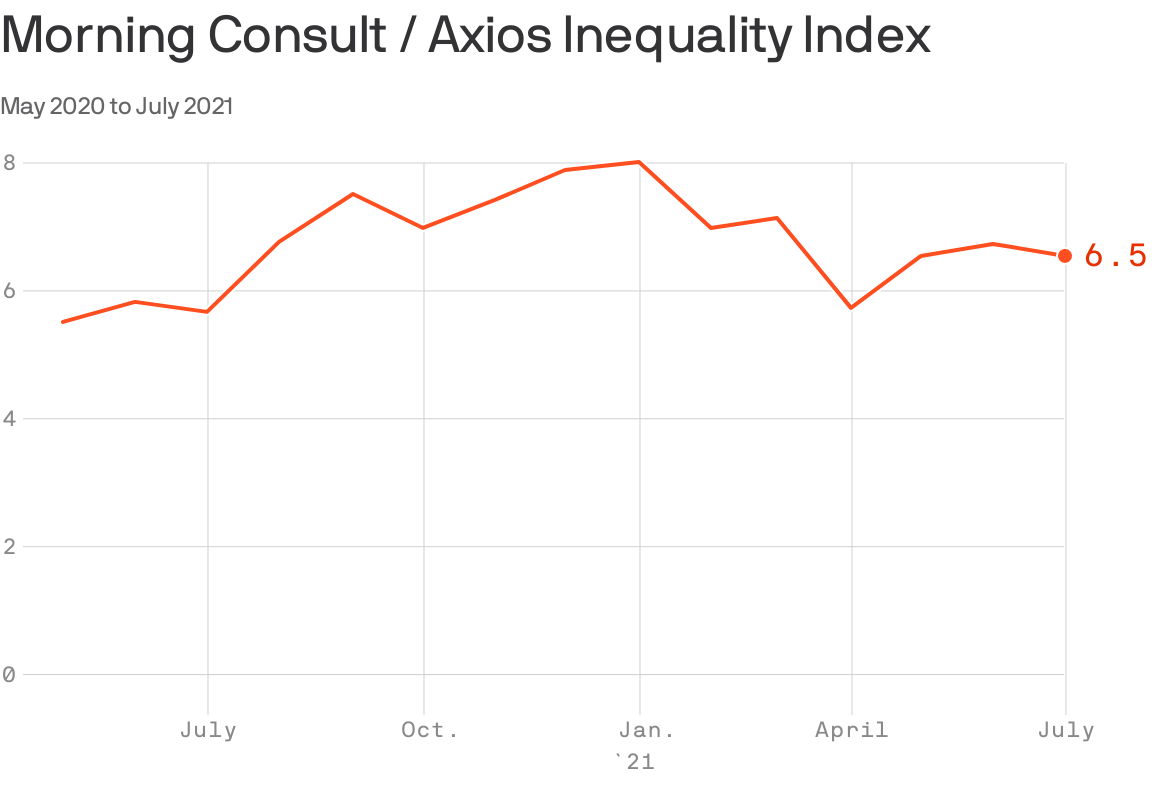
The gap between the way people in different income groups experienced the U.S. economy got smaller in July, compared to the Morning Consult/Axios Inequality Index's June reading.
Why it matters: The economy may be at a turning point as expanded government fiscal support tails off — so signs of increasing inequality could start to pop up in the coming months, Morning Consult chief economist John Leer tells Axios.
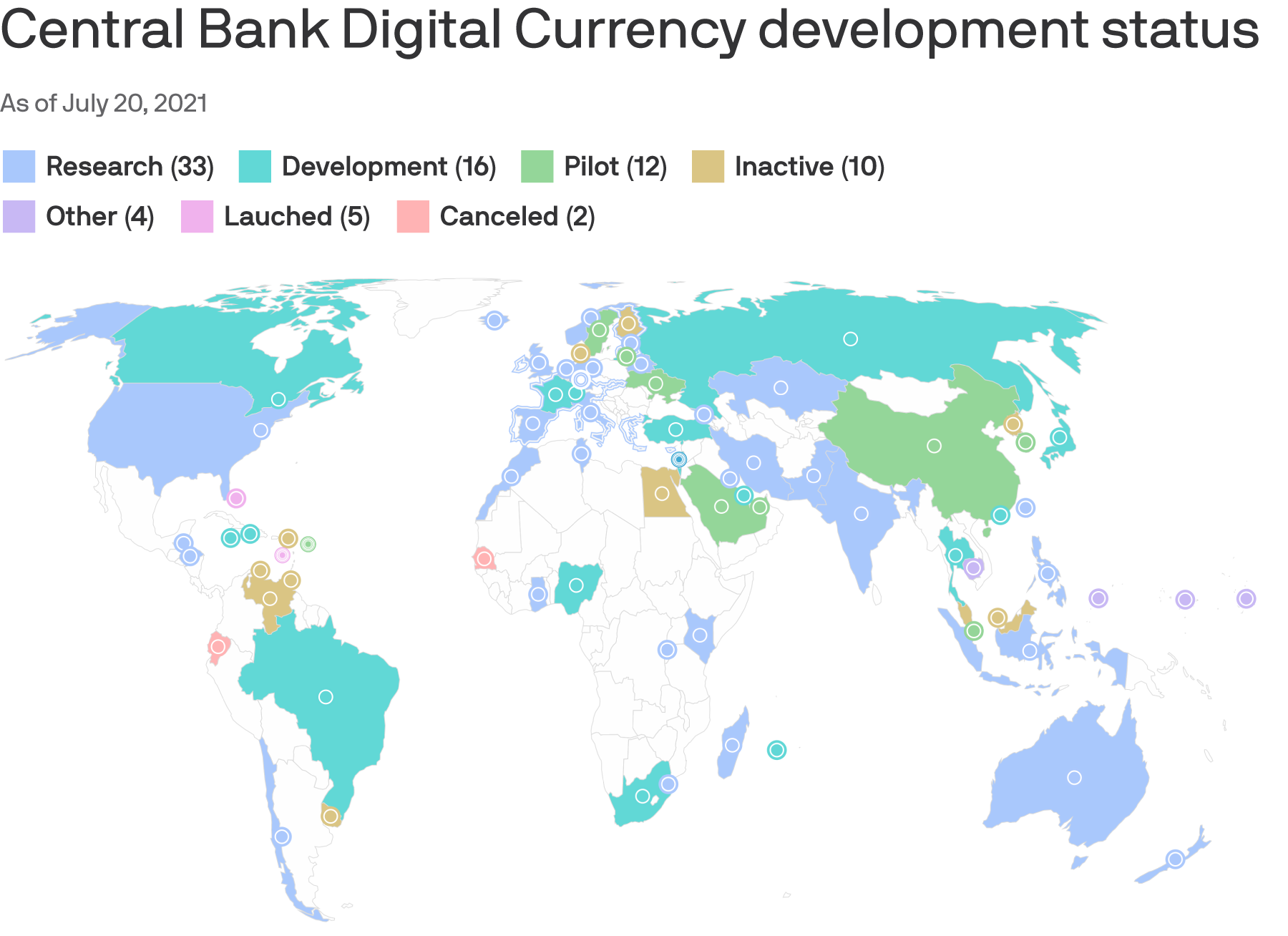
Central bankdigital currency (CBDC) is probably not top of mind for most global consumers. But we may soon have no choice but to think about it — since 81 countries, representing over 90% of global GDP, are now exploring the development of one.
Why it matters: The U.S. lags much of the world. It could miss out on the opportunity to take a leadership role in an increasingly likely global transition to some form of digital currencies.
One of the more reliable predictors of inflation is the amount of time it takes for suppliers to deliver goods to businesses. And those wait times have been getting longer.
Wall Street's equity research isn't what it used to be. There are signs the longtime cutback in sell-side attention is getting worse. In the last five years, the number of ratings on S&P 500 companies shrank by nearly 800, or 6.5%, according to FactSet data provided to Axios.
Why it matters: The research desks haven't traditionally been direct money-makers for banks. But as they shrink, the information they provide to investors goes with it (though exactly how much value they add is a point of debate).
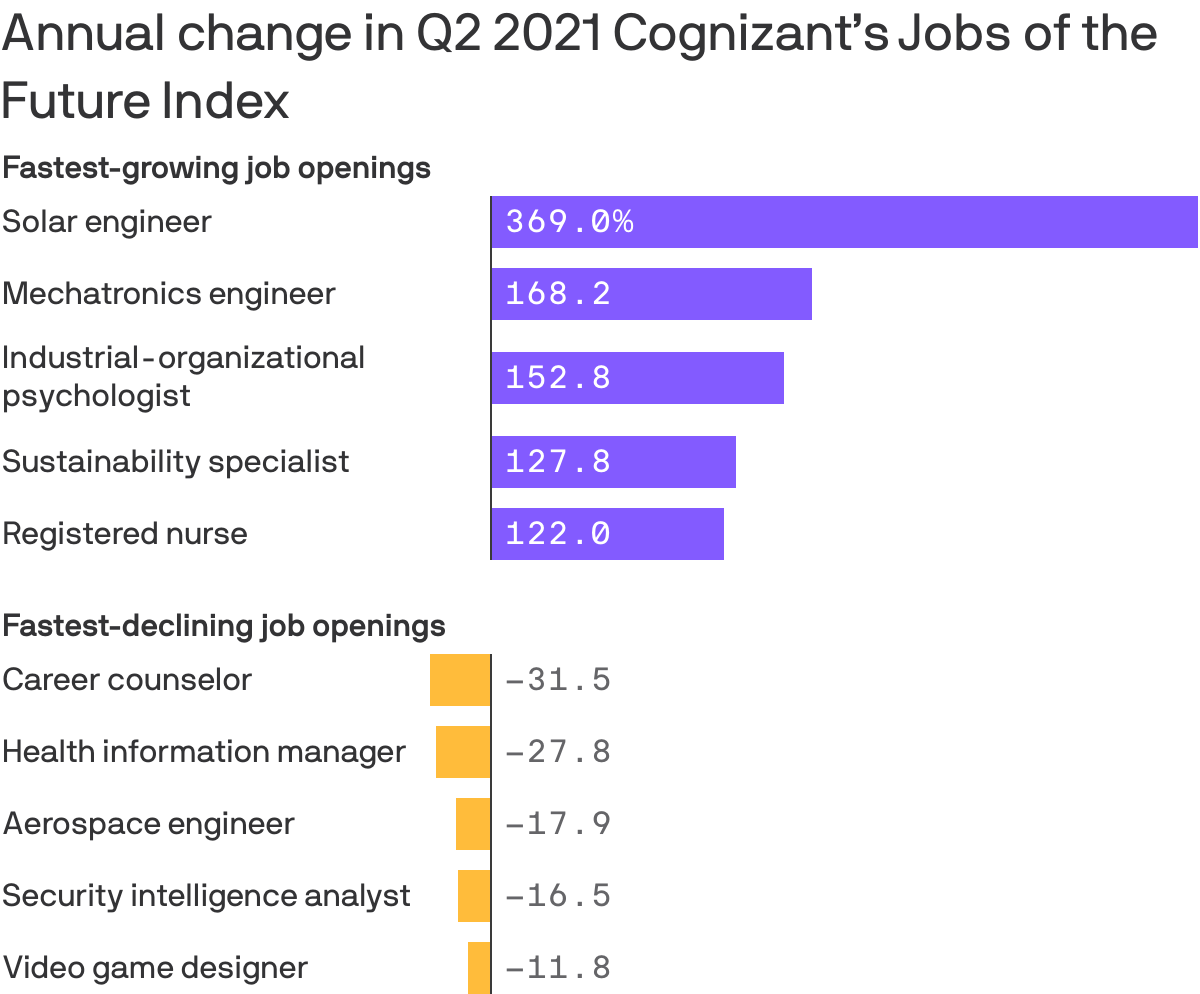
Postings for digitally enabled jobs of the future are recovering from a sharp dip during the pandemic, but they still lag behind postings for conventional jobs as companies desperately try to rebuild their workforces.
The big picture: The pandemic hit the labor pool hard across the board, but jobs previously poised to grow in the future lost even more ground as companies retrenched.
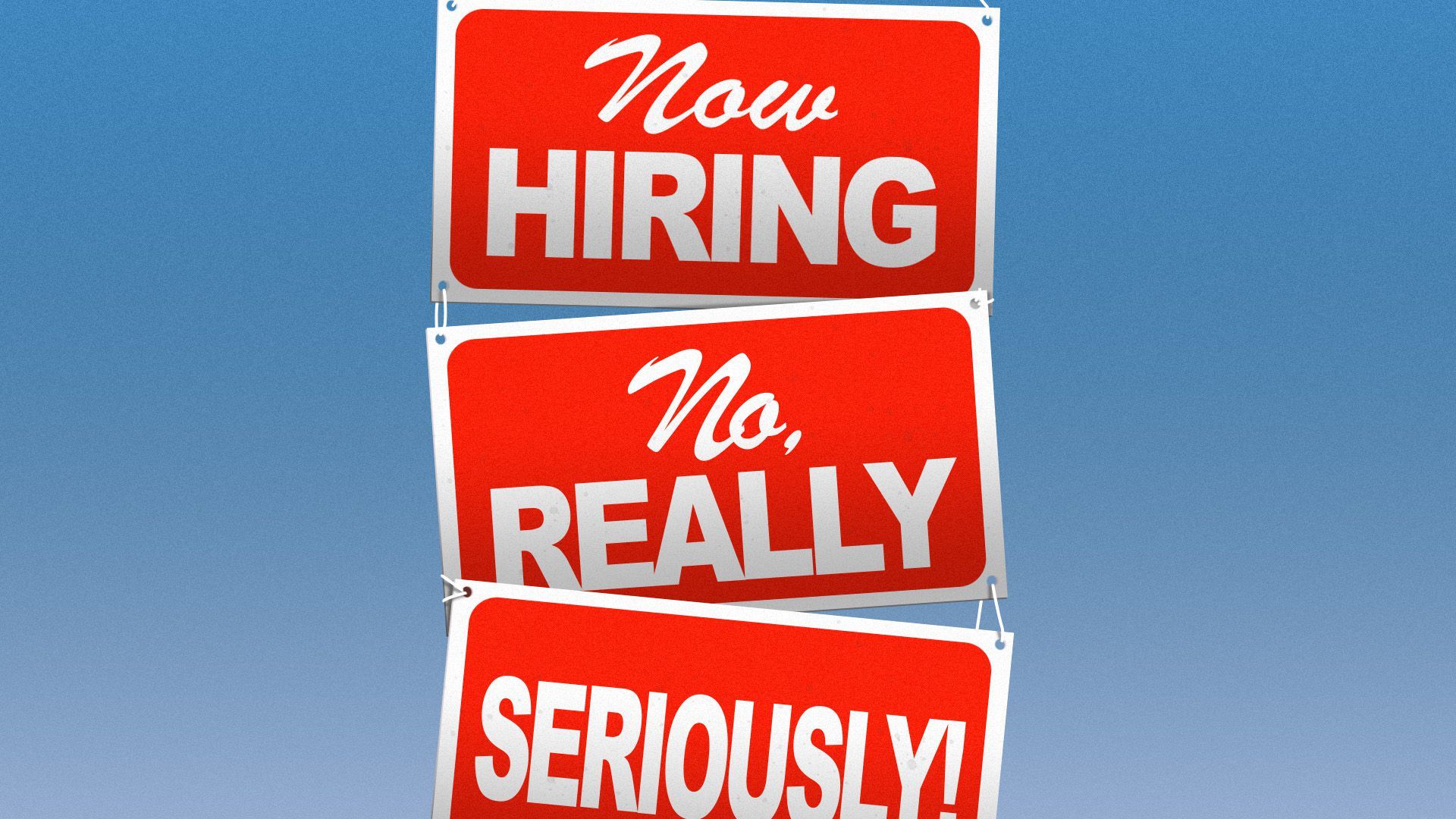
Workers are still stalling the job search, and employers — from health care providers to trucking companies — are getting desperate.
Staggering stat: The share of job postings that use words like "hiring urgently" has spiked over 50% since the start of 2021, according to data from the jobs site Indeed.
Given its assault on democracy, imprisonment of publishers, and a slew of human rights violations, "stable" might not be the first word that springs to mind with respect to Hong Kong. But amid social and political turmoil, one key part of the economy has remained unfazed: its legendary financial services sector.
Why it matters: Beijing's increasing control and influence over Hong Kong is seen by many banks and investors as more of a feature than a bug. While there are certainly downsides to staying, for the time being, the upside seems to be even greater.
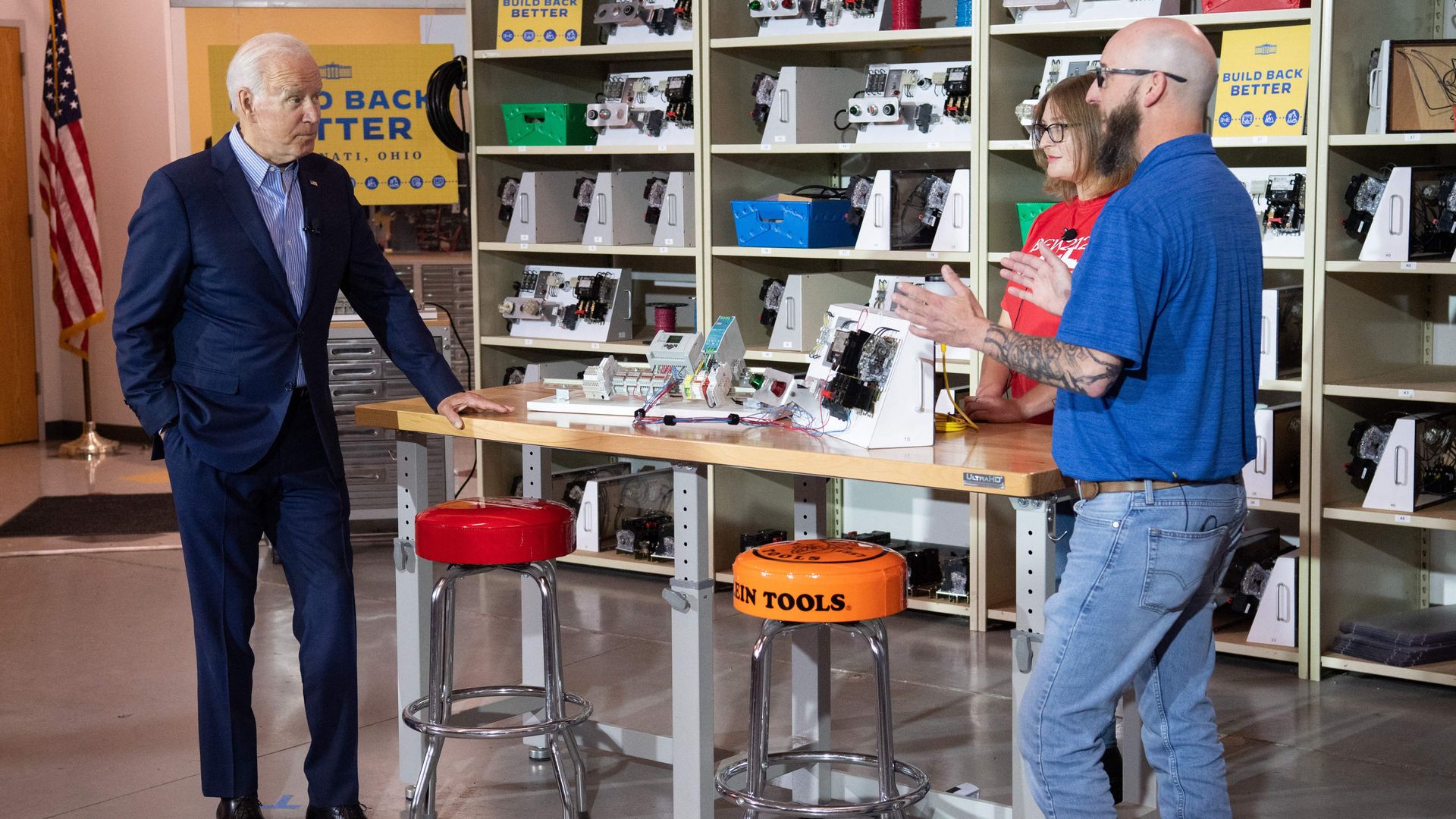
A top party pollster and senior adviser to the Biden political team is urging Democrats to confront the problem of rising prices — which she says is starting to bite with voters.
Driving the news: Celinda Lake, who polled for the Biden presidential campaign and still advises Team Biden, told Axios that worries about inflation are coming through loud and clear in both publicpolls and her own focus groups.