A Brazilian video game publisher wants to defy decades of industry wisdom by promoting a line of new games based on how quickly they’ll take to complete, not by how long.
Driving the news: Flux Games is rolling out a new label called Short N Sweet, promoting games for console and PC that can be completed in as little as a sitting or two.
Suspected China-linked hacking groups are continuing to build on a new tactic targeting internet-facing security tools as a way of stealthily breaking into some of the most data-rich organizations, researchers at Google-owned Mandiant warn.
Driving the news: In a report Thursday, researchers said they've uncovered a new bug targeting software security company Fortinet, which makes firewalls, antivirus programs and similar tools. The Wall Street Journal first reported on the new bugs.
A recent data breach involving millions of AT&T customers is bringing renewed attention to the fault lines in major telecommunications providers' security programs.
Why it matters: Telecom companies collect a wealth of data about their customers, including financial, demographic and other sensitive information. That data can later be abused to steal someone's identity or break into their other online accounts.
As generative AI tools like Dall-E and MidJourney become more mainstream, some illustration competitions are banning the submission of AI-generated artworks.
Why it matters: Debate in the art world around the impact of technology is nothing new. But AI's unique legal and ethical considerations have prompted some organizations to take a definitive public stance.
YouTube will lift its restrictions on former President Trump's channel Friday, a spokesperson confirmed to Axios.
Why it matters: The restrictions have prevented Trump from posting any new YouTube videos to his account, which has more than 2.6 million followers, for over two years.
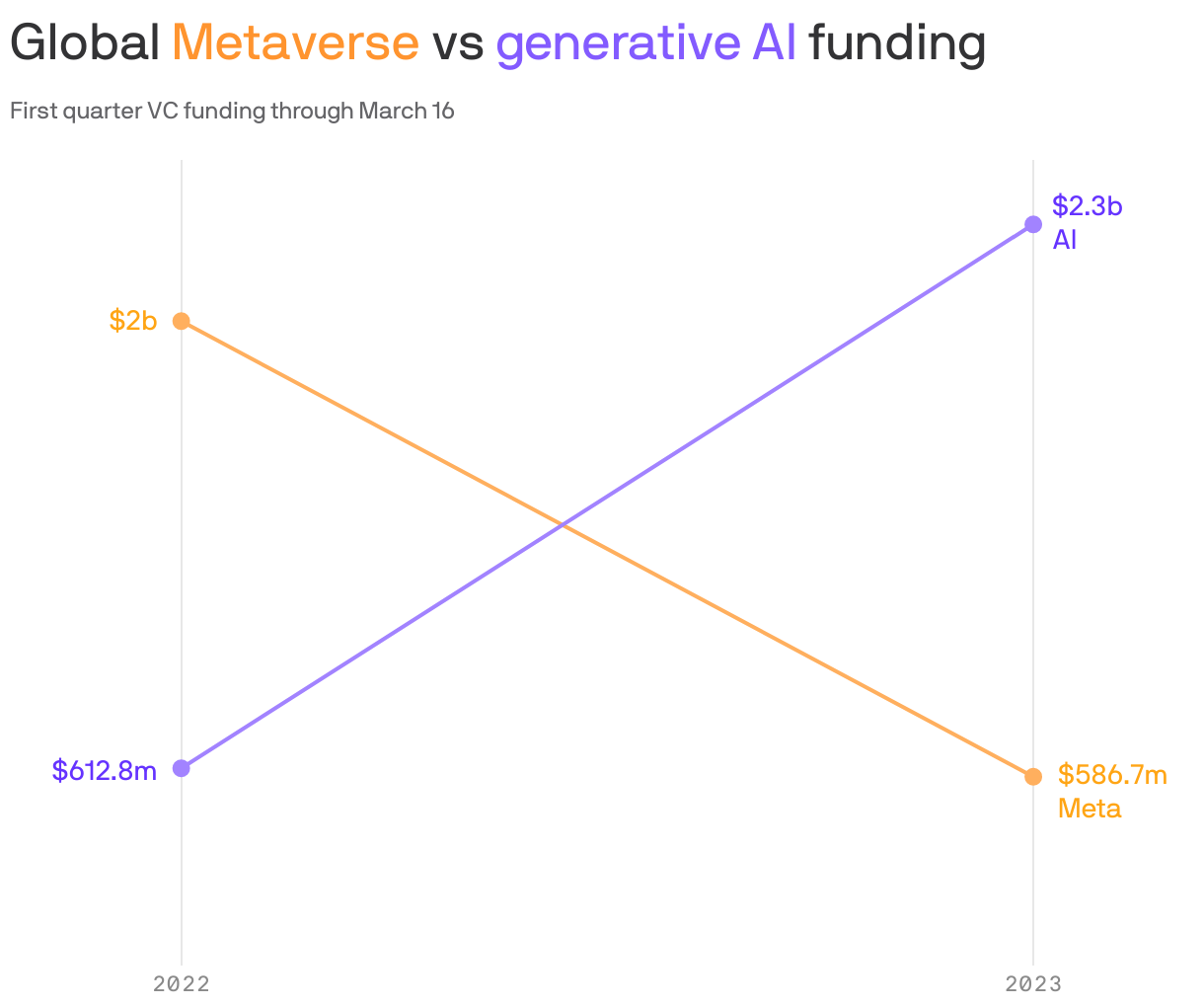
A year and a half after renaming itself after its metaverse initiative, Meta has noticeably de-emphasized that vision for the future.
The big picture: Meta is fully in sync with a moment that has many large companies cutting headcounts, shuttering side projects and chasing the promise of generative AI.
Human-shaped robots with dexterous hands will be staffing warehouses and retail stores, tending to the elderly and performing household chores within a decade or so, according to a Silicon Valley startup working toward that vision.
Why it matters: Demographic trends — such as a persistent labor shortage and the growing elder care crisis — make fully-functioning, AI-driven humanoid robots look tantalizingly appealing.
Amid mounting layoffs in the tech sector, more than a third of industry workers now say they're more likely than they were a year ago to work on military projects, according to a new Morning Consult analysis shared first with Axios.
Why it matters: Continuing tech layoffs could give the Pentagon and defense contractors a fighting chance to recruit top-tier coding talent.
What they're saying: "From a recruiting standpoint, tech workers are looking for stability," Jordan Marlatt, tech analyst at Morning Consult, told Axios. "They're looking for interesting things to work on, and they're also looking for work-life balance."
Catch up quick: The tech sector has publicly shied away from discussing its work with the military in recent years amid employee backlash over the ethics of using certain technologies in combat.
Meanwhile, more than 138,000 tech workers have been laid off so far in 2023, according to Layoffs.fyi.
By the numbers: 34% of the 441 U.S. tech workers surveyed in a Morning Consult poll said they're more likely than they were a year ago to apply their skills to military projects.
38% of those workers said they like the prospect of working on interesting projects, and 33% said they're more likely to head to defense work because of "financial considerations."
Nearly half of all surveyed tech workers (48%) said they support their employer considering defense contracts that involve battlefield technologies.
Between the lines: Government agencies could have a better chance of recruiting tech talent if they emphasize the job stability of their positions and the new technologies they'll be able to contribute to, Sonnet Frisbie, Morning Consult's lead geopolitical risk analyst focused on Europe, the Middle East and Africa, told Axios.
"They should really play to applicants' interest, not just their values," Frisbie said.
Yes, but: Despite increased interest in military work, most tech workers still think the tech sector is best positioned to give them better salaries, benefits and mission-driven opportunities, according to the analysis.
Sign up for Axios’ cybersecurity newsletter Codebook here
TikTok CEO Shou Zi Chew insisted Thursday that forcing the app's Chinese parent company, Bytedance, to sell it would not address the the national security concerns of the U.S. and other governments.
The big picture: Chew's comments to the Wall Street Journal coincided with the U.K. and New Zealand becoming the latest to announce new TikTok restrictions on government devices due to security concerns.
Some Wisconsin swing voters don't feel like their TikTok time is a national security risk, dismissing bipartisan concerns and regulation efforts coming from D.C., according to our latest focus groups with Engagious/Sago.
Why it matters: These voters, who backed Donald Trump in 2016 and Joe Biden in 2020, were more troubled by Congress having the power to decide what’s downloaded onto your phone — and convinced that it won’t end with TikTok.
Microsoft on Thursday unveiled its effort to build generative AI into Office tools, including Word, Excel, PowerPoint, Outlook and Teams, as well a new Business Chat app that works across corporate data.
Zipline and Wing, two of the world's leading drone delivery companies, are amping up their operations in preparation for wide-scale U.S. deployment starting next year.
Why it matters: The companies' new, more sophisticated systems are a sign that the industry is maturing and that drone delivery, once a novelty, could become commonplace within a few years.
The Biden Administration has warned TikTok that it faces a ban in the U.S. if its Chinese parent company, ByteDance, does not sell its stake in the U.S. version of the app, a source confirmed to Axios.
Why it matters: TikTok has become one of the most popular mobile apps in the country, amassing over 100 million U.S. users. Banning it would have an immediate impact on millions of everyday Americans, and would mark a significant escalation of tensions between China and the U.S.





















/2023/03/16/1678932289323.gif?w=3840)