Some Wisconsin swing voters don't feel like their TikTok time is a national security risk, dismissing bipartisan concerns and regulation efforts coming from D.C., according to our latest focus groups with Engagious/Sago.
Why it matters: These voters, who backed Donald Trump in 2016 and Joe Biden in 2020, were more troubled by Congress having the power to decide what’s downloaded onto your phone — and convinced that it won’t end with TikTok.
Microsoft on Thursday unveiled its effort to build generative AI into Office tools, including Word, Excel, PowerPoint, Outlook and Teams, as well a new Business Chat app that works across corporate data.
Zipline and Wing, two of the world's leading drone delivery companies, are amping up their operations in preparation for wide-scale U.S. deployment starting next year.
Why it matters: The companies' new, more sophisticated systems are a sign that the industry is maturing and that drone delivery, once a novelty, could become commonplace within a few years.
The Biden Administration has warned TikTok that it faces a ban in the U.S. if its Chinese parent company, ByteDance, does not sell its stake in the U.S. version of the app, a source confirmed to Axios.
Why it matters: TikTok has become one of the most popular mobile apps in the country, amassing over 100 million U.S. users. Banning it would have an immediate impact on millions of everyday Americans, and would mark a significant escalation of tensions between China and the U.S.
WWE chairman Vince McMahon is a playable character in the latest WWE 2K23 video game, despite controversies that have largely kept him out of the public eye.
Why it matters:McMahon announced last summer he would retire from the WWE shortly after the Wall Street Journal reported that the longtime wrestling promoter had secretly paid off a former employee with whom he allegedly had an affair.
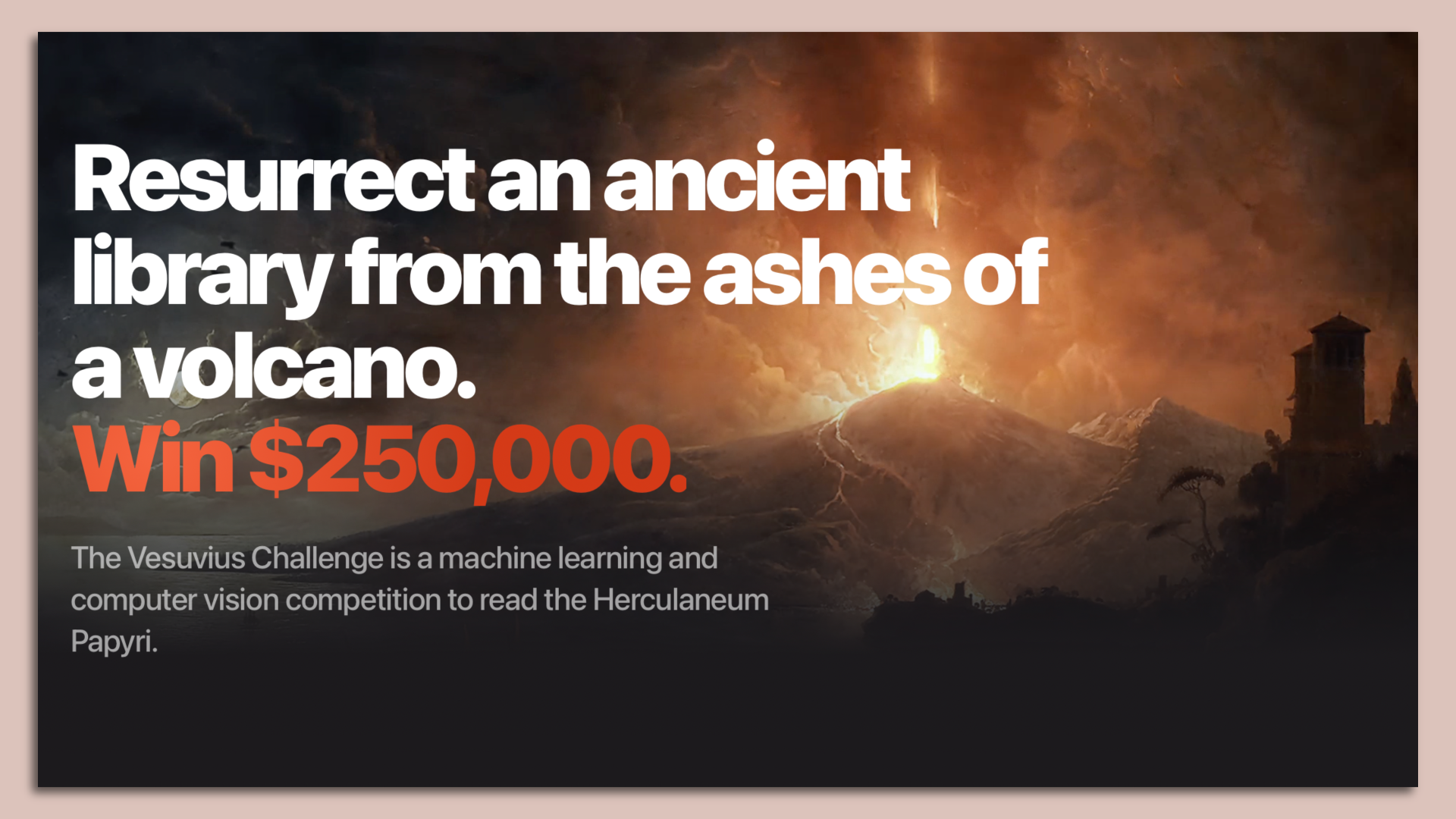
Former GitHub CEO Nat Friedman is helping fund $250,000 in prizes aimed at seeing if someone can use machine learning and computer vision to make sense of papyrus scrolls that were buried by the deadly Mount Vesuvius eruption nearly 2,000 years ago.
Why it matters: The eruption obscured the text in the scrolls, but also preserved them such that modern technology might be able to uncover what was written.
Details: The scrolls, known as the Herculaneum papyri, were part of a library in a villa once owned by the father-in-law of Julius Caesar. The villa, buried in 79 A.D., was discovered by a farmer in 1750, but many scrolls were destroyed by early attempts to open and decode them.
More recently, X-rays have allowed the 600 remaining scrolls to be virtually unrolled, but they have remained unreadable.
Friedman and co-sponsor Daniel Gross are funding $250,000 in prizes, with $50,000 going to individuals or teams who can detect ink from X-rays of the document. Another $150,000 will be shared among those who are able to read at least four separate passages of at least 140 characters long.
What they're saying: Friedman said that researchers have recently proven that machine learning can help recognize ink in papyrus fragments, convincing him the tech is up to the challenge.
"We live in an age of miracles," he told Axios. "We're using high energy physics and AI to peer into the past."
Crypto staking is a way of maintaining consensus over bookkeeping systems with thousands of simultaneously updated copies — that is, a blockchain.
Why it matters: A massive amount of value is tied up in staking. On Ethereum alone, 17.6 million ethers (about $30 billion in value, or 14% of ether's total market cap) is staked on the network, guaranteeing its transactions are provably fair.
Snapchat on Wednesday said it will begin publishing guidelines that detail what types of content gets algorithmically distributed in its app to users.
Why it matters: To date, only vetted publishing partners and professional creators on the platform have had access to the guidelines. Now, Snapchat is making them public to give parents more assurance about what their teens see on the app.
Mozilla called on entrepreneurs to create trustworthy AI applications as it announced a "Responsible AI" challenge Tuesday at the South by Southwest festival in Austin, Texas.
Why it matters: At a festival where companies could not be more eager to share their plans, half-baked and otherwise, for the explosive field of generative AI, Mozilla offered an opportunity to do so with a little more foresight.
With Tuesday's release of OpenAI's new GPT-4, generative AI just got a lot more powerful — and we got a fresh reminder of just how unprepared we are to deal with these new machines.
Why it matters: The amazing computer systems that can now ace standardized tests and maybe even do your taxes are still disturbingly prone to errors, bias and hallucinations.
Google showed off an array of new artificial intelligence (AI)-driven health care tools on Tuesday, from a souped-up chatbot that can shed light on your medical symptoms to enhanced search features that tell you if a doctor takes Medicaid.
Why it matters: There's an arms race among big tech companies to infuse their products with AI — but the results, particularly in health care, can have unwanted consequences or pitfalls, like racial bias, privacy concerns and ethical problems.







/2023/03/16/1678932289323.gif?w=3840)