Retailers have a problem: People aren't paying for stuff.
Why it matters: Retailers are already grappling with an uncertain economy, a shift toward spending on services, and rising labor costs — so the last thing they need is another threat to the bottom line.
Students are being admitted to an expanding number of colleges without a human ever looking at their application.
Why it matters: States and companies offer direct admission in an effort to decrease barriers to accessing higher education. These immediate acceptance programs are based on quantitative factors like GPA and test scores.
U.S. workers on the job hunt currently harbor record-high wage expectations, with men expecting significantly more money from job offers than women, according to a new Federal Reserve Bank of New York survey.
Why it matters: The ultra-tight labor market during the pandemic was a boon for wages and worker power. While the gradual loosening of the labor market threatens to erode some of those gains, the survey results indicate workers are feeling confident about asking potential new employers for more money.
FTX's embattled hedge fund shop and other Wall Street investment firms are banding together for a refund.
Driving the news: Alameda Research and another hedge fund, Fir Tree Partners, started GrayscaleLitigation.com to bring together potential co-plaintiffs against Grayscale Investments over fees paid to its flagship Bitcoin Trust, better known by its ticker symbol GBTC, as well as its Ethereum Trust.
A year ago, Federal Reserve chair Jerome Powell stepped to a lectern in the Grand Tetons to deliver an almost comically succinct and simple message: that inflation was too high and the Fed would do whatever it takes to bring it down.
That was then. Now, with the Fed having pushed interest rates much higher than nearly anyone expected and inflation seemingly on a glide path downward, he has room for nuance.
Americans lockedinto lower mortgage rates have been increasingly unwilling to sell their homes. That didn't change last month: Existing home sales slumped further in July.
By the numbers: Sales of previously owned homes fell 2.2% in July to an annualized rate of 4.07 million units, according to new National Association of Realtors data — the slowest pace of sales in six months. Compared to July 2022, existing home sales are down 16.6%.
Blue Wire, a sports podcast company founded in 2018, will open up a community fundraising round on Tuesday, allowing podcasters and fans to invest in the company directly, its founder Kevin Jones told Axios.
Why it matters: More companies are looking to community fundraising rounds to raise cash as the deals market slows for private funding.
Local broadcast company Cox Media Group is launching a hyper-local streaming network called Neighborhood TV, in partnership with McClatchy, its executive chair Steve Pruett told Axios.
Why it matters: CMG hopes NTV will help expand its reach to thousands of hyper-local communities in America, complementing the existing reach of its roughly five dozen local television and radio broadcast networks.
Microsoft is roping in Ubisoft in its attempt to win regulatory approval of its $69 billion bid for Activision Blizzard.
Driving the news: Microsoft announced early this morning a plan to divest cloud gaming rights that belong to Activision Blizzard games to the French gaming giant.
CEO optimism about the economy has trickled down into their organizations, a new PwC survey reveals.
Why it matters: Senior business leaders have plenty to worry about already as the effects of extreme weather threaten worker safety and supply chains, the labor market remains in favor of employees and the AI arms race raises more questions every day about the way we live and work.
Utilities are the worst-performing part of the stock market this year.
The big picture: Hawaiian Electric's recent share price collapse is a reminder of the potential risks utilities may face from changing climate conditions. But the sector's year-to-date slump stems largely from something more mundane — the rise in interest rates.
More than a century ago, the federal government filed an antitrust suit against U.S. Steel for its stranglehold on the industry — but now the company plays an extraordinarily diminished role in global steel manufacturing.
Why it matters: If U.S. Steel, now the target of a bidding war, is purchased by an American company, that would mean even less competition in the domestic steel industry. But that might not necessarily be something to avoid.
Leading media organizations are issuing guidance on leveraging artificial intelligence in the newsroom at the same time they're making licensing deals to let AI firms use their content to train AI models.
Why it matters: The sudden arrival of publicly and commercially available generative AI tools has forced a new set of ethical choices on media companies struggling to protect public trust while still experimenting with the technology and preserving their legal rights.
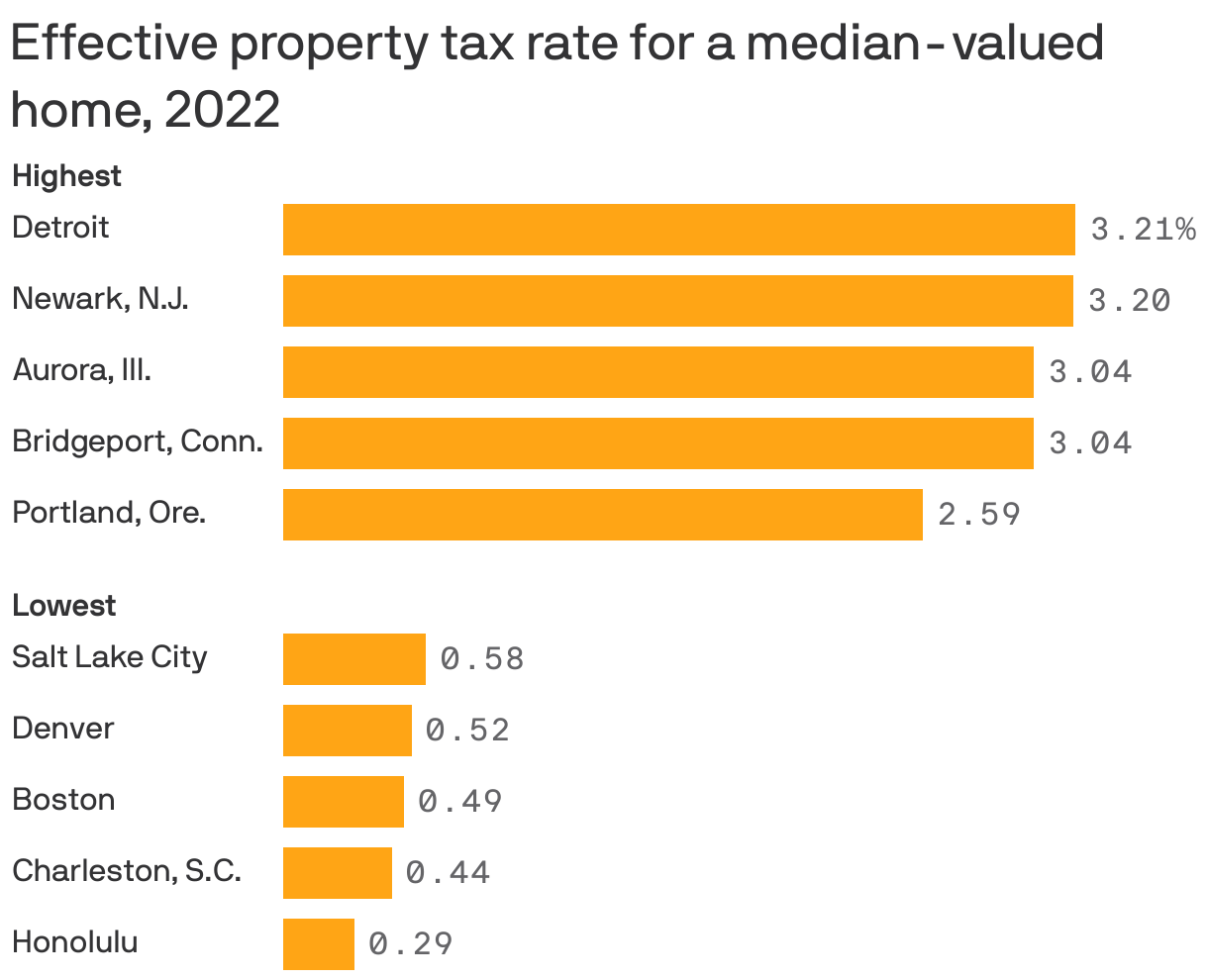
Data: Lincoln Institute of Land Policy; Note: Among the largest cities in each state, plus Washington, D.C.; Aurora, Ill.; and Buffalo, N.Y.; Chart: Kavya Beheraj/Axios
While the overall amount of property taxes Americans paid rose in 2022, effective property tax rates — a homeowner's tax bill as a percentage of a property's value — dropped slightly in large cities last year on average, as home values rose faster than taxes.
That's according to a new report from the nonprofit Lincoln Institute of Land Policy and the Minnesota Center for Fiscal Excellence.
MSNBC has seen a boost in prime-time ratings this summer, thanks in large part to its coverage of the slew of indictments against former President Donald Trump.
Why it matters: Fox News has been the undisputed cable news ratings leader for years. But Trump's legal woes, combined with Tucker Carlson's departure from Fox, have helped MSNBC close in on Fox News' prime-time lead several times in the past few months.
A group of prominent media, tech and research executives have raised nearly $3 million to launch an independent policy research center focused on addressing global internet issues, such as disinformation, algorithmic accountability, and the economic health of the news industry.
Why it matters: While the Center for News, Technology & Innovation (CNTI) is not designed to lobby or advocate on behalf of specific policy proposals, it does hope to influence future internet policy toward maintaining an open internet and an independent press.