The developers behind Tornado Cash, a privacy tool that obfuscates the origin of funds transactions, were charged on Wednesday by the Department of Justice for helping hackers launder more than $1 billion.
Why it matters: While originally conceived as a privacy tool, the mixer has been used to help launder billions in increasingly high-profile heists before getting blacklisted by the U.S. government.
What's happening: Roman Storm and Roman Semenov face charges of sanctions violations as well money laundering; Storm has already been arrested by the DoJ.
Alexey Pertsev, a Tornado Cash developer, was arrested last year in the Netherlands. He was released this year, currently awaiting trial.
Of note: The U.S. Department of the Treasury's Office of Foreign Assets Control (OFAC) also sanctioned Semenov, one of three co-founders of the now blacklisted Tornado Cash, for his role in providing support to the mixer and to the Lazarus Group.
Flashback: Tornado Cash was effectively banned in Aug. 2022. It later issued guidance for users to lawfully withdraw their funds.
Details: They are each charged with one count of conspiracy to commit money laundering and one count of conspiracy to violate the International Economic Emergency Powers Act, which each carry a maximum sentence of 20 years in prison, according to the DoJ.
Conspiracy to operate an unlicensed money transmitting business carries a maximum sentence of five years in prison.
Why it matters: The Fed has hitched its wagon to the theory that a period of slow growth will be needed to bring down inflation. Yet growth has, if anything, accelerated in recent months even as inflation has slowed.
Goldman Sachs has entered the auction for sandwich shop chain Subway, teaming with existing suitors TDR Capital and Sycamore Partners, according to Bloomberg.
Why it matters: This last-minute, deep-pocketed addition could move momentum away from Atlanta-based private equity firm Roark Capital Partners, which is seeking to become one of the world's largest restaurant owners.
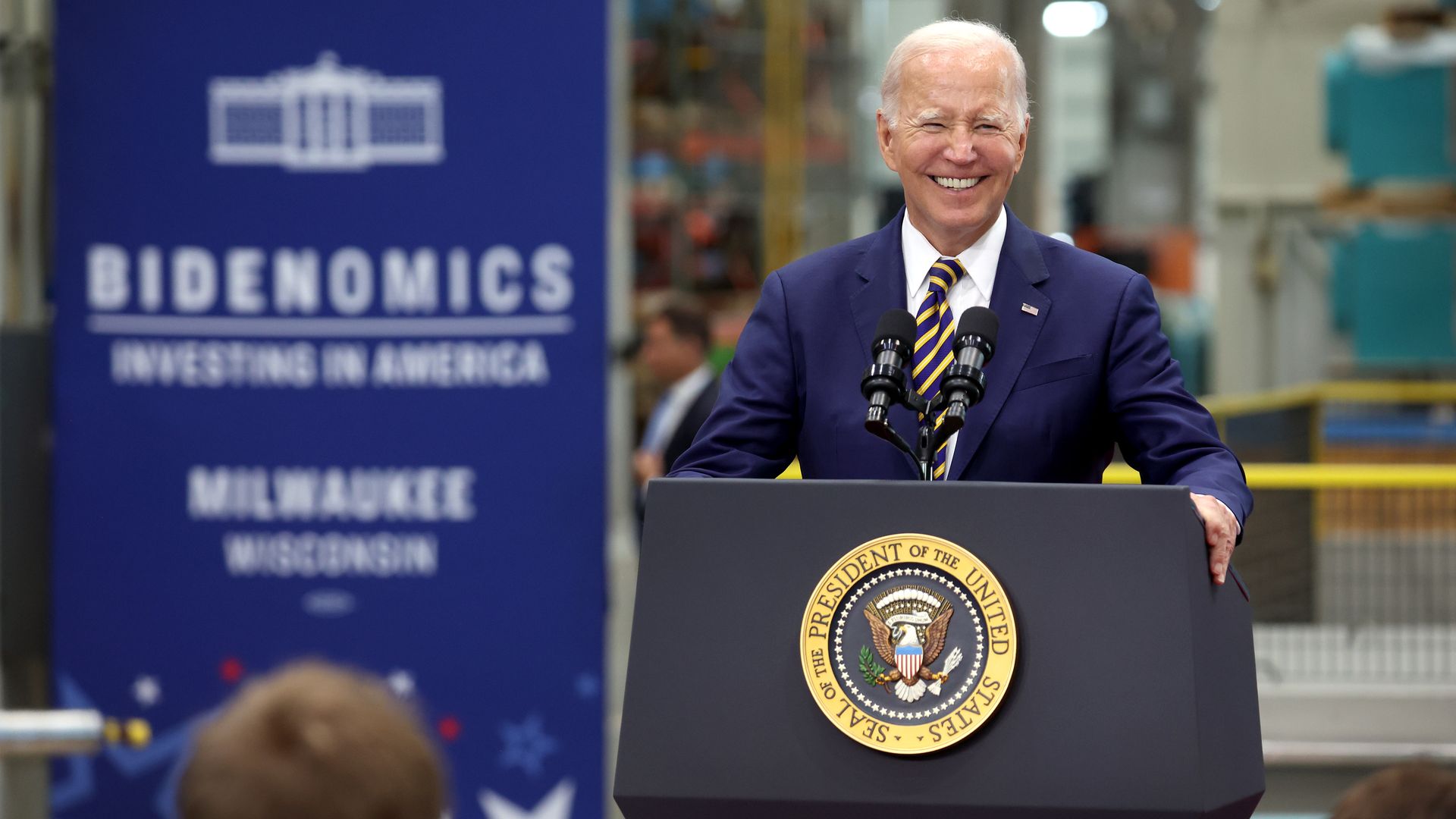
The Biden administration may soon be able to get its message about good economic numbers (or try to justify not-so-good ones) much quicker than predecessors.
Why it matters: A decades-old rule has prevented White House officials from weighing in immediately on critical economic data, even as a flurry of analysis and reactions roll in.
U.S. securities regulators today will vote to approve a Private Fund Advisers rule that's a far cry from what was first proposed 18 months ago, in a major win for private equity industry lobbyists.
The big picture: This was set to be the most significant piece of new private equity regulation in decades, with the SEC playing catch-up to an asset class that now manages trillions of dollars.
Why it matters: The move comes at a time when the world's largest asset manager and its CEO, Larry Fink, have been criticized for championing and seemingly backing away from commitments to incorporate climate change-related and other factors into investment decisions.
Yahoo has acquired CommonStock, a social platform designed for retail investors to share insights based on information linked directly to their brokerage accounts, Yahoo Finance general manager Tapan Bhat told Axios.
Why it matters: The acquisition builds on Yahoo's strategy to transform Yahoo Finance into the premier, one-stop destination for retail investors.
The peak for tech layoffs may be in the rearview mirror.
Driving the news: Polling out Wednesday from the Morning Consult/Axios Inequality Index provides another piece of evidence that the flurry of layoffs in higher-paying fields, including tech, has largely run its course.
The summer of strikes is well underway, and it could herald a big autumn for strikes, too.
Driving the news: About 205,500 workers were on strike in July, per a new tally from the Labor Action Tracker managed by Cornell's School of Industrial and Labor Relations.
A big sticking point in contract talks between Detroit automakers and the United Auto Workers union is the popular assertion that it takes fewer workers to manufacture electric vehicles (EVs) than conventional cars.
In fact, the opposite may be true: Researchers at Carnegie-Mellon University recently found that EVs require more labor hours, primarily to produce battery cells.