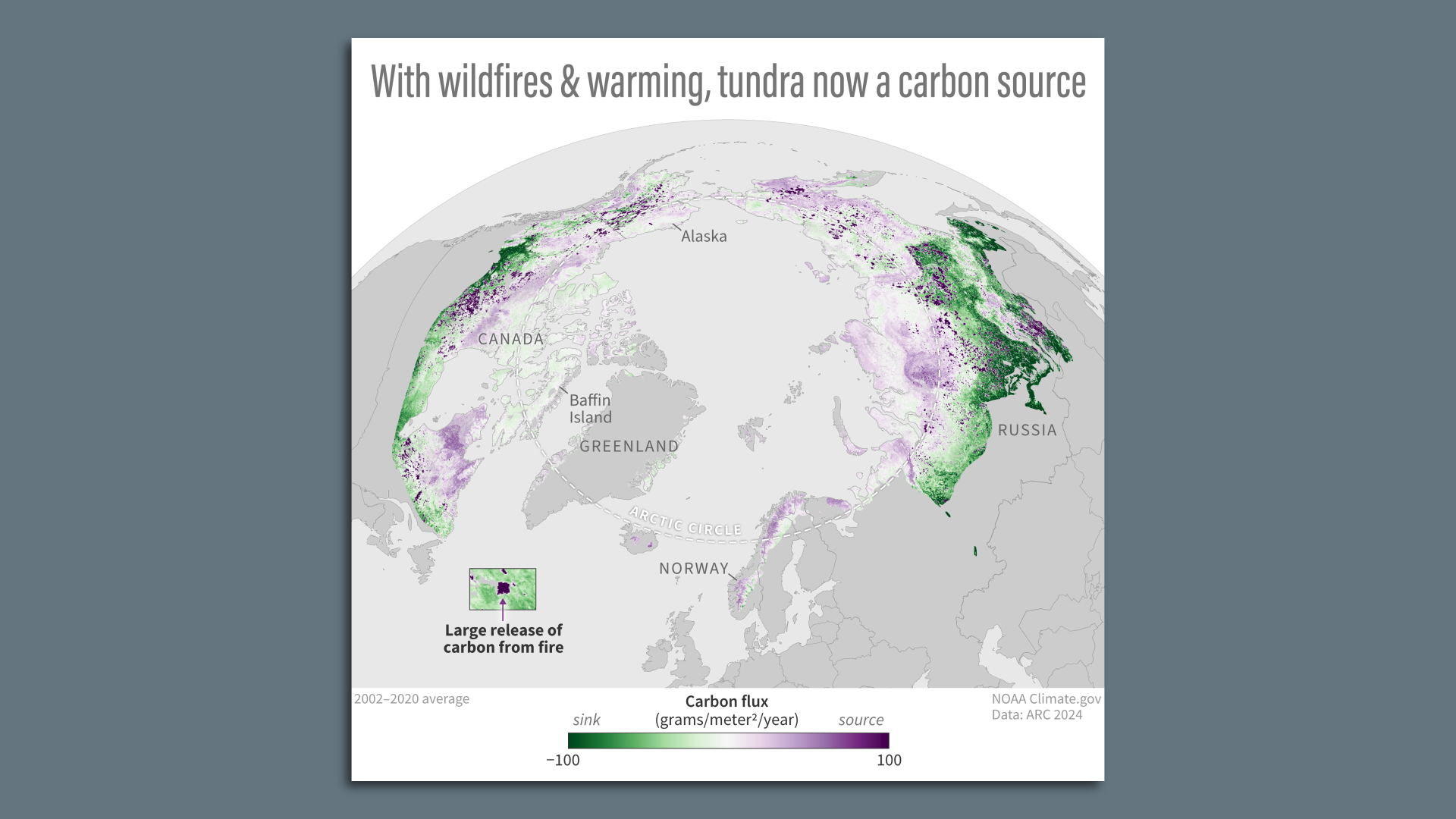
The news that the frigid Arctic tundra ringing the polar region has switched from being a net absorber, or "sink," of planet-warming greenhouse gases to a net emitter, or "source," indicates the Arctic is on the brink of further, sweeping changes.
Why it matters: This conclusion, contained in an authoritative federal report, indicates far-reaching consequences lie ahead for the world. And it suggests more Arctic climate dominoes are still to fall.
President Biden responded to the collapse of Bashar al-Assad's brutal regime in Syria by bombing ISIS camps to try to prevent the terror group's resurgence.
President-elect Trump wants little to do with the havoc in Syria, if his social media posts are gospel. He says the country "is a mess, but is not our friend," and that he doesn't want to get involved — a reflection of the isolationist banner he carried in the recent campaign.
Why it matters: Biden has less than six weeks left in office, so how the U.S. proceeds will largely be up to Trump. And while the president-elect's base may support steering clear of Syria's chaos, certain national security officials won't.
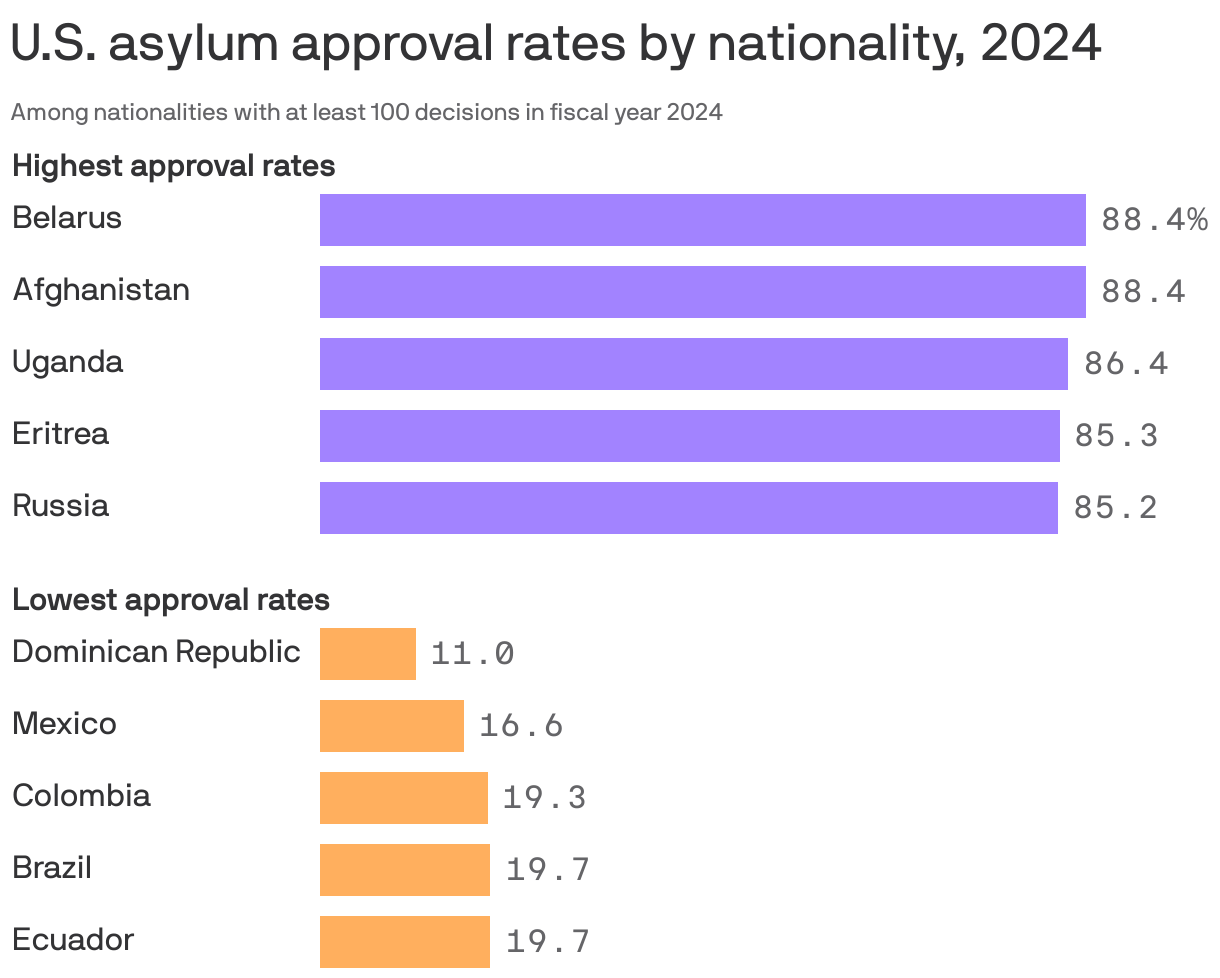
Approval rates for asylum seekers in the U.S. are dropping dramatically in the run-up to the second Trump administration, and it's become particularly difficult for Latin American immigrants to get asylum, an Axios review finds.
White House national security adviser Jake Sullivan is expected to travel to Israel, Egypt and Qatar this week in a last ditch effort to reach a hostage-release and ceasefire in Gaza dealbefore President-elect Trump's inauguration in six weeks, two sources with knowledge of the trip told Axios.
Why it matters: President Biden and his advisers have been working closely with Trump's team in recent weeks to push for a deal that both leaders want before Biden's term ends and Trump takes office.
South Korea's former Defense Minister Kim Yong-hyun, who was accused of involvement in a failed martial law attempt, tried to kill himself inside a detention center, per multiple reports citing a prison official.
The big picture: Kim was moved to a "protective cell" following the attempt, Korea Correctional Service head Shin Yong-hae told lawmakers during a parliamentary hearing on Wednesday Seoul time, Yonhap News Agency reports.
Congressional leaders are working to push through restrictions on U.S. investments in China before the end of the year, likely by attaching it to the short-term government spending stopgap.
Why it matters: House Democratic Leader Hakeem Jeffries (D-N.Y.) blocked the bipartisan measures from being included in the National Defense Authorization Act text, which was released over the weekend.
The U.S. has sanctioned a Chinese cybersecurity company and charged one of its employees with developing and distributing malware used to infect thousands of firewalls worldwide.
Why it matters: Many of the victims were U.S. critical infrastructure companies, officials said.
1. The UN partly restarted operations at its human rights office in Venezuela yesterday after it had been forced to shut in February by the government of President Nicolás Maduro.
Volker Turk, the UN's human rights commissioner, did not give details of the agreement that permitted the office to reopen, simply telling reporters it hopes to recommence prison visits and other activities soon.
2. Bolivia isholding elections this Sunday for the Supreme Court and Constitutional Court.
The South American nation was the first to implement elections for these top-level federal justices with two previous votes, in 2011 and 2017.
Observers say the elections undermine judicial independence.
A project honoring Silvia Hector Webber, known as the "Harriet Tubman of the Underground Railroad to Mexico" in Texas, is using a $150,000 grant to createan interactive mapping project and infrastructure improvements at a cemetery in Texas.
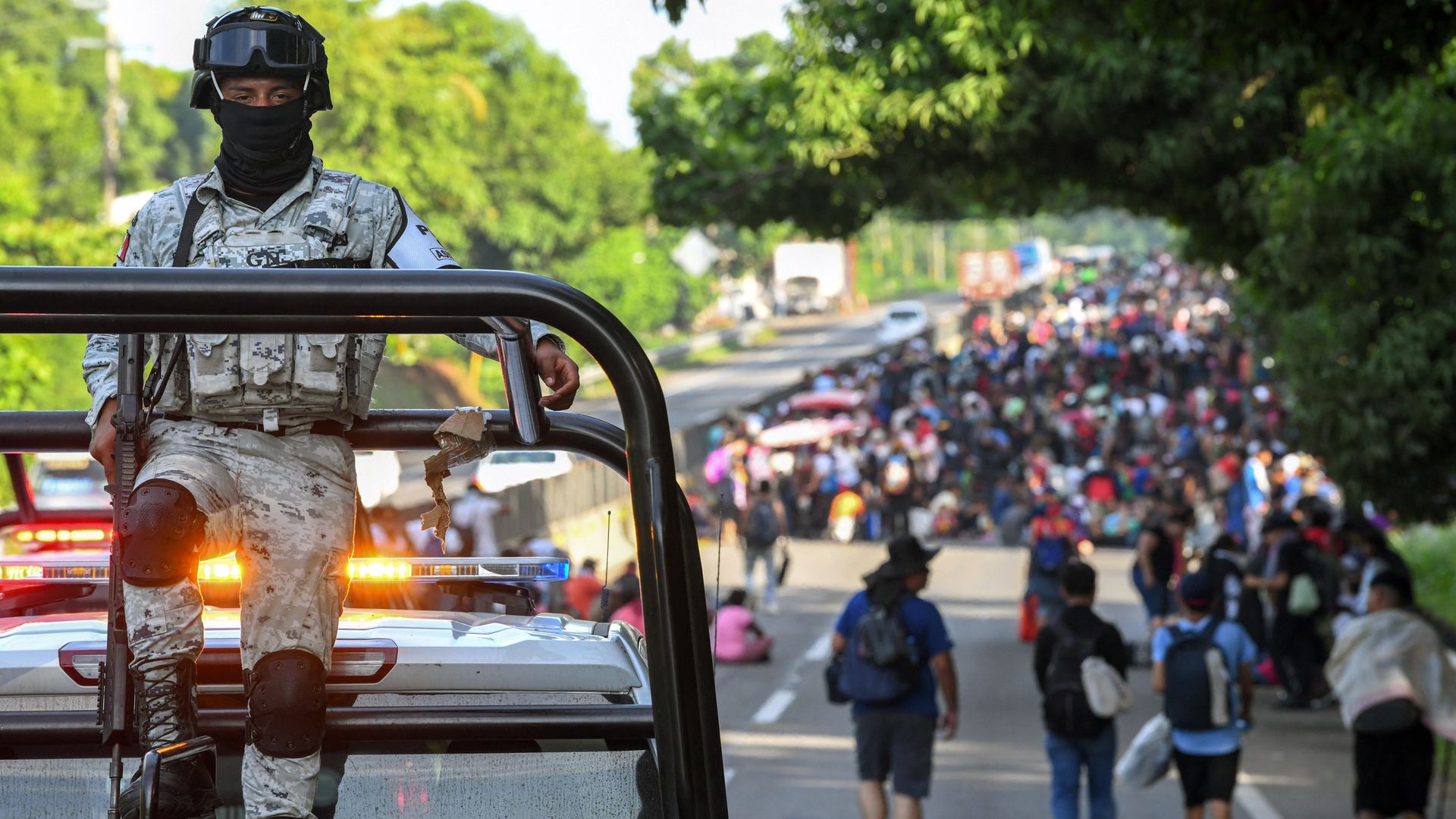
Mexico has intercepted nearly 1 million migrants this year — a record high as it has ramped up policies that reduce migration to the U.S.
Why it matters: President-elect Trump has threatened to impose tariffs that he says would force the country to "act" to stop the flow of migrants.
But Mexico has been increasingly doing just that — though some experts say it's not a viable long-term fix for the problem of unauthorized immigration to the U.S.
Nippon Life Insurance of Japan is in advanced talks to buy control of Bermuda-based insurer Resolution Life from investors like private equity giant Blackstone for $8.2 billion, as first reported by Nikkei.
Why it matters: It would be the largest-ever acquisition by a Japanese insurer, and reflects how the sector is seeking to diversify as the domestic population ages and shrinks.
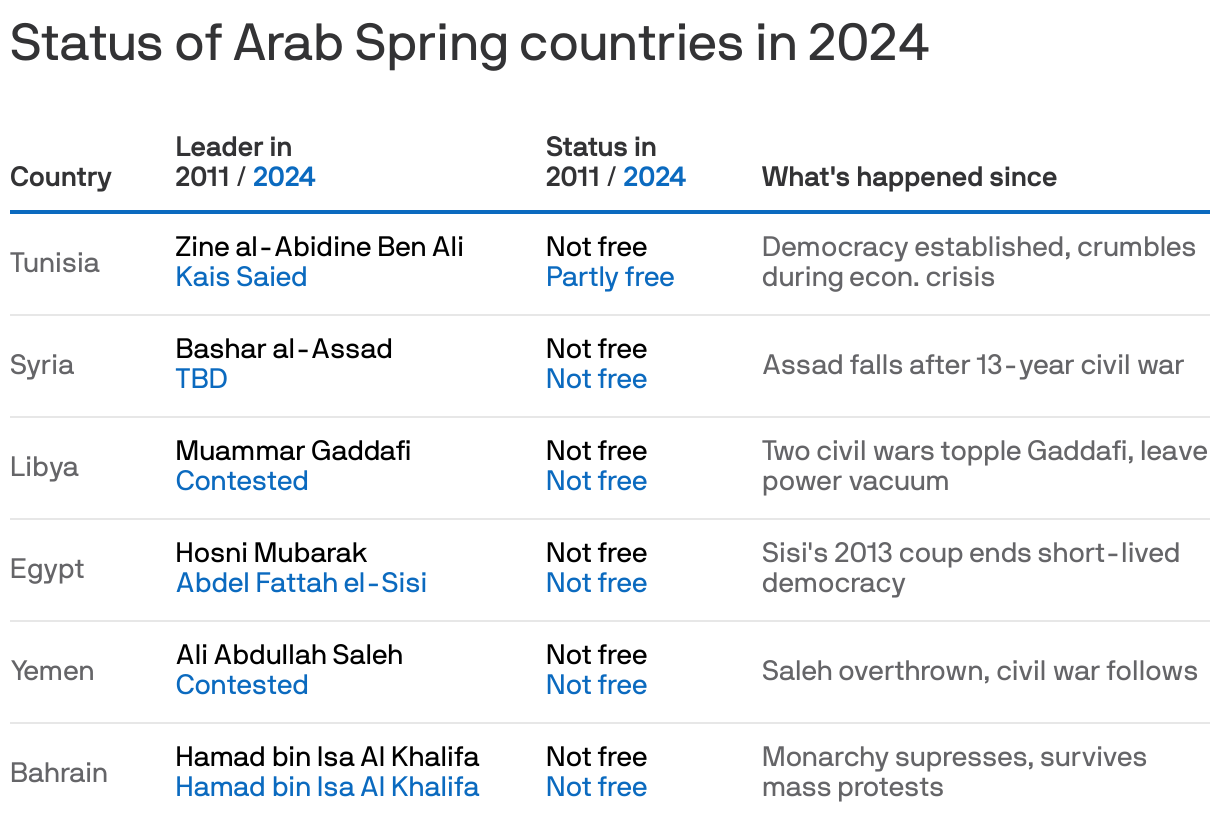
Data: Status from Freedom House Global Freedom Scores; Table: Axios Visuals
Bashar al-Assad fled Syria more than 13 years after an uprising against him began during the Arab Spring.
The big picture: Of the six countries that saw the most sustained protest movements in 2011, when fury at the ruling elites bubbled across the Arab world, Assad is the fifth leader to be ousted — more than a decade after the previous four.
The Syrian revolution has quietly played a seismic role in the trajectory of the 21st century, transforming global politics with shock waves still echoing 14 years after the Arab Spring.
Why it matters: The fall of Bashar al-Assad has ushered in an unpredictable new era not only for Syria and the Middle East, but for the great powers that have long treated the region as a battleground.
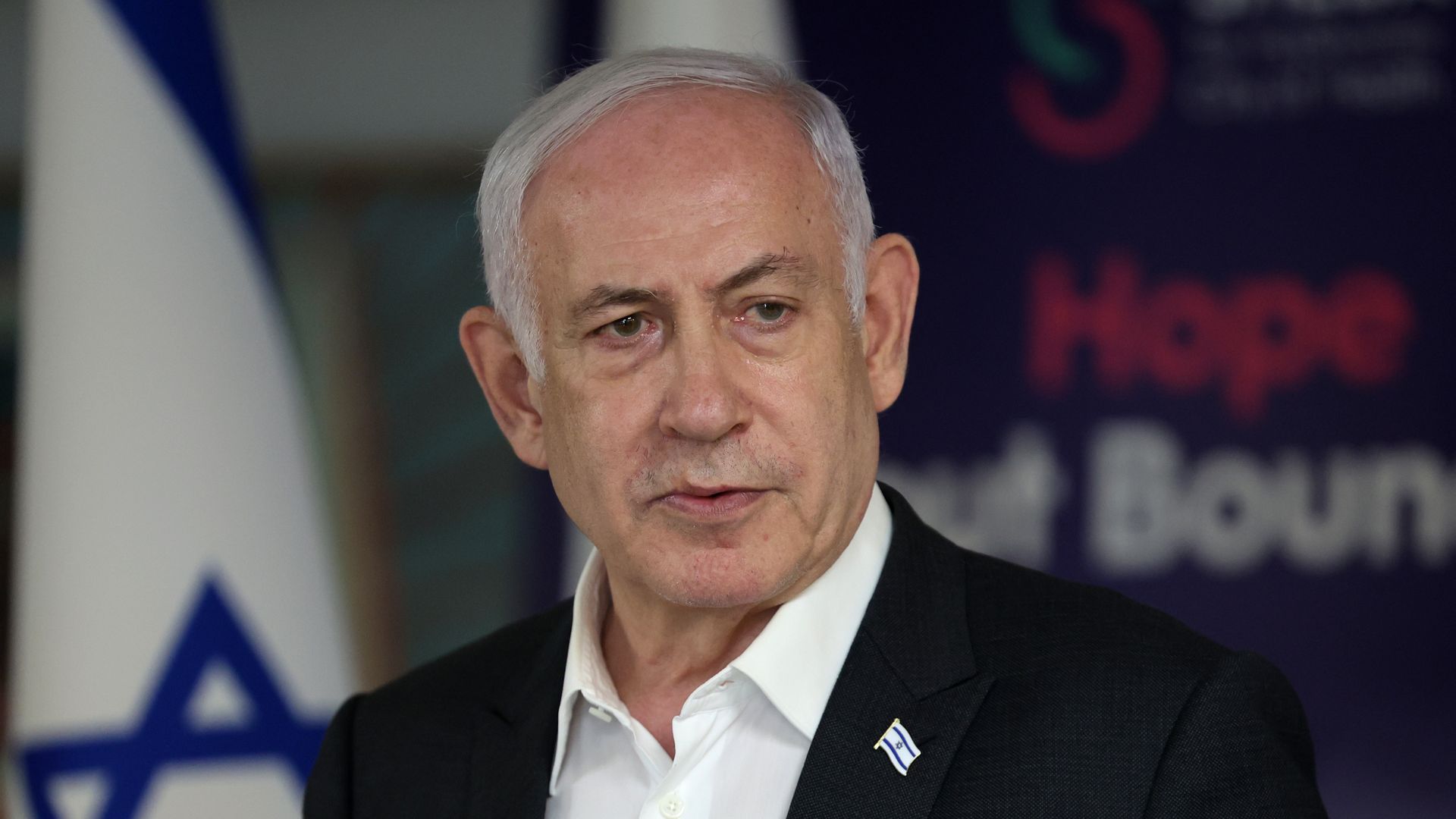
The start of Israeli Prime Minister Benjamin Netanyahu's long-awaited testimony in his corruption trial on Tuesdaybrings more uncertainty to the chaos and conflict in the Middle East.
Why it matters: Netanyahu's testimony, which he repeatedly tried to postpone and is expected to go on for months, will be a pivotal moment in the prime minister's fight for political survival and for his personal freedom.
Two top Syrian officials under the Assad regime have been charged by the Department of Justice with war crimes against Americans and others, according to a U.S. indictment that was unsealed on Monday.
The big picture: Former Syrian Air Force Intelligence officers Jamil Hassan, 72, and Abdul Salam Mahmoud, 65, have been charged with conspiracy to commit a war crime of cruel and inhuman treatment, marking the first time the U.S. has brought charges against Assad officials for human rights abuses.