South Korean parliament tables vote to impeach president

Add Axios as your preferred source to
see more of our stories on Google.
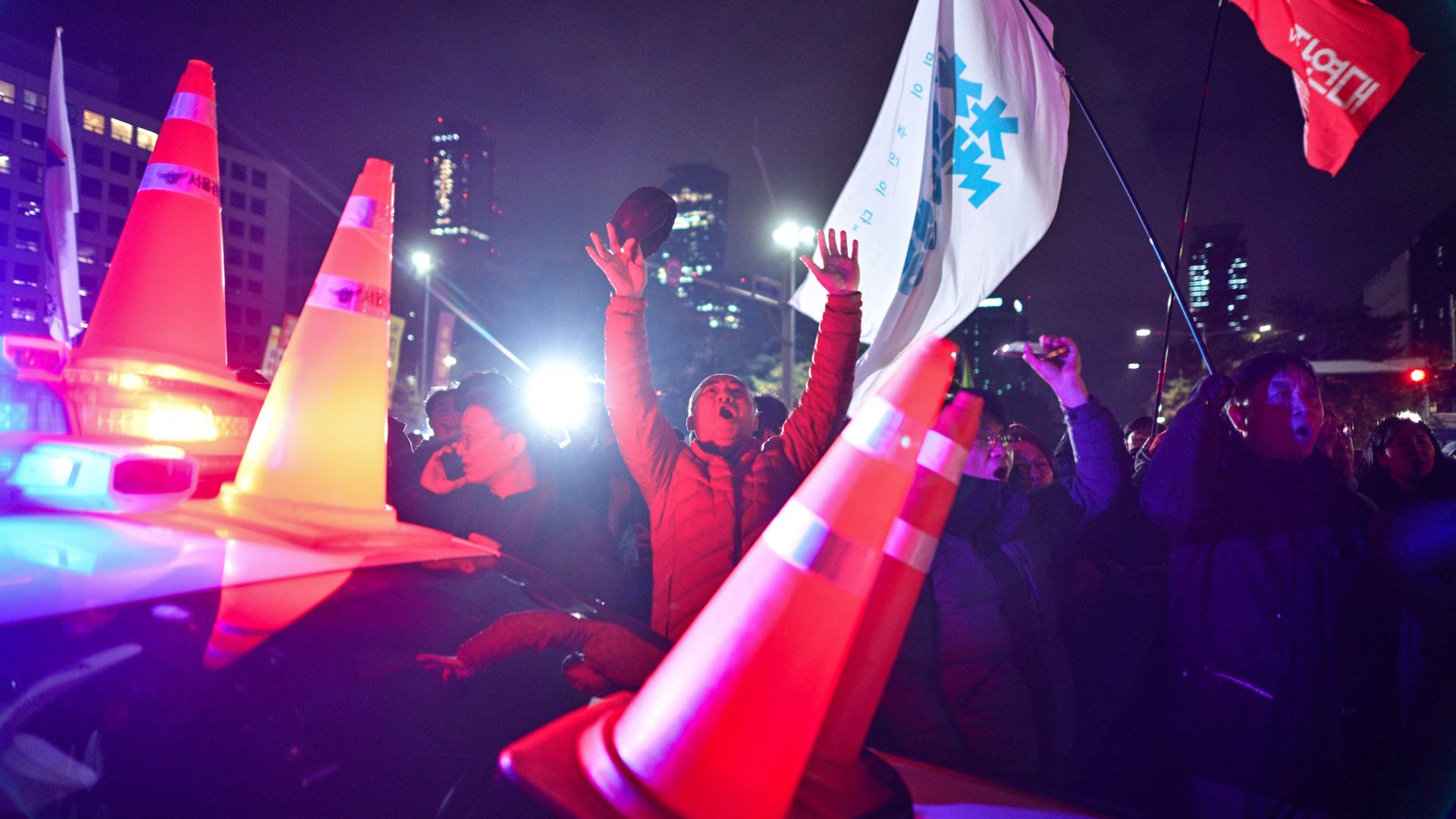
People gather outside the National Assembly in Seoul on Dec. 4 after South Korea President Yoon Suk Yeol declared martial law. Photo: Anthony Wallace/AFP via Getty Images
President Yoon Suk Yeol avoided being impeached on Saturday when his ruling People Power Party boycotted a vote in the South Korean National Assembly four days after his surprise martial law declaration sparked deep constitutional concerns.
The big picture: With the impeachment vote tabled until next week, Yoon will for now, continue his already deeply unpopular political career, cast further into controversy by his swiftly overturned, emergency martial law decree, per Yonhap News Agency.
- Yoon accused his political opposition of anti-state activities, citing the Democratic Party's handling of a budget proposal and motions to impeach top prosecutors. Hours after issuing the martial law order, the National Assembly voted it down and Yoon reversed course.
- After the overnight pandemonium, six opposition parties, including the Democratic Party, said Wednesday they had submitted a motion to impeach the embattled president.
- Hundreds of protesters gathered around the National Assembly, flooded the streets of Seoul and marched toward Yoon's office. Meanwhile, the Korean Confederation of Trade Unions announced its members planned to strike until Yoon resigned.
Zoom in: By law, a motion to impeach the president must be approved by two-thirds or more of the total members of the National Assembly.
- If parliament votes to impeach, Yoon will be suspended from exercising his presidential powers until the Constitutional Court holds an impeachment trial, per Reuters. But the court currently only has six of its nine seats filled, which could affect proceedings.
- South Korean police announced an insurrection investigation into Yoon Thursday.
By the numbers: The impeachment motion needed support from 200 of the 300 members of the legislature, in which the Democratic Party and other smaller opposition parties have 192 seats.
- The People Power Party, holds a 108-member share. Out of the 190 votes to overturn martial law, 18 came from lawmakers in Yoon's party, the AP reported.
Zoom out: South Korea's Defense Minister Kim Yong-hyun, who reportedly recommended martial law, submitted his resignation to the president on Wednesday.
- The Democratic Party had also filed a motion to impeach Kim.
- His chief of staff and more than 10 senior secretaries also resigned, per CNN's reporting. Yonhap reported that Yoon's cabinet has also offered to step down.
Friction point: This was not the first time Yoon faced calls for impeachment.
- A petition circulated over the summer accused Yoon of corruption and alleged he had stoked the risk of war with North Korea and exposed citizens to health risks from the Fukushima nuclear power plant. It gathered hundreds of thousands of signatures.
Flashback: In 2017, former President Park Geun-hye was impeached and removed after a period of political instability. She was later arrested and sentenced to prison on corruption charges but was pardoned in 2021.
Go deeper: How Trump's economic team will think about South Korea
