South Korean president faces impeachment vote after failed martial law bid

Add Axios as your preferred source to
see more of our stories on Google.

South Korean protesters hold placards that read "arrest the treasonous criminal Yoon Suk Yeol!" during a rally against President Yoon Suk Yeol at Gwanghwamun Square in Seoul on Wednesday, after martial law was lifted. Photo: Jung Yeon-Je/AFP via Getty Images
South Korean President Yoon Suk Yeol walked back his Tuesday declaration of martial law hours after the country's National Assembly voted to strike down his stunning decree that sparked a constitutional crisis for one of the closest U.S. allies in Asia.
The latest: The Korean Confederation of Trade Unions announced plans to strike until Yoon resigns and opposition lawmakers told reporters they had submitted a motion to impeach the president on Wednesday.
- They expect the impeachment bill to be voted on within 72 hours, per Reuters. South Korean presidents can be impeached if two-thirds of lawmakers in the National Assembly vote for the procedure.
The big picture: Facing pressure from his own party and a vote from the opposition-led legislature to revoke his controversial motion, Yoon said Wednesday he would lift martial law, according to multiple reports.
- After hours of protests and chaos surrounding the parliament complex, Yoon said martial law command forces had withdrawn, per Reuters.
- His cabinet approved a motion early Wednesday to end the enforcement of martial law around six hours after his surprise declaration, Yonhap News Agency reported.
State of play: Secretary of State Antony Blinken in a statement Tuesday evening welcomed Yoon's announcement that he would rescind his order declaring emergency martial law.
- "We continue to expect political disagreements to be resolved peacefully and in accordance with the rule of law," Blinken added.
- The U.S. was not notified in advance of Yoon's announcement, a National Security Council spokesperson told Axios.
- A U.S. official said President Biden was briefed on the situation while on his trip to Angola.
- Biden met with Yoon and Japanese Prime Minister Shigeru Ishiba for an Indo-Pacific security summit last month.
- Pentagon spokesperson Maj. Gen. Pat Ryder said at a Tuesday briefing that there "has been essentially no impact on U.S. forces" from the martial law declaration and he was not aware of any indication that North Korea was poised to take action in response to the situation.
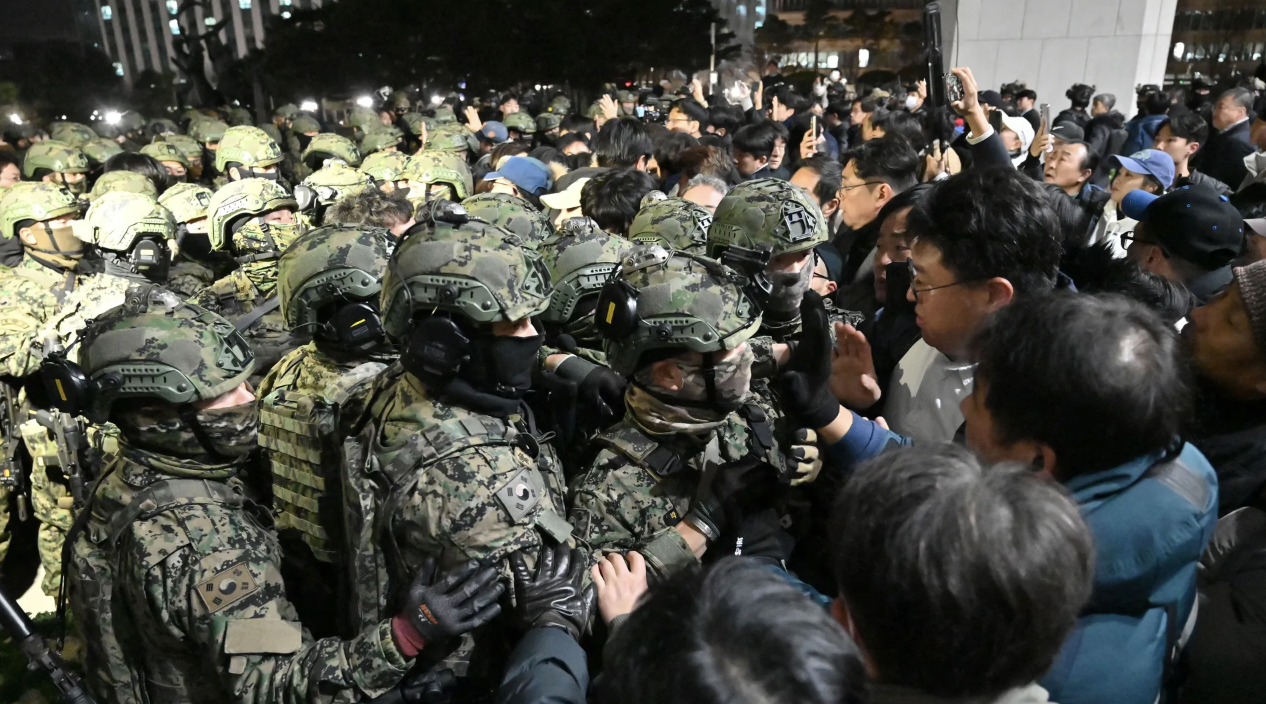
Catch up quick: The unicameral assembly, where the opposition Democratic Party has a majority, blocked the martial law order, which had suspended all political activity, per multiple reports.
- National Assembly Speaker Woo Won-shik said Yoon's declaration had become "null and void" after the assembly adopted its resolution, per the New York Times, and he ordered the military and police to leave the compound.
- Of the 300-seat assembly, 190 lawmakers were present. All of them voted in favor of blocking martial law.
- Yoon, who is highly unpopular in South Korea, said in a surprise broadcast that martial law was necessary to defend South Korea from "pro-North Korean" elements and to safeguard the constitutional order.
For the record: The president must notify the assembly that he has proclaimed martial law, per a translation of South Korea's constitution. The legislature can then request for martial law to be lifted with a majority vote and the president must comply with such a request.
- The Democratic Party called for an emergency meeting following Yoon's announcement, per the Wall Street Journal, prompting lawmakers to flock to the National Assembly building.
- Per the country's translated constitution, the declaration and termination of martial law must be referred to the State Council — which includes the president, prime minister and other executive officials — for "deliberation."
Driving the news: Yoon cited steps by the center-left Democratic Party to take over the budget process and to impeach members of his government as he declared martial law.
- Gen. Park An-soo, whom Yoon appointed martial law commander, swiftly banned "all political activities," including political party activities and citizens' rallies in a decree, per the NYT.
- It was the first time in 44 years that South Korea was put under martial law.
Friction point: Demonstrators protesting Yoon's declaration clashed with police outside the parliament building.
- "Tanks, armored personnel carriers, and soldiers with guns and knives will rule the country," Lee Jae-myung, leader of the opposition Democratic Party, said in a livestream, per Reuters.
- The leader of Yoon's party, the People Power Party, said Yoon's move was "wrong," Yonhap News Agency reported.
Reality check: The opposition may be more dovish on North Korea than Yoon, who has taken a very hard line toward Pyongyang, but it is certainly not pro-North Korea.
Context: By law, the president may proclaim martial law to cope with "a military necessity or to maintain the public safety and order by mobilization of the military forces in time of war, armed conflict or similar national emergency."
Flashback: The last time a South Korean leader declared martial law was in 1980, during a mass pro-democracy uprising against military rule.
Go deeper: North Korea sends balloons carrying bags of trash, excrement into South Korea
Axios Middle East correspondent Barak Ravid contributed reporting to this story.
This breaking news story has been updated throughout.
