What to know about the rebel offensive in Syria that toppled the Assad regime

Add Axios as your preferred source to
see more of our stories on Google.
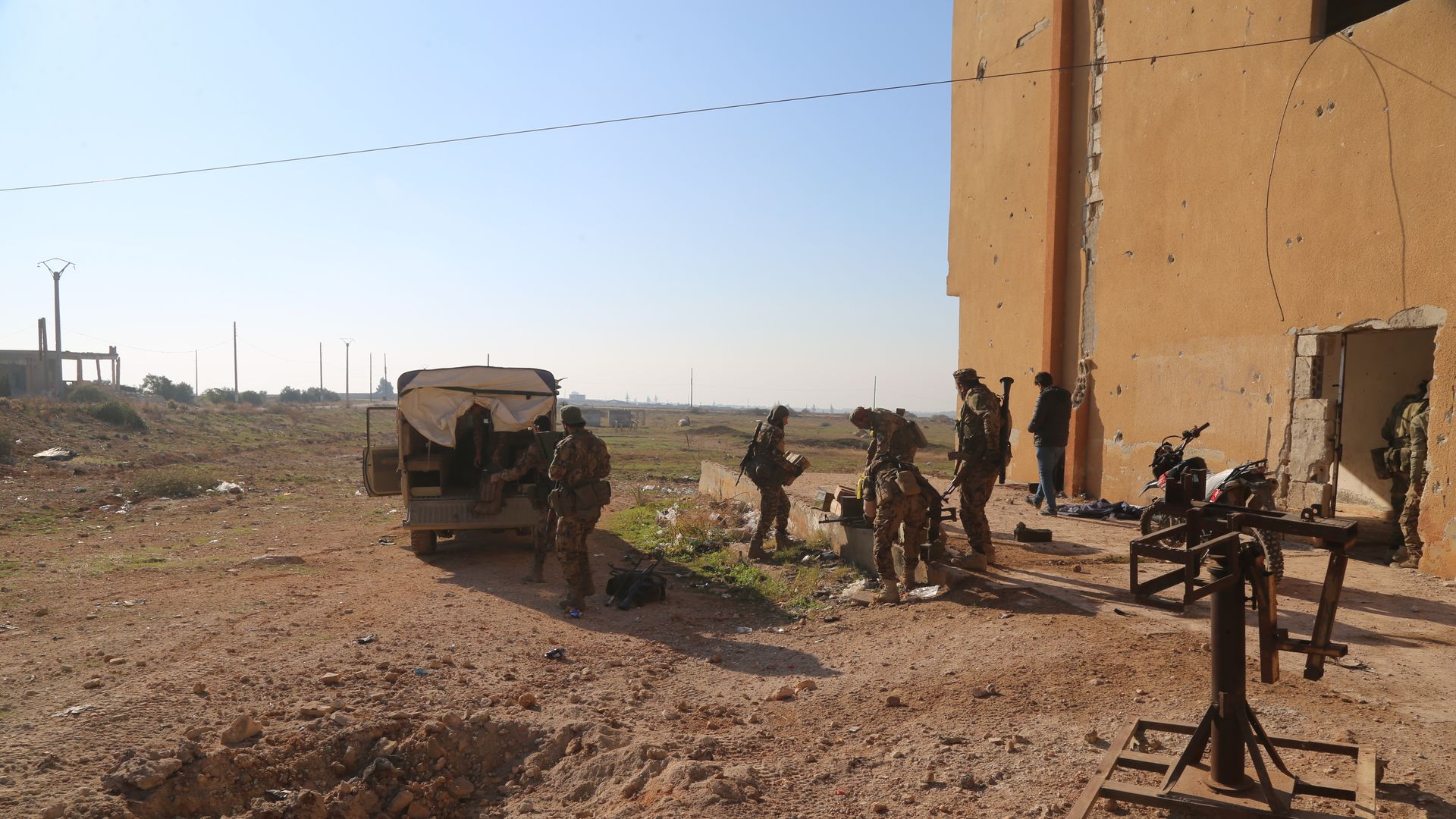
Anti-regime groups take control of some villages in Syria on Nov. 27. Photo: Kasim Rammah/Anadolu via Getty Images
A lightning offensive in Syria that began late last month successfully toppled Bashar al-Assad's regime this weekend, after 14 years of civil war.
Why it matters: Though Syria's future remains uncertain, the collapse of the regime is sure to send shockwaves through the Middle East. It could also have vast implications for Assad's allies — Russia and Iran — who, though recently bogged down by other conflicts, helped Assad stay in power for years.
The big picture: The Syrian civil war began during the Arab Spring in 2011 after Assad forcefully cracked down on anti-government protests.
- More than 14 million Syrians have been displaced from their homes as a result of the war, with millions becoming refugees abroad, according to the United Nations.
- The Syrian Observatory for Human Rights (SOHR), a human rights group based in the U.K., estimated last year that more than 600,000 people had been killed during the war.
- Assad infamously used chemical weapons against his own civilians.
What do we know about the offensive?
A coalition of armed rebel groups launched the offensive in late November and in a matter of days retook nearly all of Aleppo, Syria's second biggest city's and the country's economic capital.
- That was both a symbolic and strategic victory for the rebels. Assad's capture of Aleppo in 2016 was seen as a turning point that pushed the war in his favor.
- The rebels also captured other areas of Northwest Syria in the Idlib and Hama provinces.
State of play: The rebels then pushed onward towards Hama city — located between Aleppo and the capital, Damascus — liberating towns along the way, even as Russia and Syria targeted the rebels with airstrikes.
- The rebels continued to press forward, retaking the cities of Homs and Daraa, as they advanced on Damascus with no meaningful resistance from government forces. In the face of their advance, Syrian regime forces in some places abandoned their posts or fled for Iraq.
- On Sunday, the rebel groups officially seized control of Damascus and declared it "free."
Zoom in: President-elect Trump on Saturday urged the U.S. to not intervene as the rebels advanced on Damascus.
- Trump wrote on Sunday in a Truth Social post that Assad had fled Syria because Russia "was not interested in protecting him any longer."
What has happened since
The rebel offensive's success officially ended 53 years of rule by the Assad family in Syria.
- Assad and his family have fled Syria and been granted political asylum in Moscow, Russian state media reported Sunday.
- After the collapse of the regime, Israel recaptured territory on the Syrian side of the Syria-Israel border in the Golan Heights in what Israel said was a temporary security measure.
- The U.S. carried out airstrikes in Syria targeting Islamic State camps and operatives. U.S. Central Command said Sunday the strikes were mean to "ensure that ISIS does not seek to take advantage of the current situation" in the country.
- The U.S. is also working with other countries in the Middle East to ensure the Assad regime's chemical weapons stockpiles are responsibly destroyed or secured.
Who are the rebels?
The opposition fighters are a patchwork of rebel groups, some of whom have been opposed to each other at different points of the war, the New York Times reported.
- However, they're now united under the leadership of Hayʼat Tahrir ash-Sham (HTS), a Sunni Islamist opposition group backed by Turkey and designated a terrorist organization by the U.S.
- HTS — under the banner of its leader Abu Mohammad al Jolani — is the successor organization to former Al Qaeda affiliate Jabhat al-Nusra and has long held power in much of Idlib province, per the Center for Strategic and International Studies (CSIS).
- Another umbrella group in the rebel forces is the Syrian National Army (SNA), a coalition of Turkish-backed forces who have captured the city of Tel Rifaat, per CSIS.
- Syrian Democratic Forces (SDF) are a coalition of primarily Kurdish-led militias, who were backed by the U.S. in the fight against the Islamic State. The SDF, which has previously clashed with the SNA, claimed Tuesday to have captured seven villages from government control, though state media denied the reports, per AP.
Why is this happening now?
The fresh offensive comes as Assad's main backers in the war have become embroiled in other conflicts.
- "For many years the Syrian government has been engaged in this civil war, backed by three main players: Iran, Russia and Hezbollah. All three of those players have been distracted and weakened by conflicts elsewhere," U.S. national security adviser Jake Sullivan told NBC's "Meet the Press" Sunday, alluding to the wars in Ukraine and the Middle East.
Zoom in: U.S. National Security Council spokesperson Sean Savett said in a statement Saturday that the U.S. was "closely monitoring the situation" but that it had "nothing to do with this offensive."
- The Biden administration, he added, urged de-escalation.
Go deeper: Toppling of Assad transforms Middle East after year of chaos
Editor's note: This story was updated with new developments.
