Trump's tariffs could raise the prices of these everyday goods

Add Axios as your preferred source to
see more of our stories on Google.
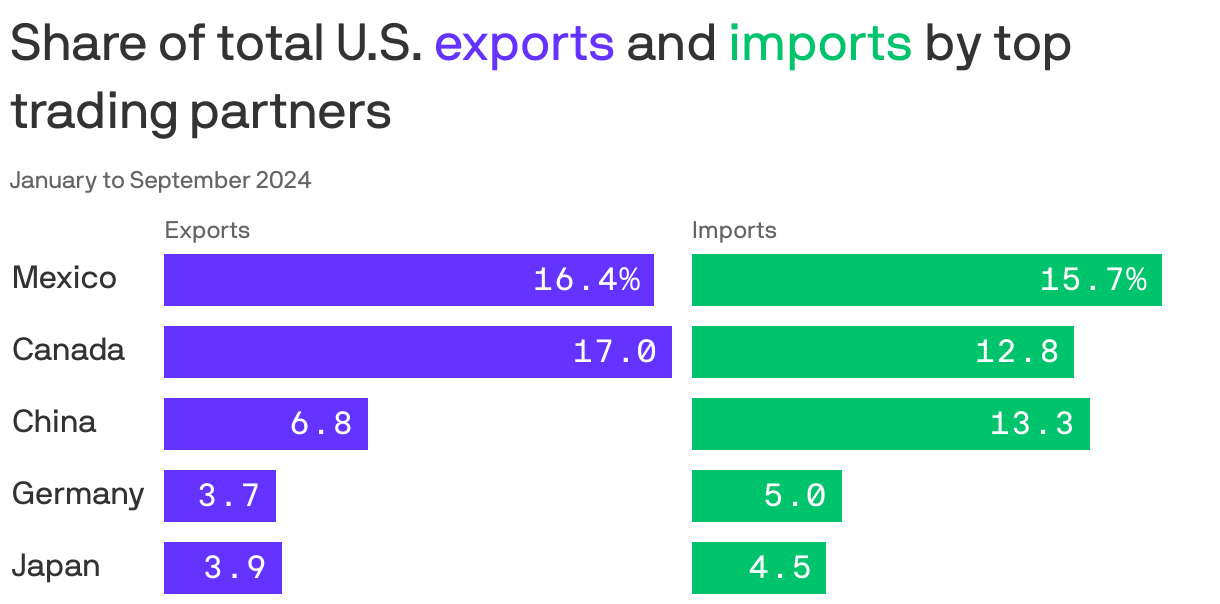
President-elect Trump made instituting sweeping tariffs one of the cornerstone pledges of his 2024 campaign, a move experts warn could lead to price hikes for many everyday goods.
Why it matters: Voters' frustration with the economy pushed many to support Trump, but experts warn levying tariffs could reignite inflation and even spark a trade war.
Driving the news: In social media posts Monday, Trump announced a tranche of new tariffs on the U.S.' top three trading partners — Canada, Mexico and China.
- Trump said that on his first day in office he would sign "all necessary documents" to charge a 25% tariff on all goods coming from Canada and Mexico.
- He also added that imports from China be levied a 10% tariff "above any additional Tariffs."
Between the lines: On the campaign trail, Trump had floated proposals to impose 10% or 20% tariffs on all imports, as well as a 60% tariff on all Chinese imports.
- Ed Brzytwa, the Vice President of International Trade at the Consumer Technology Association, told Axios Tuesday that the situation remains "unpredictable," and while the tariff on China is lower than anticipated, more tariffs could be announced down the line.
- "We're still anticipating that he wants to follow through on 60%," if not higher, Brzytwa said.
The big picture: Because of the integration of the North American market, tariffs on Mexican and Canadian imports could lead to "massive supply chain disruptions," according to Brzytwa.
- He called it "a recipe for disaster for the North American economy" and U.S. consumers.
- The National Retail Federation warned in a statement Tuesday that "lower prices and increased tariffs are mutually exclusive. It's one or the other; not both."
- "Blanket and indiscriminate tariffs on a limitless range of consumer goods will be inflationary and hurt American families and workers," the NRF added.
A spokesperson for Trump did not respond to Axios' request for comment.
Zoom out: Many retailers — including Walmart and Lowe's — have already indicated they might raise prices for consumers if tariffs are implemented.
- Others have begun stocking up on inventory to navigate the new tariff regime.
Mexico
Mexico is the U.S.' largest trading partner, with the U.S. importing almost $400 billion worth of goods from Mexico from January through September of this year, according to the U.S. Census Bureau.
- The U.S.' top imports from Mexico are cars, car parts, computer equipment, oil and gas, and electrical equipment, per the Congressional Research Service.
- The U.S. also imports a significant amount of alcohol and furniture from Mexico, CNN reported.
Canada
According to U.S. government data from 2022, the U.S imports more than $400 billion worth of goods from Canada per year.
- The U.S.' top import from Canada is crude oil and other energy-related imports, like petroleum gas and coal.
- The U.S. has been steadily growing its imports of Canadian crude oil over the past few decades and in July 2024 imports reached a record high of 4.3 million barrels per day, the Energy Information Administration (EIA) said last month.
- But the U.S. also imports leather goods, plastics, iron and steel from Canada.
China
The U.S. is the largest destination market for Chinese exports, buying about 15% of everything it sends out, according to the research firm Trading Economics's 2023 data.
- The U.S. imports a significant amount of electronics from China, including smartphones and computers.
- It also imports a great deal of machinery, toys, sports equipment, furniture, footwear, clothing and textiles from China.
Go deeper:
