Assad joins list of toppled leaders 13 years after Arab Spring

Add Axios as your preferred source to
see more of our stories on Google.
Bashar al-Assad fled Syria more than 13 years after an uprising against him began during the Arab Spring.
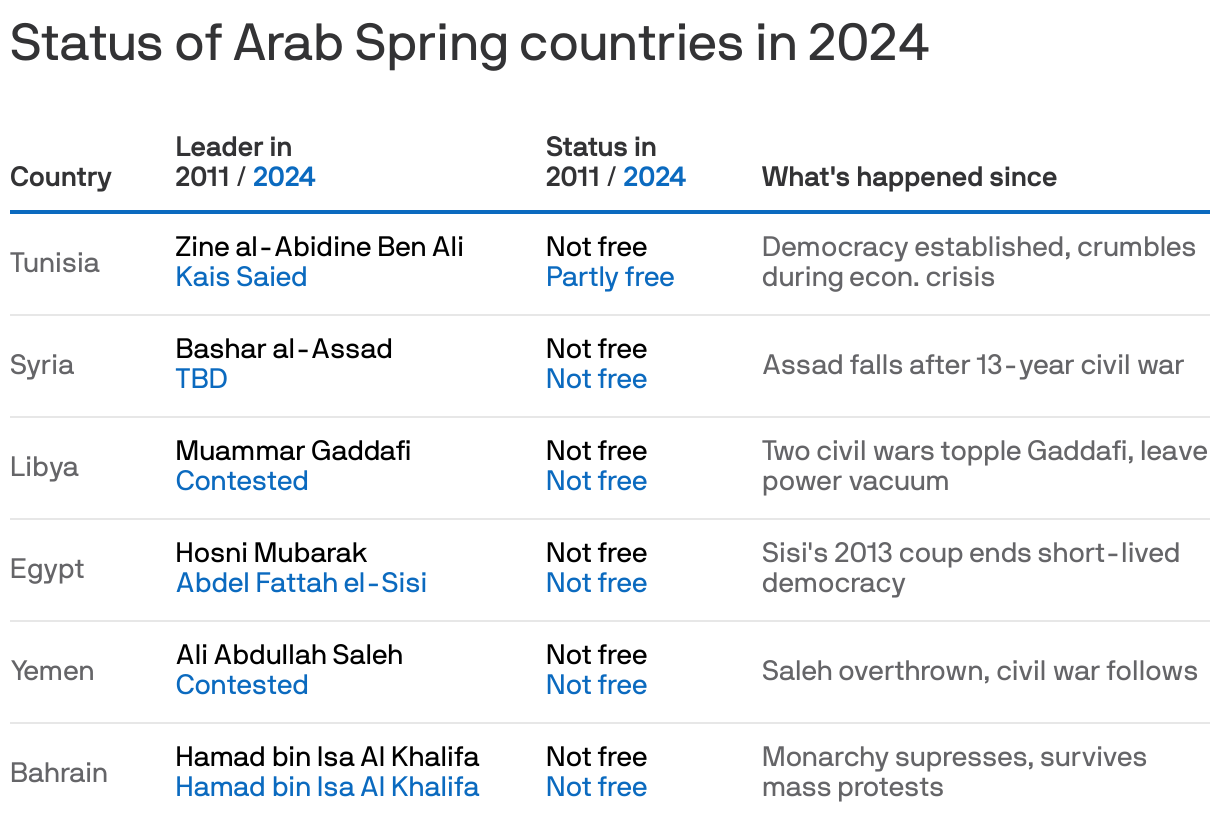
The big picture: Of the six countries that saw the most sustained protest movements in 2011, when fury at the ruling elites bubbled across the Arab world, Assad is the fifth leader to be ousted — more than a decade after the previous four.
Flashback: The Arab Spring began in Tunisia, and Tunisian President Zine al-Abidine Ben Ali was the first to be toppled, in Jan. 2011.
- Egyptian President Hosni Mubarak fell the following month.
- Libyan President Muammar Gaddafi was killed in Oct. 2011, while Yemeni President Ali Abdullah Saleh stepped down in Feb. 2012.
Breaking it down: Tunisia was the only country to build a sustained democracy after the Arab Spring, but it has deteriorated under the strain of an economic crisis and the authoritarian leadership of President Kais Saied.
- Egypt held democratic elections in 2012, but Abdel Fattah el-Sisi took power in a coup the following year.
- Libya and Yemen have both suffered through more than a decade of war and instability since their respective regimes fell.
The flipside: Bahrain's monarchy managed to survive the 2011 protests and Hamad bin Isa Al Khalifa remains on the throne.
Zoom out: Other Arab countries such as Morocco and Sudan saw significant protests in 2011, but not on the scale of the six mentioned above.
- A "second Arab Spring" hit the region in 2018, capped by the toppling of another strongman leader, Sudan's Omar al-Bashir. Sudan is now mired in a brutal civil war.
