Apple's latest quarterly results greatly exceeded Wall Street expectations, as sales of the iPhone, Mac and iPad all came in far ahead of expectations. The iPhone maker saw total sales outside the U.S. account for more than two-thirds of its nearly $90 billion in quarterly revenue.
Why it matters: Apple is seen as a bellwether for the broader tech industry and is also a huge driver of demand for chips, screens and other components.
Qualcomm executives told Axios on Tuesday that they are seeing demand for semiconductors exceed supply in all of their businesses, from cars to smartphones to networking gear, but they expect the shortage to start easing, at least for them, by the end of the calendar year.
Why it matters: A global chip shortage is hampering supply of all kinds of goods, but most notably the auto industry which is having to cut car production due to a lack of required semiconductors.
More game developers have had projects delayed than in past years due to COVID-19, according to a recent state of the industry survey from Game Developer Conference organizers.
Why it matters: Delays are an inevitable part of development, but there's been a noticeable jump since pandemic's arrival. According to GDC's findings, 44 percent of the over 3,000 respondents polled said their games have been subject to delays. Compare that to last year's responses at 33 percent.
Volt Capital, a venture capital firm focused on the cryptocurrency industry, tells Axios that it raised $10 million for its first fund.
Why it matters: Volt plans to maintain its focus on early-stage startups, which are being increasingly ignored by venture capital firms that are raising ever-larger funds.
Sony shipped 7.8 million PlayStation 5s between the new console’s November 2020 launch and the end of March, with demand outstripping supply, the company said in its latest financial reports.
Why it matters: The video game business has boomed since the onset of the coronavirus pandemic, but a shortage of semiconductors threatened to slow down the manufacturing of new game consoles, including the PS5.
Wing, the drone unit of Google-parent Alphabet, is teaming up with a Virginia Girl Scout troop to offer airborne delivery of Thin Mints, Samoas and other cookies during the pandemic.
Why it matters: Orders are down 50% this year due to lower foot traffic downtown. Plus, Wing says the arrangement is helping teach the scouts about drone technology.
Spotify on Wednesday reported strong Q1 revenue growth, fueled by positive subscriber additions and strong ad sales, as well as lowered headwinds from foreign exchange rates.
The big picture: The Swedish tech giant noted that increased subscriber growth and user engagement can be attributed in part to the better-than-expected performance of "The Joe Rogan Experience," a podcast it acquired exclusively for over $100 million.
Tech giants are facing increasingly hostile foreign governments that are taxing their profits, attempting to halt their acquisitions, labeling them as monopolies and passing laws to limit their powers.
Why it matters: Big Tech's international policy challenges mean companies are positioning themselves for regulatory fights overseas while the U.S. is still struggling to figure out what it wants to do.
DoorDash's new pricing tiers for restaurants reveal that there's no magical math that can keep customer fees and restaurant commissions low — one group will have to bear the cost.
Why it matters: During the pandemic, food delivery companies like DoorDash came under fire for charging high fees to restaurants, and faced tacit criticism that they didn't give up their own margins to help both drivers and eateries earn more.
SpaceX scored a regulatory victory at the Federal Communications Commission Tuesday, overcoming opposition from Amazon and other satellite companies on a key change to its plans for a satellite network that will beam internet access across the globe.
Why it matters: SpaceX needed FCC approval to move forward with its plan to provide internet access in hard-to-reach areas.
U.S. Air Force researchers are partnering with a quantum computing company to use its machine learning algorithms, Axios has learned.
Why it matters: Quantum is the next generation of computing, and its growing adoption by the military shows the progress of the technology as it gradually moves out of the lab and into the real world.
The days of unwieldy internet user tracking by advertisers are coming to an end, sending the web's largest publishers scrambling.
Why it matters: The new online privacy changes are a massive pivot from the decades-long practice of selling hyper-targeted ads to users based on their web history. Many big web publishers rely on targeted ads to support their businesses.
Podcasts have historically been open and freely distributed, but new subscription offerings for podcasts from Apple and Spotify aim to challenge that status quo.
Between the lines: As the subscription podcast ecosystem develops, it wouldn't be surprising if other major podcast publishers start to toy with the idea of putting some of their podcasts behind a paywall.
Spotify on Tuesday launched its new subscription podcast platform that gives creators the ability to create podcasts exclusively for paid subscribers on and off Spotify.
Why it matters: The move follows Apple's announcement last week that it has launched a new podcast subscription service within Apple podcasts.
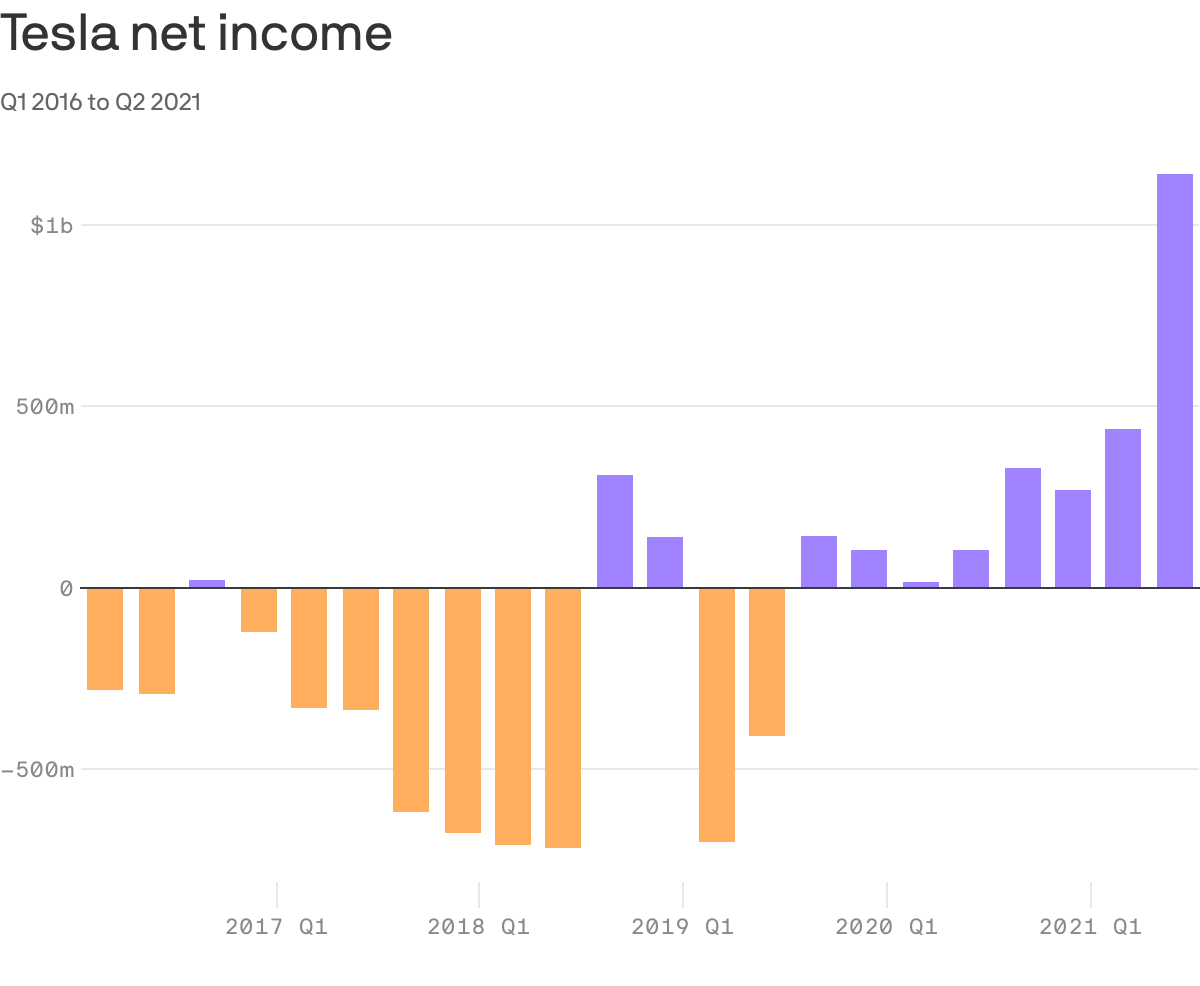
Data: FactSet, company filings; Chart: Will Chase/Axios
Tesla's latest earnings reportbeat expectations handily, thanks largely to its investment in bitcoin and regulatory credits, but the stock fell by as much as 3% in after-hours trading.
By the numbers: Tesla reported revenue of $10.4 billion and a record-high $438 million in net profits. The company said it made $101 million from the sale of some of its bitcoin holdings after investing $1.5 billion in February.
Tech platforms have built the heart of their businesses around secretive computer algorithms, and lawmakers and regulators now want to know just what's inside those black boxes.
Why it matters: Algorithms, formulas for computer-based decision making, are responsible for what we get shown on Facebook, Twitter and YouTube — and, increasingly, for choices companies make about who gets a loan or parole or a spot at a college.
The Washington, D.C., Metropolitan Police Department (MPD) said late Monday that the FBI is investigating "unauthorized access on our server," per the Washington Post.
The big picture: The breach is the latest in a series of apparent hack attacks targeting the federal government, agencies and businesses in the U.S. in recent months.