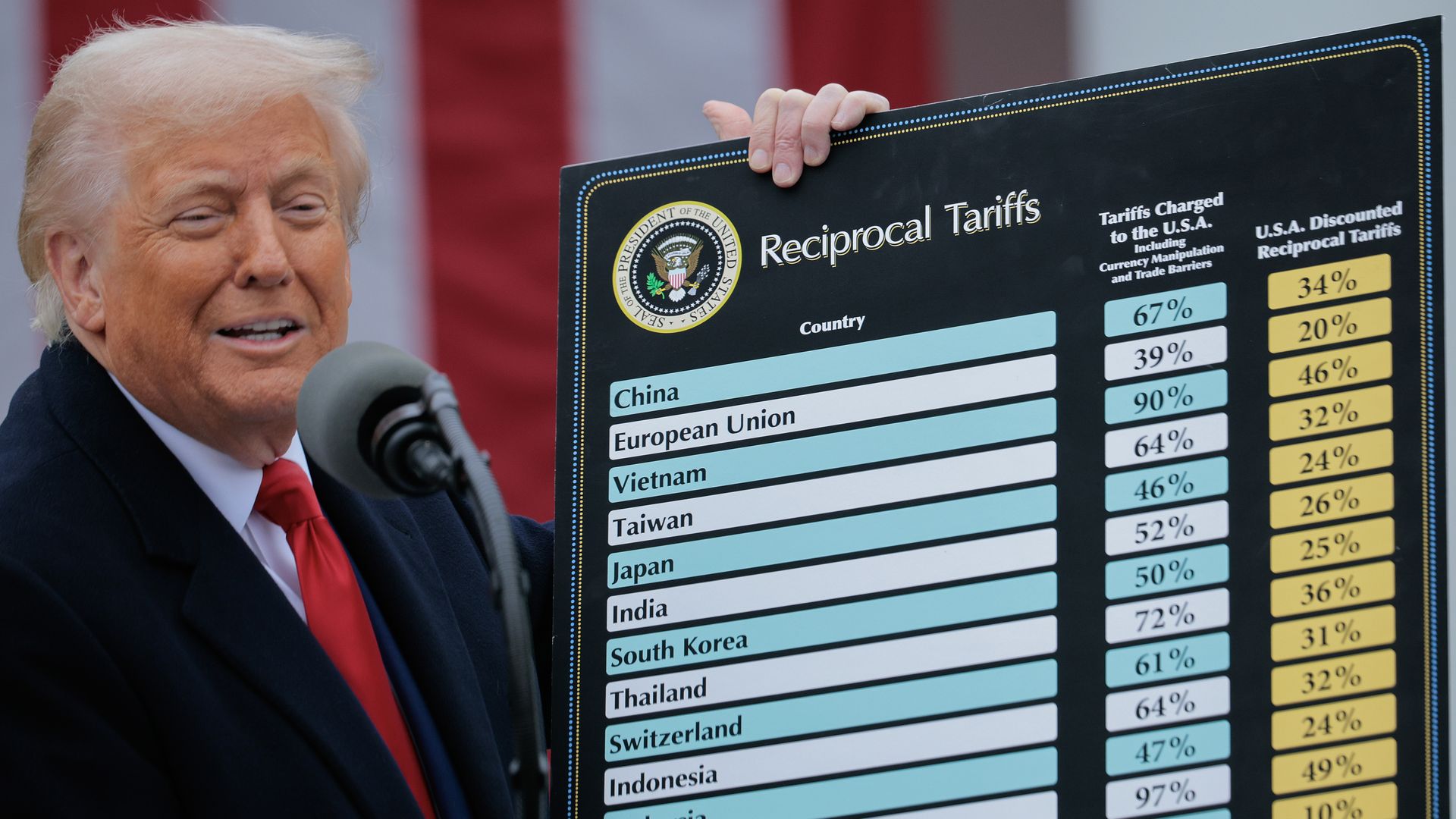
President Trump's tariffs are set to go into effect at midnight, and at least for now — with roughly six hours to go — the White House appears poised to slap a triple-digit levy on China.
State of play: "Negotiations" has been the word of the day.
The White House has spent much of Tuesday touting the "massive amount of requests" for talks from the roughly 80 trading partners set to be hit with tariffs tonight.
So far the president has prioritized at least two countries for talks: Japan and South Korea.
🇨🇳 Friction point: Who hasn't called yet: the U.S.'s largest source of imports.
"China also wants to make a deal, badly, but they don't know how to get it started," Trump wrote this morning in a social media post. "We are waiting for their call."
If a Cinnabon wasn't already sweet enough for you, how about some ice cream to go with it?
The big picture: GoTo Foods is combining its Cinnabon cinnamon roll and Carvel ice cream brands into one for a new restaurant concept: Cinnabon Swirl.
GoTo Foods — which also owns Auntie Anne's, Jamba and Moe's Southwest Grill — said today that it plans to open 30 Cinnabon Swirl locations, beginning with Hillsboro, Oregon, in May.
Zoom in: Signature itemswill include:
The Bonini, a Cinnabon with Carvel vanilla soft serve.
Cinnabon Swirl Sundae: "Warm, center swirls of a Cinnabon Classic Roll chopped & topped with Carvel vanilla soft serve & a caramel drizzle."
💭 Nathan's thought bubble: Given everything else that's going on right about now, I'm all for throwing caution to the wind.
One of the surprises out of the big tariffs announcement on April 2 was that the Trump administration used a surprisingly simplistic approach to calculating these much-hyped reciprocal tariffs.
Why it matters: This was not a finely tuned set of import taxes calibrated to exert pressure on trading partners to adjust specific policies with which the U.S. has grievances.
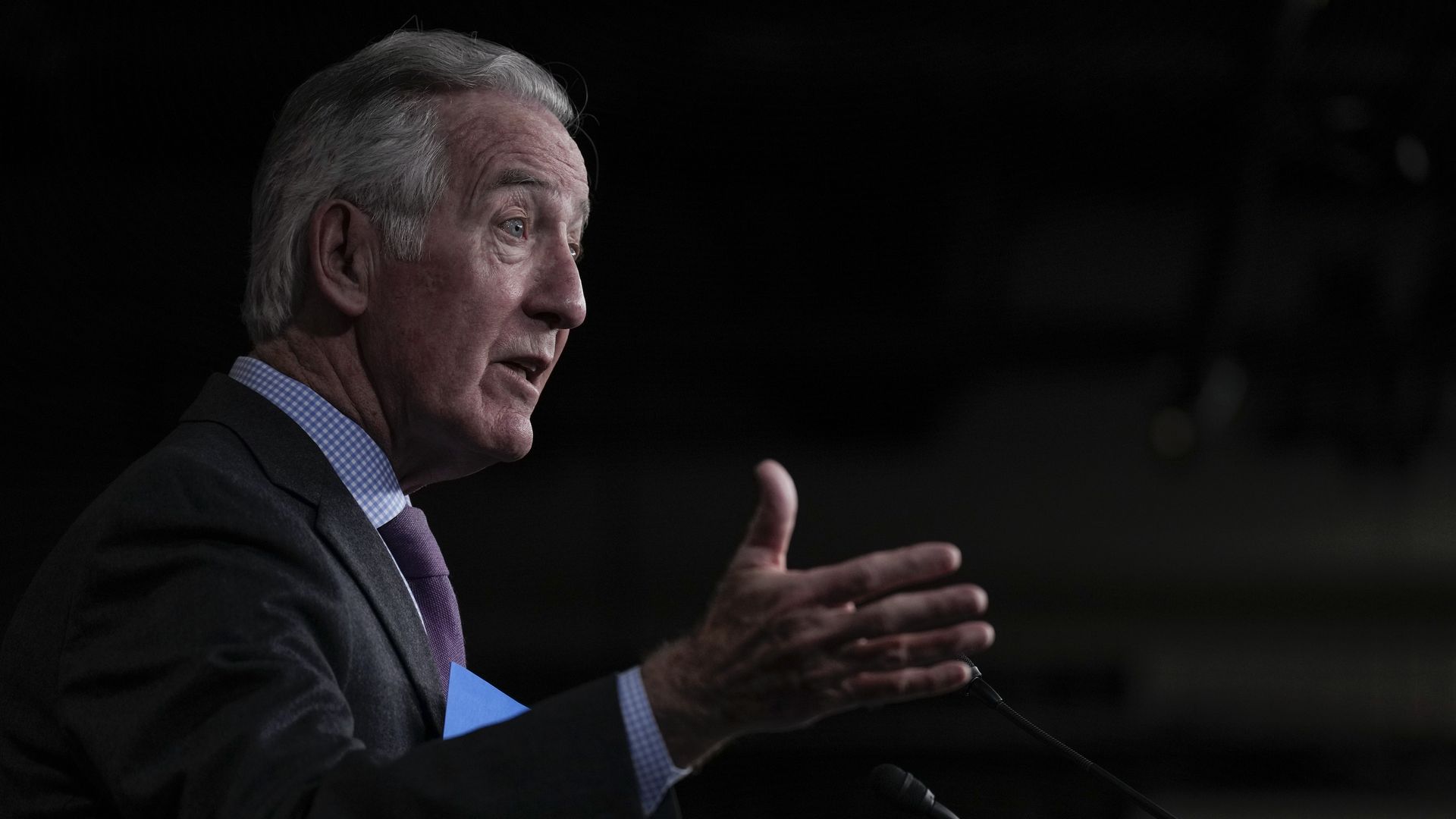
House Democrats are moving forward with their plan to try to force a vote on killing the across-the-board tariffs President Trump rolled out last week.
Why it matters: Trump is almost certain to veto the measure if it passes, but Democrats want to force House Republicans to choose between their loyalty to the president and uneasiness with his trade policy.
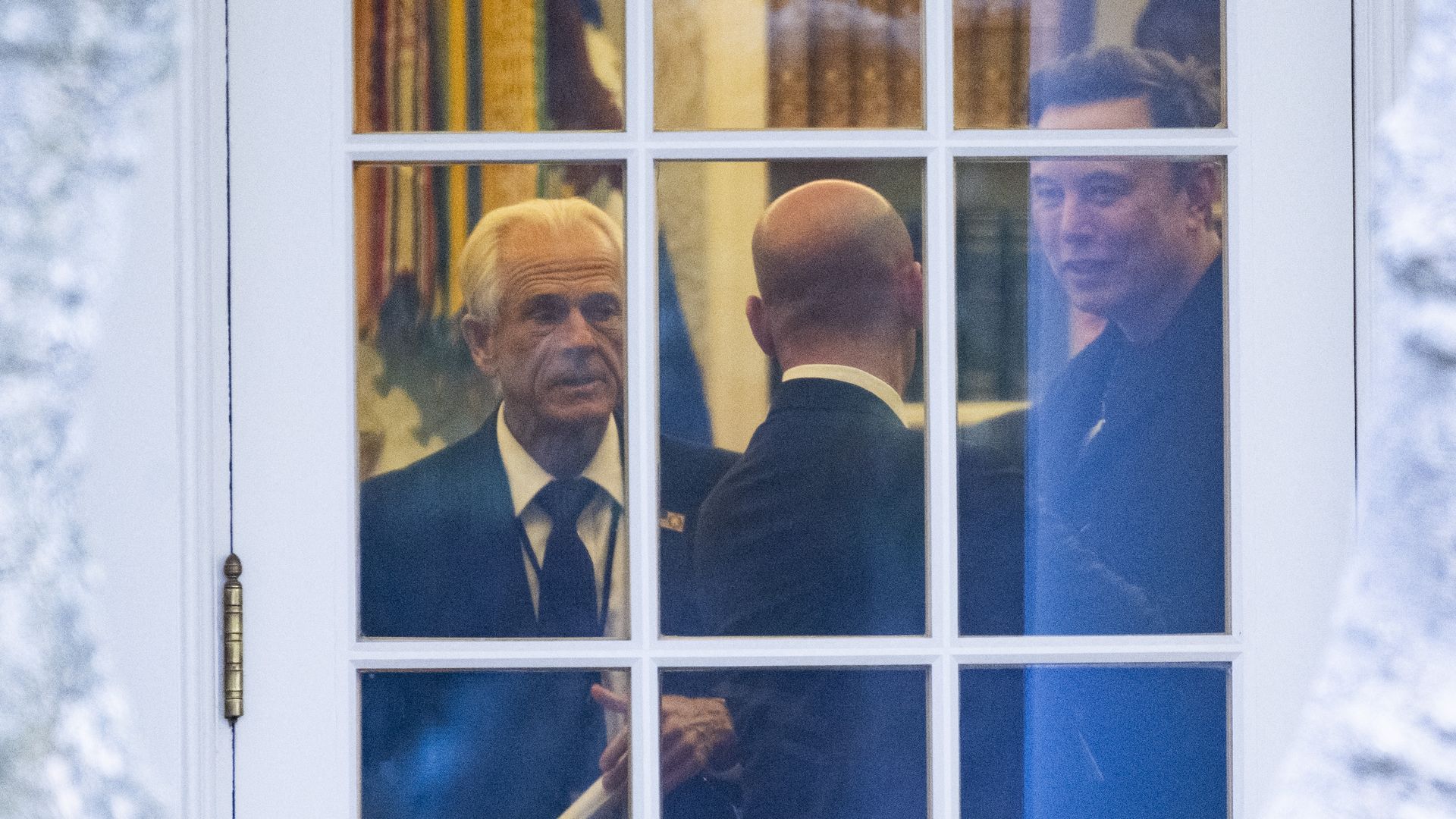
Elon Musk escalated his war of words with Trump trade adviser Peter Navarro on Tuesday, calling him "truly a moron" and "dumber than a sack of bricks" over comments about Musk's businesses.
Why it matters: The gloves are off, and Musk — who has already challenged Trump's trade policy publicly — is now getting increasingly personal with the architect of that policy, too.
Escalating U.S.-China trade tensions are likely to fuel a surge in Beijing-backed cyber espionage, a top security executive warns.
Why it matters: U.S. companies and government agencies were already grappling with an unprecedented wave of hacking activity linked to the Chinese government.
Nebraska is ready and willing to put its imprimatur on stablecoins.
Catch up quick: The private company Telcoin got the green light from Nebraska regulators in February to become the state's first crypto deposit bank. It's expected to launch its stablecoin, eUSD, early this year.
It's the result of the state's Nebraska Financial Innovation Act, passed four years ago, which created a path for its banking regulator to approve a stablecoin, Nebraska finance director Kelly Lammers tells Axios.
Between the lines: The law is live, and the state isn't waiting on federal action, but Lammers is watching the forthcoming legislation from Congress.
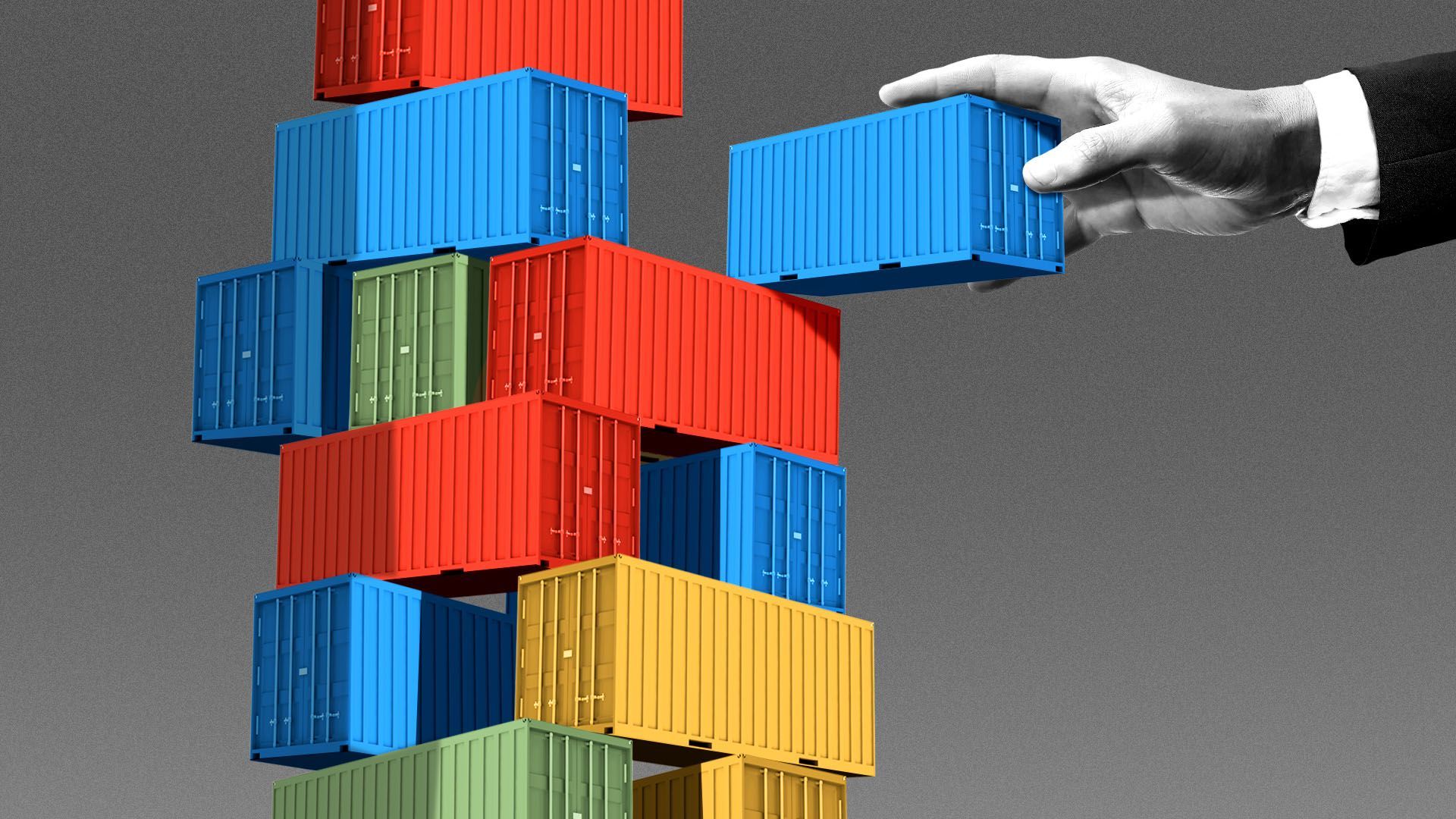
Global corporationsrushed out of China to dodge tariffs during President Trump's first term. This time around, they have nowhere to hide — and policy is changing faster than supply chains can.
Why it matters: With high tariffs set to go into effect Wednesday in nearly every nation, there is no shield to be had (barring last-ditch negotiations or suspensions). It means multinational companies can't duck import taxes by rerouting goods.
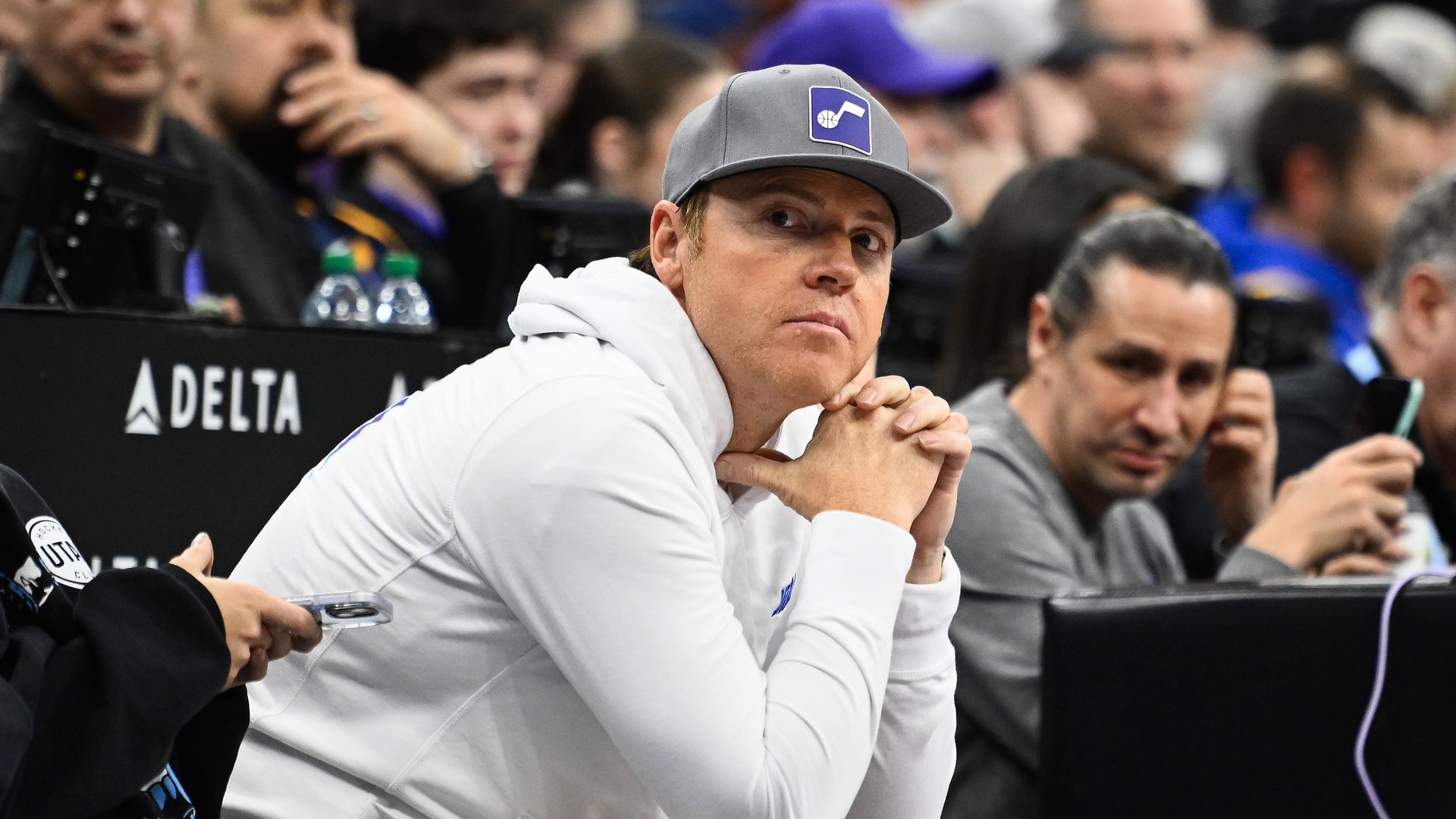
Ryan Smith, the billionaire owner of the NBA's Utah Jazz and NHL's Utah Hockey Club, tells Axios that he's forming a $1 billion venture capital fund with longtime Accel partner Ryan Sweeney.
The big picture: The launch comes as the worlds of tech, business, and sports are colliding.
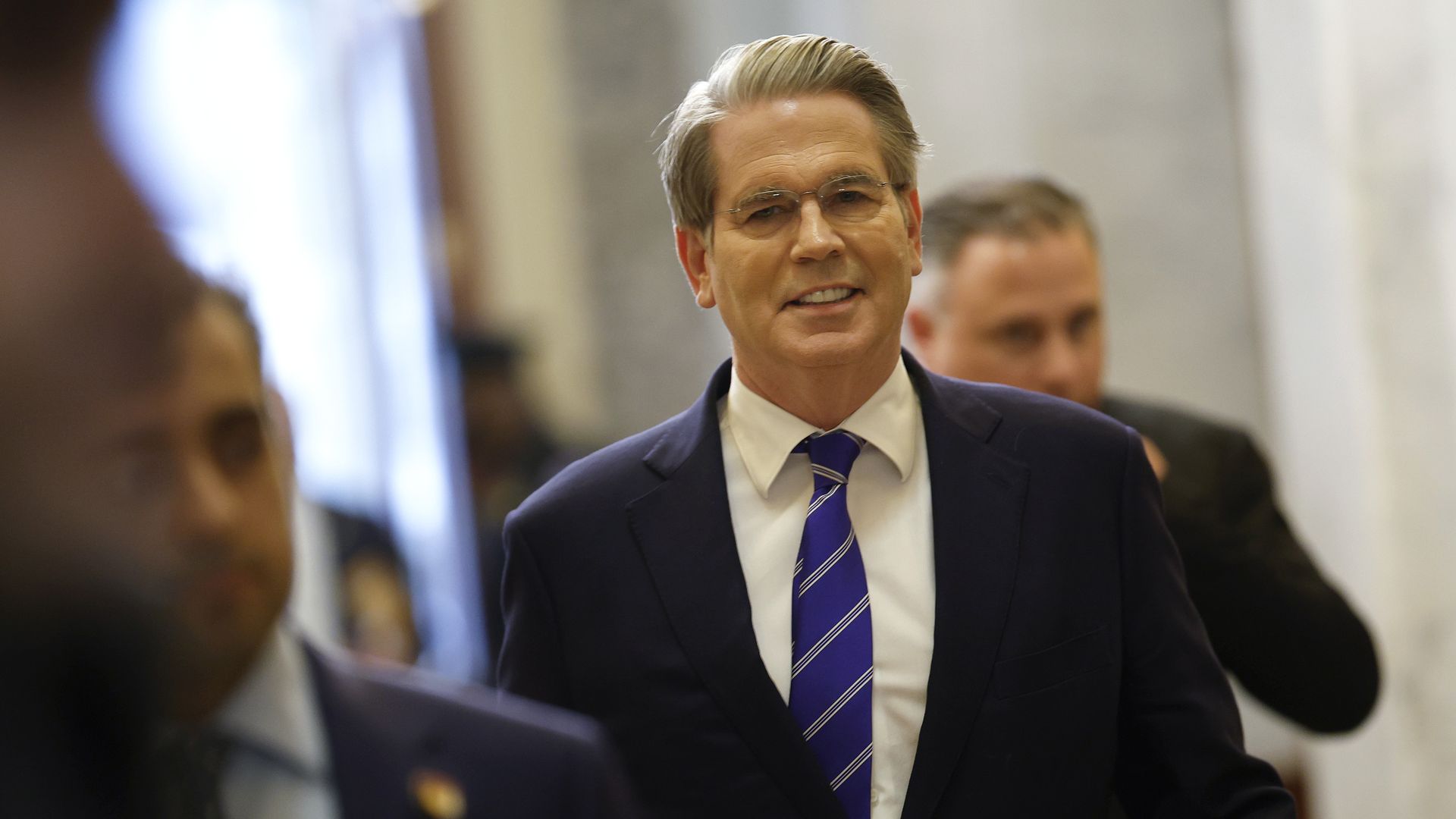
Treasury Secretary Scott Bessent on Tuesday said trade negotiations can lead to "good deals," but insisted that a posture of being open to those talks had nothing to do with last week's stock market plunge.
Why it matters: The market doesn't much care about the motivations — the mere fact that the conversations are happening at all is causing stocks to surge after days of uncertainty and mounting recession fears.
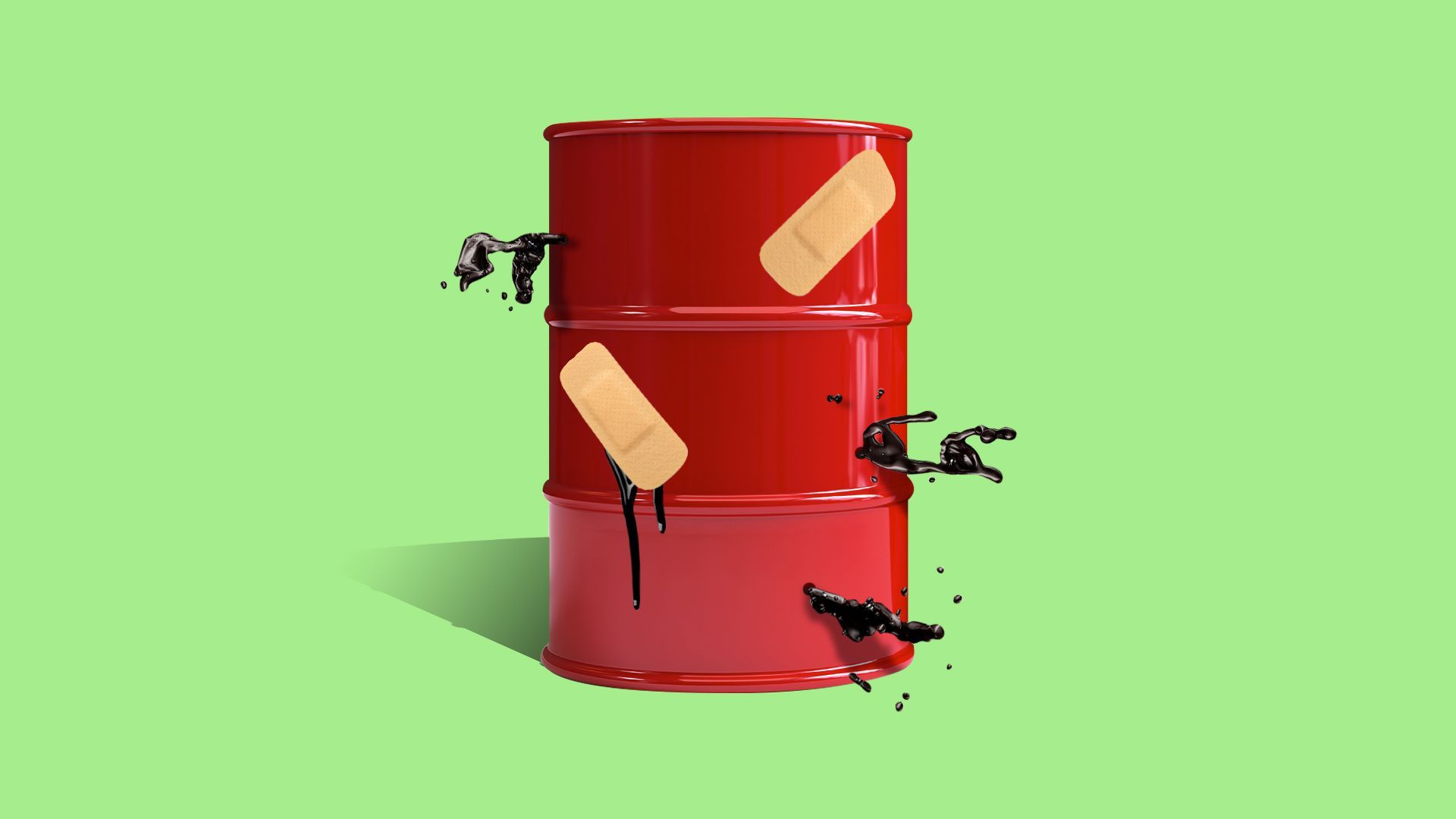
President Trump's social mediacelebration of falling oil prices highlights how — intentionally or not — his policies favor lowering fuel costs over boosting output. For now, anyway.
The S&P 500 has fallen more than 15% since Donald Trump's inauguration, the worst showing for a new administration since George W. Bush was in office during the dot-com bust.
Why it matters: Trump usually touts stock market performance as an indicator of his success, and in his first term as president, he backed off on policies that sparked market sell-offs.
It's been an awful stretch for stock market investors who've seen trillions of dollars evaporate after the dramatic sell-off last week.
Why it matters: A majority of Americans hold stocks, including half the private sector workforce, which is saving for retirement through 401(k) investment accounts.
President Trump has a much different vision of the future than the tech titans who raced to shape and support his economic agenda.
Why it matters: The collision of those visions helps explain the most glaring private and public fights inside the Trump coalition over tariff strategy.
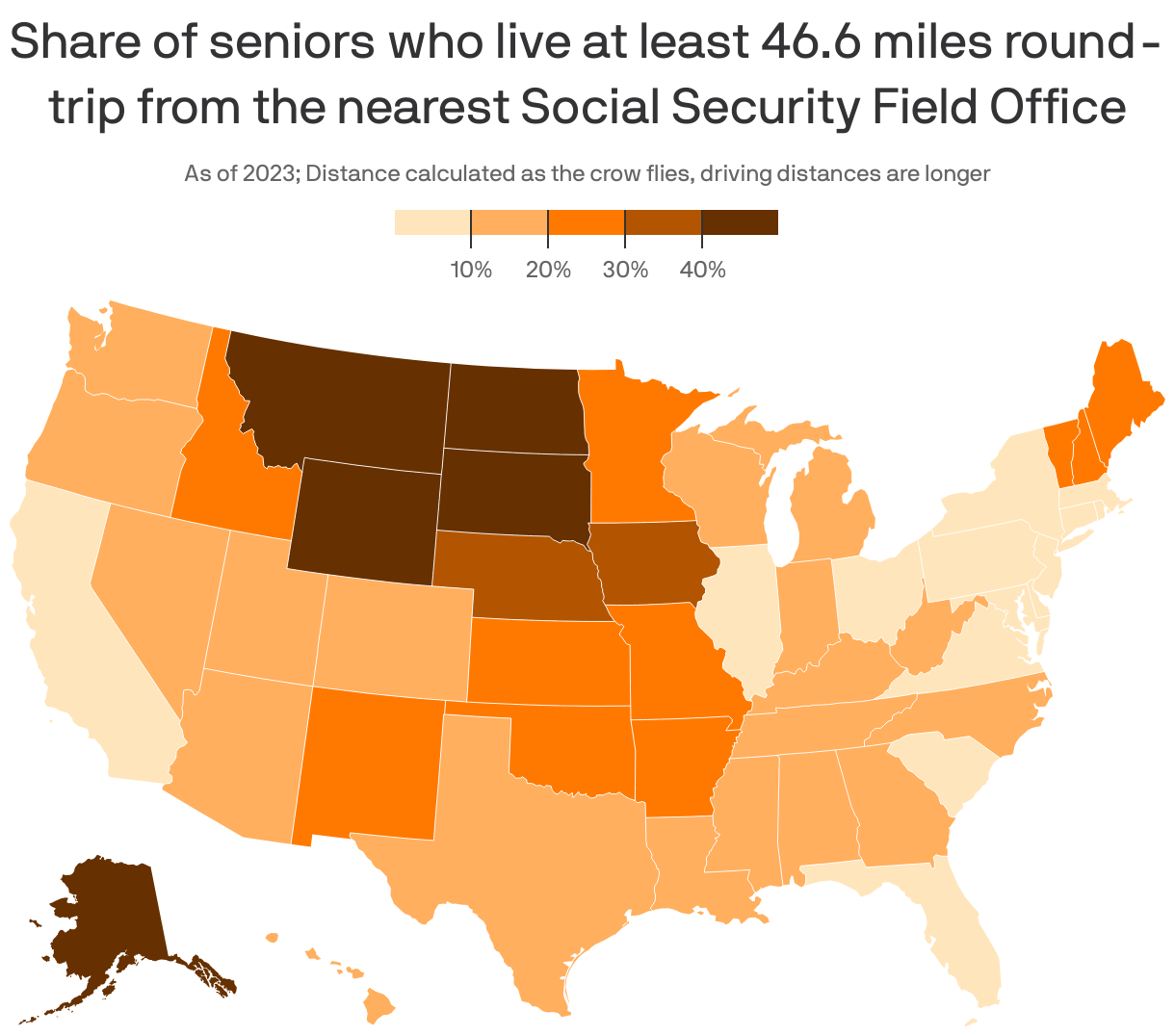
Data: Center on Budget and Policy Priorities; Note: 46.6 miles is twice the average daily travel distance for seniors; Map: Axios Visuals
In less than one week, many Americans will no longer be able to apply for Social Security benefits over the phone, setting the stage for disruptions and upheaval for millions of seniors.
Why it matters: The abrupt change, implemented at breakneck speed at White House request, increases the likelihood thatsome eligible people will miss out on benefits; others could simply not get them at all.
Rep. Jared Golden (D-Maine) is perhaps the only Democrat on Capitol Hill willing to defend President Trump's new tariffs to the hilt. In fact, his main concern is that the president will back down from his trade policy.
Why it matters: It'sone vote House Minority Leader Hakeem Jeffries (D-N.Y.) can't count on as he makes opposition to the tariffs a new centerpiece of House Democrats' anti-Trump messaging.
The AI industry's two-and-a-half-year investment spree is about to enter a new phase of turmoil and doubt thanks to President Trump's massive tariffs.
Why it matters: Key industry players backed Trump or made nice with him after his election win, but the centerpiece of his economic policy makes an AI slowdown — or even a crash — much more likely.
China's government said Tuesday it will "resolutely take countermeasures" if President Trump carries out his threat to impose an extra 50% tariff on Chinese goods.
Why it matters: In a sign that the trade war with Beijing will not end any time soon, the Chinese Commerce Ministry said in a statement carried by state media: "China will fight until the end if the U.S. side is bent on going down the wrong path."
Republicans acknowledge the stress they're feeling from President Trump's tariffs. Their Wall Street donors are feeling it too, with some giving top GOP lawmakers an earful this weekend.
Why it matters: Trump is making it clear he won't tolerate any limits on his ability to impose tariffs, Axios scooped Monday. But rattled GOP donors wanted lawmakers to help convince the president that tariffs are crushing the economy.
President Trump's across-the-board tariffs, and the stock market chaos that has ensued, are spiking the blood pressure of many Republicans on Capitol Hill.
Why it matters: To say a stock market collapse is bad politics is an understatement, and some Republican lawmakers are desperate to see Trump at least nudge the breaks and calm the markets.











/2025/04/07/1744062482936.gif?w=3840)