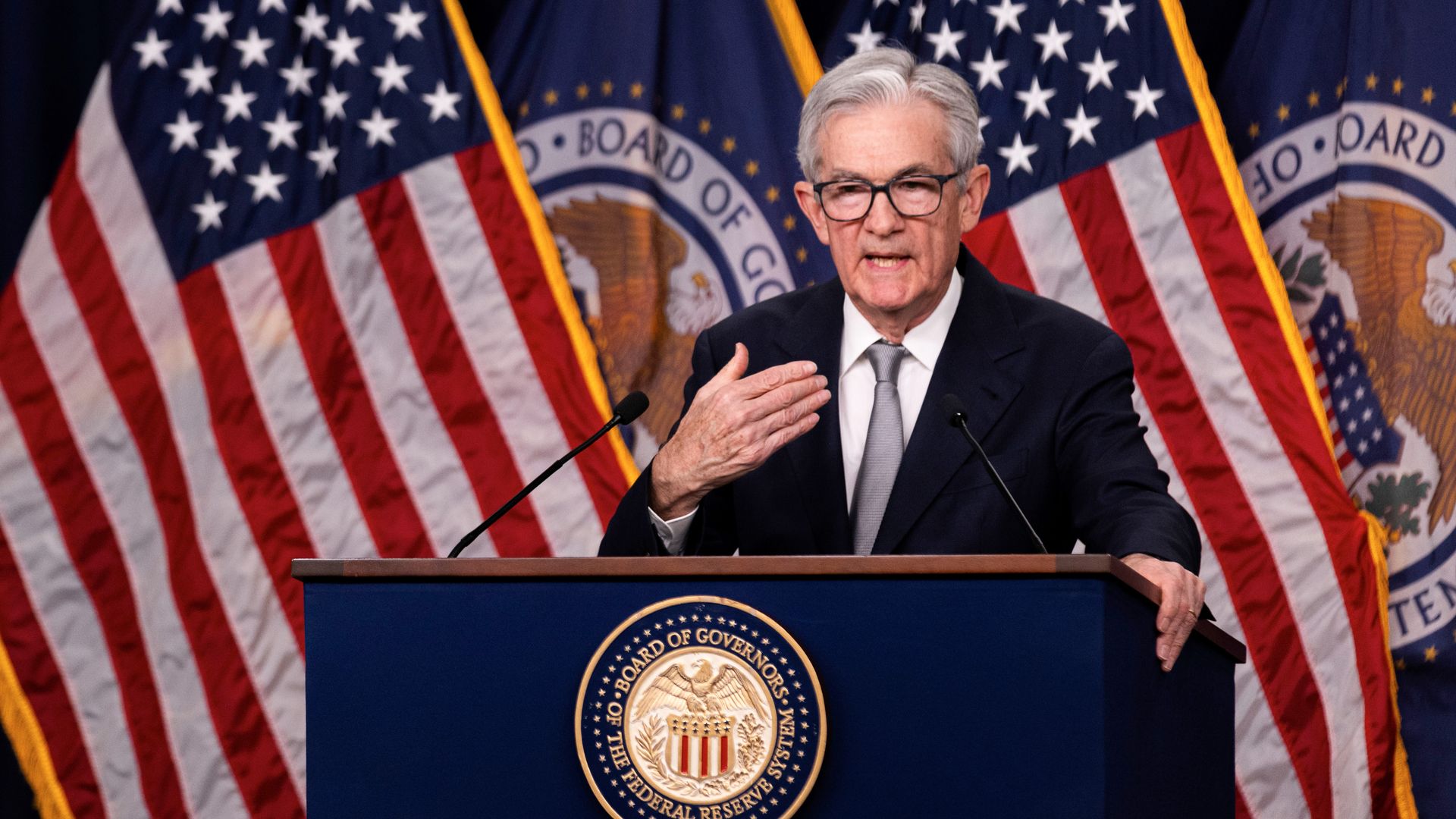
Most Federal Reserve officials continue to see upside risks to the U.S.'s battle against inflation but suggested a more cautious stance on raising borrowing costs further, according to newly released minutes from the central bank's most recent policy meeting.
Why it matters: The minutes from the Oct. 31-Nov. 1 meeting, where officials decided to hold interest rates steady, said Fed officials agreed to "proceed carefully" with future interest rate decisions as they look to wind down their rate-hiking campaign.
For a glimpse of how the Fed's rate hikes are roiling the finances of some American companies, look to the private credit markets.
The big picture: A growing share of U.S. companies borrow money in the trillion-dollar private credit market, where the debt is floating-rate, meaning interest payments go up as benchmark rates rise.
Corporate America roared back into growth mode last quarter.
Why it matters: Better-than-expected numbers from third-quarter earnings season — which unofficially ended with Walmart's results last Thursday — helped lift stocks sharply this month.
Why it matters: High housing costs are a key driver of the sour sentiment Americans feel about a U.S. economy that by most traditional measures is quite good.
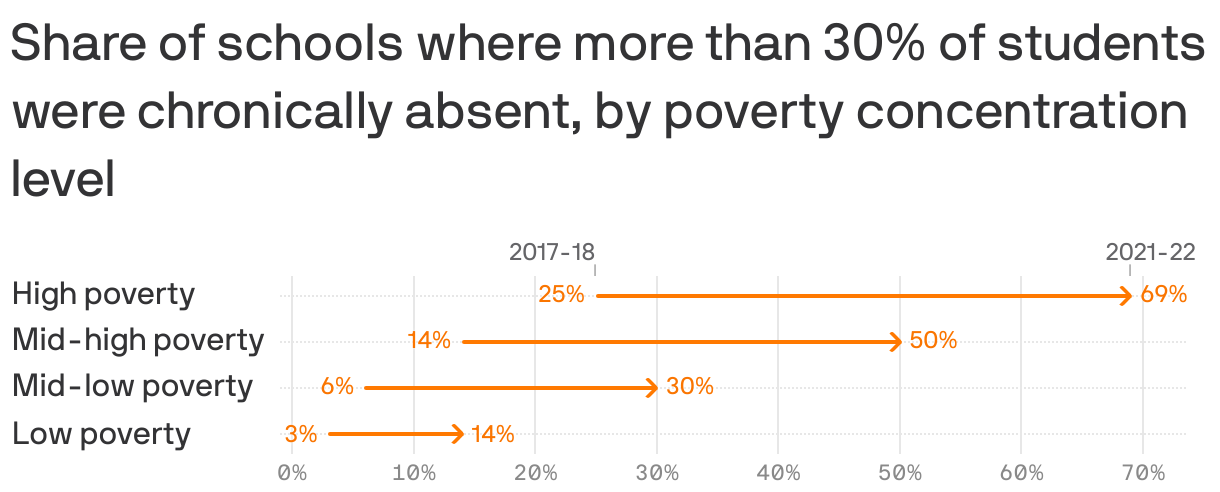
Notes: "Chronically absent" is defined as a student who has missed more than 10% of school days within an academic year. Poverty concentration level is determined by the share of students who are eligible for reduced-price or free meals. Data: Attendance Works; Chart: Danielle Alberti/Axios
Extreme levels of student absence have spiked in schools across the country since the pandemic began, according to data released Friday by Attendance Works, a nonprofit research initiative.
Why it matters: Students haven't recovered from pandemic learning losses, and widespread absences affect entire schools, not just the missing students.
Driving the news: The national average for a gallon of regular gas stood at about $3.31 Monday, which is about 25 cents less than a month ago and 36 cents less than a year ago, according to AAA data.
General Motors' big bet on self-driving cars suffered another blow this weekend with the departure of Kyle Vogt as CEO of Cruise, the autonomous vehicle company he co-founded, Nathan writes.
Why it matters: As GM's self-driving car division, Cruise's future is immersed in uncertainty after pulling its vehicles off the road amid swirling safety questions, Nathan and Axios' Kia Kokalitcheva write.
GM has invested billions in the company, heralding its robotaxis as key to transitioning to a safer, self-driving world.
Catch up quick: After an incident in San Francisco during which one of Cruise's cars dragged a pedestrian who had been hit by a human-driven vehicle, California regulators last month pulled Cruise's permit to operate cars without safety drivers.
Las Vegas closed out its first Formula One Grand Prix in four decades over the weekend — the latest sign of the city's desire to become the "sports and entertainment capital of the world."
Why it matters: Construction to accommodate the event, which transformed part of the Strip into a track for vehicles racing over 200 miles an hour, disrupted the lives of locals for nearly a year.
In coming months, a debate will begin on how the Fed should approach its monetary policy. Its every-five-years "framework review" is on track to begin in 2024 and conclude in 2025.
Driving the news: But in Boston Friday, there was some early discussion of what it should entail, as a former top official argued that the last version of the framework, released in 2020, may have contributed to the outburst of inflation in 2021.
What they're saying: Don Kohn, former vice chair of the central bank, emphasized that the 2020 framework wasn't the main reason for inflation: "For crying out loud, it was the COVID distortion, supply and demand, etc.," he said.
But he does say that it made "the inflation a bit higher and more persistent than otherwise" would have been the case. "That has its costs," he said.
He pointed to "several asymmetries" in the 2020 framework in which policy reacted to employment below the perceived maximum, but not above.
The intrigue: "I think when the committee goes back to review… its framework, a framework should produce acceptable results for the dual mandate under a wide variety of circumstances," said Kohn, an influential voice among global central bankers.
Of note: When reporters asked Boston Fed president Susan Collins about the framework review Friday evening, she said: "I think it's important to emphasize that over the medium to longer run, and that two parts of our dual mandate are really complementary, and they're intertwined."
If you are in chargeof setting interest rates for a major economy, aiming for low inflation and ample jobs, what's the best tack: Should you adjust rates quickly or gradually?
Why it matters: That is the choice the world's leading central banks faced in 2022 as high inflation took root. Their different choices — and results — could shed light on which strategy is best in the future.
At a Boston Fed conference Friday, former Bank of England official Kristin Forbes laid out the relative trade-offs of central banks that acted as tortoises and those that were hares in the monetary tightening cycle of the last two years.
Flashback: Some central banks (the tortoises) largely held to the past pattern of moving slowly and relying on small, quarter percentage point rate hikes; meanwhile, the hares ripped up the playbook quickly, and hiked rates 0.75 percentage points or more at a time.
The tortoises included the Bank of England and the central banks of New Zealand and Norway. The hares include the U.S. Federal Reserve, the European Central Bank, and the central banks of Sweden, Australia and Canada.
What they're saying: "Each of these strategies does have some important advantages and disadvantages," said Forbes, an economist at MIT.
With a tortoise strategy, she said, you can "tighten a little, see how it's affecting the labor market, see how that's feeding through into inflation and then see if you need to do more."
"Also by moving more slowly in the tortoise strategy, that allows entities to adjust and reduces the risk that something breaks," she said.
"Households have more time to plan ahead. Companies have more time to plan ahead and financial institutions have more time to plan ahead if you move more slowly."
Yes, but: "The tortoises also took longer to get where they already thought they needed to be," Forbes said. By contrast, the hares' more aggressive action may have helped strengthen the central banks' credibility, and thus made it less likely that inflation become entrenched.
"By tackling inflation more aggressively … you're less likely to see changes in the economy that could make inflation stickier. For example, you're less likely to see people build inflation indexation into contracts," she said.
That means in the hare approach you might end up doing less tightening overall, "and then you might actually have less impact on unemployment in the labor market."
The big picture: Forbes then compared the economic results of the tortoises and hares, and found the hares have achieved both bigger reductions in inflation and less labor market pain.
She acknowledges many caveats. This is more a simple back-of-envelope exercise rather than a rigorous model, though Forbes said a more sophisticated version of the analysis — accounting for many more variables — is in the works.
The bottom line: So far, at least, the central banks that have moved fast have gotten better results for their economies than those that took it slow. Whether that has broader lessons for the future is still an open question, however.
Argentina, back in its familiar position of being a fiscal and economic disaster zone, has elected a classic chaos agent, in the form of right-wing economist Javier Milei.
Why it matters: Milei ran as an ultra-libertarian — but without much support in Parliament, it's not clear how much change he can really effect.




/2023/11/21/1700584215147.gif?w=3840)