The rush backto in-person activities and events hasn't meant a total collapse in retail sales. In some ways, the reopening has actually been a driver.
Driving the news: Some of the most wanted products from Macy's and Dick's Sporting Goods during the spring months, for example, reflect demand for things that people need as they rushed out of their homes.
A superyacht formerly owned by sanctioned Russian tycoon Dmitry Pumpyansky sold at auction in Gibraltar on Tuesday, according to Reuters.
Why it matters: The sale is believed to be the first of its kind since numerous superyachts were seized as part of sanctions on Russian oligarchs over Russia's invasion of Ukraine.
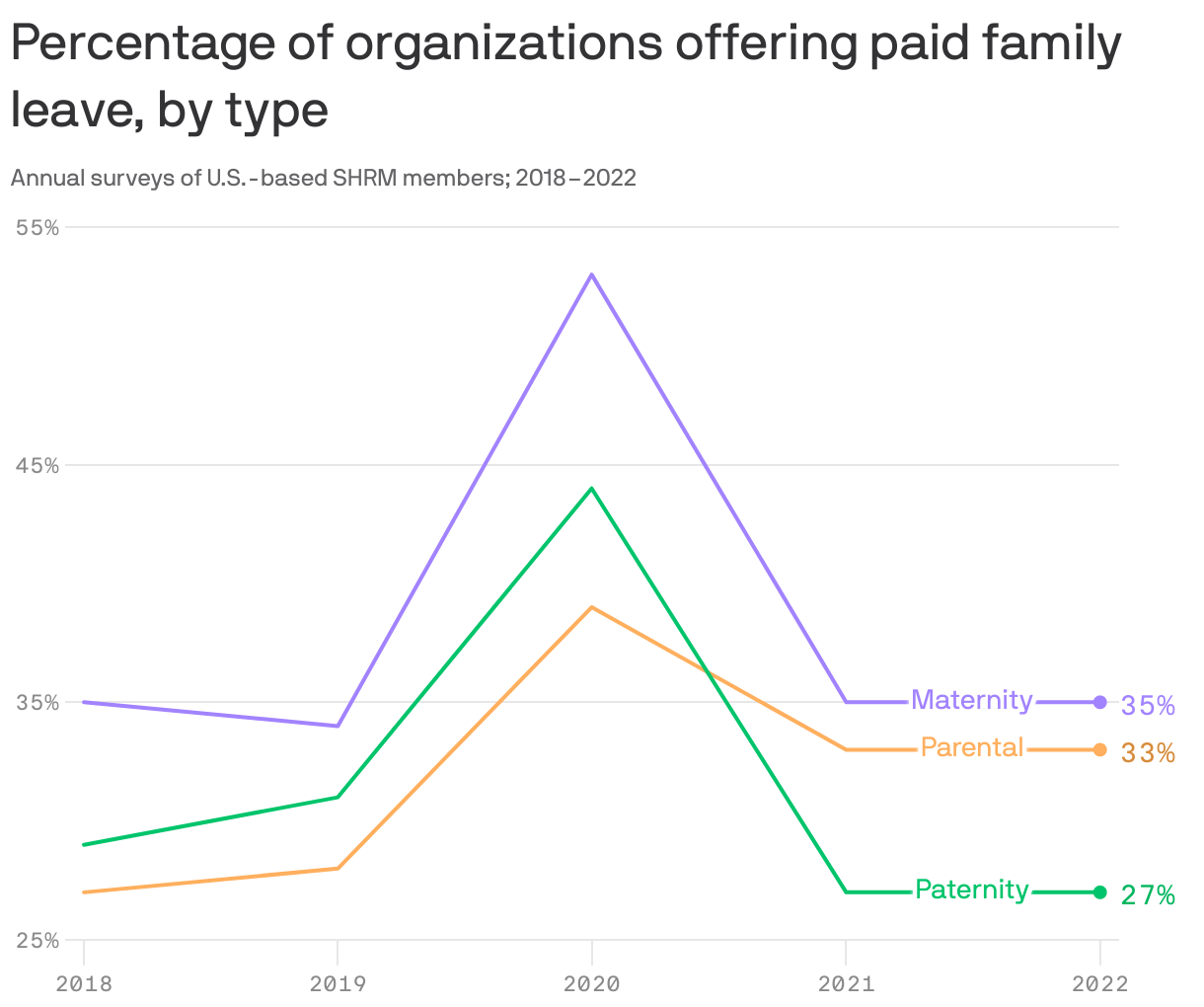
Data: Society for Human Resource Management; Chart: Nicki Camberg/Axios
Employers have largely reverted back to pre-pandemic parental leave policies after temporarily beefing up the benefit in the first year of the global health crisis.
By the numbers: Only 35% of employers are offering paid maternity leave in 2022 beyond what is legally required, down from 53% in 2020, according to a survey of 3,000 employers by the Society of Human Resource Management. It was 34% in 2019.
Usain Bolt applied to trademark his iconic victory celebration pose, according to an application filed with the U.S. Patent and Trademark Office on Aug. 17.
Why it matters: Bolt, who holds the world records for the 100 meter and 200 meter and won eight Olympic gold medals, wants to use the logo on clothing, foot ware, sunglasses, watches and other jewelry, bags and several other products, according to the application.
The Biden administration dramatically cut its forecasts for economic growth and upped inflation projections, according to new estimates published on Tuesday by the White House's budget office.
Why it matters: The new forecasts reflect the drastically different economic reality the Biden administration faces — including disruptions stemming from Russia's invasion of Ukraine — since it last released projections.
A new tie-up between a startup content studio and a data science startup aims to flip the way Hollywood green lights movies and shows.
Why it matters: The deal comes as media giants (think Disney, Warner Bros. Discovery and Amazon-owned MGM) are struggling to decide which movies and shows to fund, which platforms or theaters to release them, when — and for how long.
Why it matters: Like other restaurants, Chipotle has raised prices multiple times and said last month that it planned to increase prices in August by about 4% to help offset rising ingredient costs and wages.
Why it matters: Retailers need to mark down merchandise to clear access inventory as they prepare for the important holiday shopping season, which for the third year is expected to kick off early, a trend started in 2020 to spread out sales and consumer demand during the pandemic.
Hyundai and Kia are recalling more than 281,000 vehicles over concerns that they will catch fire and telling owners to keep the cars parked outside until they are fixed, the National Highway Traffic Safety Administration said Tuesday.
Why it matters: Both automakers reported more than two dozen fires or melting accidents in the U.S. and Canada due to the malfunction, per the AP, but no crashes or injuries.
Ethereum watchers now fret that, when the blockchain upgrades next month, there's more danger that some of its operators will start censoring transactions based on the rules made by nation-states.
Why it matters: It has been argued that the only real value of blockchains is the fact that they offer censorship resistance. Without that, it could be argued, they are just very cumbersome, expensive databases.
Kevin Owocki is the founder of Gitcoin, an Ethereum-based funding marketplace, and author of "GreenPilled: How Crypto Can Regenerate The World."
Why it matters: What gets funded on Gitcoin, with its democratized model for project funding, is effectively a snapshot of the priorities within the crypto software developer community. And its solarpunkian founder is optimistic about a crowdsourced future.
Volkswagen plans to buy stakes in Canadian mines and mine operators, per a company director, and has signed a related MOU with the Canadian government.
Why it matters: This would help the German automaker ensure access to raw materials for battery production, including nickel, cobalt and lithium. It also would help VW sidestep new U.S. tariffs imposed by the Inflation Reduction Act.
Elon Musk may have just gotten some much-needed help in his legal fight against Twitter.
Driving the news: Twitter's former security chief, Peiter "Mudge" Zatko, last month filed a 200-page whistleblower report with Congress and various federal agencies, as first reported by CNN and the Washington Post.
Around 300 members of the New York Times 1,400-person editorial union sent emails to the highest levels of the Times' management team on Monday in an effort to pressure the company over stalled contract negotiation talks, according to sources familiar with the effort and copies of emails obtained by Axios.
Why it matters: The campaign comes ahead of what's expected to be a tense bargaining meeting on Wednesday. If the two parties don't come to an agreement, the bargaining committee could take the issue up with the National Labor Relations Board.
DirecTV, the satellite TV provider that has for years exclusively broadcast the NFL's lucrative Sunday Ticket package, has struck a deal with Amazon Prime Video to air Thursday Night Football games in over 300,000 sports bars, restaurants, hotels and other venues outside of homes.
Why it matters: The deal gives fans the opportunity to watch the games, which are only available via streaming on Amazon Prime Video, in places outside of their homes that may not have smart TVs installed.
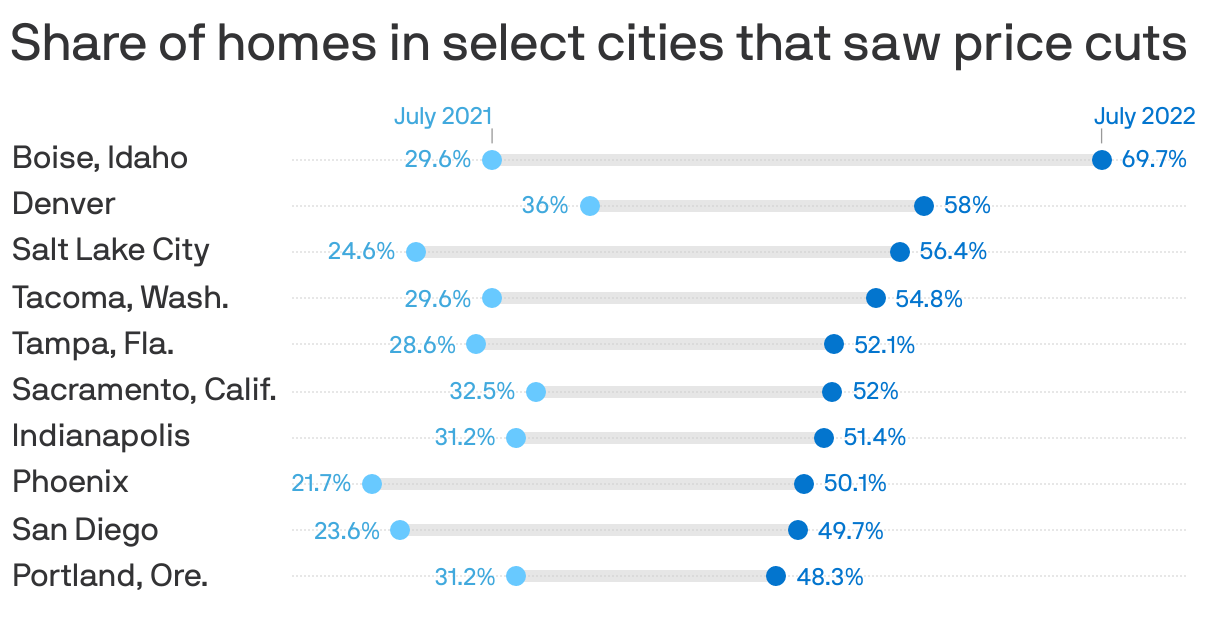
Nearly 70% of home sellers in Boise, Idaho cut the asking price on their house in July, Redfin reports; a remarkable turn for the once-hot real estate market.
Nationwide, the number was 32% — up from 27% in July 2019.
Why it matters: This is just the latest indication that the pandemic housing boom is going bust, as higher mortgage rates chill demand for homes.
The high percentage of cutsshow that sellers expectations are too high: They're still living in the world of wild bidding wars.
"They priced too high because their neighbor’s home sold for an exorbitant price a few months ago, and expected to receive multiple offers the first weekend because they heard stories about that happening,” said Boise Redfin agent Shauna Pendleton in the company's press release.
Keep in mind: While the percentage of sellers cutting prices is very high in Boise, the actual price cuts are quite modest — less than 5% off the original list price.
The median listing price for a home in Boise fell $30,000 to $613,000 in July from the prior month, according to data from Zillow.
But prices are still, as Crazy Eddie was famous for yelling, “Insane:” In July 2019, the median list price for a home there was $381,000.
Nationwide, the median home sales price fell $10,000 in July from the month before, the National Association of Realtors reported last Friday. But it's still near a record high.
What's next: Home prices are likely to come down further.
A bipartisan group of House and Senate lawmakers on Monday unveiled an updated journalism competition bill that, if passed, would force tech companies to pay news companies for their content.
Why it matters: Such a law would create a historic lifeline for the news industry, which has struggled in the digital era to compete with Big Tech firms for ad dollars, particularly at the local level.
Efforts by CEOs to push workers back to the office are failing, as it's becoming increasingly clear that the world of strictly in-office work is gone.
Why it matters: While the country is back to normal from the height of the pandemic in so many ways — we go to restaurants, movies, get on planes — office life appears to be permanently changed.
Part 1 of a 3-part "Generations" series ... A rising number of younger workers are "quiet quitting." The idea is to work to live, instead of living to work — stay on the payroll, but focus on fun, fulfilling activities outside of work.
Why it matters: It's exposing a stark generational divide in the way we think about work. So we set out to explore the different generations' perspectives.
Sign up herefor Axios Finish Line, our nightly newsletter with tips and tricks on work, life and wellness, where we'll feature reader responses in future editions.
We'll start with the youngest workers ...
I'm a 1995 kid — on the millennial–Gen Z cusp, and part of the newest cohort of workers, Erica Pandey writes.
I can't speak for my entire generation. But I've had many candid chats with peers about things we wish our older colleagues understood about the way we think and the way we work.
The big picture: We grew up online, we're the most diverse and well-educated generation in American history, and we've been shaped by the pandemic.
Here's what I hear most:
1. Time to ditch the grind for grind's sake. Younger workers want more from life — and that’s a good thing! A balanced life ought to have time for hobbies, relationships and relaxation as well as work.
What that doesn't mean: We're lazy and don't want to work hard.
What that does mean: We want to work for a company we care about, and for a boss we respect. And we don't see the point in clocking in super early and clocking out super late if it's only to show face. (The glory in the 17-hour Wall Street workday is quickly dwindling.)
2. Give us something to believe in. Yes, not every job can be glamorous from the get-go, but every company's mission and purpose can be.
If the leadership doesn’t live and breathe the mission — it shows. Hook us on your vision, and you'll get the best work out of us.
3. We’re lifelong learners. We grew up amid lightning-fast technological change, and we've seen jobs transform in front of our eyes. We’re innately aware of how important learning on the job is — and we’re not afraid to change up how things are done.
Leaders who harness this generation's willingness to learn new things every day will tap into a hugely productive, talented and resilient workforce.
4. Inclusivity isn't just a word that sounds nice. Lip service won’t cut it anymore. Millennials — and even more so Gen Z — are a more diverse workforce than any that came before them.
We don’t want to work somewhere where we don’t see a single person who looks like us rising beyond the rank-and-file. That's plain demoralizing.
5. Take a joke! The super-serious corporate culture is fading.
Case in point: Companies are ditching their strict dress codes. We fear that managers will think we don’t take our work seriously just because we like to poke fun at ourselves and joke around with colleagues.
As long as it’s respectful and professional, there’s nothing wrong with having a laugh with colleagues sometimes.



















/2022/08/22/1661194867074.gif?w=3840)