Sunday's economy & business stories
/2022/06/19/1655647196245.gif?w=3840)








U.S. weighing penalizing airlines if flight disruptions continue: Buttigieg





One bank's program to boost Black homeownership


What's next for reparations
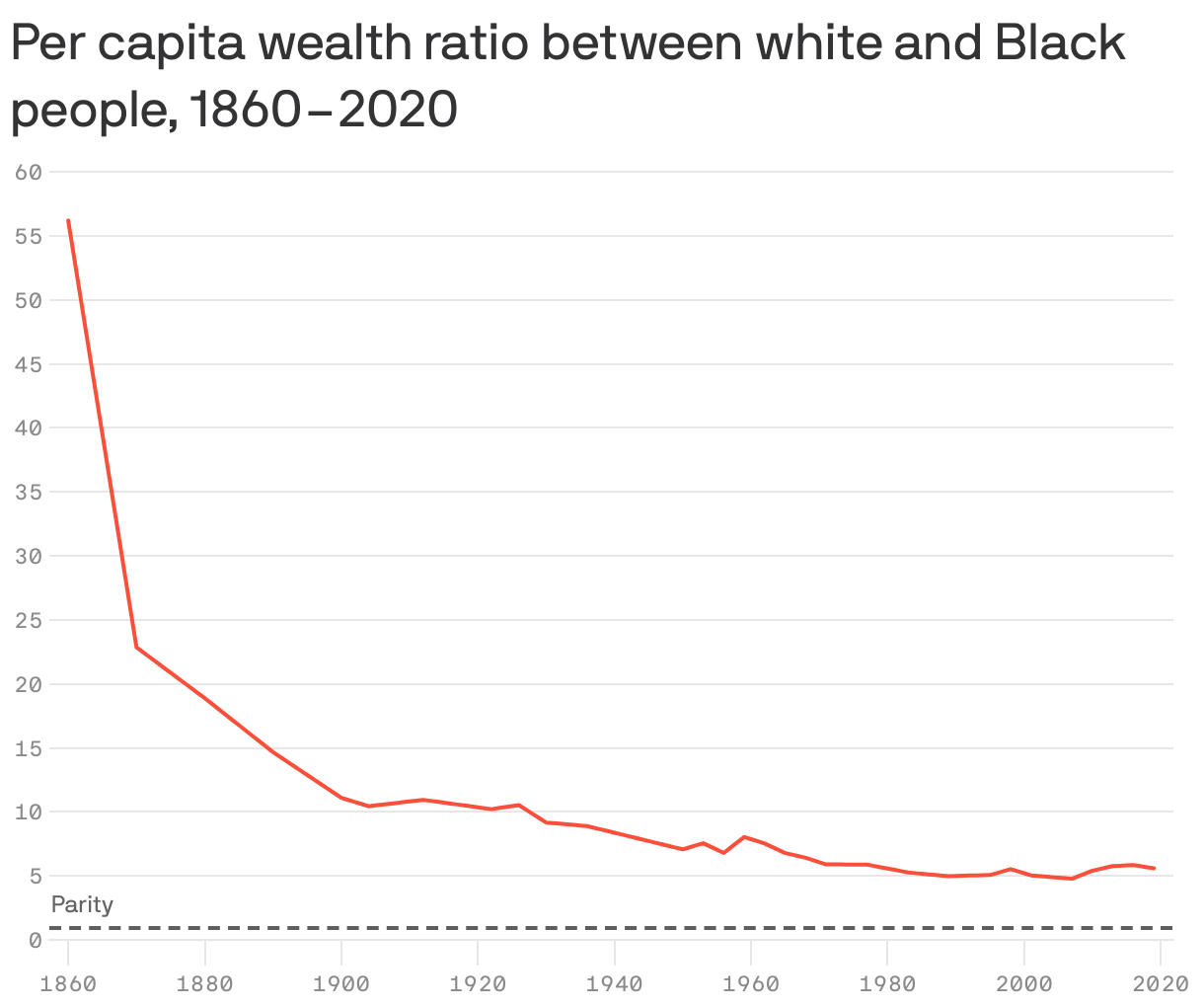

Where homeownership by people of color thrives


A $181M ether bet gone bad is unfolding in real time

This is how markets unwind, and, with blockchains, savvy users can all watch it live as it goes down.
Over the last few days, crypto watchers have been captivated by two large wallets that appear to be linked, that contain $181 million in ether (ETH). They also have collateral in loans that are right on the edge of solvency.
- Most of the debts are on the money market Aave (152,098.98 ETH worth $166 million at the time of writing, but the rest is on Compound (14,316.90 ETH worth $15.6M).
Why it matters: If the price of ether falls further, these debts will be liquidated, unleashing a gush of ether onto the market, which will drive the price of ether down even further.
Driving the news: Crypto's winter is turning increasingly frigid, with Bitcoin sinking below the psychologically-charged $20,000 level early Saturday, and ether briefly dipping below $1000 as investors bail on digital coins. Both have shed over 30% of their value in the last week alone.
With a whale in a dangerous position like this, traders who believe ether will return to its prior highs in the long term now have an incentive to sell. If it goes down enough, big loans like these will be liquidated and drive the price down even more.
- That could be their signal to buy again, increasing their total ETH holdings for free, but only after the market's longs take serious pain.
- Meanwhile, liquidations are surging at decentralized finance lenders right now, with $250.6 million of liquidations taking place on Aave, Compound and MakerDAO over the last 7 days, according to Dune Analytics.
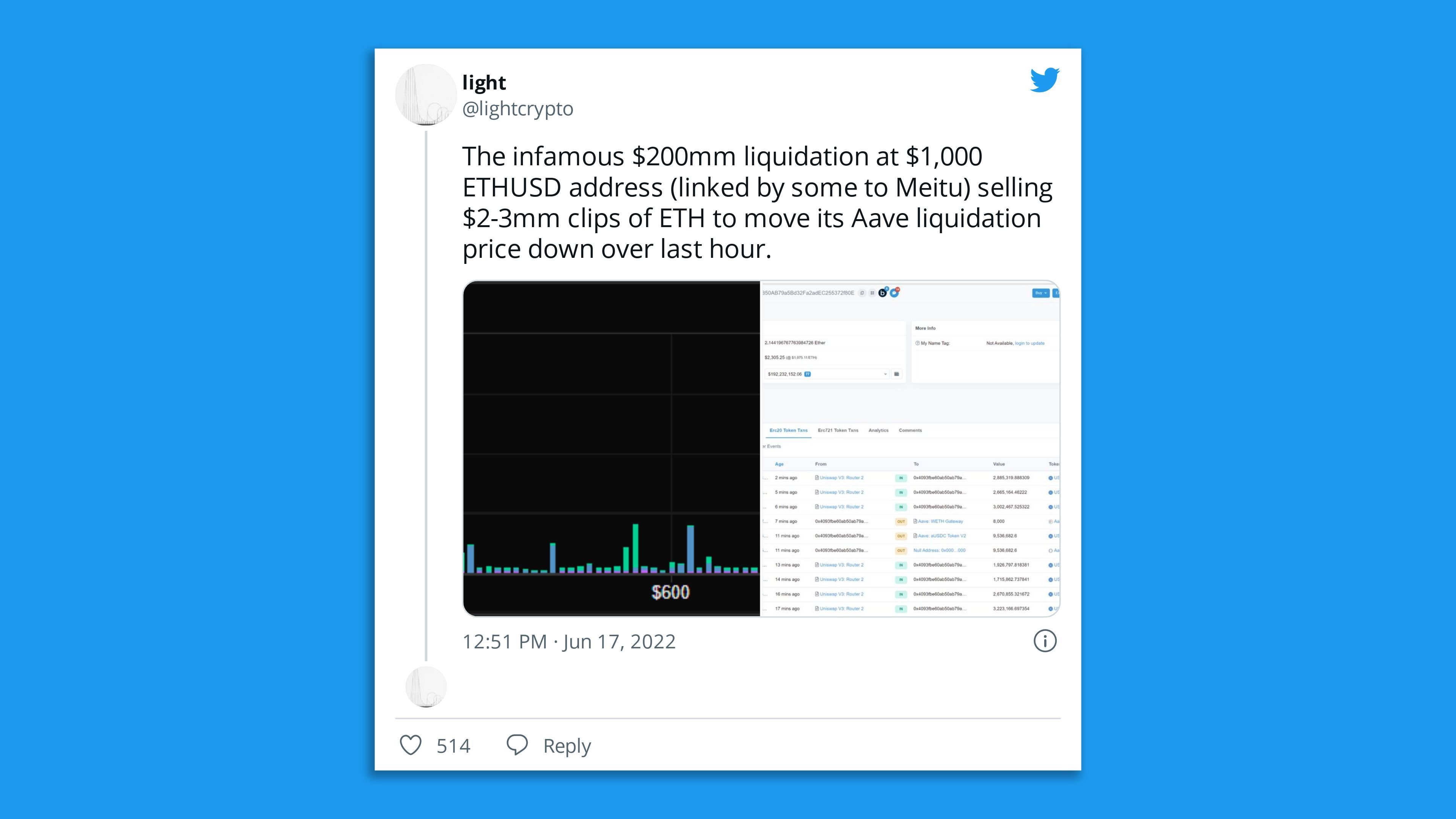
Details: The wallets in question are 0x493F and 0x7160. For the first wallet, scroll down to Aave v2 and see the largest loan.
- These wallets appear to be related, because they can be seen making larger transfers of ether, from the former to the latter, here and here, prior to topping up collateral on Compound loans.
One might naturally ask: Why not just close out the loans? They can't, because the wallets are levered long. The owner has deposited ETH, borrowed stablecoins, bought more ETH, and deposited that to borrow more stablecoins to do it again. And so on.
- ZoomerAnon of the team at DeFi analytics company Uniwhales, explained that you can see the wallet repeatedly taking stablecoins liked USDT and USDC, sending it to Binance, and withdrawing thousands of ethers.
- Early January, multiple transactions like this could be seen using Etherscan.
Be smart: Traders lever long when they believe an asset's price will go higher. If it does, they can withdraw enough to repay their loan, withdraw their collateral and come out of the trade with more of the underlying asset.
Yes, but: It only works if the asset's price goes up.
- These wallets were making bets that ether would go up further back in January, when it was trading at over $3,300. Today it's barely holding $1,000.
- "He borrowed 96,040 ETH prior to borrowing any money," ZoomerAnon told Axios over Telegram.
DeFi lenders are automated. They monitor prices of collateral to make sure each loans are properly collateralized. As soon as collateral becomes inadequate, these protocols automatically sell the underlying collateral on the open market.
- Whenever a borrower is liquidated, they take a painful haircut. When they have levered their position, that haircut is multiplied.
By the numbers: One researcher calculated that the largest position, on Aave, will be liquidated at a $982 ETH price. Uniwhales puts his liquidation price at $870.
- ETH would need to fall $212, almost 20%, to trigger that lower price. That said, ETH has lost $212 in value since June 13, and almost $900 since June 1.
The intrigue: It's speculated that these positions are owned by a major Chinese entrepreneur, but he might be operating alone, without the sophisticated risk modeling of trading firms and without the ability to watch positions around the clock.
- That said, if the owner has liquid capital, they can always buy stablecoins and close out some of the dead positions, staving off liquidation.
Thought bubble: This might sound like another giant disaster ahead in the crypto world, but there's another way to view it: as a transparent marketplace, functioning as expected.