The pandemic hit millions of renters hard — especially people of color, individuals living with children and those living in the South, according to a new report from the Center on Budget and Policy Priorities (CBPP).
Why it matters: Rent reached an all-time high in recent months in large part due to the pandemic, which exacerbated existing inequities.
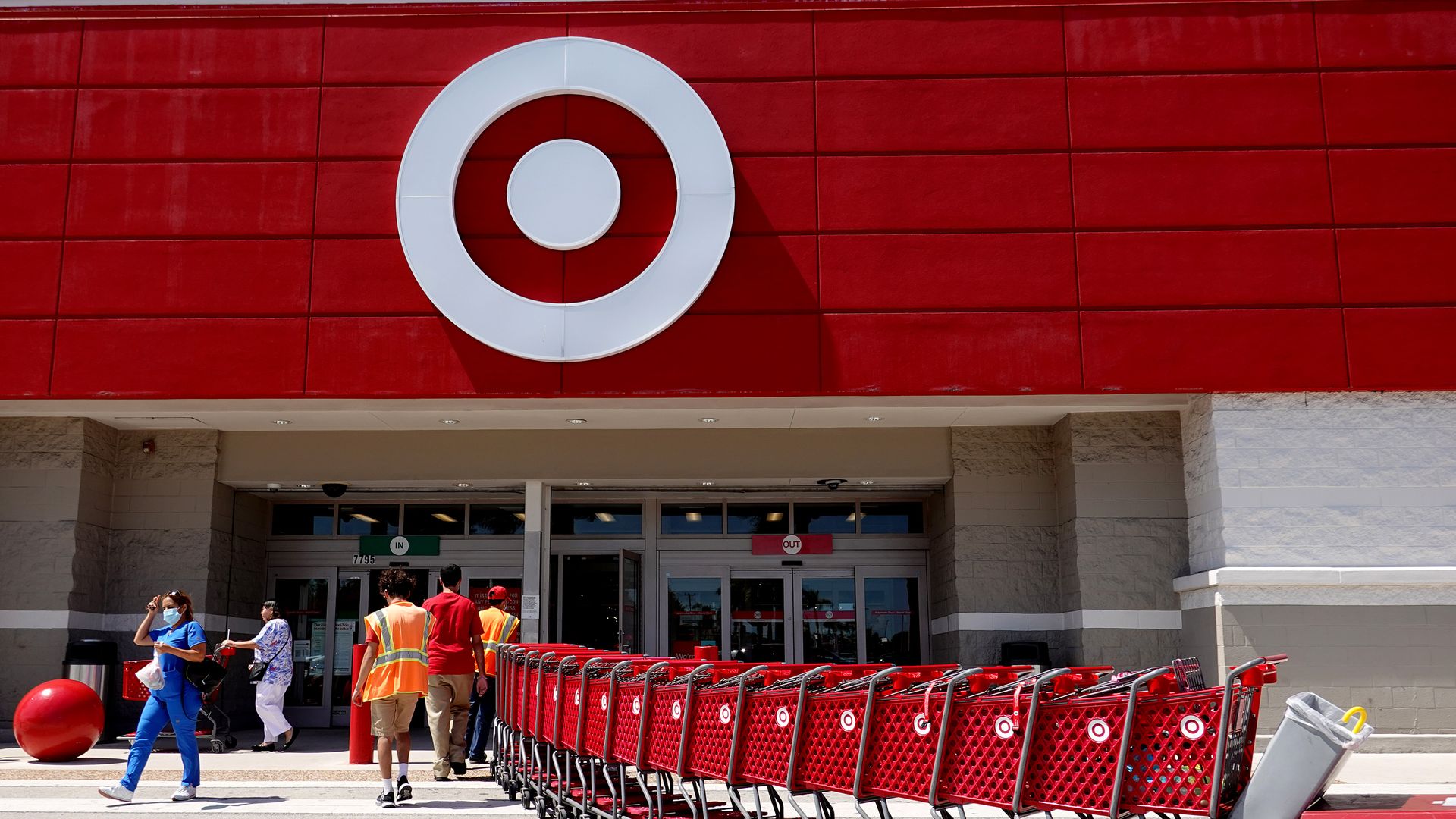
Why it matters: The retailer warned earlier this month that its overstock problem would eat into its profits this quarter, Axios' Hope King reported. As part of its plan to "right-size" its inventory, Target said it would take additional markdowns, remove excess inventory and cancel orders.
The price of celebrating someone else's love is climbing to stratospheric heights — especially as the COVID wedding backlog clears out.
By the numbers: The average 2022 wedding guest is attending 4 weddings in 3 different cities — and spending hundreds of dollars on each, according to a survey conducted by the wedding website Zola.
Widespread baby formula shortages have bolstered the profit margins of the product's manufacturers.
Why it matters: Families have been scrambling to find formula for their babies since a massive recall in February — and now they’re paying more for it, too.
Driving the news: The industry’s profit margin has jumped from 11.6% in 2021 to an estimated 14.2% in 2022, the highest point since 2015, according to new IBISWorld data provided to Axios.
“While the COVID-19 pandemic disrupted supply chains and caused input costs to increase, high demand for formula and high market share concentration have allowed manufacturers to increase prices and maintain profit,” IBISWorld said in the June report.
State of play: Between March 2021 to May 2022, baby formula prices jumped by an average of 11%, according to an analysis of a dozen major retailers — including Kroger, Amazon and Costco — conducted by DataWeave.
Four companies like Abbott Laboratories, Mead Johnson, Perrigo and Nestle accounted for more than 87% of the market, according to IBISWorld.
Of note: Officials with all four companies did not respond to requests seeking comment. But industry leaders have acknowledged that the mad rush to buy formula has boosted the bottom line.
“We also are benefiting this year from, frankly, a terrible situation … and I need you to know that Perrigo is part of the solution, not part of the problem,” Perrigo CEO Murray Kessler said Wednesday at a conference, noting the company had increased production to help meet demand.
Yes, but: Baby formula price increases had started before the Abbott Nutrition recall, according to DataWeave.
Manufacturers have been dealing with extra costs associated with raw materials, labor and distribution, all contributing to the industry’s broader inflation crisis.
The FBI is working closely with LinkedIn to combat crypto-related fraud on the platform.
Why it matters: The FBI has opened investigations, saying scams pose a "significant threat," a field office agent told CNBC, which first reported the story.
What's happening: Criminal rings are exploiting people's trust in LinkedIn as a reliable place for networking.
Schemers create fake profiles and reach out to real people on LinkedIn, under the guise of helping them make money through crypto.
Victims told CNBC that they tended to believe the investments they're presented with as legitimate.
CNBC recently talked to a group of victims whose losses ranged from $200,000 to $1.6 million.
The big picture: Between January 2021 and March 2022, scammers siphoned $575 million from victims in bogus crypto investment schemes, according to the Federal Trade Commission.
Instagram, Facebook, WhatsApp and Telegram came up most frequently in crypto fraud reports.
What to watch: "While our defenses catch the vast majority of abusive activity, our members can also help keep LinkedIn safe," Oscar Rodriguez, LinkedIn's senior director of trust, privacy and equity, wrote in a blog post.
The platform removed roughly 32 million fake accounts last year, according to LinkedIn's transparency reports.
For context, there are currently more than 830 million people on the site.
Our thought bubble, via Axios Crypto's Brady Dale: Scammers are always finding new ways to build credibility. A part of becoming sophisticated in crypto is learning how to spot these things.
Your next call to the Internal Revenue Service could be answered by a voice bot capable of verifying your identity and helping you set up or change a tax payment plan.
Why it matters: The IRS on Friday announced the expansion of its use of voice bots that rely on artificial intelligence to help taxpayers resolve issues. The initiative aims to cut down long wait times and help eliminate a backlog of tax returns.
SpaceX fired employees on Thursday who helped write an open letter criticizing CEO Elon Musk's tweets and other recent behavior, according to the New York Times.
Why it matters: Musk is currently attempting to acquire the social media platform Twitter in what he has said is an effort to create a haven for free speech. Musk has repeatedly said that open discussion and debate is necessary for society and democracy to function.
Targa Resources said that it will pay $3.55 billion in cash to buy Lucid Energy Group, a natural gas processor in the Permian Basin, from private equity firm Riverstone Holdings and Goldman Sachs.
Why it matters: U.S. shale, particularly in the highly productive Permian, is one of the merger market's only bright spots, with strategic buyers buoyed by climbing commodity prices and strengthened balance sheets.
Since the bear market in crypto set in in early May, users have been redeeming the stablecoin tether (USDT) for dollars at a high rate.
Why it matters: The dollar-backed tether has been the liquidity lubricant that has made crypto markets work. It's the main partner in trading pairs with cryptocurrencies on exchanges all over the world.
If something is financial and in crypto,does that mean it counts as "decentralized finance," or "DeFi"? Short answer: No.
Why it matters: The question is more salient right now, with crypto lender Celsius Network locking up users' deposits as questions swirl about its solvency, drawing interest from several state regulators.
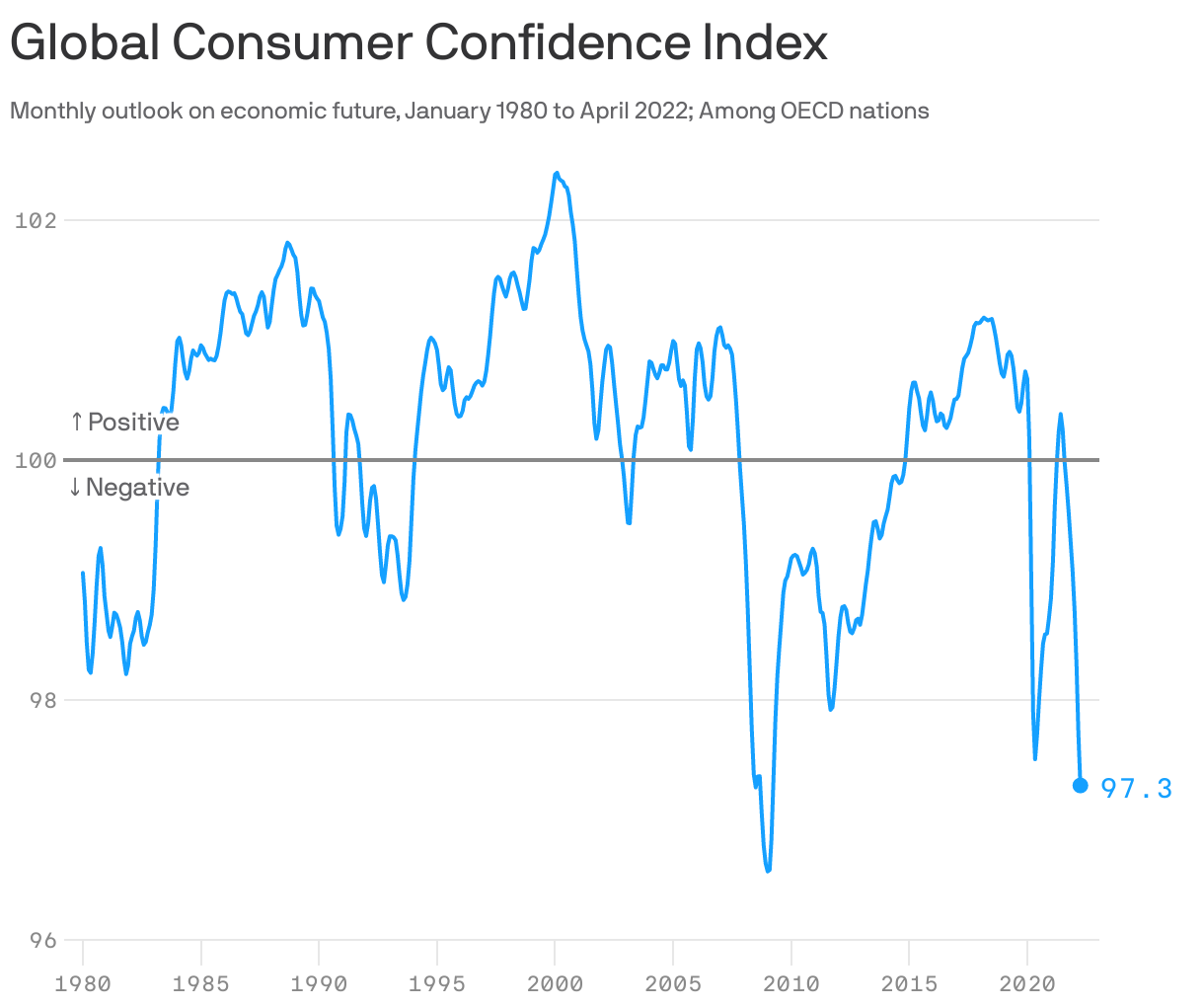
Americans aren't the only ones unhappy with how things are going. Consumer sentiment around the globe hasn't been this bad since 2009, when the world was mired in a historic recession.
Why it matters:Rising prices are pressuring household budgets and pushing down consumer confidence in a slew of nations, a sign that households may tighten their belts and spending will dry up.
The bitcoin blockchain continues to dominate all the rest for transactions among whale investors — that is, those with the deepest pockets, according to a new report from blockchain surveillance firm Chainalysis.
Why it matters: It’s hard to really know exactly who is moving money on blockchains, by design. However, the more extremely large transactions start to take place, the more likely it is that the largest and most conservative investors in the world are taking the asset class seriously.
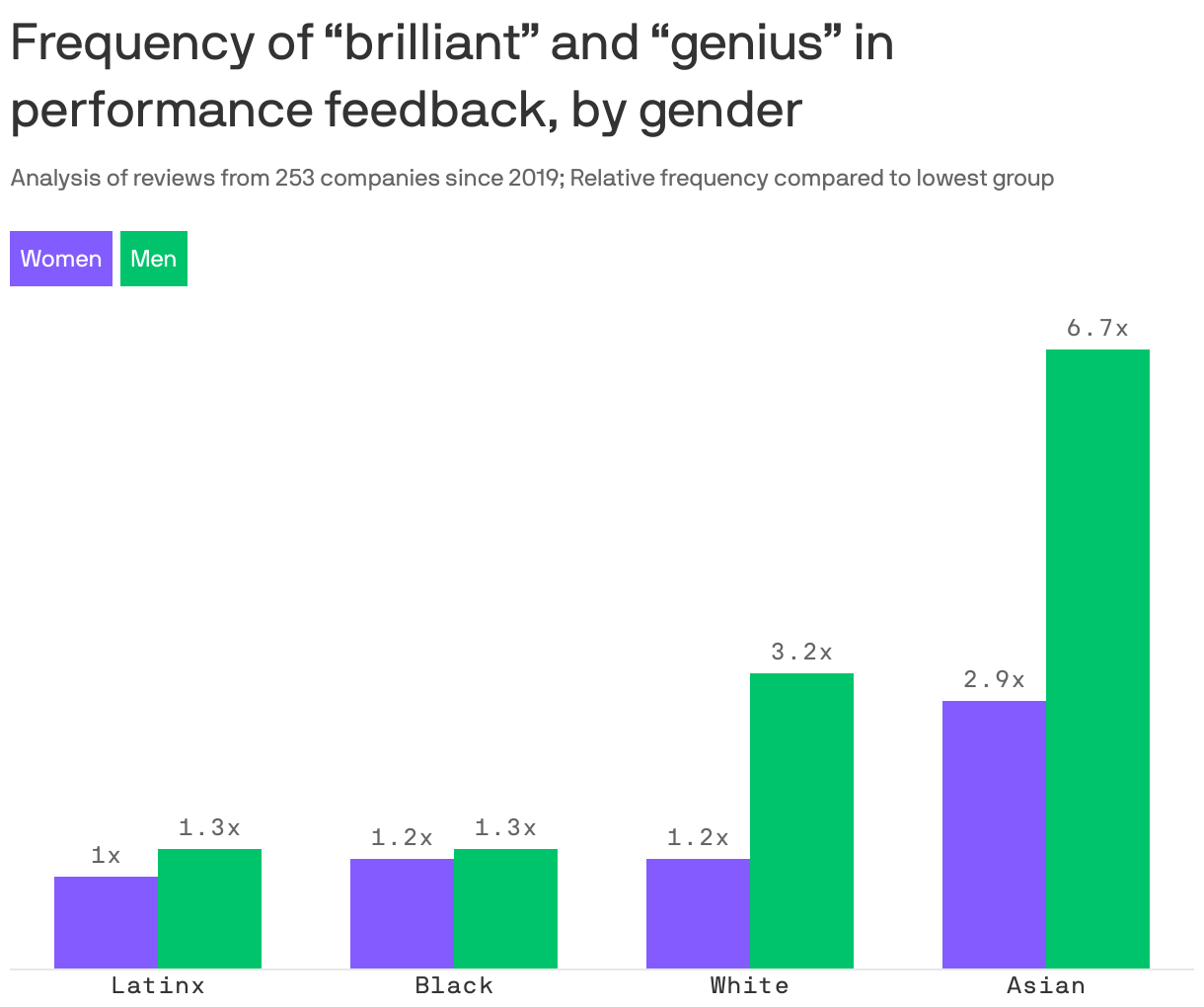
The tenor of your performance review might depend on your race and gender.
Driving the news: Men tend to get reviews that focus on the substance of their work; while women are 22% more likely to get feedback on their personality, according to a new analysis of performance reviews from 253 companies.
Surging borrowing costs are making it tougher for struggling companies to raise new capital — a big shift from the last few years of unusually easy access to markets. It's also changing the deal calculus for private equity funds that buy companies using as much borrowed money as they can.
Why it matters: These are examples of how rising rates ripple out into the markets and the lending ecosystem. And when the credit spigot slows, the riskiest borrowers are the first to get choked off.
Why it matters: Amid discussions of racial injustice following the death of George Floyd, 8% of private employers offered Juneteenth as a paid holiday in 2020 compared to 30% this year, according to survey data from the Wisconsin-based International Foundation of Employee Benefit Plans.
If child care subsidies like those proposed by the Biden administration were enacted — not the likeliest of scenarios at this point — a significant number of women would enter the job market, Emily writes.
A new working paper published by the National Bureau of Economic Research shows this could amount to more than a million American moms joining the full-time workforce.
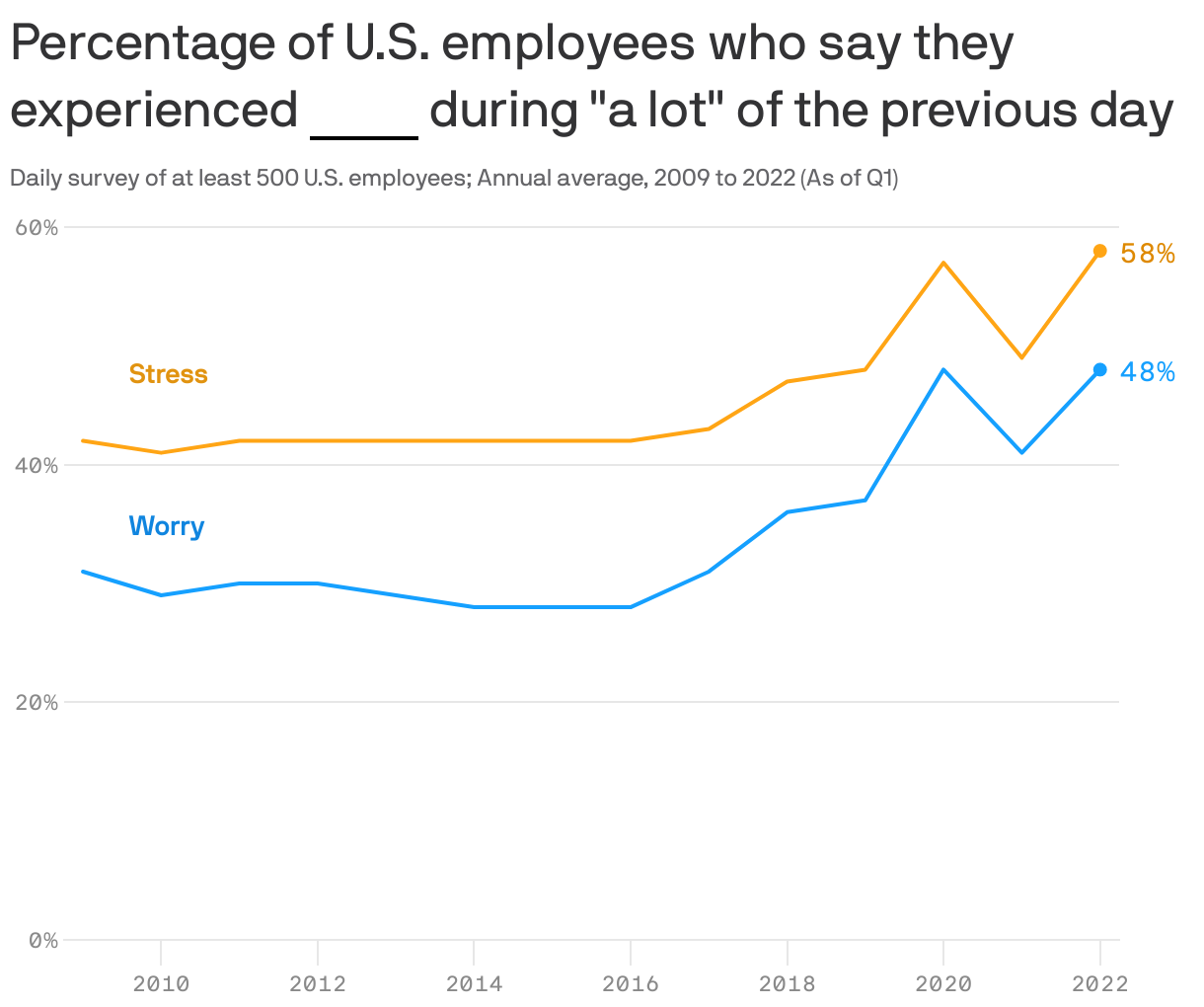
Stress and burnout are rising in the U.S., but jobs are plentiful and Americans are willing to move to new places for work.
Why it matters: The CEOs who can get company culture right, and the mayors who can sell their cities, have an unprecedented opportunity to lure top-tier talent.
In the counties most devastated by this week's historic flooding in and around Yellowstone National Park, only 3% of residents have federal flood insurance, virtually guaranteeing huge losses and long waits for repair money.
Why it matters: Most Americans don't buy flood insurance,even as climate change makes epic catastrophes like the Yellowstone disaster more likely.
One of my favorite maxims from one of my favorite business books is: "If you are going to eat shit, don’t nibble."
Why it matters: Ben Horowitz, writing in "The Hard Thing about Hard Things," coined this wonderful, if crude, concept for taming the human instinct to avoid tough actions. He was spot on.
Think of all the time wasted avoiding tough conversations, or difficult decisions, or unpleasant moments. We dither, ignore, nibble around the edges.