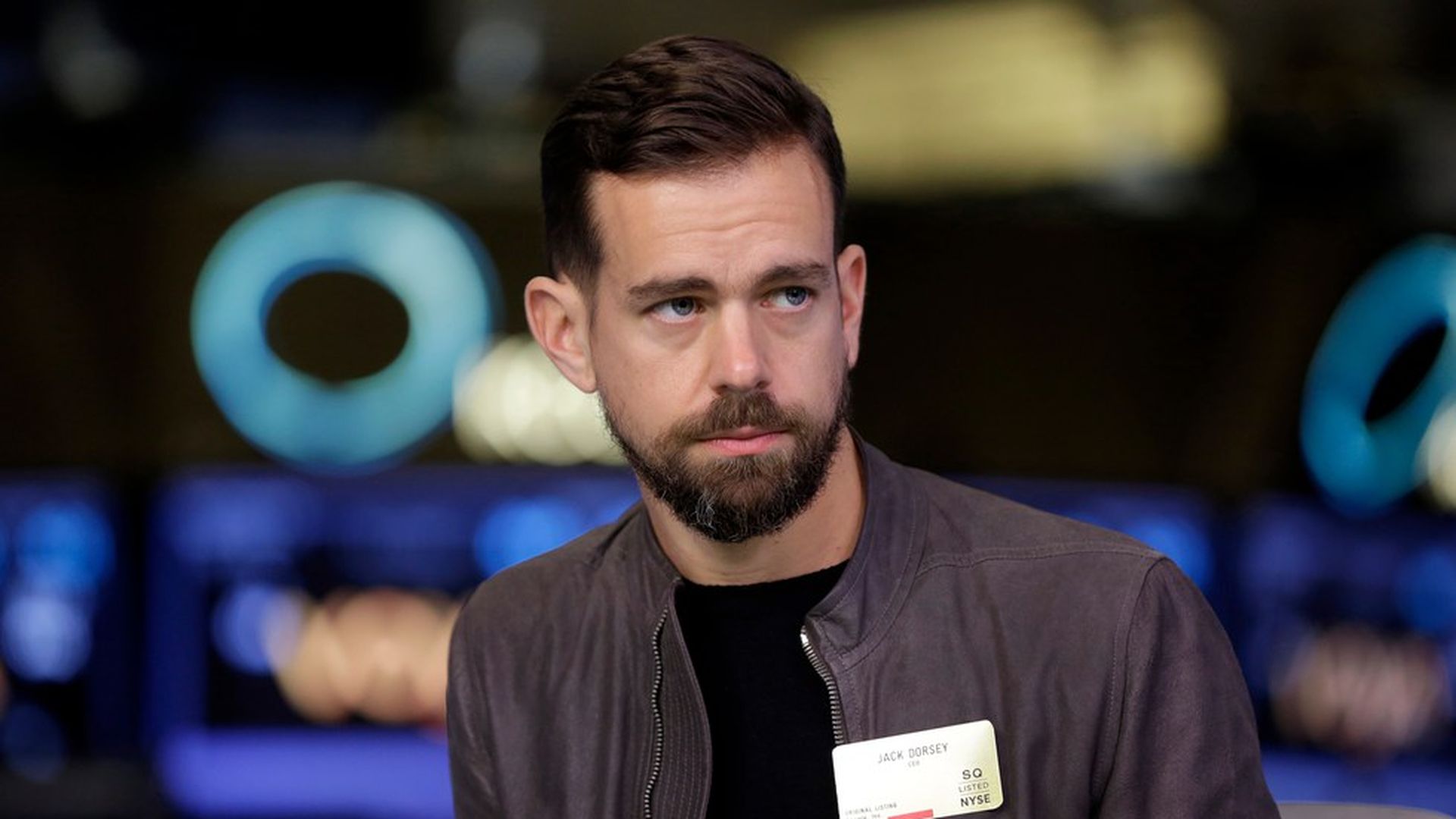
Twitter CEO Jack Dorsey retweeted a Twitter account that was identified as being created by the Kremlin, according to the Daily Beast.
The account, @Crystal1Johnson, tweeted mostly positive and encouraging stories, but then would occasionally tweet "inflammatory stories about Hillary Clinton," the Beast reports. This played into the method of other Russian propaganda accounts, in which they would build an audience with shareable content, and were then "weaponized for divisive political messages."
Why it matters: This follows a string of instances in which Russia created fake accounts on Twitter for influence. Dorsey's retweets prove "just how pervasive Russian propaganda became on major American social media platforms," per the Daily Beast.
Apple is issuing a cellular settings update that will allow iPhones to activate the currently unused Band 8 to access the Loon-based service. It's the second time Project Loon has been activated to assist with an emergency (the first was in Peru) and the first time Loon has been used in the U.S. The FCC earlier granted temporary approval for Loon to operate in Puerto Rico.
Why it matters: Connectivity and power remain major challenges for Puerto Rico and communications are seen as a necessary starting point for other parts of recovery and rebuilding to move forward. Without cellular service, even first responders and humanitarian groups are forced to use pricey satellite phones.
Snapchat parent company Snap has laid off employees as it slows its growth heading into 2018, Business Insider reports. The company has grown fast over the past two years: it had 600 employees at the end of 2015 and ended last quarter with 2,600.
Why it matters: Snap believes the company has reached a size that is functioning well, so it is reducing its rate of hiring and therefore cutting some staff recruiter roles. The company said it will continue to hire aggressively in engineering and sales roles, but the overall pace of those hires will also slow next year.
BuzzFeed News' Charlie Warzel finds that employees at Facebook feel the company doesn't deserve to be the focus of the deepening crisis of Russian election meddling online, especially after critics previously hit the company for censoring content. "There are lots inside thinking, 'We're the victims,'" one source told him, and that the company is "just a battlefield in a greater misinformation campaign."
Go deeper: The whole story is worth reading to get a sense of what the mood is like inside the secretive company.
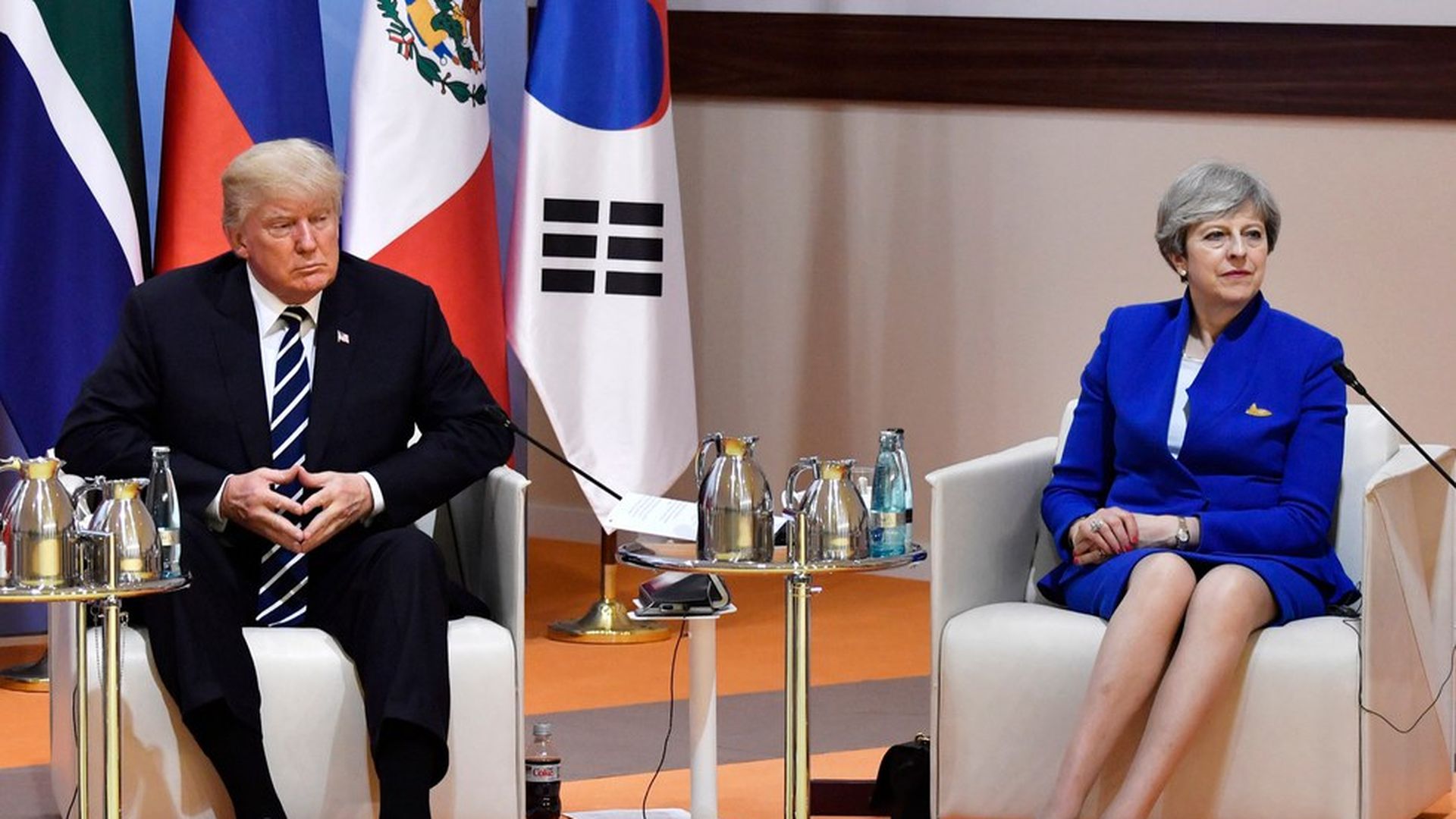
In a morning tweet, President Trump tied increasing crime rates in the United Kingdom to the "spread of Radical Islamic terror" after the country suffered a series of terror attacks in 2017:
Fact check: While the U.K.'s Office of National Statistics annual crime report did indeed mark a 13% year-on-year increase in crime, it barely mentions terrorism. The portion of the report likely to cause more concern across the pond: a notable increase in violent crimes like knife attacks and sexual assaults over the past year, per The Guardian.
Chicago Mayor Rahm Emanuel proposed on Wednesday a tax on ride-hailing companies, the revenue from which would be exclusively invested into the city's public transit. The proposal is for a a $0.15 fee in 2018, increasing to $0.20 in 2019, added on top of an existing fee of $0.52. If it passes, this will be the first ride-hailing fee in a U.S. city dedicated to a city's public transit.
Why it matters: Questions over ride-hailing's impact on public transit have persisted over the years. Last week, researchers published a study that showed that services like Uber and Lyft have led to a 6% decline in public transit use by respondents. Still, the companies have continued to say that they want to be a partner to public transit systems in cities.
Apologizing for past lapses, Twitter pledged to do a better job of keeping users safe on the social media platform and offered a calendar of planned enhancements.
"This won't be a quick or easy fix, but we're committed to getting it right," the company said in a blog post. "Far too often in the past we've said we'd do better and promised transparency but have fallen short in our efforts."
Why it matters: Twitter has a reputation for promising to improve safety, but not for accomplishing much in terms of reducing harassment and hate speech on its platform.
President Trump has selected the next FTC chairman and minority commissioner. The White House announced Trump plans to nominate Joseph Simons, a Washington antitrust attorney who's served two tours at the FTC, to the chairmanship. Rohit Chopra, a senior fellow at the Consumer Federation of America, will be nominated as a commissioner.
What to expect: Simons is seen as a traditionalist when it comes to enforcing antitrust laws, meaning he likely won't revamp the way the government defines markets when looking at the dominance of large tech companies. He'll undoubtedly be questioned on the topic during his confirmation hearing.
Google, Facebook and Twitter will all send their top lawyers to testify before Capitol Hill investigators looking into Russian election meddling at public hearings in early November. Google confirms it is sending General Counsel Kent Walker, Twitter has chosen its acting General Counsel Sean Edgett and Facebook General Counsel Colin Stretch was confirmed as the company's pick Wednesday morning.
What it tells us: In sending their top legal executives, the companies are acknowledging the seriousness of the investigation at hand.
Samsung's developer conference is always interesting because it's put on by a giant company that invests a ton of money, but doesn't always get a following for all its efforts.
The good: Samsung is working to get its many different divisions talking together, which could make life easier for developers and give it some needed scale. There were some impressive small efforts on display in the exhibit space, including a partner using virtual reality to help people recover from strokes. Another one tries to "epicycle" old Galaxy smartphones into everything from a security camera, to a pet feeder, to part of a bitcoin-mining server. (That last one requires a lot of old smartphones.)
Facebook General Counsel Colin Stretch will testify for the social giant at two Capitol Hill hearings next month on Russian meddling, per the company. NBC News first reported the news.
The bigger picture: By sending its top lawyer — rather than a lower-level policy staffer — the company is trying to project that it's taking the investigations being conducted by the House and Senate Intelligence Committees seriously.
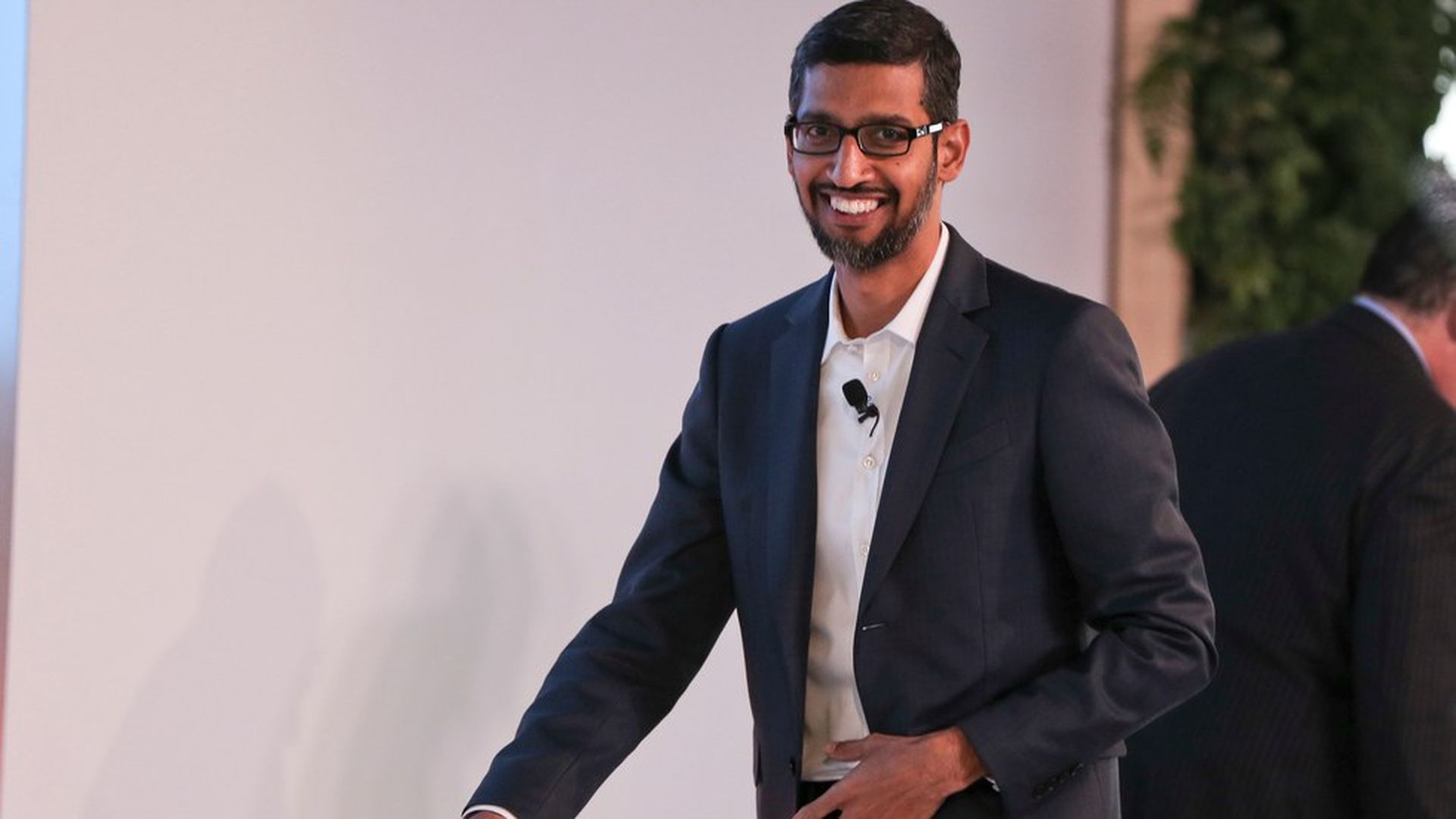
"Everyone's Mad at Google and Sundar Pichai Has to Fix It: The CEO is increasingly boxed in by regulators, tech critics on both the right and the left, and even his own employees," Mark Bergen and Brad Stone write on the cover of Bloomberg Businessweek. There's fake news to deal with, the limits of AI to sift out hateful material, Russian use of Google's AdWords, not to mention regulation in Europe.
"Pichai has ... recast Google's mission in the most dramatic way since the search engine went live 20 years ago. Inside and outside the company, he's elevated the role and glorified the promise of artificial intelligence — the ability of advanced computers to make independent decisions."
"Those decisions might be as small as when to flag a calendar appointment, or as consequential as how a multibillion-dollar hedge fund might trade."On Russian use of Google's AdWords and YouTube last year: "There's clearly stuff which shouldn't be happening which happened, so we should fix it ... Anytime we make a mistake, it's very public for the world to see."Scott Galloway, a New York University professor and author of The Four, a critical book about big technology companies, says "Google would be the scariest company in the world if you didn't believe they had adult supervision."
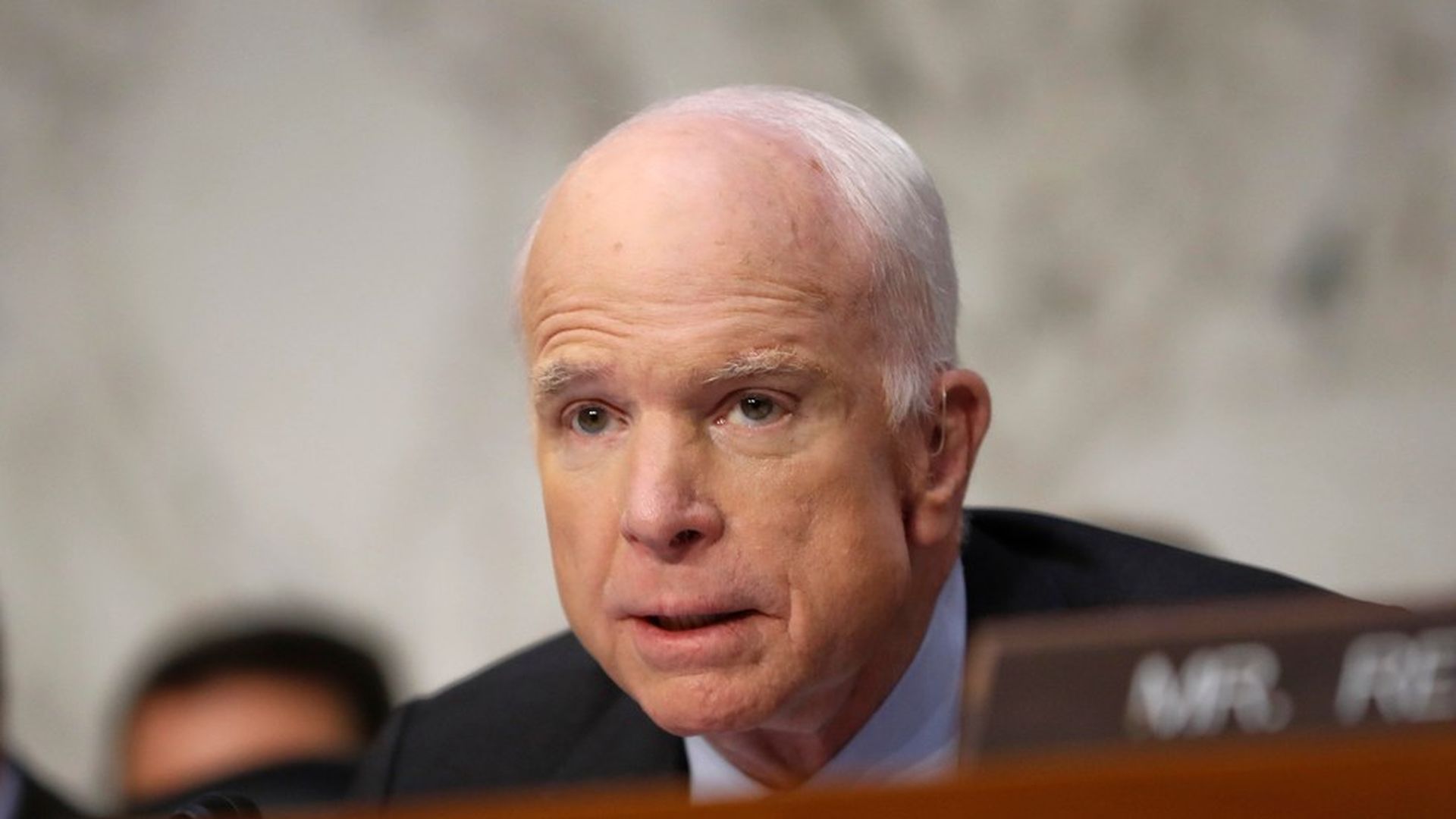
Republican Sen. John McCain (Ariz.) knows his time in the public eye is short, so his big statements in recent weeks are especially resonant. Today, McCain will join with two Democrats — Sens. Mark Warner (Va.) and Amy Klobuchar (Minn.) — to give bipartisan imprimatur to the first of the "Facebook bills," responding to last year's election interference.
Axios has a sneak peek at provisions of the Honest Ads Act, which would increase disclosure requirements for online political ads like the ones Russians surreptitiously bought, putting the rules on par with those for radio and TV ads.
Why it matters: This is the first in a wave of legislative and regulatory proposals we can expect in response to the disclosures that Russian agents used tech platforms to meddle in the 2016 election.
Cities across the country are falling over themselves to score the winning ticket in the biggest local lottery — Amazon's second North American Headquarters. Today's the deadline for them to submit proposals. But luring Amazon's promised 50,000 jobs comes with costs that may outweigh the benefits for some cities.
Why cities care: Mayors see dollar signs in Amazon's pledge to bring 50,000 jobs that pay an average salary of $100,000 to the winning city. They know "HQ2" will instantly put even the most obscure city on the map as a tech hub that will attract more businesses and talent. But an influx of people brings higher costs, and probably only marginal increases in local taxes thanks to the tax breaks most cities are prepared to offer.