An expert panel of the Food and Drug Administration today endorsed updating COVID boosters for the fall, unanimously recommending that they target an omicron strain known as XBB that’s responsible for nearly every infection in the U.S.
Why it matters: The current bivalent booster targets variants that are no longer circulating and shows signs of offering only waning protection against severe disease, according to data presented during a daylong advisory panel meeting.
With the public's immunity likely reduced by fall, federal health officials said updating the boosters might be the best way to keep pace with a still-evolving virus.
Details: The 21advisers largelyagreed that the new single-shot boosters should specifically protect against the XBB.1.5 variant, which accounted for nearly 40% of COVID cases as of last week.
This would make the shots monovalent, in contrast to the currently available bivalent vaccines that target multiple strains.
Vaccine manufacturers Pfizer, Moderna and Novavax have already begun to develop a shot targeting this strain — which data showed outperforming current vaccines — and indicated that it would be ready by early fall, pending regulatory approval.
Pfizer estimated it could start handing doses out as early as the end of July.
“This is not going to be the final formulation for this vaccine forevermore,” said Peter Marks, head of the FDA’s vaccine division. “It will likely require another update at some point.”
Catch up fast: This is the second time the FDA panel has endorsed updating the formula for COVID vaccines.
The first was last summer, when it backed the Pfizer and Moderna shots now in use that combine the original COVID strain with BA.4 and BA.5, omicron variants.
Those still help protect against severe disease, but uptake has lagged, with fewer than 1 in 5 Americans having received a shot.
In a January meeting of the Vaccines and Related Biological Products Advisory Committee, or VRBPAC, each vaccine manufacturer suggested adopting a model of annual shots similar to seasonal flu.
And last fall, federal health officials floated the possibility of a yearly one-dose schedule for the general population, similar to what's in place for influenza jabs.
Yes, but: Panel members were split over comparing coronavirus to the flu, with some worried about the way it could complicate public messaging and increase vaccine hesitancy.
“It's only been a few years,” said Mark Sawyer, temporary voting member and pediatric infectious diseases specialist at Rady Children’s Hospital.
“We don’t really know what the COVID season is, and it may ultimately confuse people about when and where they should get vaccinated and how frequently.”
What they’re saying: “Our discussion reflects the challenges of where we are now,” said Ofer Levy, director of the Precision Vaccines Program at Boston Children's Hospital.
"We have safe and effective vaccines that are saving lives,” Levy said. “We have some degree of public confusion and we have a virus that continues to change and uncertainty about how often we’re going to have to update the vaccine.”
What’s next: The FDA does not have to follow the panel’s recommendations but is likely to endorse the recommendation, since it’s in line with suggestions the agency’s own staff outlined earlier this week.
There’s also the question of whether the Centers for Disease Control will recommend that certain groups get the updated shot first, since older adults and people with weakened immune systems remain at greatest risk of hospitalization and death.
Large percentages of insured adults who say their mental health is only "fair" or "poor" report problems finding therapists or available mental health services, a new KFF survey finds.
Why it matters: The shortage of behavioral health workers is exacerbating the mental health crisis, and some patients say even when they find help their insurance may not cover needed treatment or services.
Hospital revenues appear to be on the upswing as more patients receive care — which is welcome news for the hospital industry and not-so-great for insurers.
Why it matters: Hospitals have been warning for months that their financial stability is threatened by inflation, labor costs and other factors in the wake of the pandemic, which could ultimately threaten patient care.
Food and Drug Administration advisers on Thursday will vote on whether the next round of COVID-19 shots should target XBB, a subvariant of omicron that’s driving the majority of new infections in the U.S.
Why it matters: The FDA is on a tight deadline to make a decision so drugmakers can manufacture the new vaccines in time for the fall and winter, even as polls show most Americans have put the pandemic behind them.
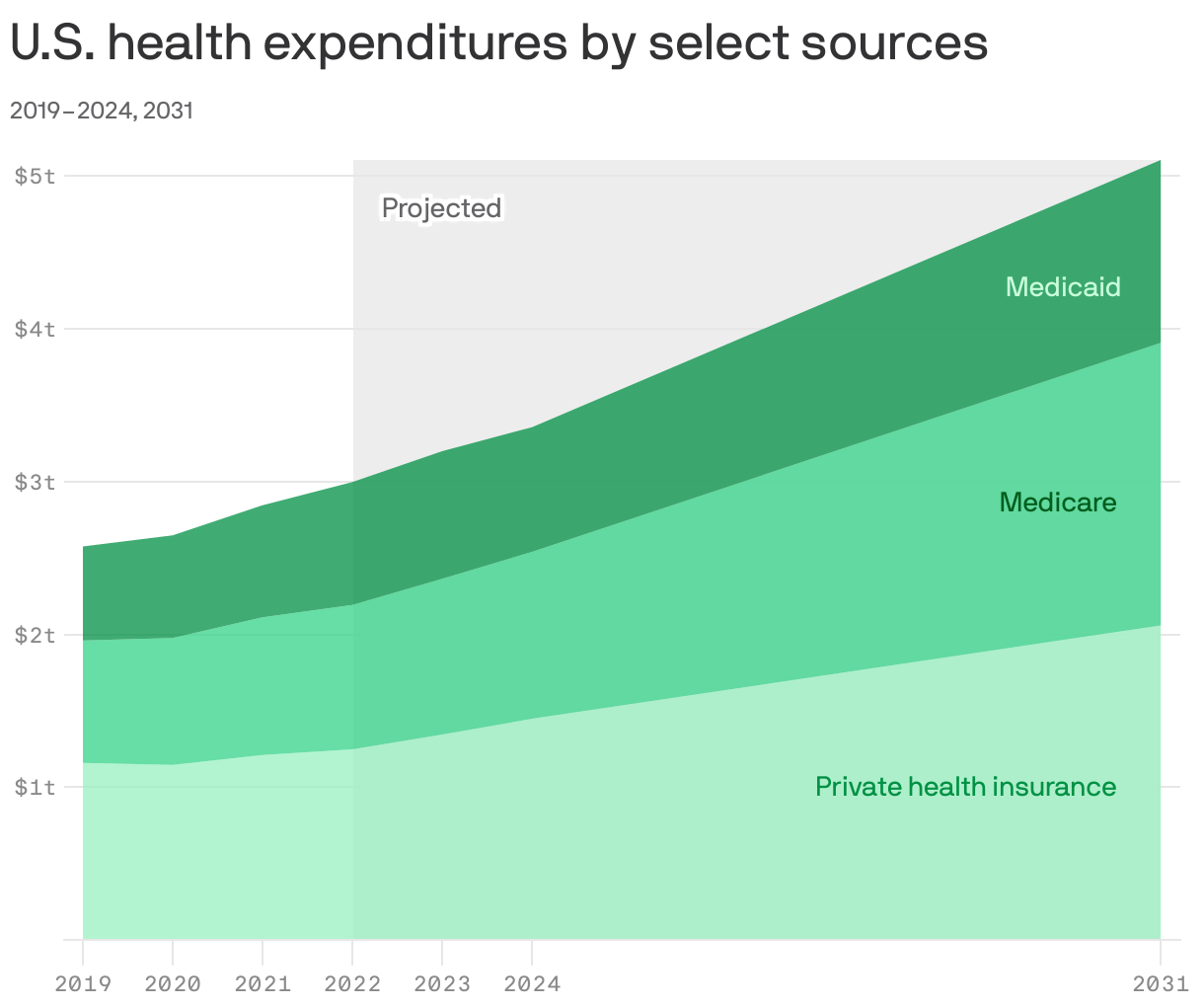
A surge of Medicare spending on hospitals and other services later this decade will help U.S. health care expenditures outpace inflation and top $7.2 trillion by 2031, federal actuaries said on Wednesday.
Why it matters: The new projections show medical spending across all categories rebounding from the pandemic doldrums, with hospitals being the biggest cost-driver. That likely will make health care become a larger part of household spending.
A former Harvard Medical School morgue manager has been accused of stealing and selling body parts donated to the institution as part of a nationwide scheme from 2018 through 2022, prosecutors announced Wednesday.
Driving the news: Cedric Lodge, 55, and his wife, Denise Lodge, 63, of Goffstown, New Hampshire, were indicted with several others by a federal jury in Pennsylvania and face charges of conspiracy and interstate transport of stolen goods, per a Justice Department statement, which said the school was a victim in the case.
Multiple brands of frozen strawberries and fruit products sold at Walmart, Costco and HEB stores are being recalled after being linked to a Hepatitis A outbreak that has sickened nine people.
Overpayments to insurers administering Medicare Advantage plans now exceed $75 billion a year due to aggressive coding of patients' health conditions and easily-achieved bonus payments tied to quality, researchers with the USC Schaeffer Center for Health Policy & Economics found.
Why it matters: More seniors are choosing private Medicare Advantage plans over traditional Medicare, and continued overpayments could threaten the long-term viability of the program.
A critical shortage of chemotherapy drugs is fueling calls to fortify the U.S. drug supply chain, which advocacy groups and lawmakers say too often relies on a handful of manufacturers to churn out products in highest demand.
Driving the news: Cancer drugs, including widely used cisplatin and carboplatin, are in such short supply that doctors are rationing care, asking patients to drive long distances for treatment, or turning to alternative treatments with riskier side effects.


/2023/06/15/1686844428113.gif?w=3840)