Friday's economy stories

Trump threatens more tariffs over Canadian wildfire smoke
President Trump is threatening to raise tariffs on Canada over wildfire smoke that drifted from the country into the U.S., triggering health warnings and disrupting outdoor activities.
Why it matters: Dealing with Canadian wildfire smoke is becoming a semi-regular occurrence in the Midwest and Northeast.

Taco Bell's ties to "explosive" diarrhea outbreak threatens Yum Brands' crown jewel

Taco Bell is going viral in the worst way. The fast-food chain is engulfed in a billowing food safety crisis that threatens to inflict lasting damage on the crown jewel of Yum Brands.
Why it matters: Foodborne illness outbreaks can scare off customers long after the immediate health risk has passed, sometimes keeping people away for years.

Axios Live: New housing law fuels bipartisan momentum
WASHINGTON — The passage of landmark federal housing legislation is encouraging optimism for more collaborative reform, lawmakers and advocates said at an Axios Live event.
Why it matters: Homeownership costs are nearing historic levels, and addressing the national housing shortage is a rare bipartisan priority.
Axios' Courtenay Brown and Mimi Montgomery moderated conversations with Rep. Darin LaHood (R-Ill.), Rep. Brittany Pettersen (D-Colo.) and National Multifamily Housing Council president Sharon Wilson Géno. The July 16 event was sponsored by Citi.
Stunning stat: Americans hoping to afford payments on a median-priced home need over 75% more income than they did in 2020, according to Harvard University's Joint Center for Housing Studies.
Driving the news: The 21st Century ROAD to Housing Act automatically became law last week despite President Trump's refusal to sign it.
What they're saying: The bipartisan work to pass the legislation is a "beacon of hope," Pettersen said.
- "We'll know if it's working when people start to feel like [housing] is within reach again — that they're not spending 50% of their paycheck to put a roof over their head," she added.
- The bill's elimination of a 1974 requirement of a permanent steel chassis for manufactured homes could be "the biggest change," Wilson Géno said.
- One of the most important things the bill accomplishes is the "reduction of the regulatory barriers that go into construction," LaHood said, and the creative financing solutions that free up capital and investment funding.
Yes, but: "There are many pieces that are lacking ... especially that federal investment that we need to help increase the housing supply," Pettersen said.
The bottom line: Housing "affects every congressional district, every state," LaHood said. "No one is immune from it."
Content from the sponsor's segment:
In a View From the Top conversation, Citi head of enterprise services and public affairs Edward Skyler said difficult choices will need to be made for the greater good.
- "If we want to make some progress here, different jurisdictions are going to have to do things as far as expediting permitting, making sure the zoning makes sense and also making some of the hard decisions."

The surprising reason Alan Greenspan backed tax cuts in 2001
It was March of 2001. The newly installed administration of President George W. Bush was seeking a broad package of tax cuts. Greenspan, at the height of his reputation as an economic wizard, more or less endorsed the idea.
- His rationale was not what you might expect, like potential supply-side benefits or a need for fiscal stimulus. It was, to contemporary eyes at least, much weirder.
Why it matters: The past is a foreign country. And a look back at this moment of economic history a quarter century ago shows how much can change, and how fast.

Housing, imports and consumers: 3 fresh reads on the economy


The latest batch of data offered a fresh look at three corners of the economy: Homebuilding rebounded after a weak spring, import prices continued edging higher, and consumer moods brightened for a second straight month.

From mayor to U.K. PM: Inside Andy Burnham's swift ascent
Andy Burnham will be the U.K.'s new prime minister after becoming Labour's leader Friday.
Why it matters: Burnham vaulted from regional politics to the cusp of Downing Street within weeks — an unusually rapid ascent that leaves him little time to prepare for mounting economic and political challenges.

Russia roils global market for diesel
Ukraine's drone attacks on refineries have hammered Russia's oil infrastructure, creating an economic shock that is increasingly visible worldwide, including in the U.S.
Why it matters: The effectiveness of the Ukrainian drone campaign is helping drive up world energy prices already elevated by the Iran war.

SpaceX falls under IPO price, as lockup expirations loom


SpaceX closed below its IPO price Thursday after the stock declined for the eighth time in nine sessions.
Why it matters: The selloff suggests that investors' knees have gone somewhat wobbly, as the first restrictions on selling — known as lockups — are set to be lifted in less than a month.
The latest: The stock closed at $131.11 Thursday.
- That's down 42% from its intraday high of $225.64 reached on June 16.
- It's also below the stock's symbolically important $135 offering price.
Zoom in: According to SEC filings, up to 1.37 billion shares could hit the market starting in the days after SpaceX reports second-quarter results, which is projected to be on Aug. 6, according to FactSet.
- That includes 911.5 million of class A common shares.
- And it could include an additional 455.8 million shares if the stock price meets certain conditions. (The shares would have to close at or above $175.50 on a certain number of trading days surrounding the Q2 earnings release.)
Reality check: The actual SpaceX IPO — the largest ever, raising $86 billion — involved the sale of only 639 million shares.
- That means the first lockup expiration could roughly quadruple the supply of tradable SpaceX shares.
The intrigue: Will the buying public be eager to buy them? Especially after the recent drop?
Between the lines: The SpaceX IPO last month was a masterpiece of financial engineering.
- SpaceX CEO Elon Musk was able to generate a surge of retail interest.
- The company was also fast-tracked into some key indexes, like the Nasdaq 100, ensuring some steady purchases from index-based investors.
- Those factors, along with a surge of online hype and a relatively constrained amount of stock to sell — about 5% of all SpaceX shares — generated more than a satisfying pop in the price.
- At its closing high, the company was valued at $2.64 trillion, on paper.
Yes, but: That valuation always deserved to be viewed pretty skeptically.
- All things being equal, the constrained supply of stock in the face of strong demand results in an elevated price and a potential overvaluation of the company.
The bottom line: As more SpaceX shares are released into the wild, we'll get a more accurate picture of what the market thinks SpaceX's "true value" is.

Axios House: AI is reshaping America's industrial future
WASHINGTON – The next phase of America's economic growth will depend on whether the U.S. can outcompete rivals in AI, energy and advanced manufacturing, policymakers and business leaders said at Axios House D.C.
Why it matters: America is entering a new industrial age as AI and new technologies boost economic growth and revamp how every sector operates.
Axios' Nathan Bomey, Neil Irwin, Colin Demarest, Mike Allen, Courtenay Brown and Ben Geman hosted conversations with NYSE Group president Lynn Martin; Rep. Gregory Meeks (D-N.Y.); Kalshi co-founder and CEO Tarek Mansour; Commodity Futures Trading Commission chair Michael Selig; Zillow Group CEO Jeremy Wacksman; Northrop Grumman chair, CEO and president Kathy Warden; U.S. Trade Representative Jamieson Greer; and Southern Company chair, president and CEO Chris Womack. The July 14 event was sponsored by Accenture and Ford.
Here are the takeaways:
- Meeks is worried the Iran war will become this generation's "forever war," and he criticized President Trump for using "basically real estate negotiators" in diplomatic talks. On Trump's strategy, Meeks said: "I don't think that you're going to be able to bomb yourself out of this."
- Martin said AI's biggest economic opportunities will come from energy and infrastructure, predicting both sectors are positioned for "outsized returns for a longer period of time."
- As the battle to regulate prediction markets intensifies, Selig says the CFTC will defend its authority over prediction markets "all the way up to the Supreme Court" if necessary.
- Mansour said prediction markets are "here to stay" because many people feel traditional financial systems are "rigged against them."
- The world is still figuring out how to regulate tech companies, but Greer said the U.S. won't let Europe become "the arbiter" of regulating American tech companies.
- U.S. energy demand is growing, and Womack said the U.S. needs to commit to building 10 new nuclear plants to meet that demand.
- Wacksman said the homebuying process has become so complicated that half of Americans cry at some point during the process, according to Zillow's 2022 study.
Content from sponsors' segments:
In a sponsored conversation, Ford Motor Company executive chair Bill Ford said most of America's critical minerals come from China. The U.S. has them – it just doesn't have the proper regulation to develop those minerals.
- To compete with China, Ford said a bipartisan industrial policy is needed. "Having a planning horizon that we can count on makes a huge difference, because our lead times are longer than political lead times," Ford said.
- He also said flying cars are "very possible."
In a View from the Top conversation, Accenture Federal Services CEO Ron Ash shared his concerns over the AI boom, saying the U.S. is in a prototyping bubble.
- "My biggest concern is that we win this race for developing the best AI technology and we lose the race to deploy it," he said.
Go deeper: Watch the full event.

Americans are trimming their grocery carts
Americans are putting fewer groceries in their carts than they were a year ago, extending a troubling trend for the food industry.
Why it matters: The era of boosting sales simply by charging more appears to be ending, leaving food companies under growing pressure to grow volumes.

Scoop: Russia sanctions bill hits 60 co-sponsors
A bipartisan push to pass the late Sen. Lindsey Graham's (R-S.C.) revised Russia sanctions package has more than 60 co-sponsors — enough to clear a Senate filibuster.
Why it matters: The legislation, which would impose 100% secondary tariffs on countries that continue buying Russian oil and gas, now appears to have the votes it needs to pass the Senate. The biggest remaining hurdle is getting floor time.

Trump's deportation push is rewiring U.S. policing, ACLU report says

President Trump's deportation campaign has expanded far beyond ICE, turning federal agents, state troopers, local police and even wildlife officers into a massive 50,000-person internal enforcement force, a new ACLU report says.
Why it matters: The aggressive expansion is blurring the lines between local public safety and federal immigration enforcement, fundamentally changing U.S. law enforcement — and raising civil rights concerns, the report says.

White House teleprompter operator investigated over alleged Kalshi trades on Trump speeches
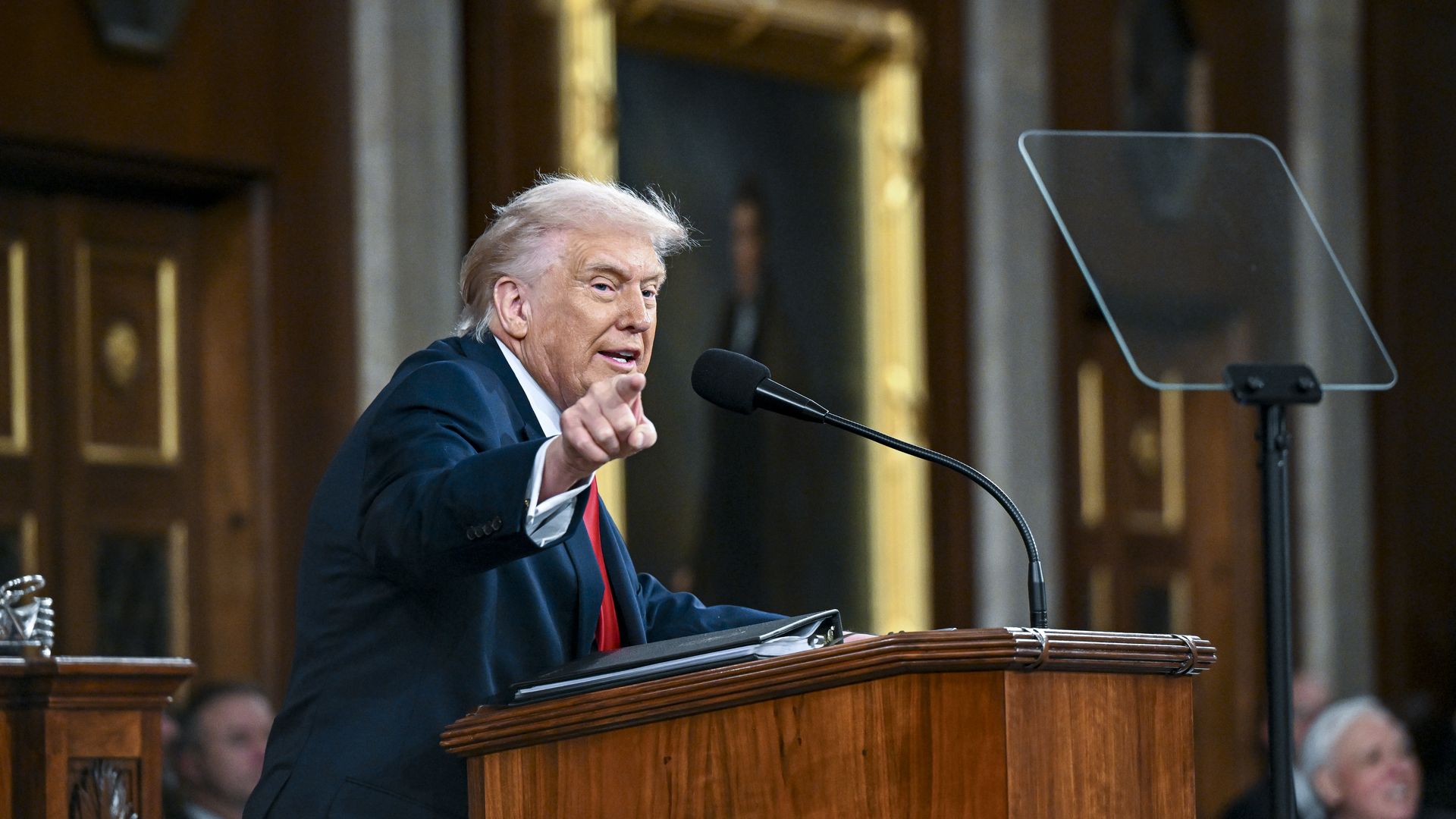
Federal regulators are investigating whether a White House teleprompter operator capitalized on his knowledge of President Trump's prepared speech text by making trades on the prediction market Kalshi, according to two sources familiar with the matter.
- The speeches the person allegedly traded on included the State of the Union in February.
Why it matters: The rise of prediction markets has raised concerns about insider trading, which Kalshi and federal regulators say they're well positioned to combat.

Spending won't crack, despite dreadful consumer sentiment


The list of headwinds facing American consumers keeps getting longer. Yet their willingness to spend has not yet cracked.
Why it matters: Economists feared that the Middle East-driven jump in gasoline prices would dent consumer spending. Instead, a still-stable labor market and rising household wealth appear to have given consumers enough cushion to keep spending.

AI buildout creates employment bottlenecks
Businesses across America are telling similar stories about the effects of AI: The buildout is increasing the competition for certain kinds of workers, driving up the price of memory chips and reshaping how companies hire.
- They are describing a scramble for workers and resources from electricians and skilled technicians to transformers and memory chips as companies race to build AI infrastructure.
The intrigue: This was one prominent theme in the Federal Reserve's latest Beige Book, which compiles on-the-ground observations from businesses across the Fed's 12 districts.

The hidden consequences of permanent daylight saving time
The U.S. moved closer to making daylight saving time permanent this week — but the potential side effects are prompting renewed debate.
Why it matters: Permanent daylight saving time would affect far more than clocks, possibly impacting sleep, commuting, school schedules and religious observance.

Exclusive: Rogo taps former Grammarly CTO for next growth phase
Rogo, an AI startup creating software for Wall Street, has hired former Grammarly chief technology officer Joe Xavier as its CTO, the company tells Axios.
Why it matters: Rogo is tapping a Silicon Valley tech expert for its next growth phase on Wall Street.

Exclusive: Truth Social to license its data to Wall Street
Trump Media & Technology Group is launching a backend interface that will allow financial services companies to access real-time Truth Social data for a fee, interim CEO Kevin McGurn tells Axios.
Why it matters: It's the company's first step toward expanding its media business into licensing, McGurn says.

New housing law could reinvent the mobile home
Perhaps the most consequential piece of the new landmark housing legislation involves an astonishingly simple change to a 50-year-old federal law.
- Manufactured houses, or mobile homes, no longer must have a permanent chassis, the steel under-frame used to transport the house and then left attached.
Why it matters: The U.S. desperately needs more affordable starter houses for low- and middle-income folks currently priced out of the market, and some builders and housing advocates say this little tweak could help do the trick.

AI continues to pressure power prices


AI-related demand within the largest U.S. power grid continues to keep pushing power bills higher for the 67 million Americans served by PJM Interconnection.
Why it matters: AI-related costs such as noise, pollution and higher prices have provoked a broad public pushback against data center building that's gaining traction among local and state officials.

Trump imposes 25% tariffs on Brazilian goods
The Trump administration said Wednesday it will impose an additional 25% tariff on many Brazilian goods, escalating a trade fight it says is rooted in Brazil's treatment of U.S. companies.
Why it matters: The new policy includes exemptions for key consumer staples like coffee and beef, suggesting the White House is trying to minimize the inflationary impact on American shoppers even as it steps up pressure on Brazil over disputes involving U.S. tech firms, ethanol and more.

China surpasses U.S. in global favorability, poll finds
China is now viewed more favorably than the U.S. in most of the 36 countries surveyed by the Pew Research Center, according to a new report spanning six continents.
Why it matters: The findings suggest the global standing of the U.S. has slipped as President Trump advances his "America First" agenda, while China's international image has improved.