The surprising reason Alan Greenspan backed tax cuts in 2001

Add Axios as your preferred source to
see more of our stories on Google.
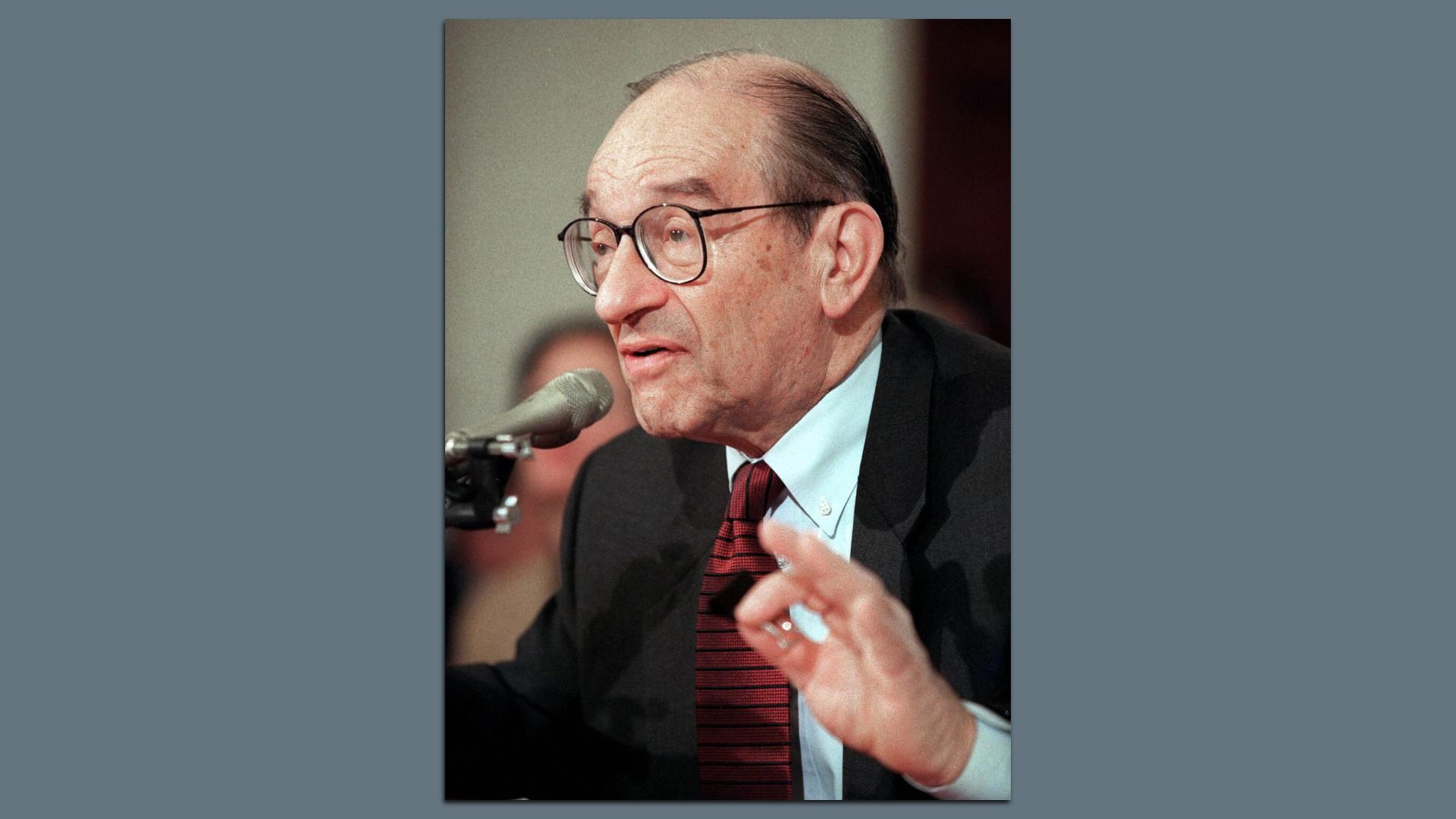
Alan Greenspan before the House Budget Committee in March 2001. Photo: Shawn Thew/AFP via Getty Images
It was March of 2001. The newly installed administration of President George W. Bush was seeking a broad package of tax cuts. Greenspan, at the height of his reputation as an economic wizard, more or less endorsed the idea.
- His rationale was not what you might expect, like potential supply-side benefits or a need for fiscal stimulus. It was, to contemporary eyes at least, much weirder.
Why it matters: The past is a foreign country. And a look back at this moment of economic history a quarter century ago shows how much can change, and how fast.
Flashback: Greenspan feared that the U.S. government was running such large budget surpluses — which were forecast to continue indefinitely — that it would eventually pay off the entire national debt.
- Then, in turn, it would have little choice but to plow surplus revenue into private sector assets. Government control of enterprise, he feared, would choke off America's economic dynamism.
What they're saying: "These most recent projections," Greenspan told the House Budget Committee in March 2001, "make clear that the highly desirable goal of paying off the federal debt is in reach and, indeed, would occur well before the end of the decade under baseline assumptions."
- "At zero debt, the continuing unified budget surpluses now projected under current law imply a major accumulation of private assets by the federal government," he continued.
- "Such an accumulation would make the federal government a significant factor in our nation's capital markets and would risk significant distortion in the allocation of capital to its most productive uses."
- "Such a distortion could be quite costly, as it is our extraordinarily effective allocation process that has enabled such impressive increases in productivity and standards of living."
Zoom in: The prospect for sustained fiscal surpluses evaporated practically as Greenspan was testifying.
- The dot-com boom was rapidly going bust. The U.S. economy was flashing signs of trouble, and the very month he testified was ultimately declared the start of the 2001 recession.
- Six months later, terrorists attacked the World Trade Center and the U.S. embarked on a costly program of overseas wars and expansive domestic security.
- And Bush secured his 2001 tax cut and another one in 2003 for good measure. Seven years later, a global financial crisis caused both a collapse in federal revenue and budget-busting stimulus measures.
By the numbers: Greenspan cited projections that the U.S. government was on track to have an $800 billion surplus in 2010. Instead, there was a $1.3 trillion deficit that year.
- Now, the U.S. government is running deficits of around $2 trillion each year, even in a period of full employment.
The intrigue: Greenspan's warnings about the perils of government private sector ownership look similarly anachronistic.
- The U.S. government, under a Republican president, has taken equity stakes or claims on future revenue from more than two dozen companies, including in semiconductors, critical minerals and defense.
- The list includes household names like Intel and U.S. Steel. There are rumblings the government could obtain equity stakes in AI giants.
- The government is demanding these equity stakes not because it has fiscal surpluses that it has to deploy somewhere but, essentially, because it can.
Of note: At the time of Greenspan's warning, the term "sovereign wealth fund" hadn't yet been coined. But a quarter-century later, there has been much study of how a country can pour fiscal surpluses into a fund that is a wise allocator of capital.
- Norway's $2.2 trillion pool of oil wealth is a prime example.
The bottom line: Even for an economic maestro like Greenspan, predicting how the future will evolve is no easy task. And the range of possibilities for what the world looks like decades from now is wider than we can possibly fathom.
