The race to build new nuclear reactors — fast

Add Axios as your preferred source to
see more of our stories on Google.
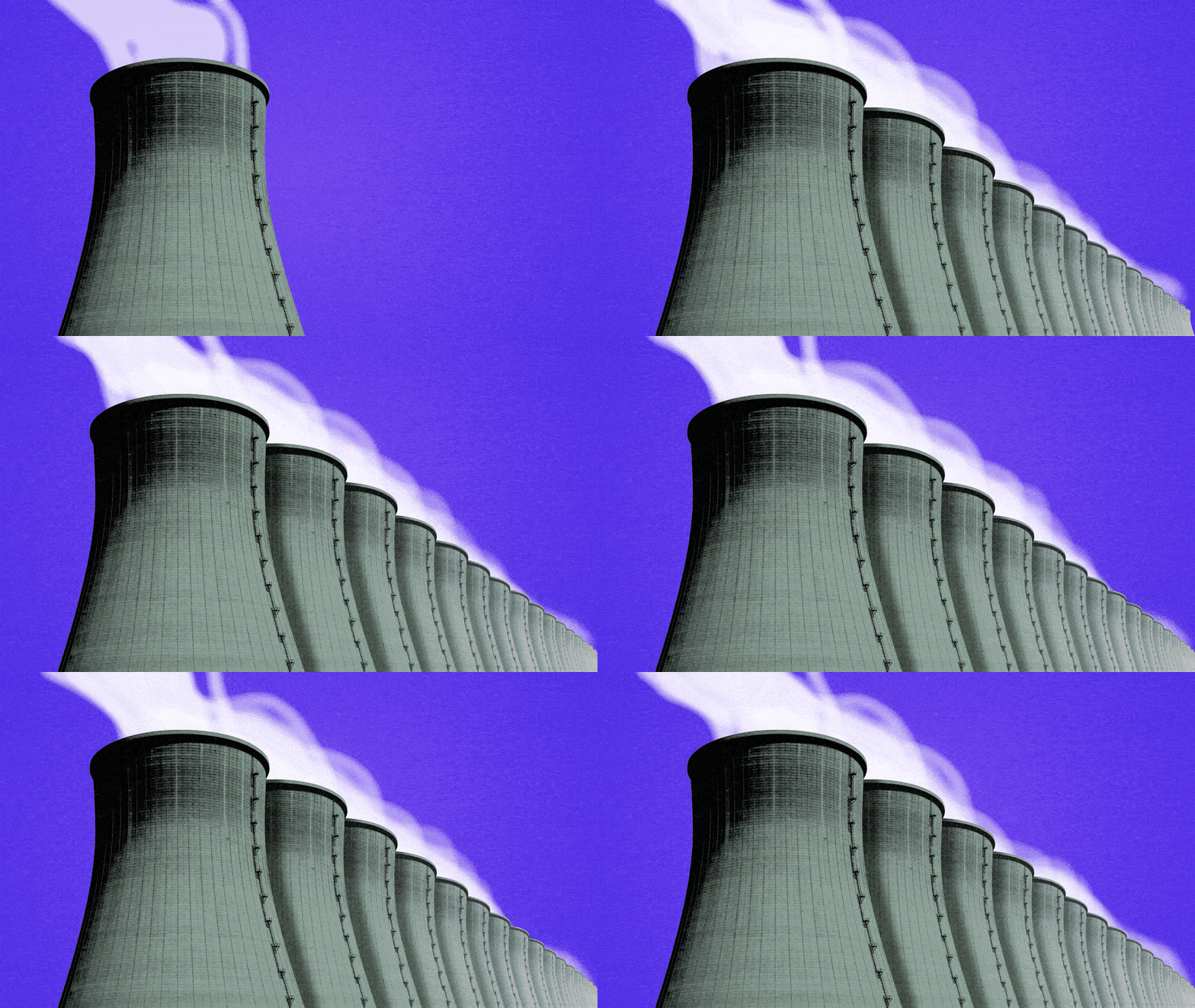
Illustration: Brendan Lynch/Axios. Stock: Getty Images
HOUSTON — As nuclear energy industry deals pile up, executives are turning their focus to what many describe as a huge challenge: How to build multiple plants quickly.
Why it matters: Nuclear energy is seen as critical to supplying enough power for AI data centers' massive electricity needs.
- And AI itself is being seen as part of the solution.
The big picture: A March report from the Nuclear Scaling Initiative research group concluded that "a concentrated set of structural bottlenecks" has created "an industrial capacity constraint" on future nuclear plant projects.
- Unless that constraint is addressed, the result could be a series of one-off projects "rather than sustained, multi-unit delivery" of new plants, said the group, a collaboration among the Nuclear Threat Initiative, Clean Air Task Force and EFI Foundation.
- The report said that while nuclear technology has advanced rapidly, other areas — such as the development of supply chains as well as enough skilled workers to build the plants — have not.
Driving the news: At last week's CERAWeek energy conference in Houston, industry officials predicted that companies' willingness to try new approaches — particularly with AI — will speed things up.
- "It's much more of a Silicon Valley-type ecosystem than we've ever seen in this sector," John Kotek, the Nuclear Energy Institute's senior vice president of policy development and public affairs, told Axios.
- Two tech industry heavyweights — Nvidia and Microsoft — announced last week they're joining forces on a new initiative aimed at breaking nuclear construction bottlenecks.
- It involves using AI tools that can help identify documentation inconsistencies, make sure the data for plant construction is consistent from beginning to end, and support "digital twins" — virtual replicas that allow engineers to test changes.
Zoom in: Aalo Atomics said it already has cut the time-intensive permitting process by 92% using Microsoft's Generative AI for Permitting solution while saving about $80 million a year.
- Aalo broke ground last year on a precursor to the "Aalo Pod," a reactor designed for data centers that the company says will be in commercial use by 2029.
- Aalo aspires to a "copy and paste" approach, said Jon Guidroz, the company's senior vice president of commercialization and strategy.
- "We need to build this [nuclear] stuff the way server racks and data centers get built," he said.
Another advanced-nuclear company, Kairos Power, said it's also aiming for a copy-and-paste approach by building in both New Mexico and Tennessee and comparing what works, said Mike Laufer, Kairos' CEO.
- "So if you kind of combine those two, we're getting a lot of real information," Laufer said at a CERAWeek panel.
- Google and Kairos plan to deploy a reactor for the Tennessee Valley Authority's grid to power Google's data centers in Tennessee and Alabama.
Zoom out: Getting a qualified workforce fully up to speed to build many plants will take time, said Ross Ridenoure, Hadron Energy's chief nuclear officer.
- "There will be, I think, a shortage initially, until the training programs catch up with the demand," he told Axios.
- The Nuclear Energy Institute's Kotek, however, isn't fazed by any potential workforce shortages.
- "What I've heard, particularly from labor, is, you show them the nuclear jobs, they'll find you the people," he said. "Because nuclear pays well, it's safe, it's long-term."
The bottom line: Hyperscalers are bringing more than just a demand for electricity to the nuclear field — they're bringing a much-needed sense of urgency, said TerraPower president and CEO Chris Levesque.
- His company in March received a Nuclear Regulatory Commission permit for its Natrium advanced reactor in Wyoming.
- "They're really kind of shocking our pretty slow-moving industry," he said.
