China surpasses U.S. in global favorability, poll finds

Add Axios as your preferred source to
see more of our stories on Google.
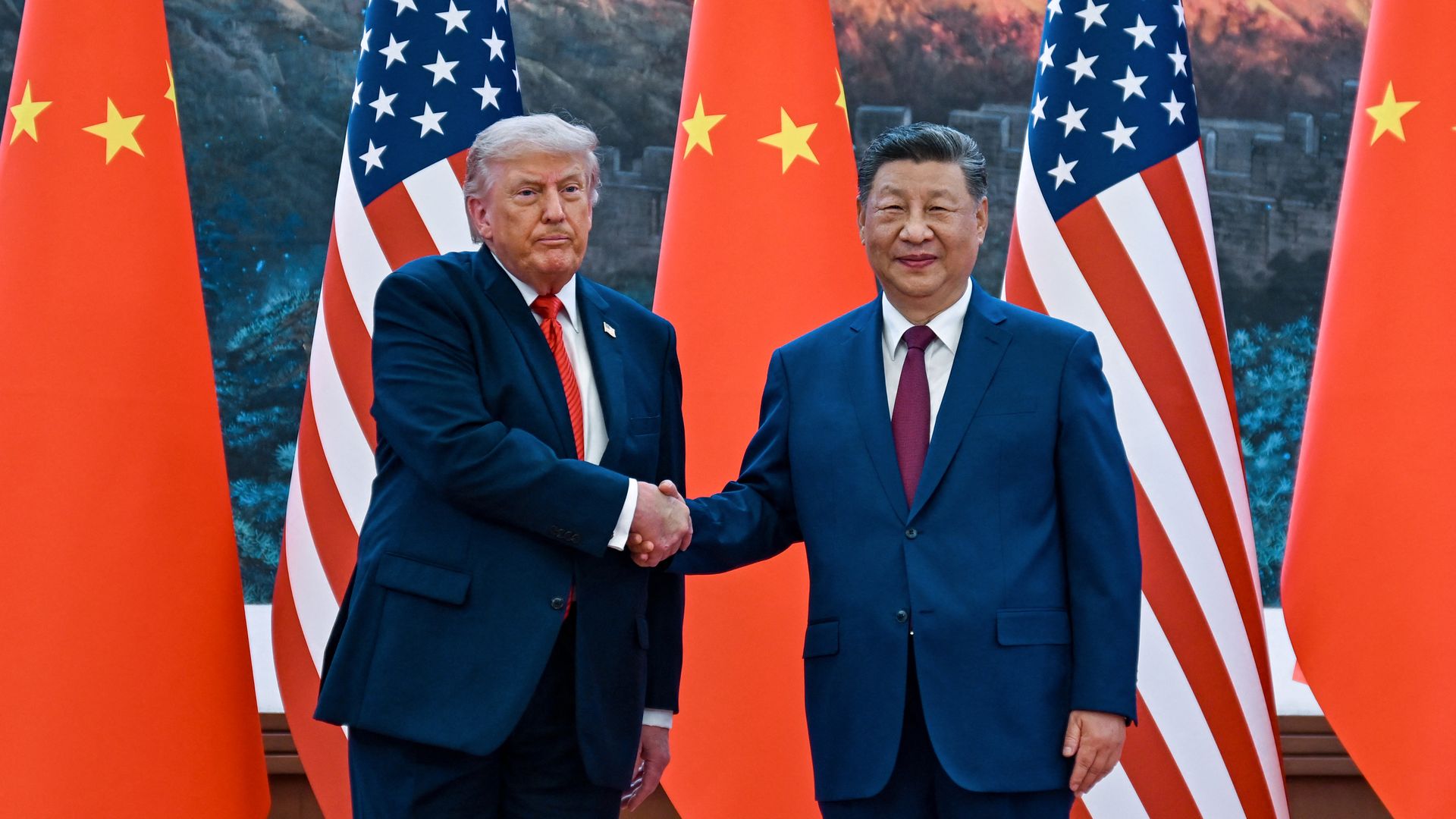
President Trump shakes hands with China's President Xi Jinping at the Great Hall of the People in Beijing on May 14. Photo: Kenny Holston/AFP via Getty Images
China is now viewed more favorably than the U.S. in most of the 36 countries surveyed by the Pew Research Center, according to a new report spanning six continents.
Why it matters: The findings suggest the global standing of the U.S. has slipped as President Trump advances his "America First" agenda, while China's international image has improved.
- It's the first time in some 20 years of Pew global opinion polls that China has surpassed the U.S. in being viewed more positively among many of those surveyed, Laura Silver, associate director of Pew's Global Attitudes Research, told AFP.
Driving the news: Interviews were conducted from Feb. 8 to May 13, a period during which the U.S. and Israel launched military strikes against Iran.
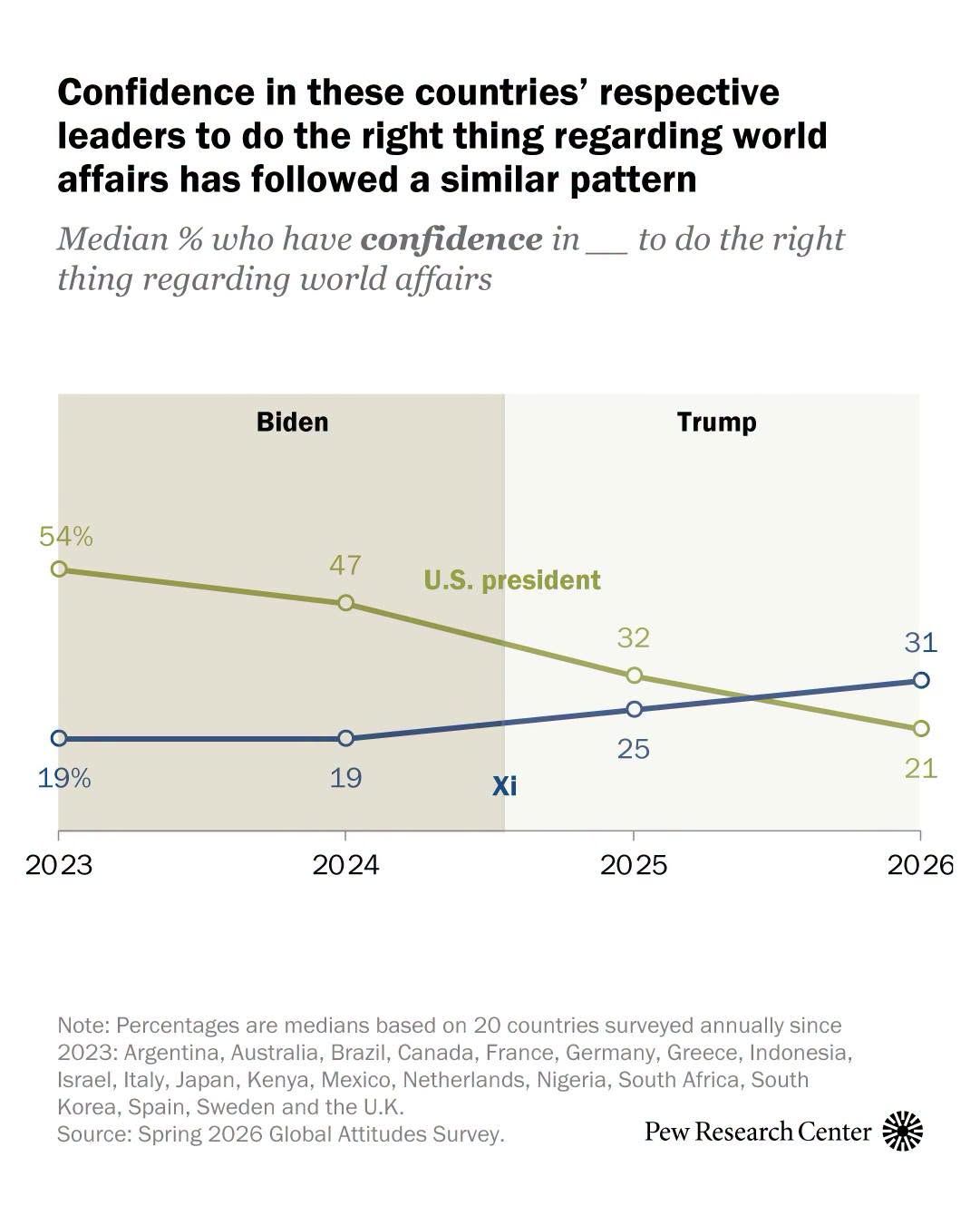
What they found: The survey of 42,151 people found that more have confidence in Chinese leader Xi Jinping than in Trump — reversing a trend seen when former President Biden led the U.S., though many of those surveyed lack confidence in both leaders.
- The U.S. leads in only six countries: India, Japan, the Philippines, South Korea and two others.
Stunning stat: U.S. favorability in Canada has fallen from 57% in 2023 to 33% this year, while China's has risen from 14% to 44%.
- The pattern is similar among other U.S. allies, including France, Germany and the U.K.
Yes, but: The U.S. still scores higher than China on respecting personal freedoms. However, that advantage has narrowed considerably since 2021 as confidence in the U.S. has fallen across much of Europe and elsewhere.
- In Sweden, for example, the share saying the U.S. respects personal freedoms has fallen from 61% to 27%. Similar declines have occurred in Canada, France, Germany, Italy, the Netherlands, South Korea and Spain.
What they're saying: "President Trump has done more for global stability in the past year than anyone else," White House spokesperson Olivia Wales said.
- "President Trump is the leader of the free world, and thanks to his bold leadership the United States of America has never been stronger."
The big picture: Many respondents view China as a more reliable partner and as more likely to promote peace and stability. Respondents in many middle-income countries also view China as the better partner. Among the 17 middle-income countries surveyed:
- A median of 75% say the U.S. interferes in other countries' affairs.
- Just 45% say the same about China.
Between the lines: "There was just an actual relationship between the outbreak of the war and the sense that the US is just not contributing to peace and stability and that people have less confidence in Donald Trump," said Silver, a researcher on the study, according to AFP.
Context: Pew surveyed people living in Argentina, Australia, Bangladesh, Brazil, Canada, Chile, Colombia, France, Germany, Ghana, Greece, Hungary, India, Indonesia, Israel, Italy, Japan, Kenya, Malaysia, Mexico, the Netherlands, Nigeria, Pakistan, Peru, the Philippines, Poland, Singapore, South Africa, South Korea, Spain, Sri Lanka, Sweden, Thailand, Turkey, the U.K., and the West Bank and East Jerusalem.
Editor's note: This story has been updated with White House comment.
