Thursday's economy & business stories

How Hut 8 can hold onto its bitcoin in a downturn

One Canadian data center operation, Hut 8, has been very clear that it's not selling its bitcoin stash in this very difficult market.
Why it matters: Going long bitcoin, it turns out, doesn't have to mean going all in on bitcoin. The lesson of this downturn turns out to be an old one: multiple cash flows are a good idea.
- "The last time we sold was I think early January 2021. We sold a little bit," Sue Ennis, vice president of corporate development told Axios in a phone interview. "We don't want to be selling at these price levels."
By the numbers: Hut 8 holds 7406 BTC (just north of $150 million worth at current prices), according to their latest production update.
- It's bringing in about 10 BTC per day (approximately $200,000). Core Scientific brings in 37 per day, but it also just sold all its bitcoin cheap.
What they're saying: "Focusing on revenue diversification is a huge part of our strategy and also having revenue that's uncorrelated to the digital currency space," Ennis said.
- Hut 8 spent $30 million to buy a data center that can do graphics processing, machine learning — basically all the buzzy new cloud things.
- That generates something like $1.6 million a month for them in steady revenue that has nothing to do with the whims of token land.
- And yet, if web3 takes off, it's the tech stack Hut 8 will need to show leadership there as well.
Ennis says they are targeting 15 to 18% growth in that business this year, which is good overall but also gives them a way to weather crypto downturns without unloading bitcoin at clearance prices.
Situational awareness: Bitcoin difficulty is dropping, which indicates that miners are powering down. Lower difficulty improves the returns for operations like Hut 8.
- Ennis says the drop can partly be explained by old hardware that's no longer worth running. "Apparently about 25% of the total network hash rate was being run on S9s, and S9s are among the oldest miners out there," Ennis said.
- Plus, Texas is in a heat wave, so many of their competitors shutting down to support local grids there.
Red alert: Hut 8 has a view into the market much deeper than the average person. Looking every day at prices for miners and used miners, they started to get a warning sign that trouble was coming.
- "Equipment that we had picked up in the previous bear market for $20 to $30 a terahash, we saw it start trading for $80 to $90 a terahash," Ennis said.
- Hut 8 backed away from capital expenditures at that point, but all indications are that many others didn't.
- "We do like the prices where they're at now," Ennis said.
Zooming out: Founded in 2017, Hut 8 is a publicly traded miner that also provides other data processing services. It's name is a reference to the World War II codebreaking station once led by Alan Turing.
Editor's note: This story has been corrected to show Hut 8's bitcoin total holdings are 7406, not 7408.
OpenSea lays off 20%, braces for "prolonged downturn"

OpenSea, the most prominent marketplace for non-fungible tokens (NFTs), announced layoffs on Thursday that impacted 20% of their current workforce.
- CEO Devin Finzer announced the move in a Twitter post Thursday afternoon.
- After the staff reductions, OpenSea's staff stands at 230 people, the company told Axios in an email.
Why it matters: This is the latest announcement of layoffs from a major cryptocurrency player, suggesting that the pain hasn't quite stopped as a brutal market downturn batters the industry.
- Layoffs are being announced at crypto exchanges all over the world, including Coinbase and Gemini, and in the centralized crypto lending sector, at places like BlockFi.
Details: According to Finzer's post, each employee was notified one-by-one before the news was rolled out to the whole team.
- They were promised additional benefits, such as health coverage into 2023, and accelerated vesting for those who hadn't served long enough yet.
What they're saying: "We've been through winter before, and we built this company with the cyclicality of crypto in mind," Finzer wrote in a Slack message he shared with the company, and on Twitter.
- "We've also built a strong balance shee through the money we've raised the product-market fit we've proven," he added. "We need to prepare the company for the possibility of a prolonged downturn."
- Finzer wrote that at current volumes, the company could weather a 5-year downturn.
Zoom out: As a whole, the NFT market has taken a definitive turn for the worse. NonFungible.com has been tracking about $30 to $40 million in NFT sales each day since mid-May, across the whole market, compared to late 2021 when it frequently brought in more than $100 million each day.
OpenSea came into 2022 as one of the strongest companies in crypto. According to a Dune Analytics chart, its estimated revenue on the Ethereum blockchain peaked in January at $4.9 billion (in crypto).
- That same month, it raised $300 million at a $13.3 billion valuation, in a round co-led by Coatue and Paradigm.
- That said, competitors began to circle: A DAO-owned NFT marketplace, LooksRare, launched in January, with revenue that's consistently rivaled OpenSea's, based on TokenTerminal data.
- In June, Magic Eden, an OpenSea competitor that focuses on the Solana blockchain, hit unicorn status with its latest funding round.
- OpenSea launched on Ethereum, and has primarily focused on that ecosystem, though it has expanded to other chains, such as to Polygon and Solana.
Bottom line: Finzer ascribed the cuts to macroeconomic conditions, while also noted he looks forward to significant innovations in NFTs during the downturn.

Amazon Prime Day allure remains high
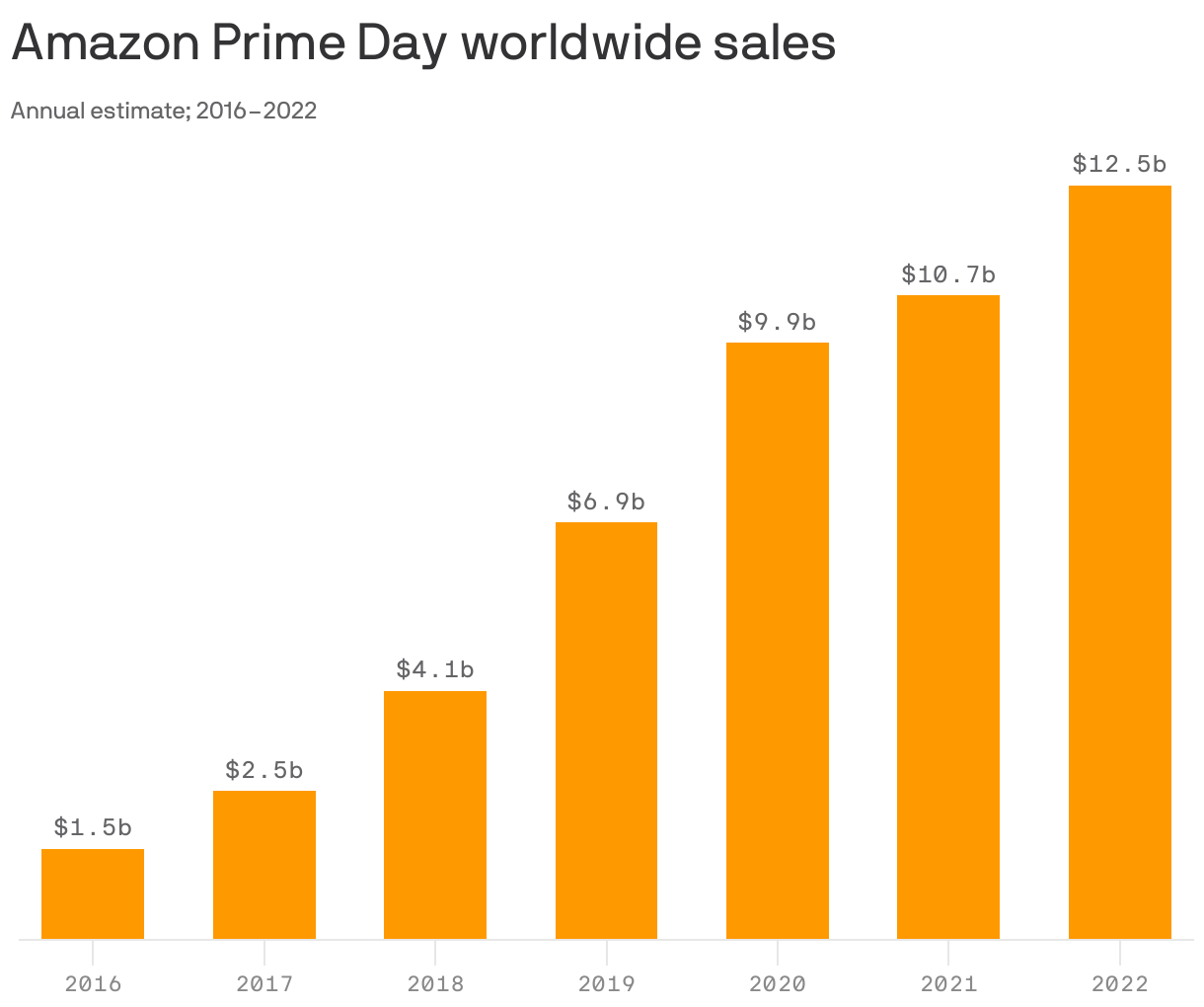
Amazon continues to tout Prime Day's growth year after year.
Why it matters: The giant summer sales event has helped drive new signups to Amazon's Prime subscription service, minting new members who spend at least two to three times more a year than non-members.
By the numbers: Amazon Prime Day this year saw global sales grow 17% from last year, to $12.5 billion this year, Insider Intelligence estimates.
- Comparatively, Adobe Analytics says total U.S. sales hit nearly $12 billion this year.
- Worth noting: Online retail prices grew 0.3% in June from last year, meaning higher prices did not have a significant impact on sales growth, according to Adobe.
Amazon did not release sales numbers itself today. But the company said it sold nearly 10 times the amount of goods this year — 300 million items — during Prime Day than its first year, 2015.
Be smart: Amazon Prime Day was actually 48 hours. The company expanded its Prime Day sales beyond 24 hours in 2017.

Fed watchdog: Top officials did not break law in trading scandal probe

The Federal Reserve's government watchdog on Thursday cleared two top officials of any wrongdoing in a financial market trading scandal that rocked the central bank last year.
Why it matters: It was the biggest ethical scandal in the Fed's history, which drew ire from lawmakers and raised questions about how top economic policymakers can benefit from the policy they set.
Everything is still fine, apparently
/2022/07/14/1657822149534.gif?w=3840)
Although economic storm clouds are everywhere, it has yet to rain.
Why it matters: The market has been pricing in the growing risk of a recession as inflation continues to soar.
- But businesses are in good shape and consumer spending — the backbone of the U.S. economy — remains strong because workers have more income and "jobs are plentiful," according to JPMorgan CEO Jamie Dimon.
Driving the news: Americans are spending 10% more than they did last year and about 30% more than 2019, Dimon said this morning on a call with analysts as he reviewed second quarter results. (They fell short of Wall Street expectations.)
- On the same call, CFO Jeremy Barnum noted that the country's biggest bank has "yet to observe a pullback in discretionary spending, including in the lower income segments."
By the numbers: Travel and dining spending jumped 34% over last year, Barnum said, as consumers shifted their demand from goods to services this year.
- Combined credit and debit spending is up 15%, he added.
Yes, but: Inflation is eating into take-home pay, making more rely on credit cards, which may dent growth going forward.
- Real average hourly earnings dipped 1% from May to June, and 3.6% from June of last year to this year, according to government data out this week.
What they're saying: "The most important indication for the economy over the next few weeks will [be] earnings releases as companies report," Gargi Chaudhuri, head of BlackRock's iShares Investment Strategy Americas, wrote earlier this week.
- Specifically, Chaudhuri and her team will be keeping an eye on which companies can continue to pass high prices onto consumers, and which sectors are revising forecasts lower.
The big picture: "Even if we go into a recession, [consumers are] entering that recession with less leverage, in far better shape than they did in '08 and '09, and far better shape than they did even in 2020," Dimon said.

Wordle to be reimagined as a board game

Hasbro and the New York Times are partnering to turn the popular word puzzle game Wordle into a board game, the companies announced Thursday.
Flashback: Wordle, a daily word game which was bought by New York Times for an undisclosed price in January, went viral after it was first released to the world last October.

Unwanted Amazon purchases can earn you a Kohl's discount

If you placed too many Prime Day orders or end up with unwanted purchases, it’s possible to get rewarded for your Amazon returns.
The big picture: Amazon said its two-day sale, which ended Wednesday, was its “biggest ever” with Prime members worldwide saving more than $1.7 billion. Still, it’s inevitable that shoppers will end up sending some items back.

Nissan Leaf EV said to be discontinued

The Nissan Leaf's days are numbered.
Driving the news: Nissan is discontinuing the small electric car "by mid-decade," trade journal Automotive News reported Thursday.
- Nissan representatives did not immediately respond to Axios' requests for comment.
Why it matters: Electric vehicles are widely seen as the future of the auto industry (hello Tesla), but early models like the Leaf failed to catch on.
- "Leaf was an attempt at bringing electrification to the masses, but with quirky styling and range limits ... it never really had a chance at becoming what it set out to be," Edmunds analyst Ivan Drury tells Axios in an email.
Flashback: After its debut in 2011, the Leaf quickly became the best-selling EV in the world.
- But it soon ceded the throne to Tesla, and never came close to achieving the vision laid out by former Nissan CEO Carlos Ghosn: selling 500,000 a year by 2013.
- Nissan sold only 14,239 units of the Leaf in the U.S. in 2021, a sliver of the 977,639 vehicles it sold that year.
Zoom out: The Leaf's struggles were tied to its low battery range and its compact frame, with the first version (a 2011 model) traveling only about 73 miles on a single charge.
- The range improved over time, but Nissan has since shifted much of its attention to future EVs, like the sleek Ariya crossover.
- When gas prices tumbled in the late 2010s, the Leaf also fell prey to shifting consumer demand for SUVs and pickups.
The bottom line: The Leaf is now blowing in the wind, but EVs are far from dead.
- "There's going to be a lot of new product that comes to market that will be far better with better battery technology," Autotrader analyst Michelle Krebs tells Axios.
(Editor's note: Autotrader is owned by Cox Enterprises, an investor in Axios.)

You.com raises $25 million to challenge Google's search dominance

"Why won't Google just build that?"
- That question has been posed to entrepreneurs by venture capitalists so often that it's become a cliché. But not when asked of Richard Socher, the former Salesforce chief scientist who founded a web search startup called You.com.
Driving the news: You.com today is announcing $25 million in Series A funding led by Radical Ventures.

Embattled crypto lender Celsius files for Chapter 11 bankruptcy

Celsius Network on Wednesday filed for Chapter 11 bankruptcy protection after the embattled crypto lender halted customer withdrawals in the face of insolvency. Celsius is casting its bankruptcy as a restructuring rather than a liquidation.
Why it matters: The firm is just one among several platforms in crisis amid the great debt unwinding that marks this crypto winter, leaving their customers—many of whom were regular people drawn in by the firm's promises of uber-high yields—in the lurch.

Lower production is driving up new car prices — and automakers' profits

Car manufacturers and dealers are making more money by selling fewer vehicles at higher prices — and this could be a lasting transformation for the U.S. auto industry.
Driving the news: After the chaos and disruption of the pandemic, sales and production of vehicles in the U.S. remain well below pre-COVID levels.

Your commute is hundreds of dollars more expensive this year
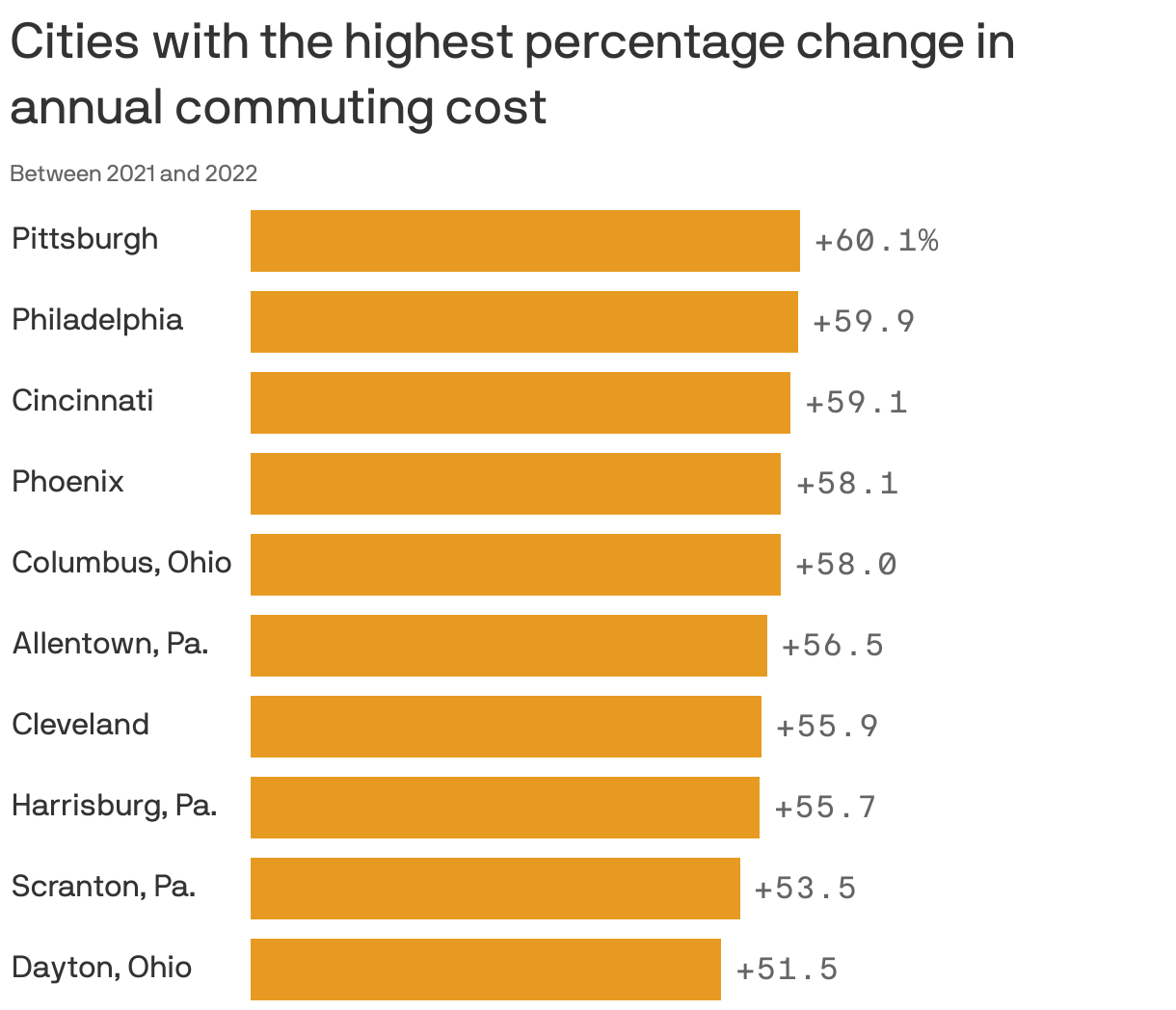
Rising prices for gas and auto insurance mean the average American is now paying $2,914 a year to commute, up $757 — or 35% — from last year, according to a new report.
Why it matters: The sheer expense of getting to work is not just hurting our bank accounts — it's contributing to wrangling between workers and employers over returning to the office.


FDA issues more than 100 warnings over new synthetic nicotine law

The FDA said it has issued warnings to two manufacturers for marketing synthetic vaping products without authorization and sent 107 other warning letters to retailers for illegally selling such products to underage buyers in recent days.
Driving the news: The Food and Drug Administration has moved to crack down on vaping companies that use non-tobacco nicotine products since a law designed to close a loophole that companies had exploited to avoid oversight of devices like e-cigarettes took effect in April.
Uber sued by women over driver sexual assault complaints

Uber is being sued by women who allege they were assaulted by drivers who use the ride-hailing service across the U.S. and the lawyers who filed the suit say they represent “approximately 550 clients with claims" against the company.
Details: The lawsuit alleges passengers "were kidnapped, sexually assaulted, sexually battered, raped, falsely imprisoned, stalked, harassed, or otherwise attacked by Uber drivers," per a statement from attorneys at Slater Slater Schulman LLP, who filed the complaint in the San Francisco County Superior Court on Wednesday.

Manhattan rents cross $5,000 threshold for first time


The average price of a rental apartment in Manhattan surged above $5,000 in June for the first time, hitting $5,058, according to a report from brokerage firm Douglas Elliman out Thursday.
Why it matters: Manhattan is ultra-expensive — typically an outlier — but in this case it's on-trend. Rents are up across the country, as soaring mortgage rates keep potential homebuyers stuck in the rental market.