There are a handful of perks to living in the hometown of a global tech titan — among them, thousands of high-paying jobs, bustling shops and restaurants and first access to the coolest new tech.
What's going on: Seattle, Hangzhou, and Columbus, Ohio are among a lucky few places that have become lab cities for the cutting-edge technologies of the future. Here, companies roll out their new concepts for shops, cars and hotels, and work out the kinks before peddling them to the rest of the world.
Deepfakes — realistic AI-generated audio, video, and images — are denounced as a threat to democracy and society by experts and lawmakers. So why are academics producing research that advances them?
Why it matters: Increasingly accessible tools for creating convincing fake videos are a "deadly virus," said Hany Farid, a digital-forensics expert at Dartmouth. "Worldwide, a lot of governments are worried about this phenomenon. I don't think this has been overblown."
As Facebook tried to regain its footing after the sudden departure of Instagram's founders, the departed co-founder of WhatsApp gave Forbes an account of his clashes with the social giant after it bought the messaging app in 2014. A Facebook executive promptly fired back with a 600-word note (on Facebook).
Why it matters: The dramatic back-and-forth underscores the disconnect between Facebook’s leaders and the founders of WhatsApp and Instagram as those apps buoyed the company in the face of stagnant growth on its original platform.
While major tech and telecom companies told lawmakers Wednesday that they generally support federal privacy rules, they pushed back on some of the most significant policy changes backed by privacy advocates.
Why it matters: Companies are drawing lines in the sand for lawmakers who are under pressure to produce something, thanks to new privacy rules in Europe and a California privacy law that will go into effect in 2020.
Why it matters: Rather than initially disclosing the breach, Uber paid a hacker $100,000 to destroy the stolen data. California Attorney General Xavier Becerra said the settlement shows Uber that "we will hold them accountable" in protecting user data.
The development of autonomous vehicles (AV) continues at a fast pace. Ford and GM, for example, have invested heavily into this technology to launch commercial models as early as 2020, while Japan hopes to showcase AVs at the 2020 Tokyo Olympics manufactured by Toyota and Honda. As remarkable as these advances are, significant business challenges remain.
The big picture: Automation comes at a price, and that price is power. The more autonomous features a vehicle has, the more power it requires from its battery system. As AV technology develops, larger batteries will be required that will, in turn, require longer charger times.
21st Century Fox says will sell its minority stake in Sky Broadcasting to Comcast.
The details: Disney, which struck a deal to buy the majority of Fox's entertainment assets this year, including its 39% stake in Sky, said in a statement Wednesday that it agreed to the transaction because it will help offload debt.
No one ever says "Let's see what's on Google" the way they might say "Let's see what's on Facebook" when they turn on their phones or computers. The search giant is hoping to change that, with the announcement Monday that it will offer a personalized feed of stories, items and links on the Google search home page on all mobile browsers.
Why it matters: After 20 years of dedication to its minimalist home screen, Google may be ready to embrace the shape of Facebook's News Feed, which holds users longer.
A group of companies including Apple, Google and AT&T will call for federal privacy legislation at a Wednesday Senate hearing.
Where it stands: Despite that agreement, expect the firms' differences to be in stark relief, as some of them look to differentiate themselves from the major ad platforms, Google included, that have led the way in monetizing user data.
Eager to use artificial intelligence, some companies may be unnecessarily complicating easy business problems.
What's going on: Companies are over-using complex AI techniques when they would be better served with simpler approaches. Rule-based systems, for instance, show their work, thus allowing non-experts to pop the hood and see why an algorithm is misbehaving, unfair or biased.
State attorneys general discussed privacy concerns with large platforms during a meeting on Tuesday with Attorney General Jeff Sessions, according to accounts of the closed-door session.
What to watch: Whether state attorneys general or the Justice Department step up investigations into the privacy practices of Silicon Valley or the market dominance of major online platforms.
Google Ventures has participated in London-based cybersecurity startup Snyk’s latest Series B $22 million investment round, with venture capital firm Accel leading the round.
The trend: The tech titan’s venture capital arm appears to have a knack for cybersecurity investments that lead to acquisition deals. In 2012 Google Ventures invested in Duo Security, a multi-factor security tool which Cisco announced this year it intends to acquire. More recently in 2016, Google Ventures invested in CoreOS, a container management system which was acquired by RedHat earlier this year.
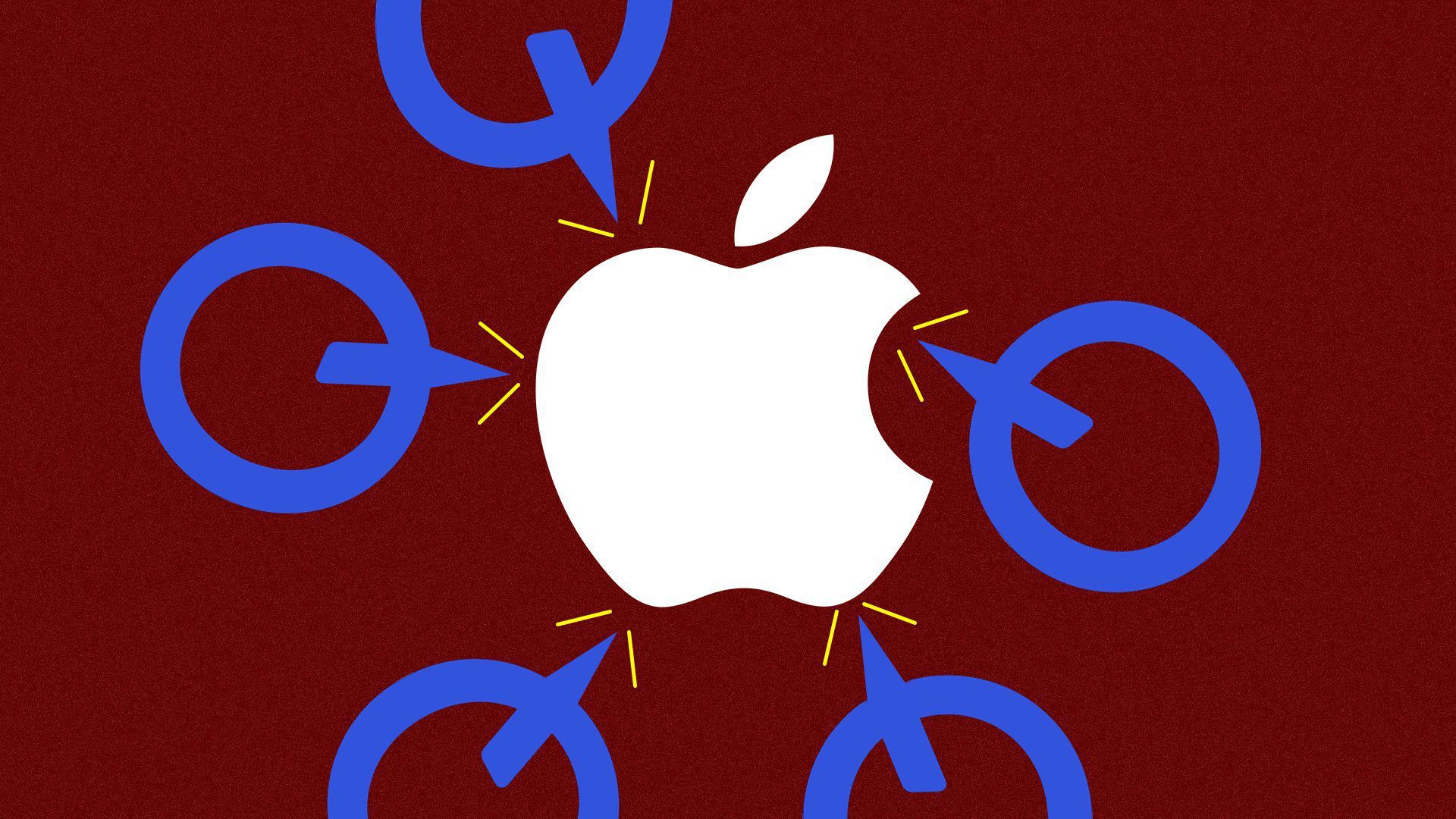
The most high-stakes legal battle in tech just got even juicer. In court documents, Qualcomm says new evidence shows Apple made improper use of its modem technology to help Qualcomm rival Intel develop a more competitive alternative.
Why it matters: Apple and Qualcomm were already locked in a bitter, global court battle. Both companies are behemoths used to getting their way in business dealings — and their face-off has been epic.
The Trump administration has done little to support artificial intelligence research, experts say. Now, the top members of a House subcommittee are calling for a plan to maintain American leadership in AI.
Why it matters: As the White House idled, China implemented a national plan that is propelling its AI research and implementation. Now, the two countries are in a race to reap the technology's economic and military rewards.
Representatives of more than a dozen state attorney general offices will convene Tuesday morning with U.S. Attorney General Jeff Sessions to discuss concerns about social media platforms.
Why it matters: The threat of an antitrust investigation of the big tech platforms looms over the proceedings, but it’s unclear what exactly the Department of Justice's plan is for the gathering.
Our thought bubble: Instagram, which has become one of the most successful social media companies in the world under Systrom and Krieger, is seen as something of a savior for Facebook, providing a steady source of growth as its original platform stumbled. The photo-sharing app now has more than one billion users.
Ride-hailing drivers have seen their monthly paychecks cut in half in the last four years, a sign of declining fortunes for gig workers at a time the U.S. economy is moving away from full-time employment, according to a study released today.
What's going on: While U.S. wages are generally creeping up, ride-hailing drivers are earning an average of $783 a month, down from more than $1,500 in 2014, according to the report from the JPMorgan Chase Institute, the bank's think tank.









![A test engineer in a driverless taxi of Yandex.Taxi ahead of a test-drive in the science city [naukograd] of Innopolis. Yegor Aleyev/TASS (Photo by Yegor Aleyev\TASS via Getty Images)](https://images.axios.com/Bczg_Tp6lzWDwc2yB1MYlxgVfcU=/0x0:5184x2916/1920x1080/2018/09/21/1537559835152.jpg?w=3840)