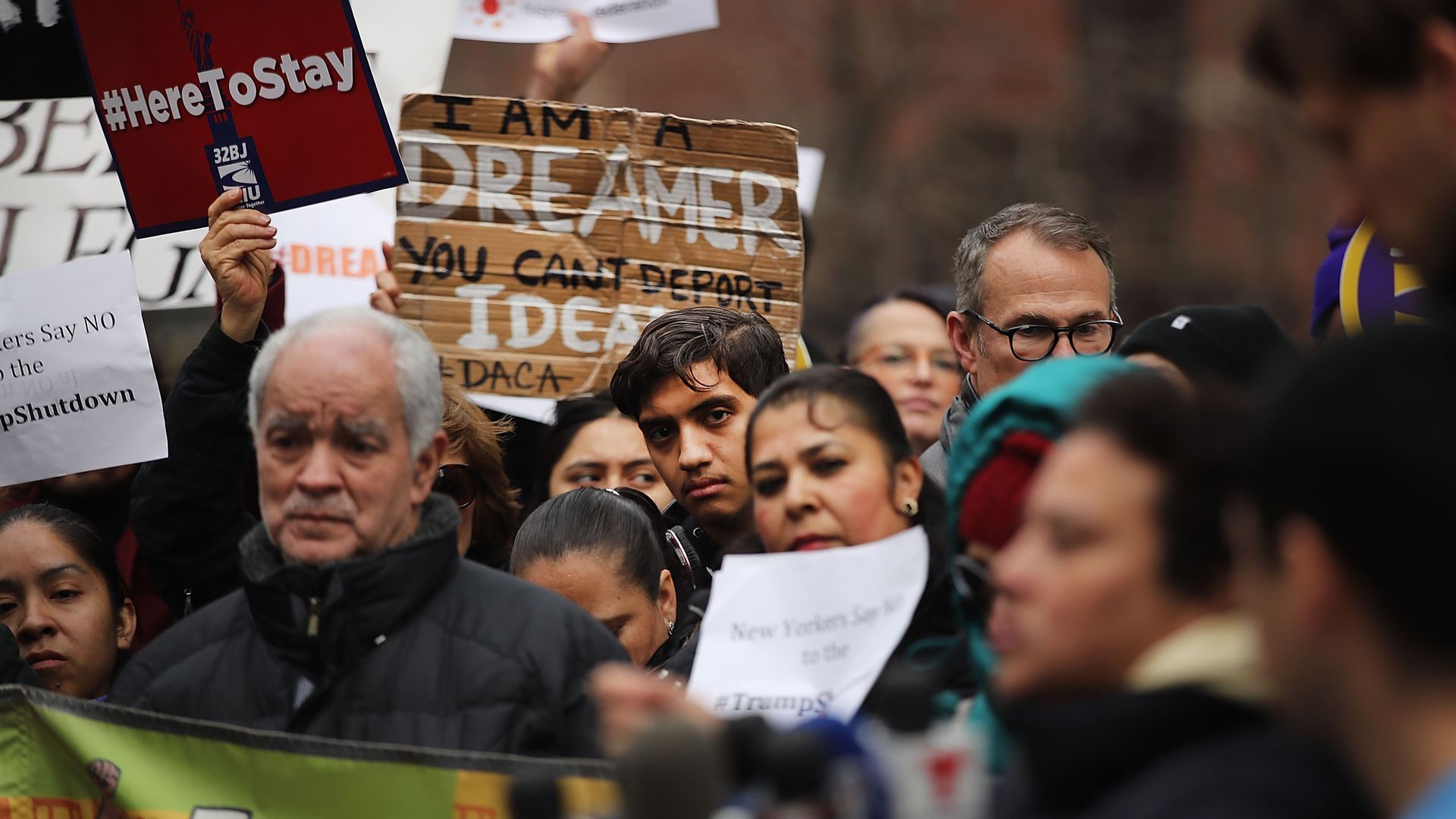
A federal judge in New York ruled today that while the Trump administration has the right to rescind DACA, it has not provided sufficient legal reasons to do so and thus the program must remain in place while a legal battle plays out. A judge in California made a similar ruling last month.
Why it matters: The rulings have bought Congress some time past the March 5th deadline established by President Trump, but make it "much likelier that the Supreme Court will take up the California case,” Leon Fresco, immigration attorney and former Deputy Assistant A.G. at DOJ’s Office of Immigration Litigation, tells Axios.
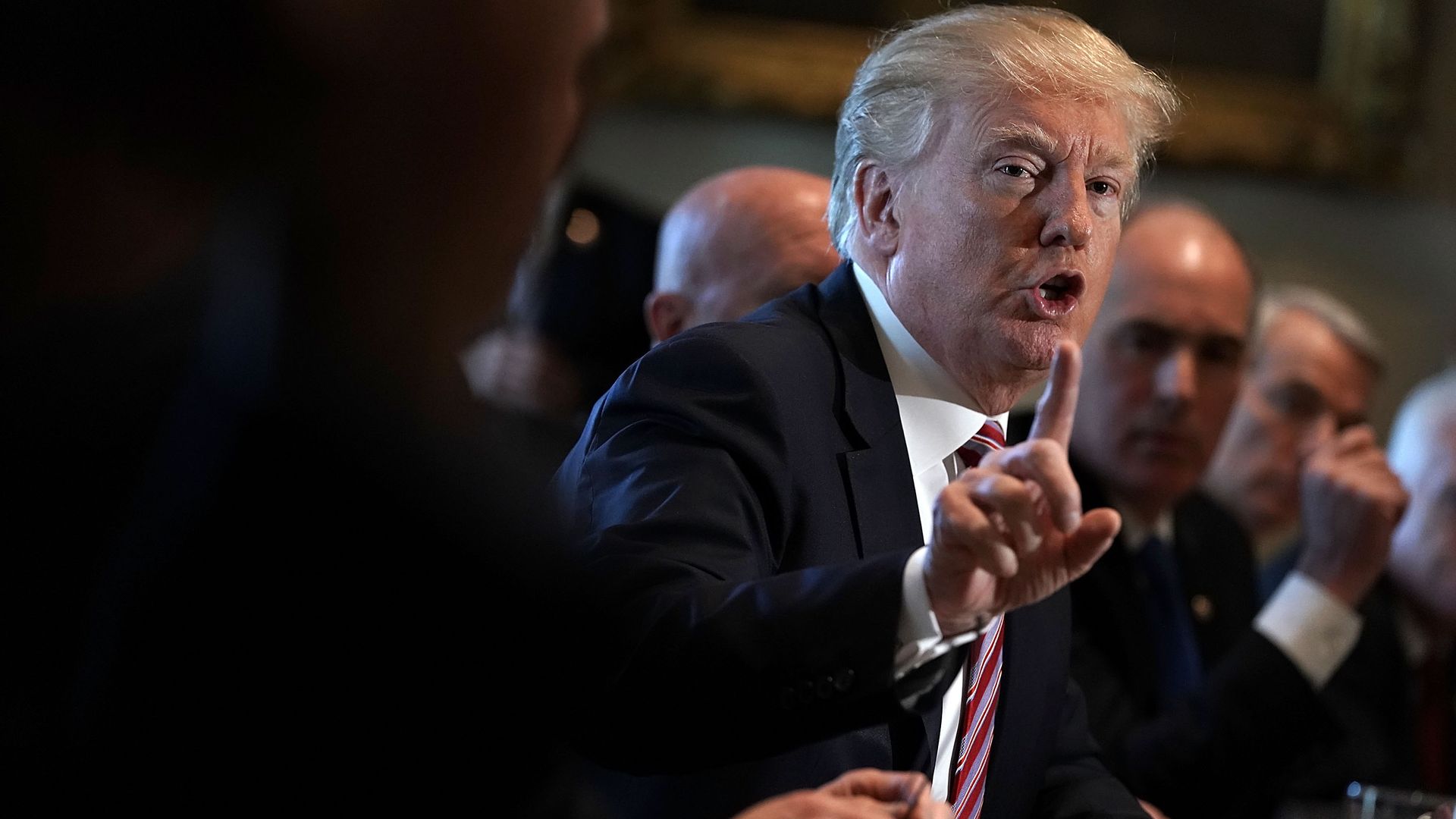
Of President Trump's 87 judicial nominees, 80 of them are white, USA Today reports. The only president in recent history to have more white nominees was President Reagan. Trump also has only one African American and one Hispanic nominee, plus five Asian American nominees.
The big question is if Trump's administration "is passing over potential African American and Hispanic candidates, or whether they are having trouble finding those with sufficiently conservative credentials," USA Today notes. 36% of President Obama's nominees were minorities; 18% of President Bush's were, per USA Today.
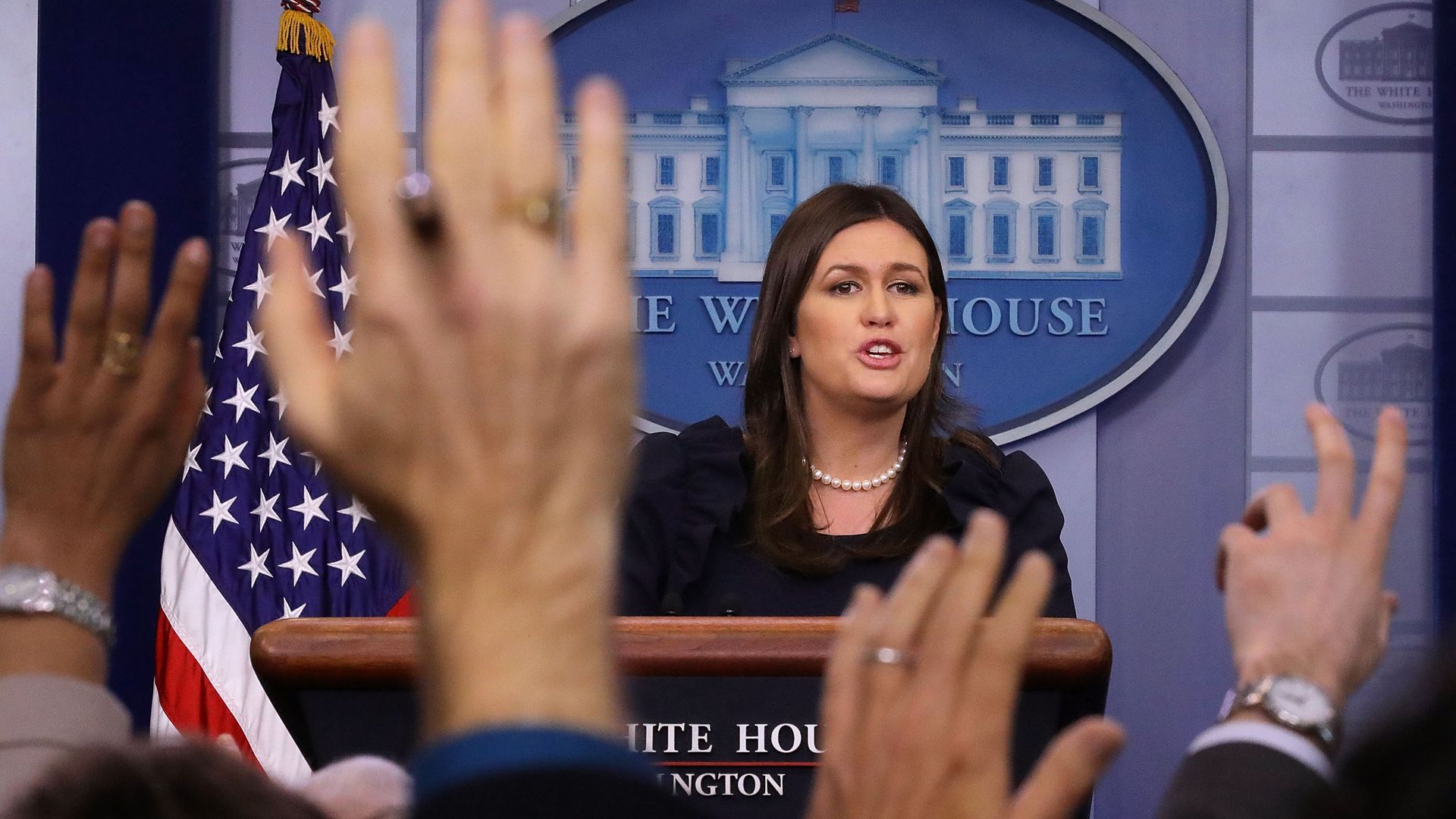
In a briefing Tuesday, Press Secretary Sarah Sanders said that the investigation of former White House staffer Rob Porter closed in January and emphasized that both the White House and FBI Director Chris Wray have told the truth about the timeline leading up to Porter's departure.
Why it matters: Wray has explained that the FBI's file on Porter closed last month, before allegations of domestic abuse between Porter and his ex-wives surfaced last week. However Sanders said today that the "White House Personnel Security Office...had not finished their process" in January. This is another example in a string of confusing instances coming out of the White House about Porter.
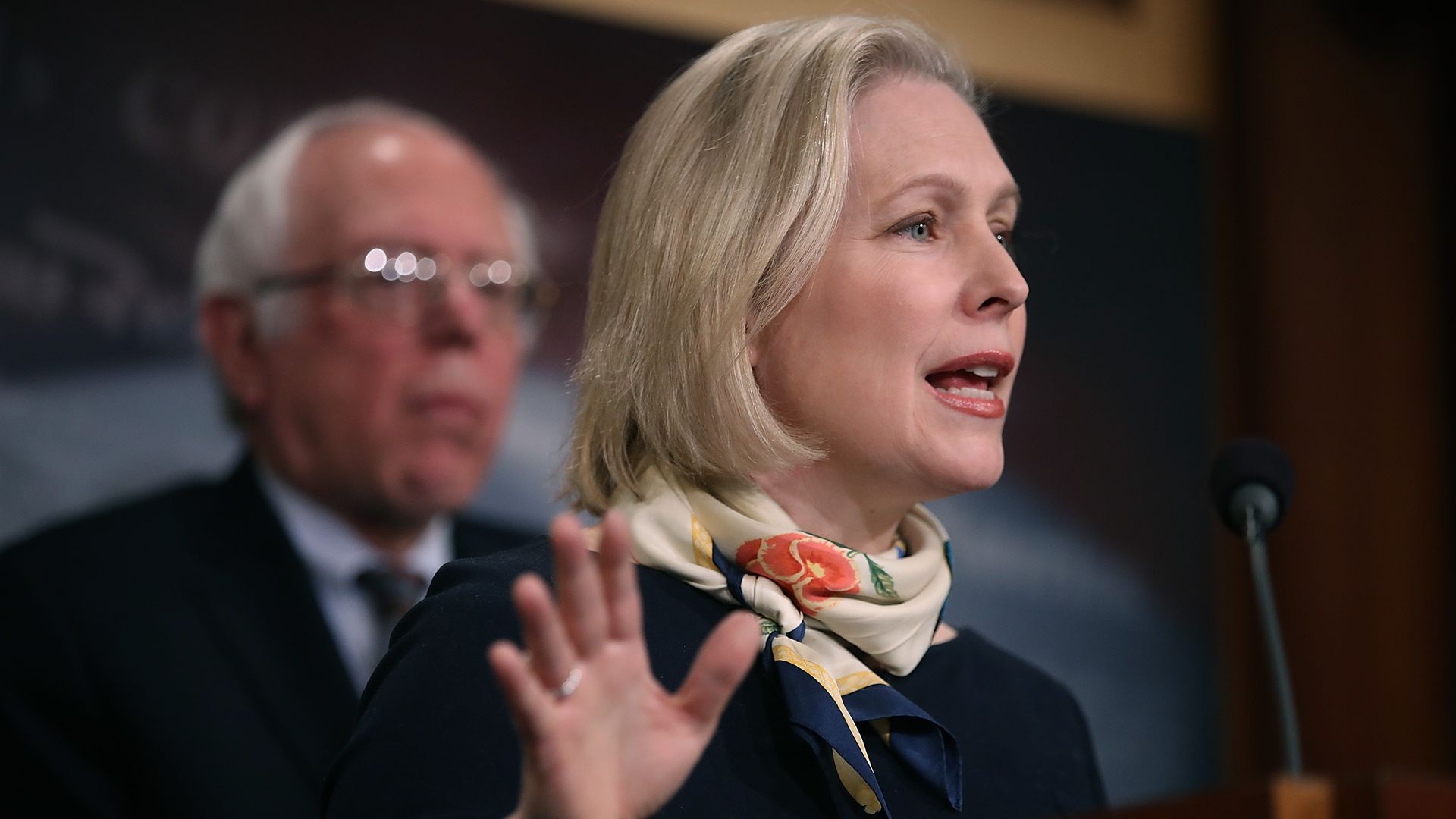
Sen. Kirsten Gillibrand on Tuesday pledged to stop accepting campaign contributions from corporate PACs, joining a small group of sitting Senators who made a similar move.
The backdrop: The pledge by the New York senator, who’s up for re-election, coincides with an endorsement from End Citizens United, a Democratic group created in response to the U.S. Supreme Court’s landmark ruling in 2010 that allows unlimited corporate spending to support political campaigns.
A rising number of retirements, court rulings dismantling Republican gerrymanders, and falling behind in fundraising and candidate recruitment are a few ways Republicans are losing their advantage in the months before the 2018 midterm elections, per NYT.
Why it matters: There's no guarantee that Democrats will win the House — there are too many things that can change between now and November. But if these disadvantages for Republicans continue to rise throughout the year, they'll have a tougher time fighting off the wave election many Democrats are predicting.
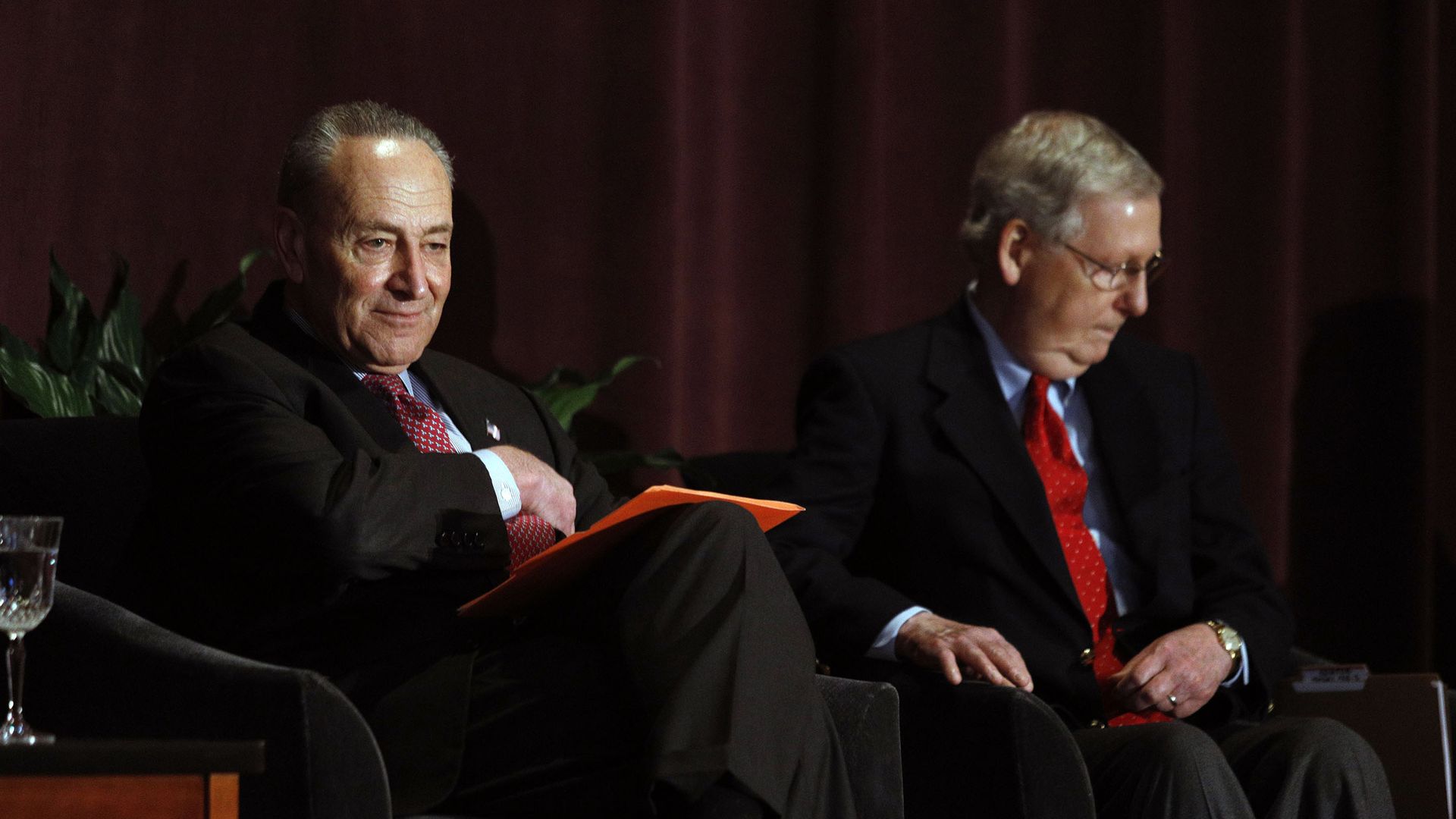
Senate Majority Leader Mitch McConnell suggested today that the immigration debate begin with a bill on sanctuary cities. Sen. Chuck Schumer objected, suggesting they start with the bill proposed by seven Republicans based on President Trump’s immigration priorities or the bipartisan proposal by Sens. Chris Coons and John McCain.
Why it matters: The fight has started before the debate has even begun. You can expect a lot more partisan bickering over what to include and which amendments to accept in the final Senate immigration bill.
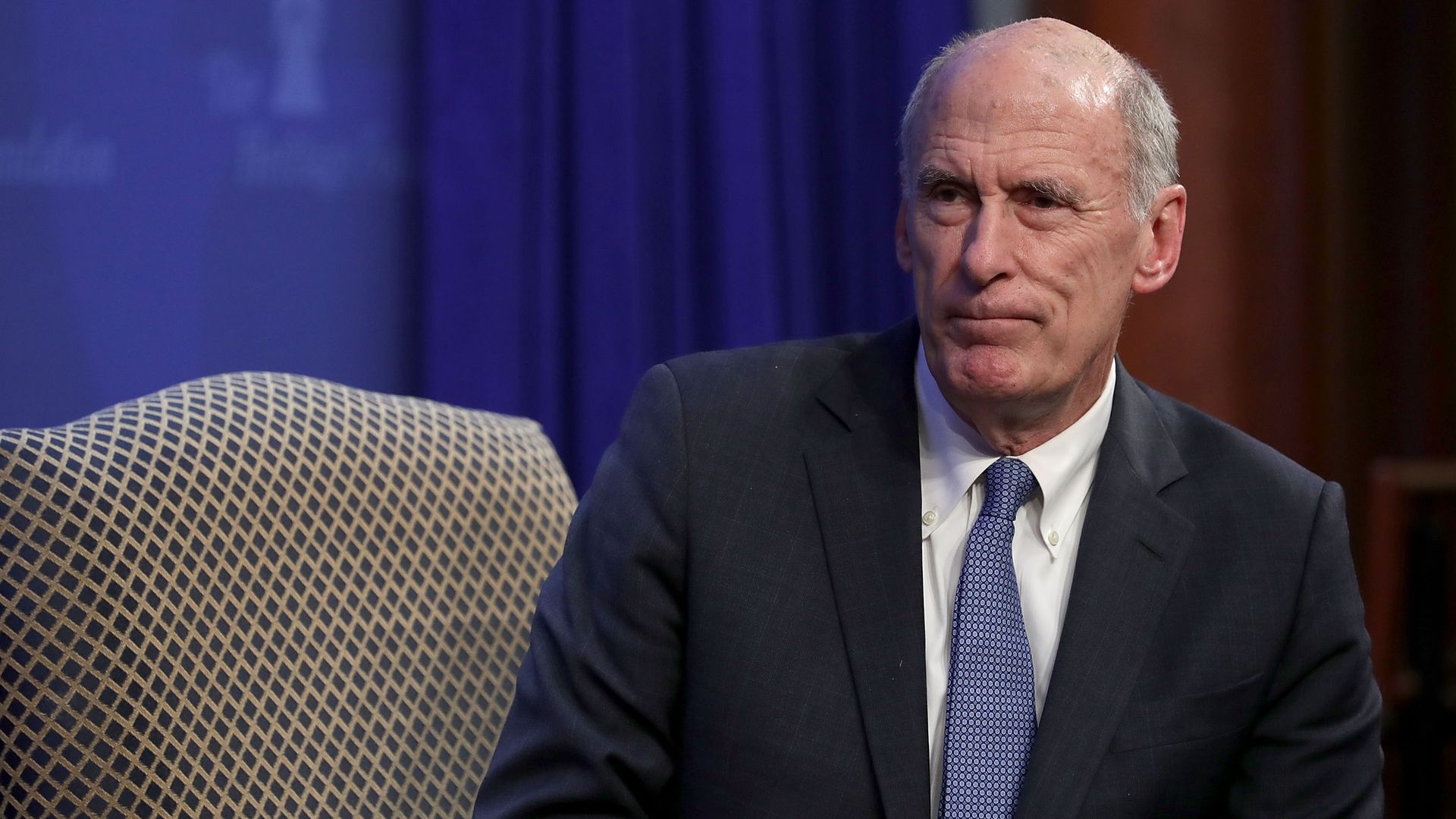
Director of National Intelligence Dan Coats said that Russia “views the 2018 midterm elections as potential for Russian influence operations ... Frankly, the United States is under attack," Coats said speaking to the Senate Intelligence Committee in a hearing Tuesday with other intelligence directors.
Why it matters: President Trump has gone back and forth on Russia's involvement in U.S. election systems. The nation's top intelligence officials, including Coats, each confirmed the consensus of the intelligence community that Russia unequivocally interfered in the 2016 election and continues to strategize on how to do so again.
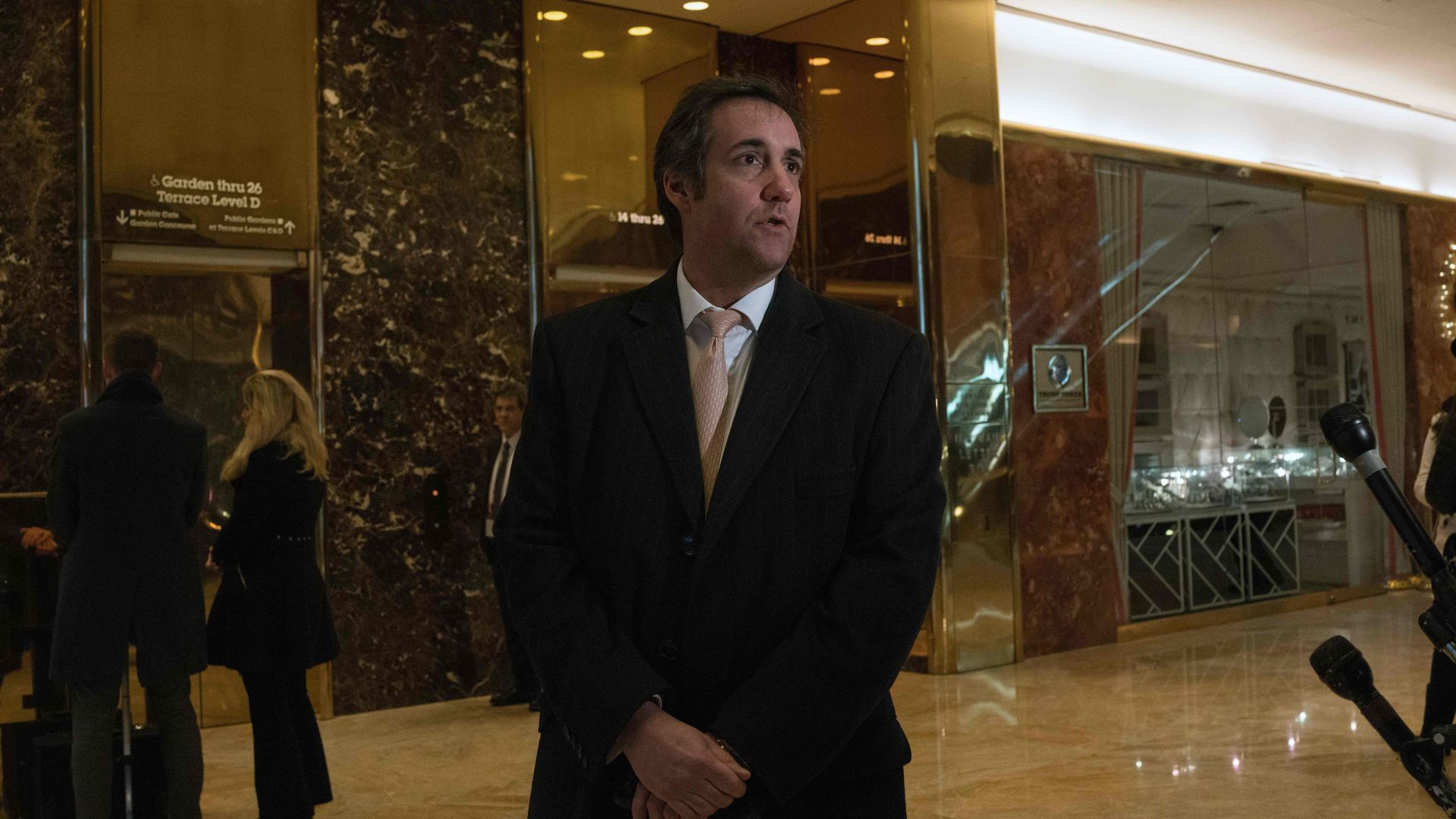
President Trump's personal attorney, Michael Cohen, is pitching a book to publishers that details the "complexities and nuances" of the First Family, according to a proposal shopped to multiple publishers and obtained by The Daily Beast. The book is being pitched with the title, Trump Revolution: From The Tower to The White House, Understanding Donald J. Trump.
What to expect: Cohen’s proposal addresses his relationship with the president through the campaign and during his time at the White House. It will also reportedly detail how few people outside Trump’s family truly understand the president besides Cohen, who calls himself the "family fix-it guy." The book is expected to be a partial response to Michael Wolff's Fire and Fury.
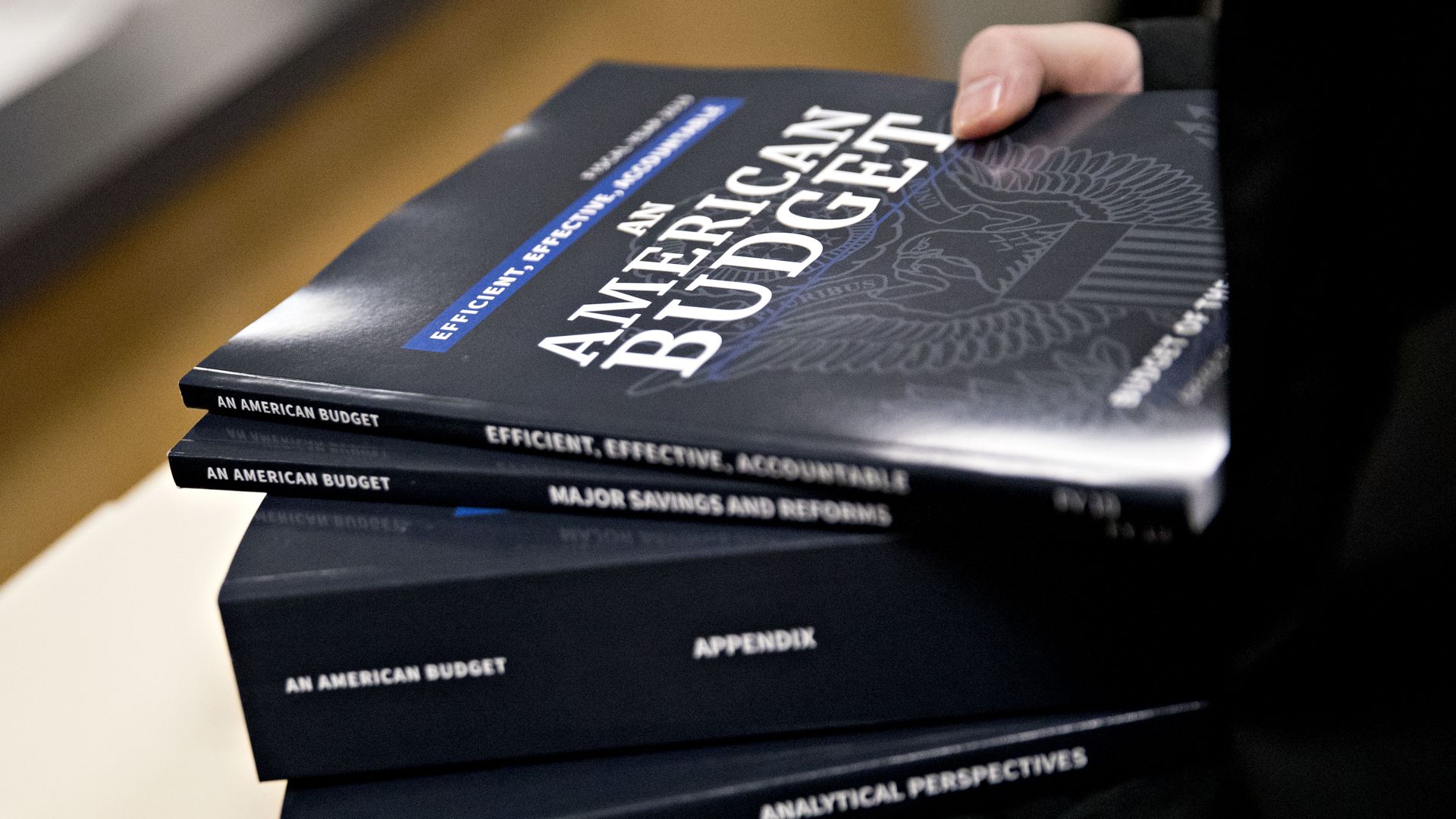
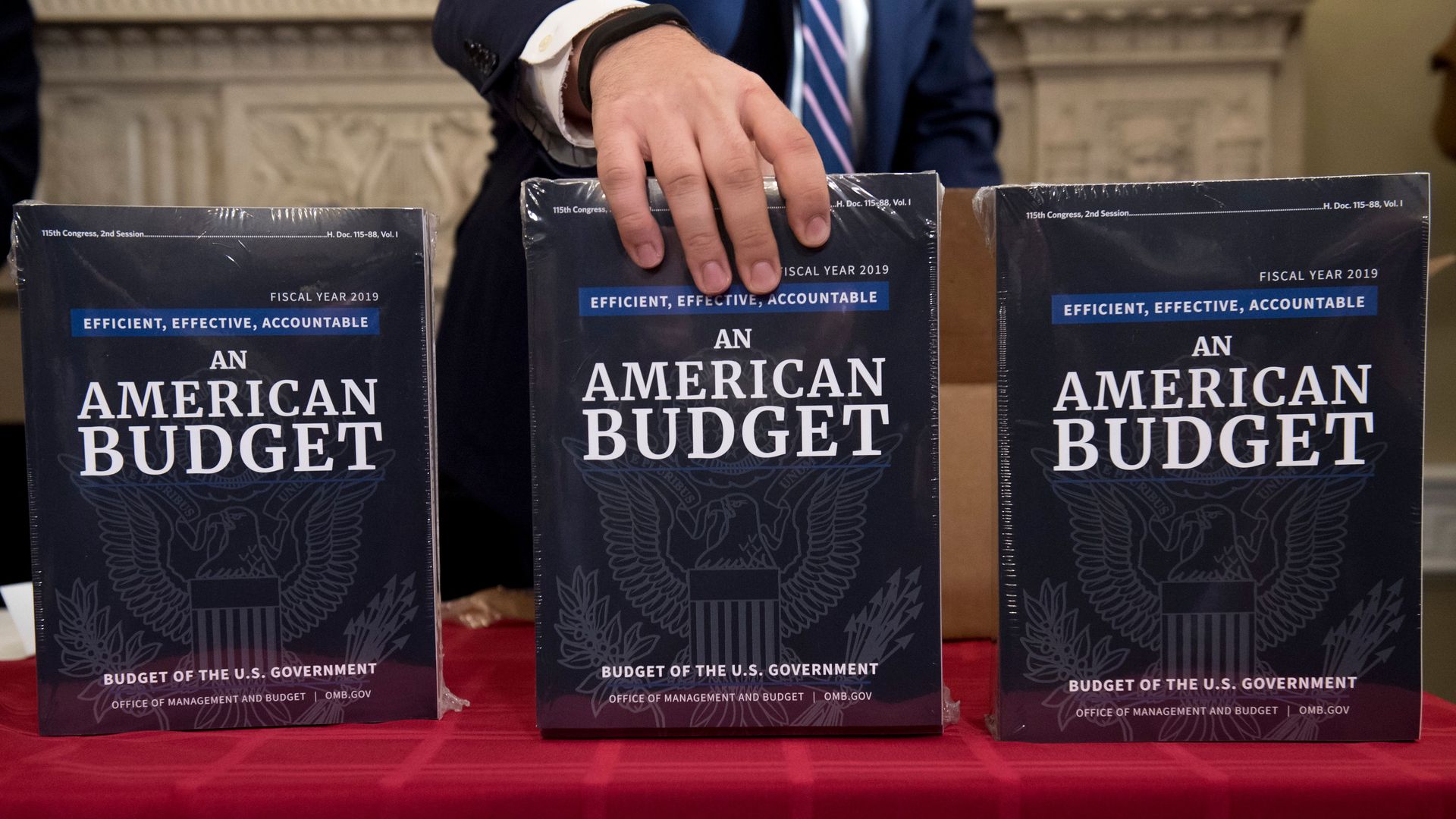
Secretary Mattis’s National Defense Strategy targets readiness, lethality and reforms to better counter great power competition from China and Russia. Yet President Trump’s budget calls for only a 2% annual increase in defense spending — enough to dig the Pentagon out of its current hole, but not enough to pursue the pivot envisioned in Mattis’s NDS or the rebuild touted by Trump on the campaign trail.
Presidents’ budgets are not legislative documents. They’re wish lists. So it’s easy to make too much of them — there’s really no penalty for swinging for the fences, nor is there much incentive to try to craft a budget that would please a lot of people.
The bottom line: A lot of these proposals would need congressional approval, and that’s why a great many of them will never see the light of day. But this is a pretty good roadmap to the administration’s priorities — one that should make Medicaid advocates, including hospitals, especially nervous.
An unusually high rate of staff turnover has characterized the first year of the Trump presidency, reports The New York Times' Peter Baker.
Why it matters: Axios' Mike Allen predicted this turmoil last October, calling the stampede to exit the White House in 2018 "the biggest threat to the Trump presidency, the markets and our ability to deal with future crises."
Starting in 2004, Appalachian counties filled with Kennedy Democrats began to shift Republican during presidential races. "And in 2016, Donald Trump carried each with 70% to 80% of the vote," USA Today's Rick Hampson writes from Barwick, Kentucky.
Why it matters: "What was Kennedy country is Trump country. Children of Kennedy Democrats are Trump Republicans."
"The World After Trump: How the System Can Endure," by Jake Sullivan — Hillary Clinton's chief foreign policy adviser, now at the Carnegie Endowment writes in the March/April issue of Foreign Affairs. Sullivan previously served in the Obama administration as State Department director of policy planning, and national security adviser to Vice President Biden.
The key quote: "Trump ... has thus far been unable to do the level of systemic damage in foreign affairs that he threatened on the campaign trail. He has ... been constrained by Congress, by his own national security team, and by reality."
"The White House and Congress have shown little willingness to cut back on spending, finding it easier to cut taxes and increase spending during Trump’s presidency," the WashPost reports in its lead story.
Why it doesn't matter: "The deep safety-net cuts in Trump’s budget may play to his base, but they will go nowhere in the Senate, where support would be needed from Democrats."
The Koch network, the most well-funded and powerful network on the right, is launching a $4 million ad campaign to hit vulnerable Democrats ahead of the midterm elections for their votes against the new tax law. The campaign is part of the network's plan to spend $20 million to advance the GOP tax cuts.
Why it matters: The Koch network has a history of running ads early in the midterm election cycle to try and shape races, and this is an example of them coming out in full force for 2018.