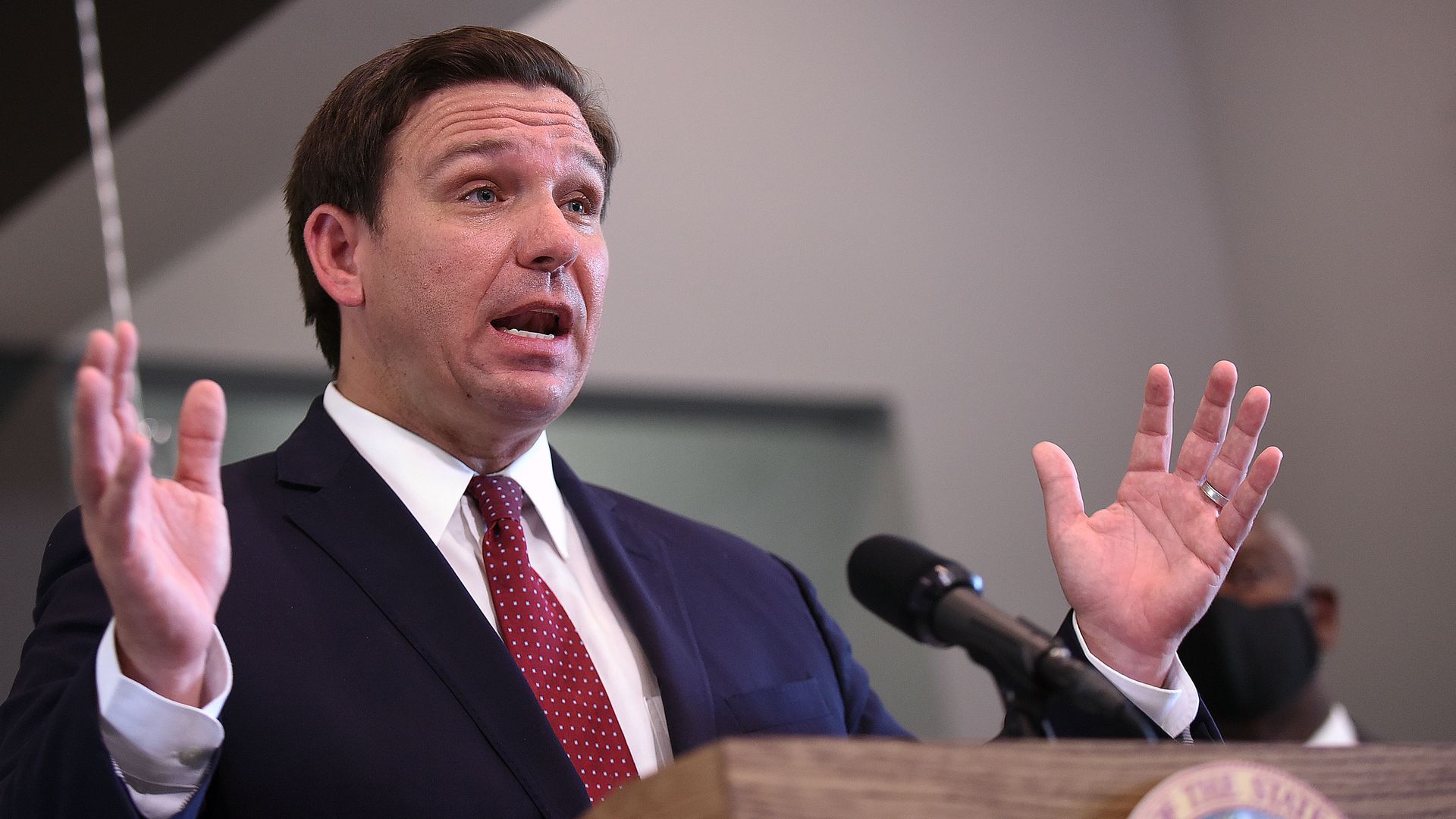
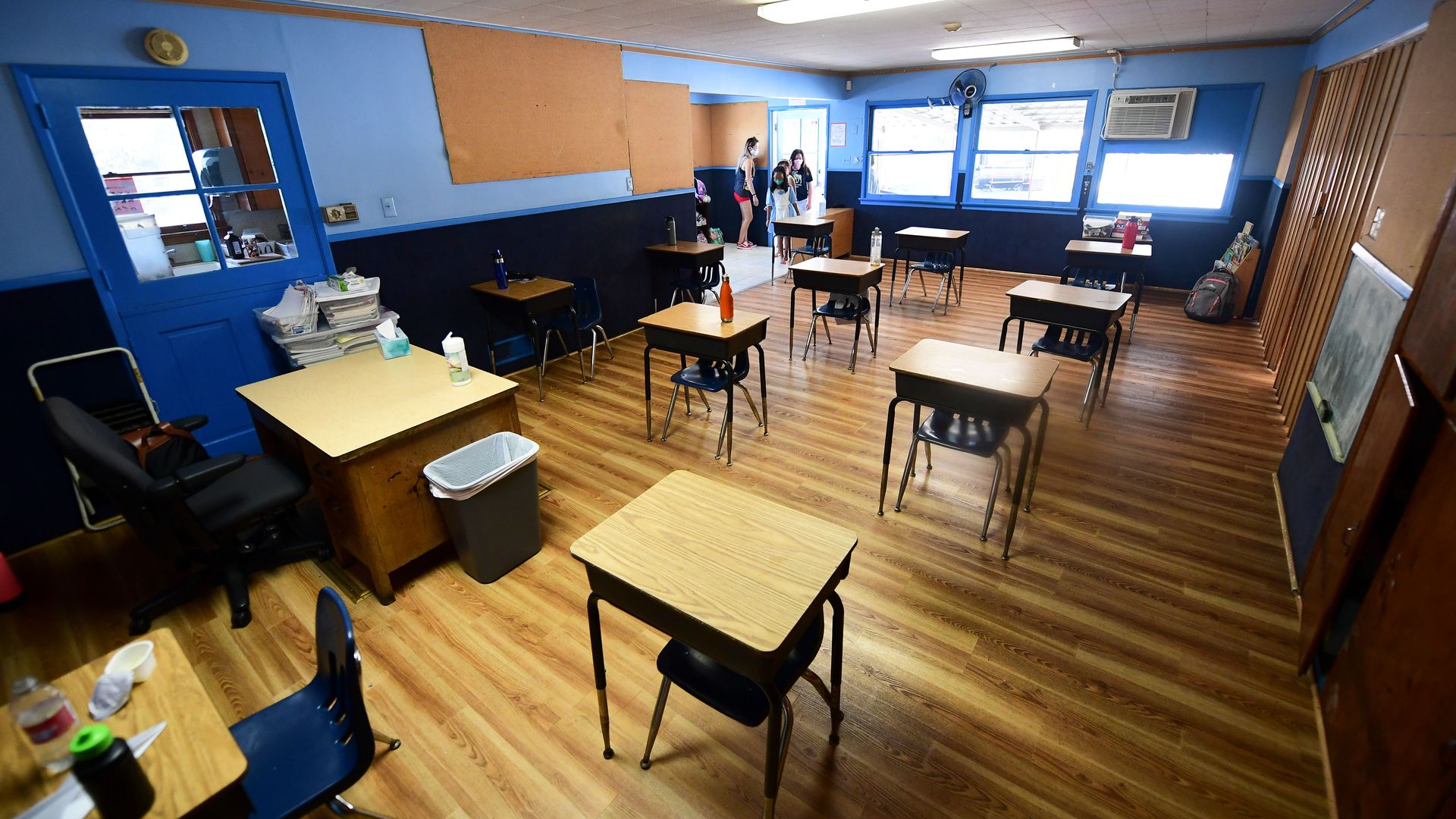
Florida is shaping up as America's bellwether on reopening schools, with teachers unions suing the state on Monday.
Why it matters: The state is the epicenter of the coronavirus outbreak in the U.S., home to five of America's 10 biggest school districts and governed by an ally of President Trump.
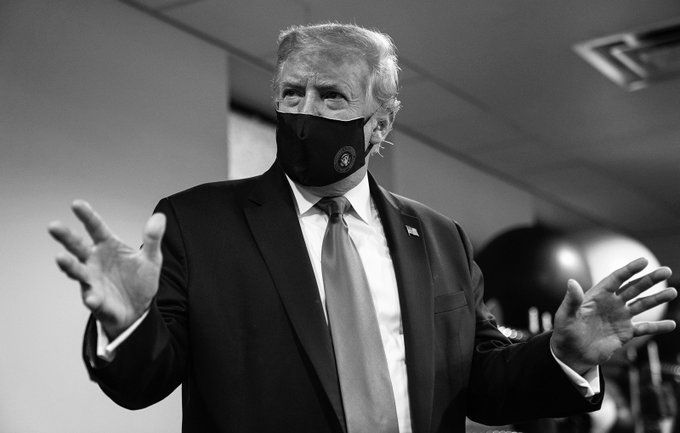
President Trump posted a photo of himself wearing a face mask on Monday and tweeted that "many people say that it is Patriotic to wear a face mask when you can’t socially distance."
Why it matters: It's the first time Trump has ever tweeted a picture of himself in a mask, which he had not worn in public until he visited Walter Reed National Military Medical Center earlier this month.
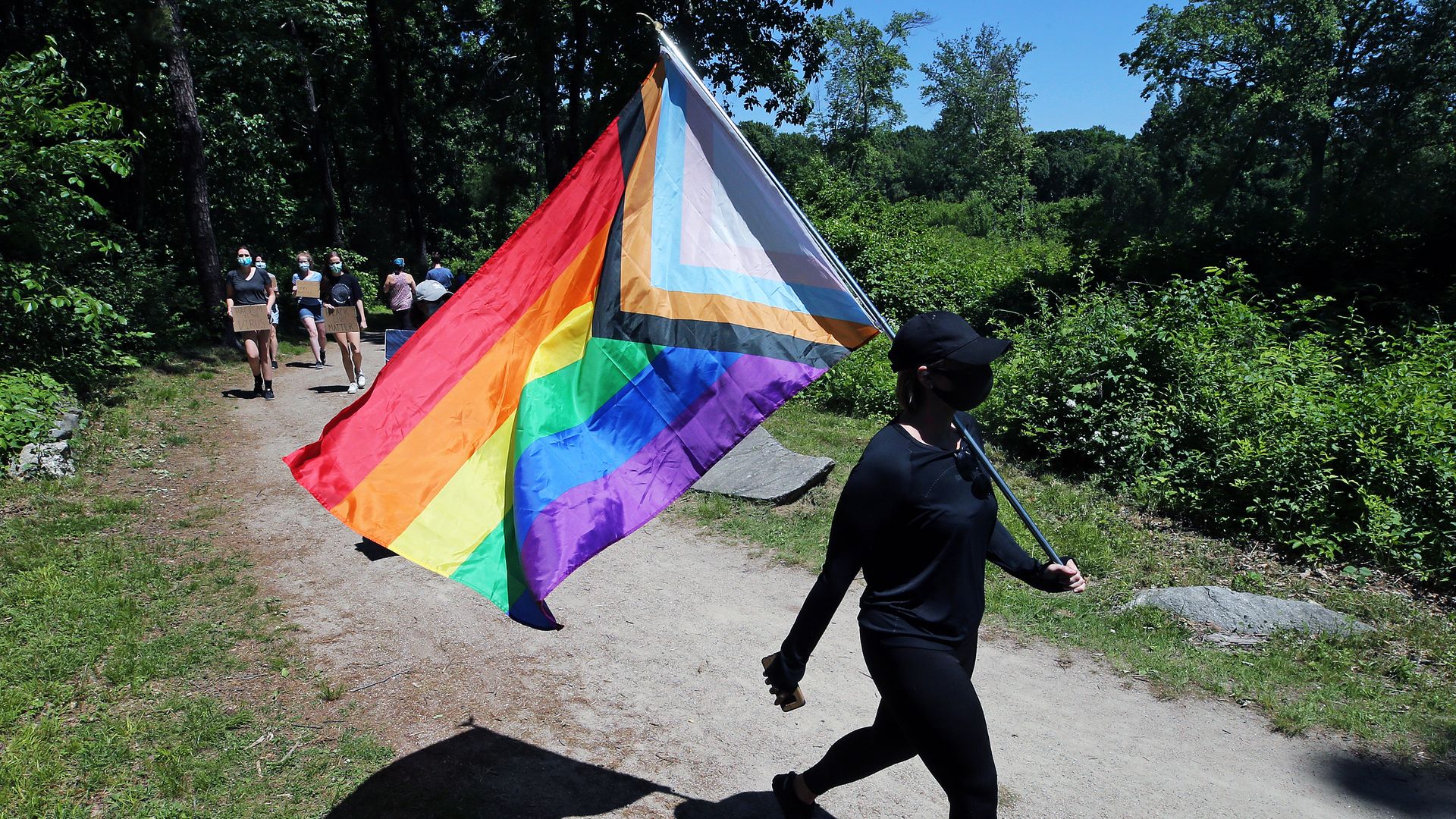
22 states and Washington, D.C., are suhing the Department of Health and Human Services over a rule finalized in June that would make it easier for doctors, hospitals and insurance companies to deny transgender people health coverage.
The big picture: The states and D.C. argue that patients won't seek medical care if they are afraid of discrimination. Many Americans are already avoiding doctors' visits during the coronavirus pandemic for financial reasons or fears of catching the virus, the New York Times reports.
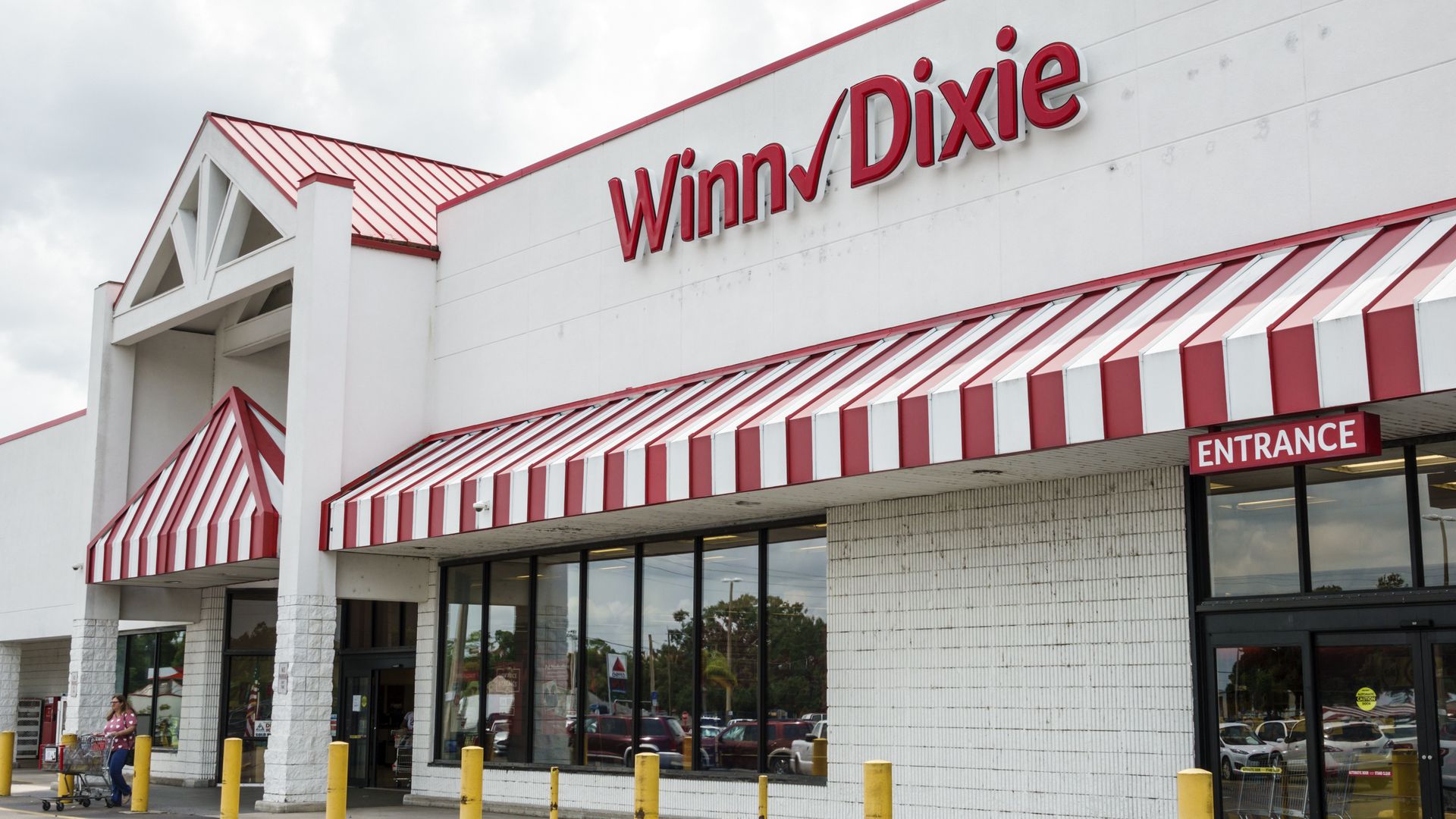
The parent company of Southern supermarket chain Winn-Dixie will not require face masks to be worn in its roughly 500 stores, saying it doesn't want to "put [its] associates in a position to navigate interpersonal conflict," reports the Washington Post.
Why it matters: The announcement underscores the political partisanship that has surrounded face mask requirements, despite scientific evidence suggesting they have been effective in stemming the spread of the coronavirus.
President Trump told reporters at the White house Monday that he plans to resume his daily coronavirus press briefings sometime this week, "probably starting" Tuesday.
Why it matters: The president ended the briefings in April after aides urged him to scale them back given their length and penchant for drawing controversy, such as when Trump suggested that disinfectants, like bleach, could be used to treat coronavirus.
A coronavirus vaccine from Oxford University and AstraZeneca, perhaps the most promising candidate currently in development, appears to be safe and produces an immune response, according to preliminary findings published in The Lancet.
Why it matters: The race is on to get a vaccine approved and into circulation. A separate report published today finds that a Chinese candidate also produces an immune response, while American biotech firm Moderna revealed last week that its candidate produces a strong immune response.
The American Federation of Teachers on Monday warned Congress that 1.4 million public education jobs could be at risk if it doesn't move to prioritize funding for state and local governments in its next coronavirus stimulus package.
Why it matters: The call from the nation's second-largest largest teachers' union comes as Congress is set to begin negotiations on its "phase 4" coronavirus relief package — and there's no clear consensus between Democrats and Republicans regarding the inclusion of state and local relief in that bill.
The Canadian government denied the Blue Jays' request to play at Rogers Centre in Toronto this season due to fears about cross-border travel.
What's happening: While the NHL's plan calls for teams to travel to Toronto and Edmonton and stay there, MLB's plan calls for regular travel, with the Blue Jays and their AL and NL East foes frequenting hot spots like Florida and Georgia.
When the pandemic arrived and upended the world, the NFL was the only major American sports league with the luxury of time.
The big picture: The clock has now run out — and on the eve of training camp, it's still remarkably unclear what the preseason and regular season will look like, particularly in regards to health and safety.
Americans' comfort level with returning to their offices for work breaks down along a number of interesting demographic lines, new data from CivicScience shows.
The state of play: Men are 20% more likely than women to prefer returning to in-person work and young people (ages 18–24) are the most likely to prefer returning to the office.
America spent the spring building a bridge to August, spending trillions and shutting down major parts of society. The expanse was to be a bent coronavirus curve, and the other side some semblance of normal, where kids would go to school and their parents to work.
The bottom line: We blew it, building a pier instead.
Coronavirus hospitalizations are skyrocketing, even beyond the high-profile hotspots of Arizona, Florida and Texas.
Why it matters: The U.S. made it through the spring without realizing one of experts' worst fears — overwhelming hospitals' capacity to treat infected people. But that fear is re-emerging as the virus spreads rapidly throughout almost every region of the country.
The coronavirus pandemic has affected almost every nation. And case numbers are continuing to surge across the world, along with the death toll.
The big picture: Locking down to combat the virus has had a crippling effect on many economies. Global debt is expected to surpass global GDP this year following coronavirus stimulus measures. As some countries reopen economies with strict health and hygiene measures in place and others lock down again to combat rising cases, take a look at how COVID-19 has changed daily life around the world.